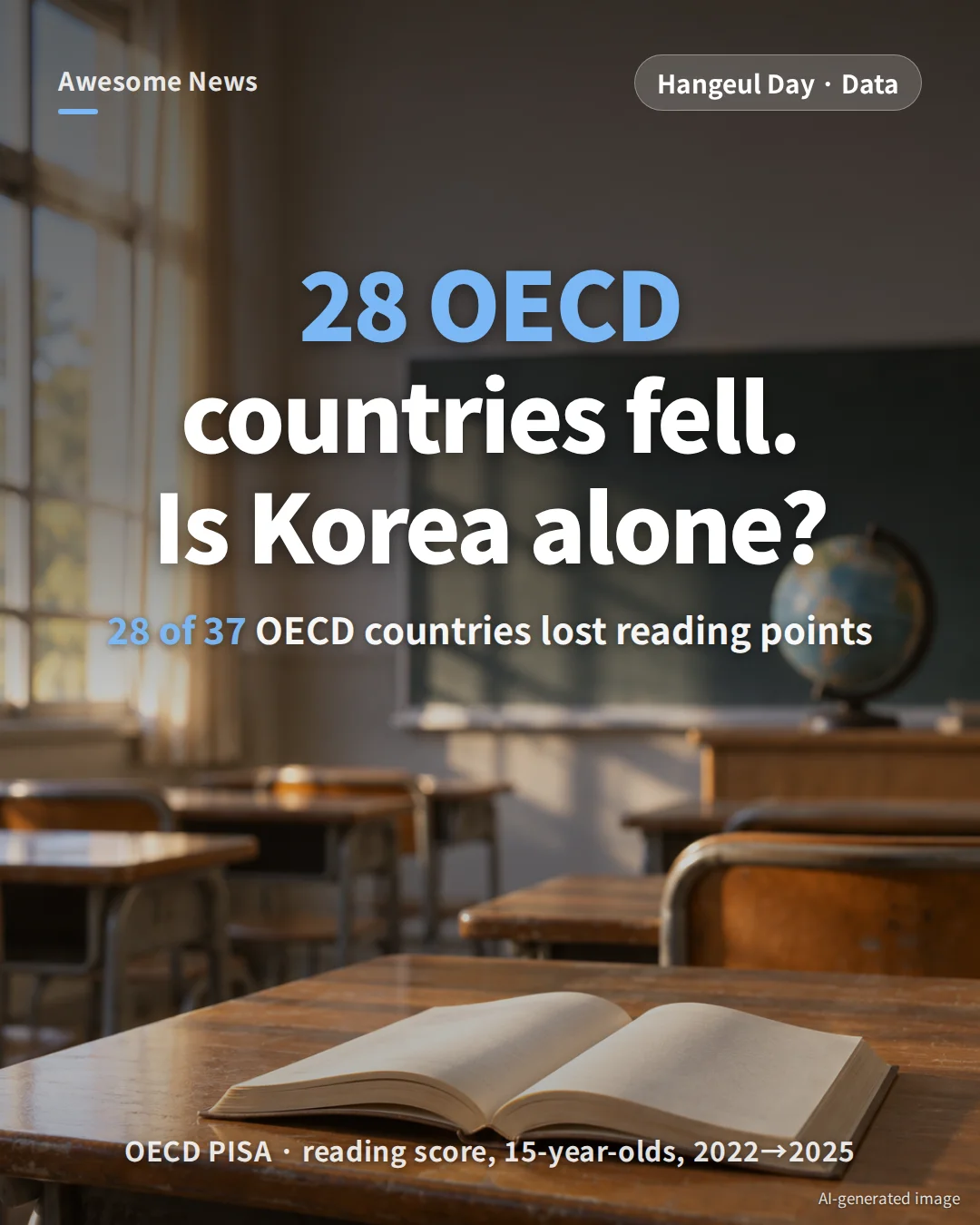
Nearly one in four South Korean 15-year-olds — 24.7% — now behave as ‘hasty readers’ on PISA, rushing through short reading items and getting them wrong: the highest share in the OECD (average 11.4%), and double Korea’s own 12.1% in 2018. Reading skills themselves have slipped too: the share of 11th-graders who clear the national ‘proficient’ bar in Korean language fell from 83.5% in 2012 to 53.0% in 2025. But the slide is not a Korean story. In OECD’s PISA 2025, 28 of 37 OECD countries saw reading scores drop between 2022 and 2025, and only Türkiye improved.
Key numbers at a glance
- Korean 11th-graders at or above ‘proficient’ in Korean language: 83.5% (2012) → 53.0% (2025) — Ministry of Education national assessment.
- 28 of 37 OECD countries fell on PISA reading (2022→2025). Only Türkiye rose. The 23-country OECD benchmark average slid from 501 (2012) to 466 (2025).
- ‘Hasty readers’: 24.7% in Korea, highest in the OECD — vs. OECD average 11.4%, Japan 9.7%, Finland 7.7%, United States 6.9%.
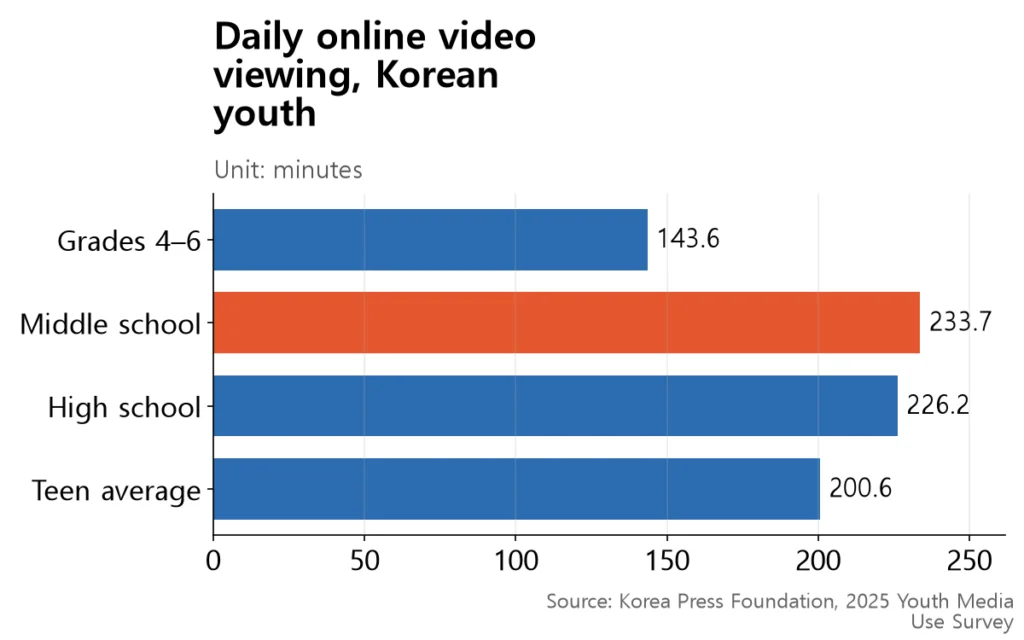
- Korean teens watch online video for an average of 200.6 minutes a day (Korea Press Foundation, 2025). No causal study yet ties video to reading scores.
- Sweden funded 685 million kronor for paper textbooks (2023); the Netherlands, Denmark, Finland and Korea (from March 2026) are banning phones in class.
1. In Korea, only half of 11th-graders now hit ‘proficient’
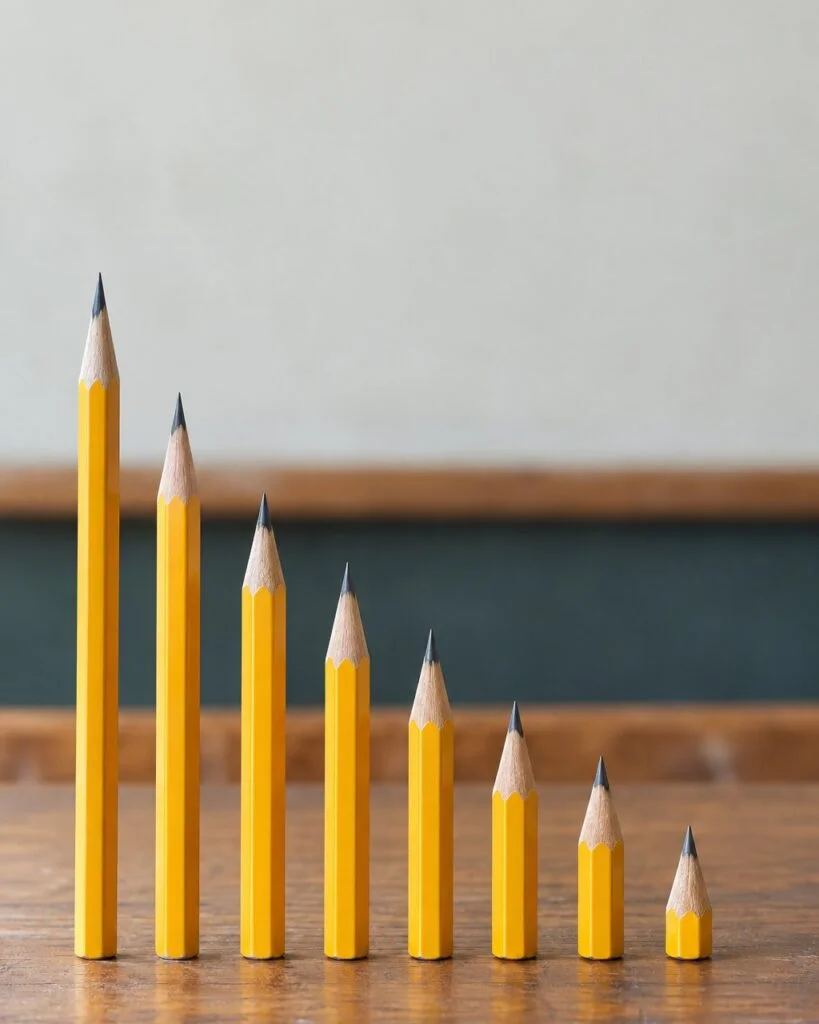
Korea’s Ministry of Education runs an annual national achievement test. The share of 11th-graders scoring at or above the Korean-language ‘proficient’ level fell from 83.5% in 2012 to 53.0% in 2025 — barely one in two. Over the same stretch, the share of 9th-graders who miss even the ‘basic’ bar in Korean rose from 1.0% to 10.8%.
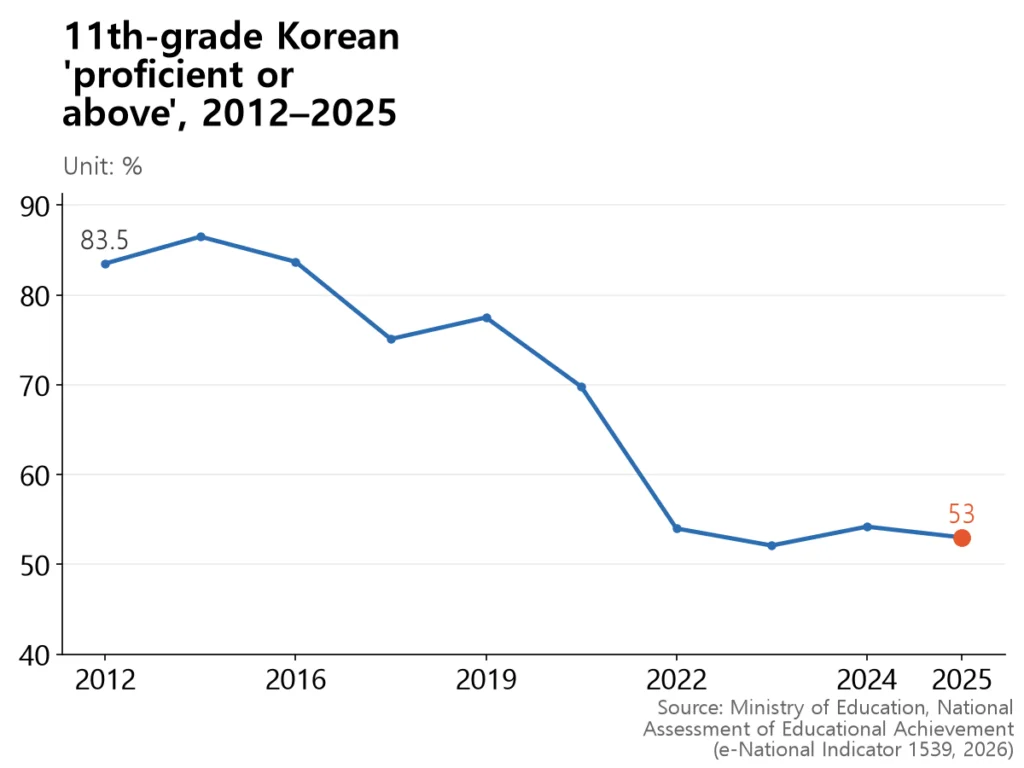
The size of the drop should be read with care. The three steepest falls (2017, 2020, 2022) coincide with changes to the test itself. In 2017 Korea switched from census testing to sampling; in 2020 came COVID-19; and in 2022 the paper test was replaced by a computer-based test (CBT). The single biggest step down — from 64.3% in 2021 to 54.0% in 2022 — matches the CBT switch. No official study has yet separated the format effect from a genuine skills decline.
So ‘×-times worse’ claims overshoot the evidence. What is clear is that the bottom of the distribution has thickened. On PISA reading, Korea’s share below Level 2 (the baseline of functional reading) rose from 5.8% in 2009 to 14.7% in 2022, while the share at Level 5 or above barely moved — 12.9% to 13.3%. Top students held up; weak readers piled up.
2. The world fell with Korea — 28 OECD countries declined

PISA is OECD’s reading, math and science test for 15-year-olds. Across the 23 countries that have taken part in every round (the OECD-23 benchmark), the average reading score fell from 501 in 2012 to 466 in 2025 — a loss of 35 points. In its PISA 2025 release, OECD called the three-subject averages ‘the lowest OECD means ever observed.’
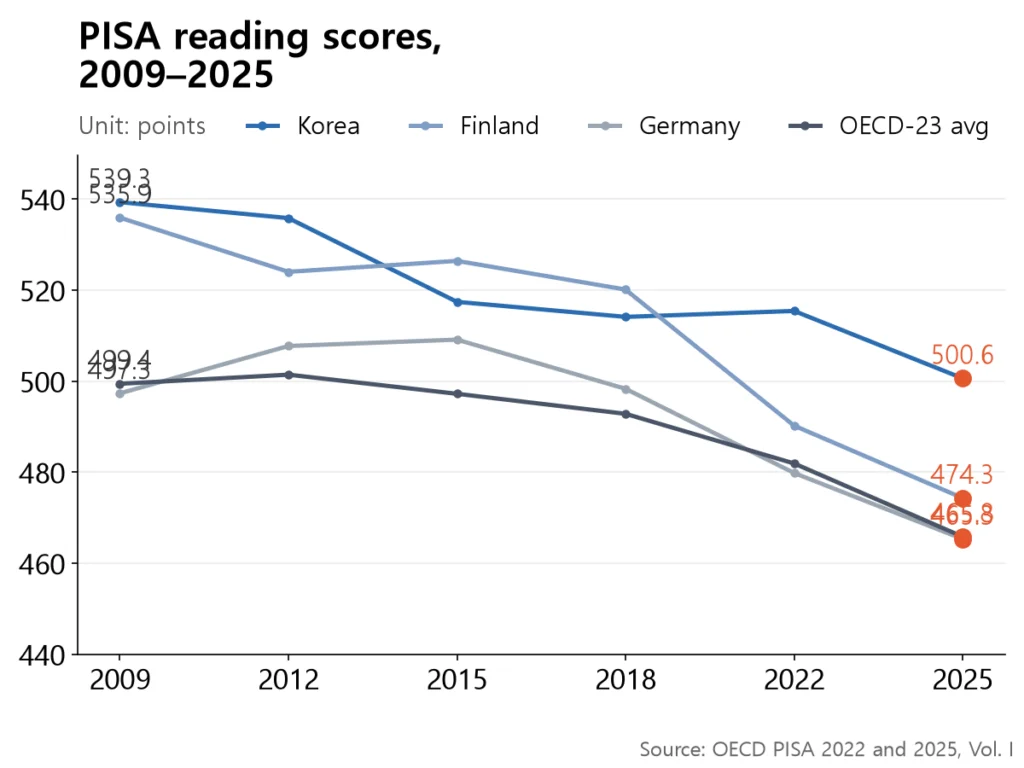
In the single round from 2022 to 2025, 28 of 37 OECD countries dropped significantly. Eight were flat (including the UK, New Zealand, Poland and Italy). Only Türkiye rose significantly, by 16 points. The sharpest falls were Latvia (−45), Israel (−38) and Denmark (−29). Korea’s −15 put it in the middle of the pack.
| Country | 2012 | 2025 | Change |
|---|---|---|---|
| Netherlands | 511 | 441 | −70 |
| Norway | 504 | 453 | −51 |
| Finland | 524 | 474 | −50 |
| Germany | 508 | 465 | −42 |
| Denmark | 496 | 460 | −36 |
| Korea | 536 | 501 | −35 |
| Japan | 538 | 503 | −35 |
| OECD-23 avg | 501 | 466 | −36 |
The slide also began before COVID-19. OECD notes that reading ‘peaked around 2012.’ Across the full 2015–2025 decade, OECD countries lost an average of 28 points. Northern and Western Europe fell the furthest; Korea, Japan and the English-speaking world fell less. Claims that ‘only Korean children are falling behind’ are not supported by the numbers.
3. Korea’s own puzzle: ‘hasty readers’, OECD’s highest share

PISA 2025 gave the first detailed look at a new indicator: ‘hasty readers.’ OECD defines them as students who missed two or more items on short sentence-fluency tasks while finishing faster than 99% of same-language peers who missed at most one. In plain words, these are students who clicked through without really reading.
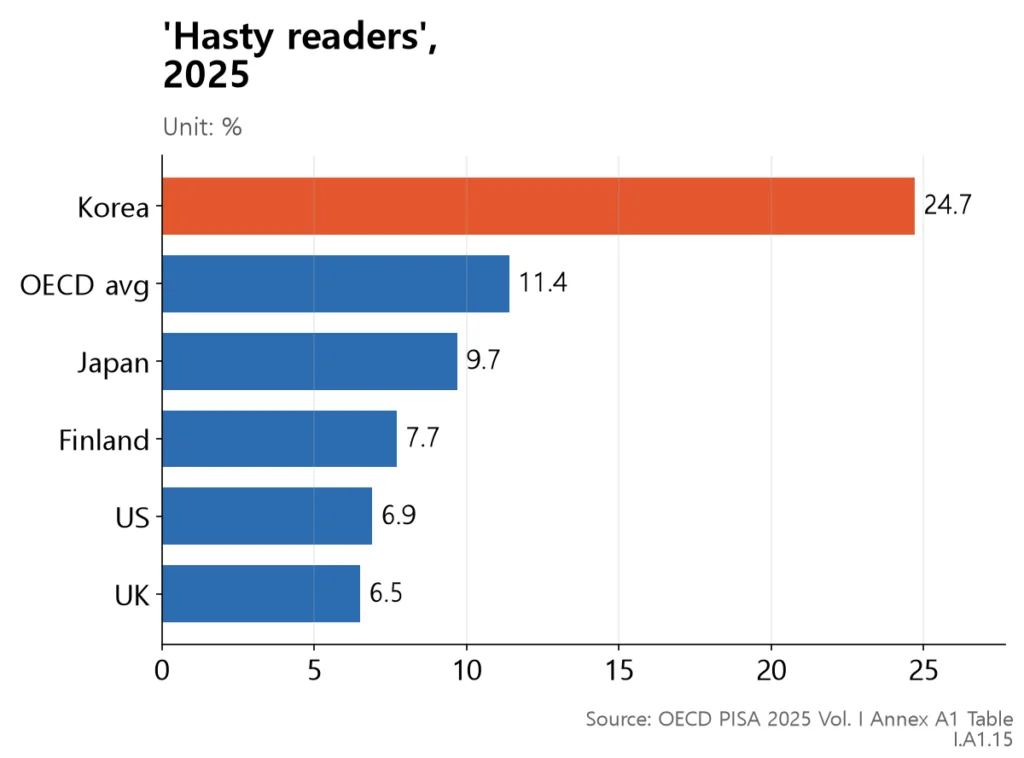
Korea’s 24.7% is the highest of 38 OECD countries, more than double the OECD average of 11.4% and far above Japan (9.7%), Finland (7.7%) and the United States (6.9%). The seven-year trend is just as striking: Korea’s hasty-reader share went 12.1% (2018) → 11.9% (2022) → 24.7% (2025), doubling in a single round. The OECD average also rose, from 6.6% to 11.4%, but far less sharply.
OECD attaches a caveat. Hasty responding, it writes, may reflect poor basic reading or low effort on a low-stakes test — PISA scores do not affect a student’s own record. So it is wrong to say ‘one in four Korean kids cannot read a sentence.’ The accurate reading is that one in four did not read carefully and answered too fast.
4. Is it video? Over three hours a day, but no proof

In teacher surveys, the most commonly named culprit is digital media. The Korea Press Foundation’s 2025 Youth Media Use Survey (2,674 students, grades 4–12) finds teens watch online video for an average of 200.6 minutes a day — roughly 3 hours 20 minutes. Middle-schoolers top the list at 233.7 minutes, followed by high-schoolers at 226.2 and upper-primary pupils at 143.6.
Separate surveys back up the pattern. The Ministry of Gender Equality and Family’s 2024 Youth Media Use and Harmful Environment Survey (15,053 students) found 94.2% watched short-form video in the past year, rising to 96–97% among middle- and high-schoolers. The Ministry of Science and ICT’s 2025 Smartphone Overdependence Survey put the share of youth (ages 10–19) in the ‘at-risk’ group at an all-time high of 43.0%.
What is missing is a causal link. No peer-reviewed study has shown that video viewing drove the drop in reading scores. OECD itself warned in the PISA 2025 release that ‘the causes are not single.’ In Korea’s 2025 National Reading Literacy survey, adults who mainly watch short-form video actually scored higher on reading — a result the National Institute of Korean Language attributed to age mix, calling for more analysis. ‘They rose together’ (correlation) is as far as the data currently reach.
5. Governments are reaching for paper, and switching off phones

As the slide went global, governments converged on three fixes: (1) subsidies for paper textbooks (Sweden); (2) bans on phones during class (the Netherlands, Denmark, Finland, Sweden, Korea and 20 US states); and (3) structured early-reading instruction such as phonics (Mississippi in the US and the English phonics screening check).
| Country | When | What | Scale / response |
|---|---|---|---|
| Sweden | 2023 | National subsidy for paper textbooks | 685 million kronor in 2023, ~500 million per year since |
| Netherlands | 2024 | Phones banned in class (national pact, not law) | Secondary principals report: focus up 75%, atmosphere 59%, grades 28% |
| Denmark | 2025 | ‘Phone-free schools’ deal (all 8 parties) | Public primary and after-school; games/social blocked on school networks |
| Finland | Aug 2025 | In-class phone ban + more Finnish lessons in grades 1–2 | Across basic education |
| Korea | Mar 2026 | Ban on smartphones and smart devices during class | Elementary & Secondary Education Act amended (passed Aug 2025) |
| Sweden | Aug 2026 | Nationwide mandatory phone ban (collected at the gate) | Compulsory school and after-school care |
UNESCO’s Global Education Monitoring team counts 79 education systems — about 40% of the world’s — with a law or policy banning smartphones in schools at the end of 2024, up from 60 (30%) a year earlier.
The use of smartphones and other smart devices during class is prohibited in principle, with exceptions for assistive devices for students with disabilities or special-education needs, for educational purposes, and in emergencies.
Summary of the amended Elementary and Secondary Education Act (Korea; passed 27 Aug 2025, in force 1 Mar 2026), Korea Policy Briefing (Korean, our translation)
What is not yet in the data is a test-score lift. The Netherlands evaluation only confirmed better focus and school climate reported by principals. Finland’s and Korea’s bans begin after the PISA 2025 test was already taken, so no reading result exists yet. Sweden expanded paper-textbook subsidies, and still fell from 487 in PISA 2022 to 466 in 2025. The current evidence supports a ‘climate’ effect; a ‘score’ effect will take several more years to show.
How to read these numbers
- ‘Below basic’ is defined differently by every test. Korea’s national assessment Level 1 (below the curriculum minimum), PISA’s below Level 2, and the adult literacy survey’s Level 1 are not on the same scale. Do not plot them on one line.
- The size of the Korean drop is hard to pin down. The 2017 switch from census to sampling, COVID in 2020, and the 2022 move to computer-based testing all line up with sharp falls.
- 24.7% ‘hasty readers’ is not the share who cannot read a sentence. OECD explicitly notes it may partly reflect low effort on a low-stakes test.
- ‘Smartphones and short-form video did it’ is still a hypothesis. OECD and Korea’s Science Ministry only report correlations; no study has shown causation.
- Korea is not last in OECD reading. In 2025 it still sits in the OECD top 10 and is 35 points above the OECD-23 average (466).
Summary
Korean teenagers’ reading scores have fallen — the numbers are real. But the fall is not uniquely Korean: 28 of 37 OECD countries dropped in PISA 2025, and Northern and Western Europe fell further than Korea. What is distinctive about Korea is the hasty-reader rate — the OECD’s highest, and double what it was in the previous round. Teens watch over three hours of online video a day, but no study has yet shown this caused the drop. The common policy response across countries — paper textbooks, phones out of the classroom, more structured early reading — comes down to one idea: make room again for reading time. Whether that moves the next PISA score is a question only several years of data can answer.

Awesome News on Instagram @awesome_news_kr
This article is the research behind our Korean-language card news. Every morning we turn Korean data and official sources into short visual stories. See it on Instagram →
Sources
- OECD — PISA 2022 Results (Volume I) (2023-12)
- OECD — PISA 2022 Vol. I Annex Tables I.B1.5.2 and I.B1.5.5 (stat.link/wh9d4z) (2023)
- OECD — PISA 2025 Vol. I Chapter 2 source data (stat.link/xgs41b) (2026)
- OECD — PISA 2025 Vol. I Annex A1 Table I.A1.15 — Reading fluency (stat.link/78340u) (2026)
- Ministry of Education / e-National Indicator (Korea) — National Assessment of Educational Achievement results (Indicator 1539) (Korean) (2026)
- Korea Press Foundation — 2025 Youth Media Use Survey (Korean) (2025-12-31)
- Ministry of Gender Equality and Family (Korea) — 2024 Youth Media Use and Harmful Environment Survey (Korean) (2025-03-31)
- Ministry of Science and ICT / National Information Society Agency (Korea) — 2025 Survey on Smartphone Overdependence (Korean) (2026-03-27)
- Korea Policy Briefing — Policy briefing: ban on smart devices in class (Elementary and Secondary Education Act amendment) (Korean) (2025-08-29)
- Government of Sweden — Government opens subsidies so schools can purchase more textbooks (Swedish) (2023-03-03)
- Government of Sweden — Mobile-free start to the school year for Sweden’s pupils (Swedish) (2026-08-17)
- Government of the Netherlands — Mobile devices in the classroom — government guidance (Dutch) (2024)
- Government of the Netherlands — Evaluation of the mobile-devices-in-class policy — Kohnstamm/Oberon summary (Dutch) (2025-07-03)
- Ministry of Children and Education (Denmark), via Ritzau — New agreement on mobile-free primary schools and after-school care — all 8 parties (Danish) (2025-09-30)
- UNESCO Global Education Monitoring Report — Smartphones in school? Only when they clearly support learning (2024)
- Ministry of Culture, Sports and Tourism (Korea) — 2025 National Reading Literacy Survey press release (Korean) (2026-03-06)
📊 Download the data
Every number in this article’s 6 charts and tables, in one CSV file (opens in Excel or Google Sheets). When you cite it, please name the original source and link to this page.
Download CSV