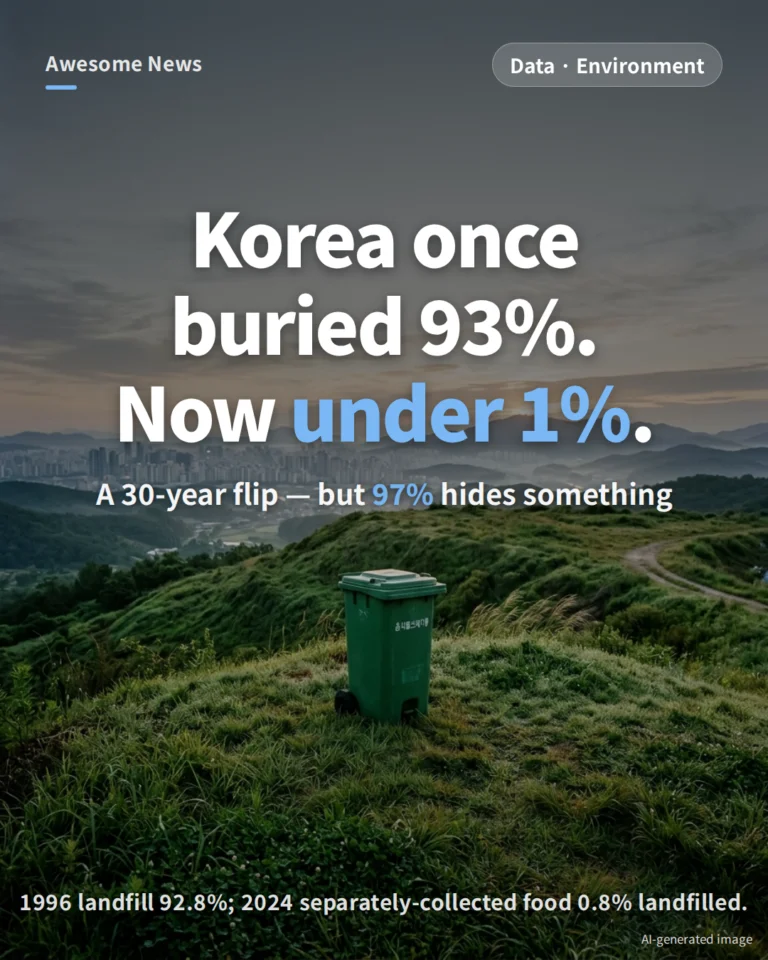
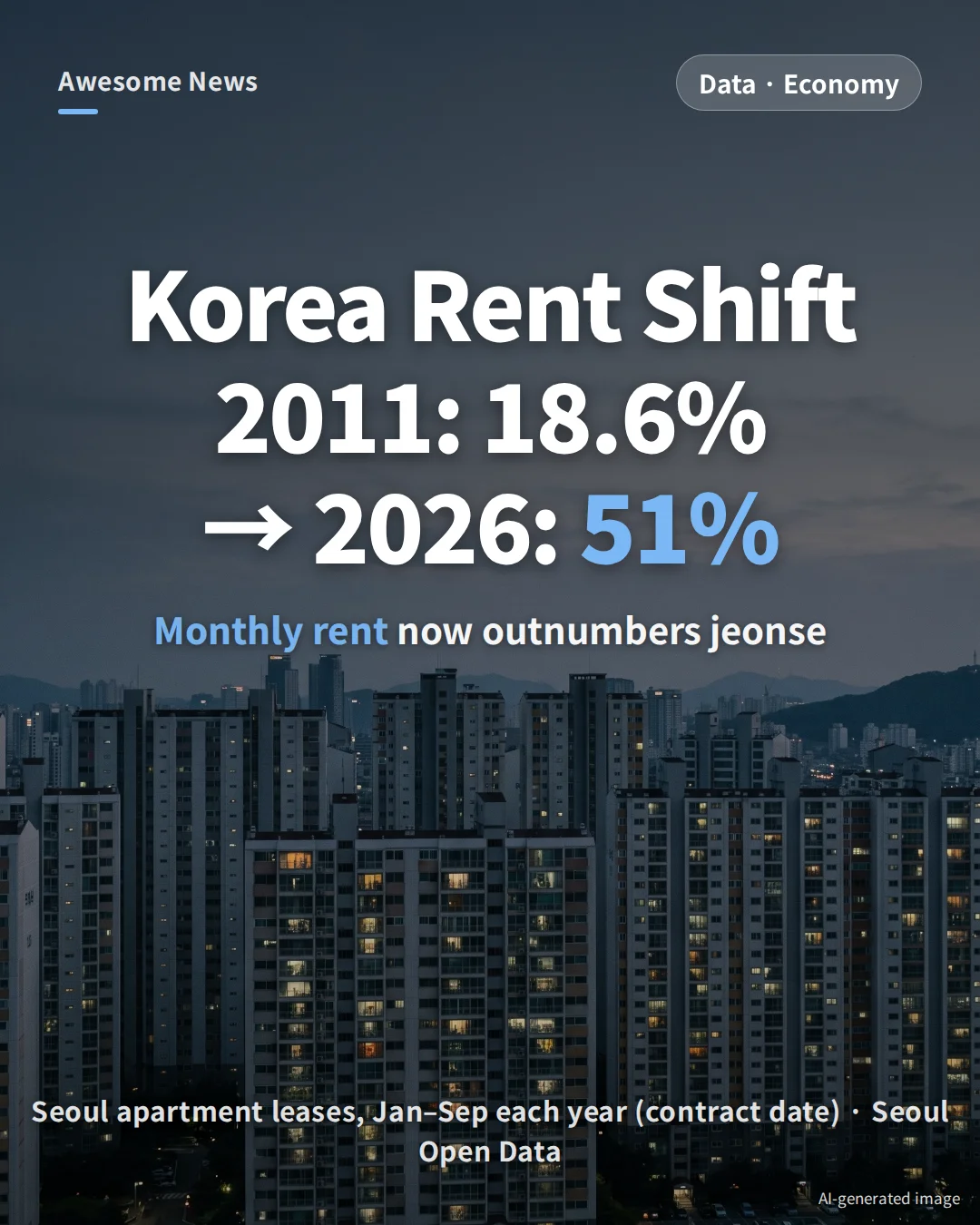
For the first time ever, more than half of Seoul’s apartment leases are monthly rent rather than jeonse — Korea’s lump-sum deposit lease, in which a tenant hands the landlord a large deposit (often half the home’s value) and pays no monthly rent, getting it back at the end. Of 172,027 apartment lease contracts filed in Seoul from January to September 2026, 87,740 (51.0%) were monthly rent, up from 18.6% in the same months of 2011 (Seoul Real Estate Information Plaza, as reported by Yonhap on 20 October 2026).
Key numbers at a glance
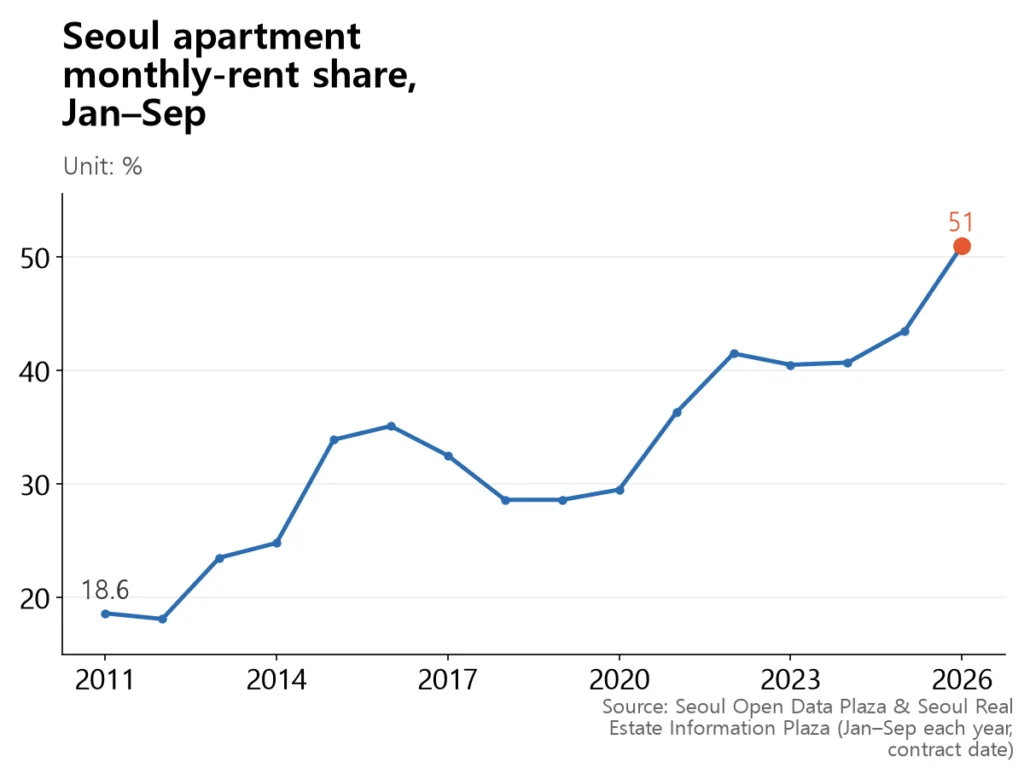
- Seoul apartment monthly-rent share (Jan–Sep) — 18.6% in 2011 → 51.0% in 2026. No single month between 2011 and 2025 ever crossed 50% (monthly peak: 49.7% in December 2022).
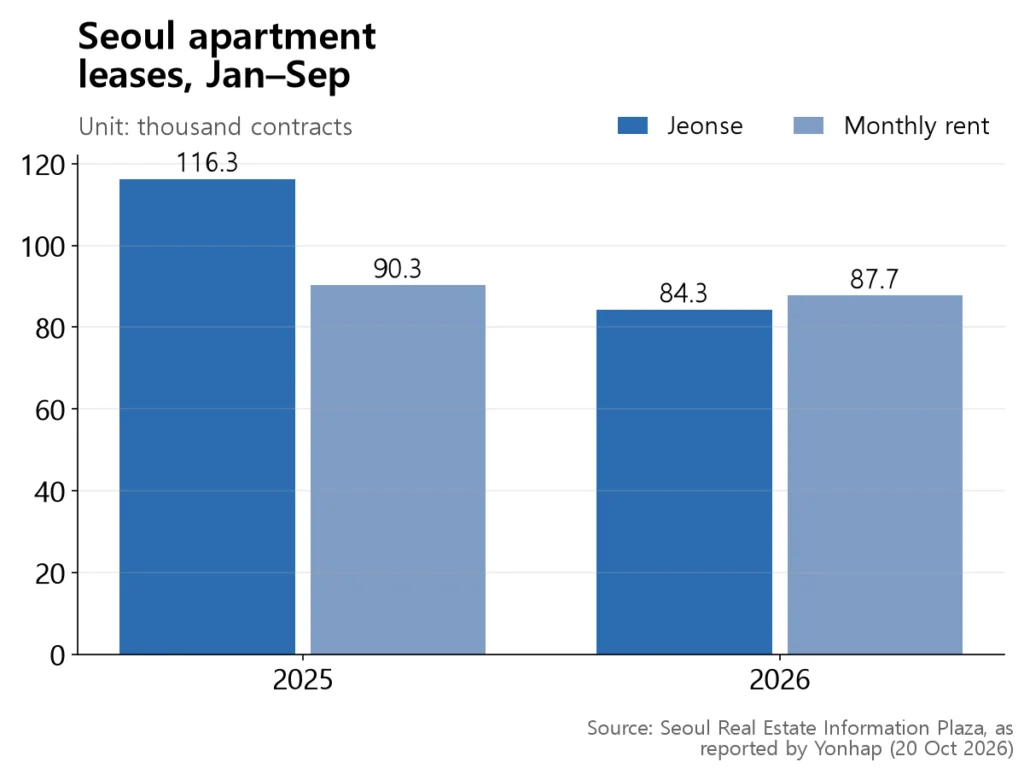
- Jeonse is vanishing — Jan–Sep jeonse contracts fell 27.5% year on year (116,272 → 84,287); monthly-rent contracts fell just 2.8% (90,310 → 87,740).
- Deposit-return defaults — Housing & Urban Guarantee Corp (HUG) claims rose from 344.2 billion won in 2019 to 4.49 trillion won in 2024, a 13-fold jump.
- Interest paid by jeonse households — Average monthly loan interest climbed from 86,793 won in Q2 2019 to 211,965 won in Q2 2026 (+144.2%); owner-occupiers rose +66.1%.
- On the same 100 million won, monthly rent is the costliest — 400,000 won/mo (Seoul apartment conversion rate 4.8%) > jeonse-loan interest 363,000 won (4.35%) > forgone deposit interest 262,000 won (3.14%).
A 50% line crossed for the first time in 15 years
The Seoul Real Estate Information Plaza, which logs leases by contract date, counted 172,027 apartment leases in January–September 2026. Monthly rent accounted for 51.0% — up from 18.6% in 2011 (after dipping to around 28% in 2016–2019) and 43.5% in the same months of 2025. Between 2011 and 2025, the monthly-rent share had never crossed 50% in any single month; its previous high was 49.7% in December 2022.
Across all housing types in Seoul (apartments, row houses, detached houses, officetels), monthly rent had already passed 50% back in 2022, reaching 60.6% in 2025. Apartments were the last segment to cross the line. Nationwide, the Ministry of Land’s figures for January–August 2026 put the monthly-rent share at 68.5% for all housing and 80.6% for non-apartment homes.
Monthly rent didn’t surge — jeonse collapsed
Previous increases in the monthly-rent share were driven by more monthly-rent deals. This year is different. In Jan–Sep 2026, Seoul apartment jeonse contracts fell 27.5% year on year (116,272 → 84,287), while monthly-rent contracts fell just 2.8% (90,310 → 87,740). The share flipped not because tenants chose monthly rent, but because jeonse supply collapsed.
The Ministry of Land’s data (filed-date basis) tells the same story: in August 2026 alone, Seoul’s jeonse filings were down 18.4% year on year while monthly-rent filings were up 5.6% (Ministry of Land, 30 September 2026). The two datasets differ in detail because Seoul uses contract date and the ministry uses filing date.
Three risky years for jeonse — scams and tighter credit

The Bank of Korea’s December 2025 report linked the rise of monthly rent to jeonse-fraud risk and tighter rules on jeonse loans (summary of the report, as cited by Kyunghyang Shinmun on 23 December 2025). The numbers back that up. Claims paid out on jeonse-deposit guarantees — triggered when a landlord fails to return the deposit — exploded. HUG’s reported claim amount rose from 344.2 billion won in 2019 to 4.49 trillion won in 2024, roughly a 13-fold increase.
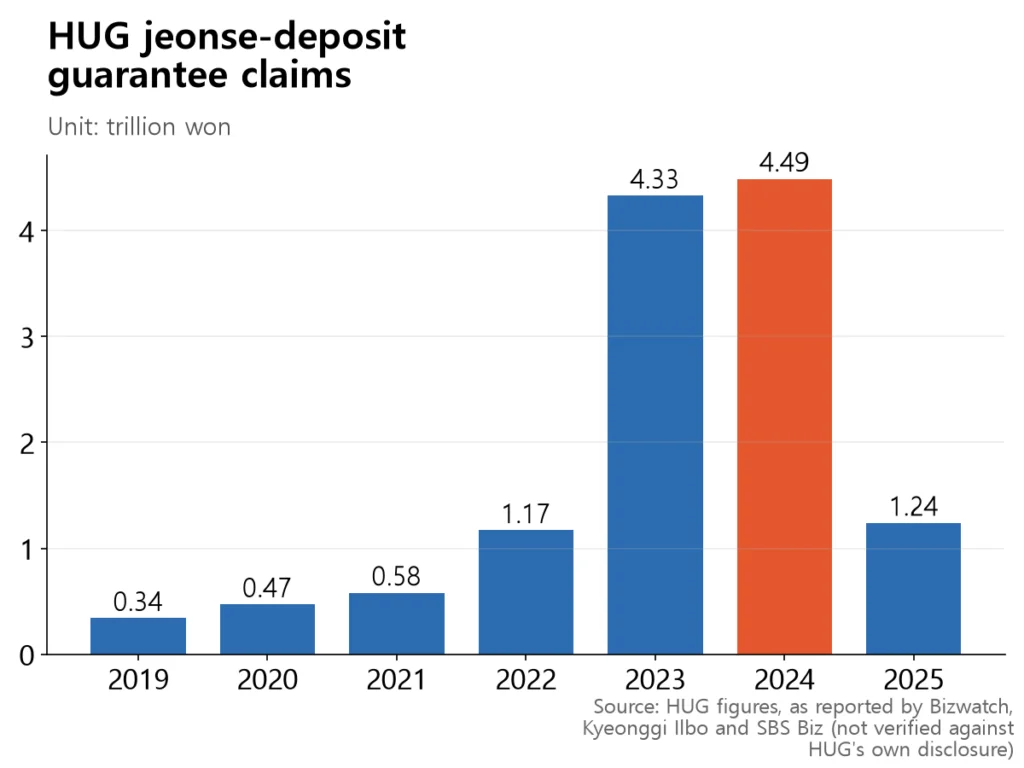
The 2025 claim total fell 72.3% to 1.24 trillion won, and the money HUG paid out on behalf of landlords (subrogation payments) also fell for the first time, from 3.99 trillion won in 2024 to 1.79 trillion won in 2025 — still more than six times the 2019 level (283.6 billion won). On the regulatory side, the Financial Services Commission cut the guarantee ratio on jeonse loans in the capital region from 90% to 80% in June 2025 and banned conditional jeonse loans tied to ownership transfers; in October 2025 it folded one-homer jeonse-loan interest into the household DSR (Debt Service Ratio). A further measure announced in August 2026 would in principle ban jeonse loans for non-resident one-home owners — but it takes effect only on 1 January 2027, so it cannot explain this year’s drop.
Those still in jeonse are paying 2.4× more interest than in 2019
Statistics Korea’s Household Trend Survey (KOSIS table DT_1L9U116) shows the average monthly loan interest paid by households living in jeonse rose from 86,793 won in Q2 2019 to 211,965 won in Q2 2026 (+144.2%). Owner-occupiers went from 101,754 to 169,041 won (+66.1%). In 2019 owner-occupiers paid more interest; now jeonse households pay about 40,000 won more every month.
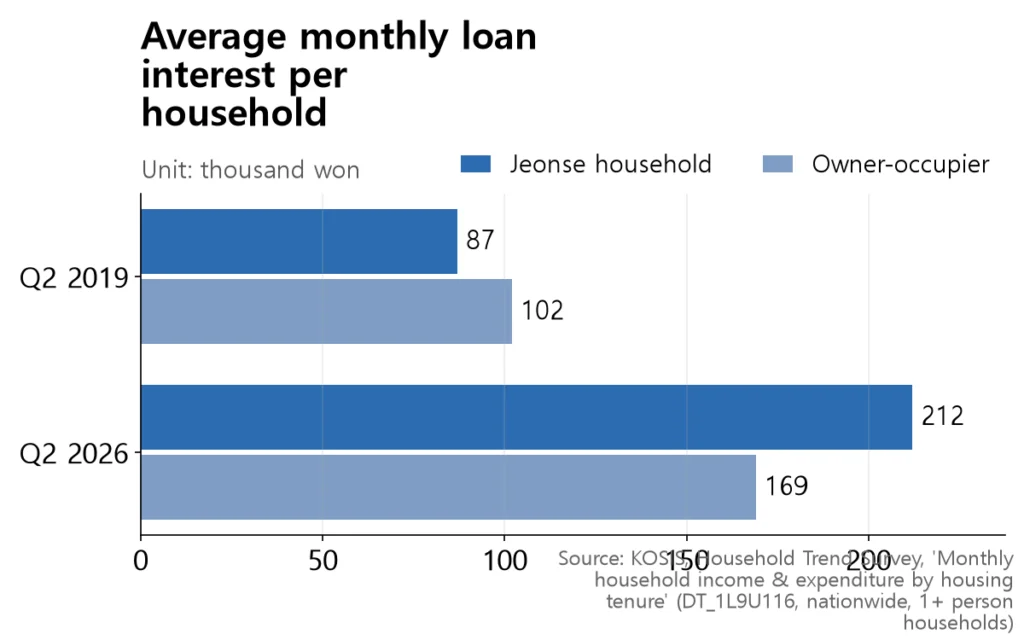
Two caveats. First, ‘interest’ in this survey covers all of a household’s loans — mortgages, jeonse loans, personal loans — not jeonse loans alone. Second, jeonse households have been paying more interest than owner-occupiers in almost every quarter since 2022, and the all-time peak was Q2 2023 (214,319 won), not the latest quarter. The number fell to 145,913 won by Q4 2024, then climbed again.
In the same survey, the share of households living in jeonse has shrunk from a peak of 17.0% in Q3 2021 to 12.71% in Q2 2026, the lowest on record in the table. Fewer households are in jeonse, and those still in it are servicing heavier debt.
On the same 100 million won — monthly rent vs jeonse loan vs deposit

Take 100 million won of deposit money. What does it cost per month if you (a) convert it to monthly rent, (b) borrow it as a jeonse loan, or (c) keep it in a time deposit? Using official August 2026 rates (calculated as 100m × annual rate ÷ 12):
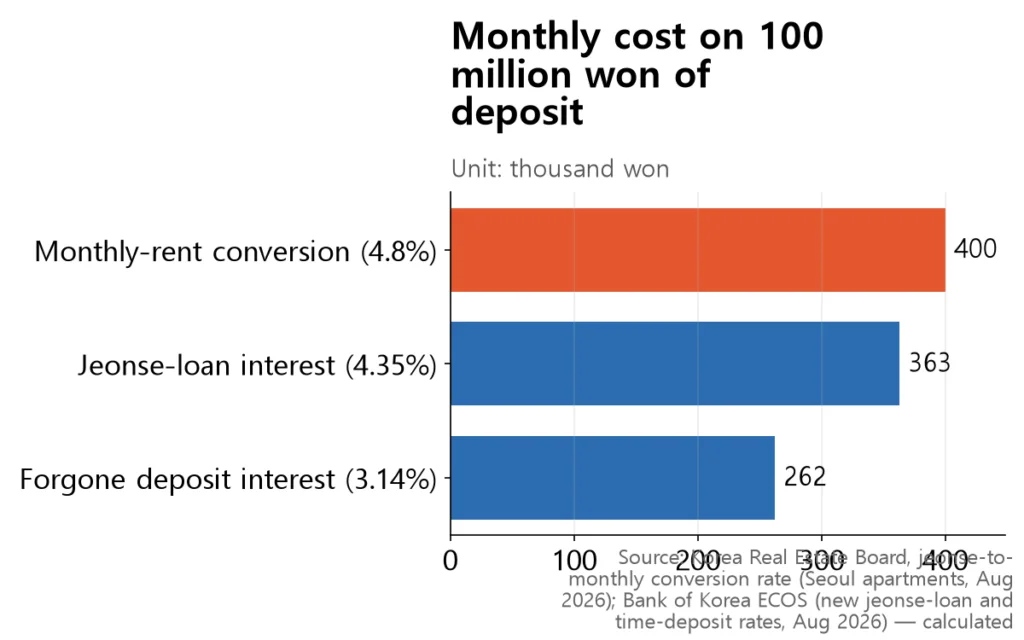
On today’s rates, monthly rent is costliest (400,000 won) > jeonse-loan interest (363,000 won) > forgone deposit interest (262,000 won). Even paying a loan to stay in jeonse is more expensive than the interest you’d earn by keeping the money in the bank. Applied to the full average Seoul-apartment jeonse of 641 million won (Korea Real Estate Board, Aug 2026), full conversion to monthly rent would mean roughly 2.56 million won per month (calculated). The arithmetic ignores jeonse-loan ceilings and the risk of losing the deposit (see HUG claims above).
The 4.8% conversion rate applies to Seoul apartments. For all housing nationwide the figure is 6.8% (Korea Real Estate Board, Aug 2026), implying about 570,000 won/month on the same 100 million won — a reminder that the experience in Seoul apartments differs sharply from non-apartments or outside the capital region.
How to read these numbers
- Three different bases are in circulation — contract date (Seoul Real Estate Information Plaza, Seoul Open Data), filing date (Ministry of Land housing statistics) and date-stamp (Supreme Court registry). For ‘Seoul apartments 2025’, the three sources give 44.0% / 44.5% / 44.8%. Never mix bases in a single chart.
- ‘Monthly rent’ includes semi-jeonse and deposit-plus-rent contracts — not only pure monthly rent with a tiny deposit.
- Before the June 2021 lease-filing law, only contracts with a court date-stamp were counted, likely under-counting monthly rent (especially small deposits). Keep this in mind when comparing 2011 to 2026 on a single line.
- The 2026 ‘51%’ is a cumulative Jan–Sep figure. The annual number is not final; late filings and cancellations can shift it (as the Yonhap report also notes), and the Ministry of Land notes that lease-volume data is not an officially approved national statistic.
- ‘Jeonse households’ in the Household Trend Survey means households currently living in a jeonse home. The interest figure covers all of their loans, not just the jeonse loan.
A note on data gaps: Korea Real Estate Board publishes long-run jeonse-to-sale ratios and conversion rates mostly as monthly report charts, not downloadable series. Annual Ministry of Land figures for 2017–2019 were not located in press releases. HUG’s jeonse-guarantee claim and subrogation amounts in this piece come from press reports citing figures provided to lawmakers, not from HUG’s own disclosures.
Summary
Seoul apartment leases crossed the 50% monthly-rent line not because monthly rent surged, but because jeonse collapsed. The Bank of Korea points to the deposit-return risk that grew after jeonse fraud cases and to tighter jeonse-loan rules. Households that stay in jeonse now pay 2.4× the monthly interest they did seven years ago; those who move to monthly rent pay about 400,000 won per 100 million won of former deposit — more than the loan interest they’d pay to keep the jeonse. Neither option is cheap anymore.

Awesome News on Instagram @awesome_news_kr
This article is the research behind our Korean-language card news. Every morning we turn Korean data and official sources into short visual stories. See it on Instagram →
Sources
- Seoul Open Data Plaza — Seoul lease price information (OA-21276) (Korean) (2011–2025)
- Yonhap News — Seoul apartment monthly-rent share tops 51% for Jan–Sep for the first time (Korean) (2026-10-20)
- Ministry of Land, Infrastructure and Transport — December 2025 housing statistics (Korean) (2026-01-30)
- Ministry of Land, Infrastructure and Transport — August 2026 housing statistics & 2025 housing-construction final figures (Korean) (2026-09-30)
- Korea Real Estate Board — September 2026 nationwide housing price survey (Korean) (2026-10-15)
- Bank of Korea — ECOS series 151Y005, 121Y006, 121Y002 (deposit-bank jeonse-loan balance & rate, time-deposit rate) (Korean) (2015-01 to 2026-08)
- Statistics Korea, Household Trend Survey (KOSIS) — Monthly household income & expenditure by housing tenure (DT_1L9U116) (Korean) (updated 2026-08-27)
- Kyunghyang Shinmun — Bank of Korea ‘Recent housing market features and financial-system impact’, as cited (Korean) (2025-12-23)
- Bizwatch — HUG jeonse-guarantee claims and subrogation report (Korean) (2024-01-16)
- Kyeonggi Ilbo — HUG 2024–2025 jeonse-guarantee claim report (Korean) (2026-01-18)
- SBS Biz — HUG subrogation & unrecovered amounts report (Korean)
- Segye Ilbo — While owner mortgage interest rose 66%, jeonse-household interest rose 144% (Korean) (2026-10-18)
📊 Download the data
Every number in this article’s 5 charts and tables, in one CSV file (opens in Excel or Google Sheets). When you cite it, please name the original source and link to this page.
Download CSV