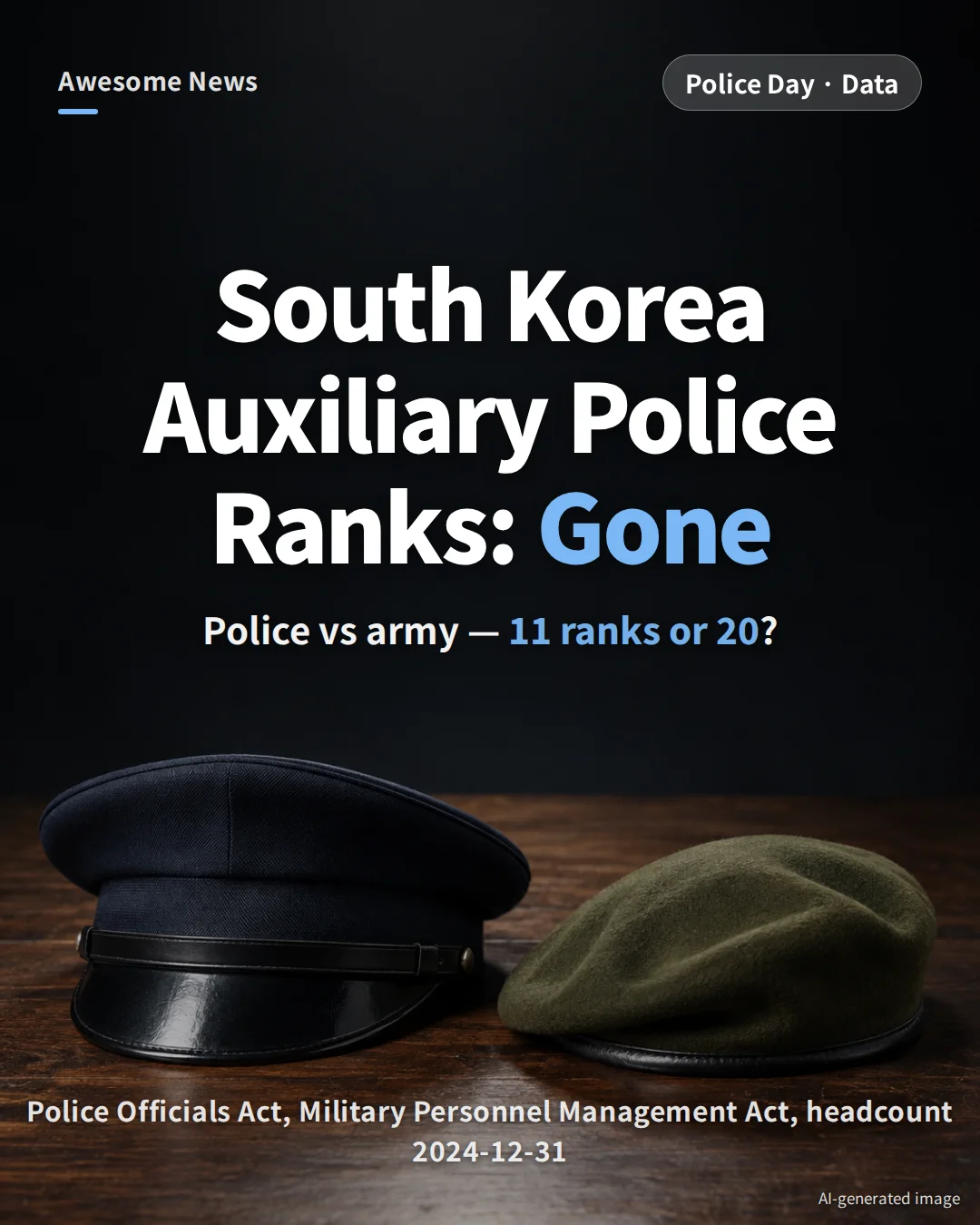
South Korea’s National Police Agency is built on 11 ranks, from Sungyeong (patrol officer) at the bottom to Chiantongam (Commissioner General) at the top. The military has 20 ranks. The two systems look alike — both use flower-and-star insignia — but they differ in three ways that confuse even Koreans: the police no longer have any enlisted conscripts, no rank wears a star, and the biggest rank by headcount is not the lowest. (October 21 is Police Day in South Korea.)
Key numbers at a glance
- 11 police ranks vs 20 military ranks (Police Officials Act Art. 3; Military Personnel Management Act Art. 3).
- The four familiar titles Igyeong, Ilgyeong, Sanggyeong, Sugyeong were never police ranks — they belonged to the Uigyeong (Auxiliary Police), a conscript branch. Recruitment ended in 2018 and the last class (1142nd, 208 recruits) was discharged on May 17, 2023 (as reported by Seoul Shinmun).
- Police Academy graduates and successful Gyeongwi (lieutenant) open-exam candidates enter at the 4th rank. Korea Military Academy graduates enter as Sowi (2nd lieutenant), the lowest officer rank.
- Of 131,807 police officers at end-2024, the most common rank is not the lowest. Gyeongwi (lieutenant) tops the list with 38,010 officers (29%). The pyramid is upside-down.
Igyeong to Sugyeong: ranks of a conscript branch, now gone
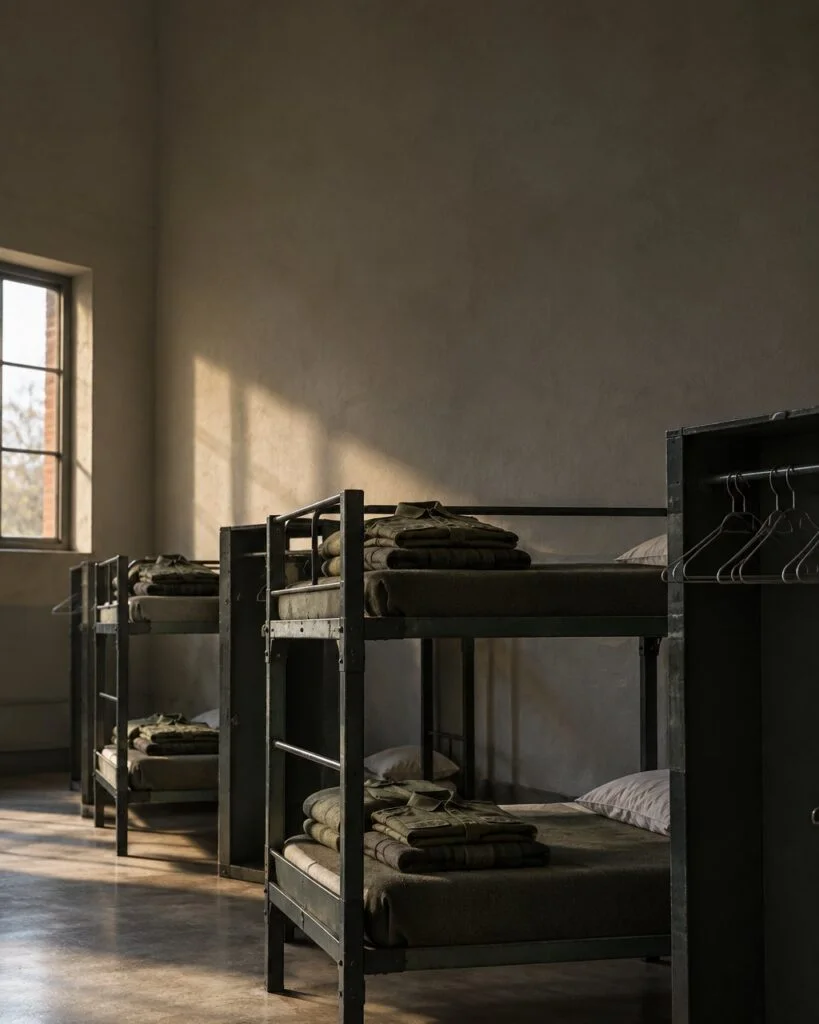
Igyeong, Ilgyeong, Sanggyeong and Sugyeong were ranks of the Uigyeong (Auxiliary Police), defined in Article 2-4 of the Auxiliary Police Act. There were actually five ranks, not four: Igyeong, Ilgyeong, Sanggyeong, Sugyeong and Teukgyeong — the last for Sugyeong selected as squad leaders (Enforcement Decree Art. 14(1)).
The Uigyeong were effectively soldiers wearing a police uniform. Under Article 2(7) of the Military Service Act, they enlisted as active-duty conscripts and then had their status ‘converted’ to Auxiliary Police. Service length matched regular soldiers, and the minimum intervals for promotion were identical to the army’s — 2 months, 6 months, 6 months.
| Auxiliary Police | Army enlisted | Time to promote |
|---|---|---|
| Igyeong | Private (E-1) | On enlistment |
| Ilgyeong | Private 1st Class | +2 months |
| Sanggyeong | Corporal | +6 months |
| Sugyeong | Sergeant | +6 months |
| Teukgyeong | — | Sugyeong squad leader |
Started 1982, ended May 2023
The Auxiliary Police was created in December 1982. After the government announced a phase-out in 2017, intake was cut by 20% every year from 2018. The last class — the 1142nd, 208 recruits enlisted on November 18, 2021 — was discharged on May 17, 2023, ending the 41-year-old branch. A joint discharge ceremony was held at the National Police Agency auditorium on April 14, 2023 (as reported by Seoul Shinmun).
Strictly speaking, the system was not abolished by law — recruitment simply stopped and the last class served out its term. The Auxiliary Police Act is still on the books (its Enforcement Decree was last amended in January 2026). The insignia rule still lists one unopened Rose of Sharon bud for the Auxiliary Police, which is why police patrol officers start at two buds — the bottom slot was reserved for conscripts.
11 police rungs vs 20 military rungs

Article 3 of the Police Officials Act sets out the 11 police ranks, from bottom to top: Sungyeong, Gyeongjang, Gyeongsa, Gyeongwi, Gyeonggam, Gyeongjeong, Chonggyeong, Gyeongmugwan, Chian-gam, Chianjeonggam, Chiantongam. Article 3 of the Military Personnel Management Act adds up to 20 rungs: 11 officer grades (Marshal, General, Lt. Gen., Maj. Gen., Brig. Gen., Colonel, Lt. Col., Major, Captain, 1st Lt., 2nd Lt.) + 1 warrant officer + 4 NCO grades (Sgt. Maj., Master Sgt., Sgt. First Class, Sgt.) + 4 enlisted ranks (Sgt., Corporal, Pvt. 1st Class, Pvt.).
| Item | Military | Police |
|---|---|---|
| Number of ranks | 20 | 11 |
| Lowest | Private | Sungyeong |
| Highest | General (Marshal) | Chiantongam |
| Enlisted conscripts | Private → Sergeant | None |
| Insignia | Bars, diamonds, flowers, stars | Buds, Rose of Sharon, Taegeuk flower |
The deeper difference is status. The military is layered into enlisted, NCOs, warrant officers and officers, with the enlisted serving as draftees. Police officers, by contrast, are career civil servants at every rank — from Sungyeong at the bottom to Chiantongam at the top. Since the last Auxiliary Police class left in 2023, no one in Korean policing is a conscript.
Same flower, different rung
Police insignia climbs from flower buds (Sungyeong–Gyeongsa) to the Rose of Sharon (Gyeongwi–Chonggyeong) to the Taegeuk Rose of Sharon at the top (Gyeongmugwan–Chiantongam). The military uses bars for enlisted, diamond-shapes for NCOs and junior officers, Rose of Sharon flowers for field officers, and stars for generals. The same ‘Rose of Sharon’ marks a junior lieutenant in the police but a mid-career field officer (Major) in the military — counting flowers across the two systems gives the wrong answer.
Two doors in: Sungyeong exam, or straight to Gyeongwi

Article 10 of the Police Officials Act sets different entry channels for different ranks. Gyeongjeong (superintendent) and Sungyeong (patrol officer) are filled through open competitive exams; Gyeongwi (lieutenant) is filled by (1) Police University graduates and (2) winners of the Gyeongwi open exam (renamed from ‘cadet candidate’ in a February 2024 amendment). The Police University Act Art. 8 states that graduates ‘shall be appointed as Gyeongwi’, mirroring Art. 7 of the Military Academy Act, which appoints academy graduates as Sowi (2nd Lt.).
| Entry route | Starting rank |
|---|---|
| Sungyeong open exam (ages 18–40, driver’s license required) | Sungyeong |
| Police University graduate | Gyeongwi |
| Gyeongwi open exam (ages 21–40, formerly ‘cadet candidate’) | Gyeongwi |
| Korea Military Academy graduate | Sowi (2nd Lt.) |
Age limits are set in Table 1-3 of the Police Appointment Decree (as of Sept. 1, 2026): 18–40 for Sungyeong, 21–40 for Gyeongwi, 25–40 for Gyeongjeong and above. Applicants for the Sungyeong and Gyeongwi exams must hold a Class 1 driver’s license. Winners of the civil service Grade 5 exam or (historically) the bar exam can enter laterally at Gyeongjeong or below.
Police University vs Korea Military Academy

The two schools share the same bones: four-year programs, full state funding, direct commissioning on graduation. The entry rules and the service obligation differ sharply.
| Item | Police University | Korea Military Academy |
|---|---|---|
| Tuition | Fully state-funded (plus stipend, uniforms, meals) | Fully state-funded |
| Commissioning rank | Gyeongwi (4th from bottom) | Sowi / 2nd Lt. (lowest officer rank) |
| Service obligation | 6 years (tuition clawback if broken) | 10 years (long-service officer) |
| Entry age | 17–41 | 17–20 |
| Marital status | No restriction | Single only |
| Transfer admission | Yes (3rd year) | No |
The Police University underwent a major reform from the 2023 school year. Freshman intake was cut from 100 to 50, with the other 50 slots filled through third-year transfer admission (25 serving officers + 25 civilian university students). The freshman age ceiling jumped from 21 to 41, and the transfer ceiling to 43 (Policy Briefing #148855521). The Korea Military Academy kept its original rule: age 17 to under 21, unmarried only, written straight into Article 3 of the Military Academy Act.
The post-graduation obligation differs too. Police University graduates must serve six years (Art. 10); military academy graduates serve ten as ‘long-service officers’ (Military Personnel Management Act Art. 7(1)1). Breaking the police obligation triggers a tuition clawback.
Is there a ‘police general’? There is no legal mapping
People often say ‘Gyeongmugwan equals a one-star general.’ In fact, no provision in the Police Officials Act, Military Personnel Management Act or Civil Servant Pay Rules pairs police and military ranks one-to-one. The closest official document is Table 1 of the Civil Servant Travel Allowance Rules (amended Sept. 29, 2026), which groups officials by travel-allowance tier.
| Tier | Military | Police |
|---|---|---|
| Minister-level | General | None |
| Vice minister-level | Lt. Gen. | Chiantongam (Commissioner General) |
| Grade 1 | Maj. Gen. · Brig. Gen. | Chianjeonggam |
| Bureau director-level | Colonel · Lt. Col. | Chian-gam · Gyeongmugwan |
On this schedule, the Commissioner General (Chiantongam) sits at vice-minister tier alongside a Lieutenant General, while Gyeongmugwan is bracketed not with a brigadier general but with a colonel/lieutenant colonel at bureau-director tier. So the popular ‘Gyeongmugwan = one-star’ comparison does not match this document. The caveat: the table is for travel allowances, not legal rank equivalence, and should be read as the government’s pay-tier grouping, nothing more.
The insignia reinforce the distinction. Military generals wear stars; senior police (Gyeongmugwan through Chiantongam) wear the Taegeuk Rose of Sharon — a Rose of Sharon surrounded by five smaller Rose of Sharon flowers arranged in a pentagon. The Commissioner General wears four of them.
The biggest rank is not Sungyeong — it is Gyeongwi
The Korea National Police Agency’s rank-by-rank headcount table (as of Dec. 31, 2024) shows 131,807 officers nationwide. The largest rank is not the bottom one. It is Gyeongwi (lieutenant), with 38,010 officers — 29% of the force. Together Gyeongwi and Gyeonggam account for roughly half (49%, calculated).
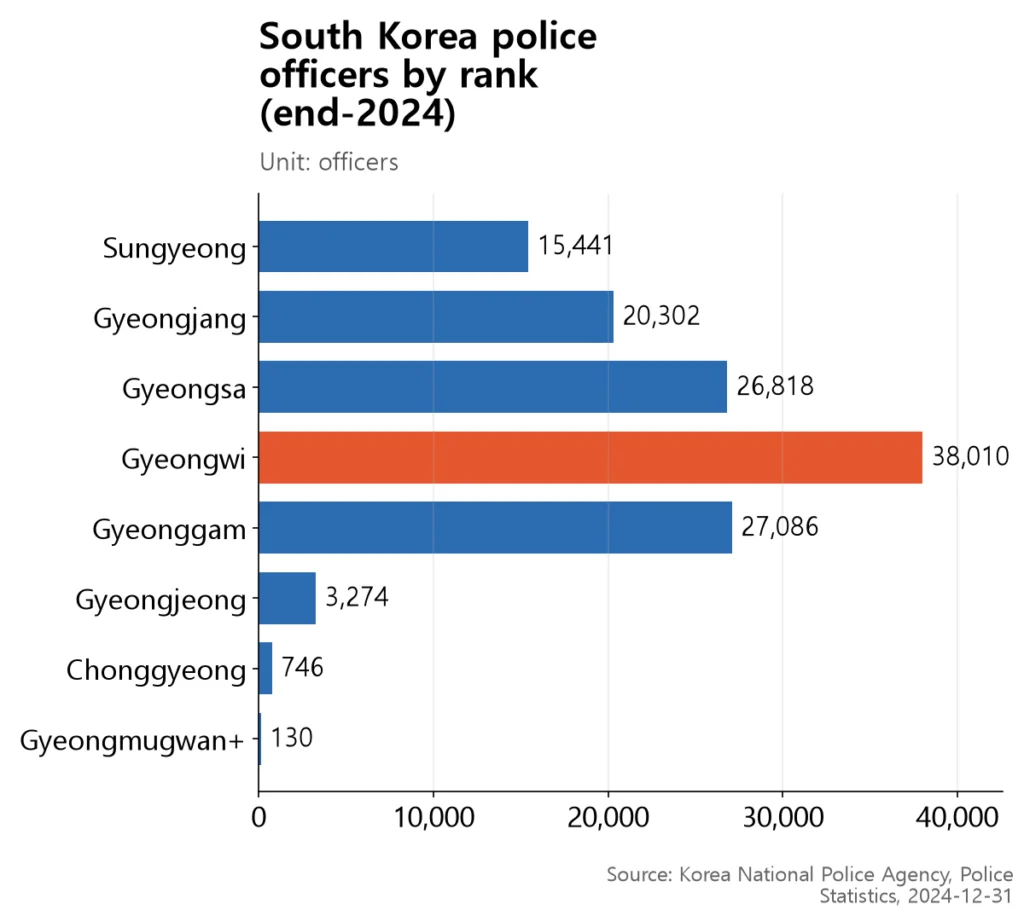
Senior officers from Gyeongmugwan upward (bureau-director tier and higher on the travel-allowance table) total only 130 — 0.1% of the force (calculated). Rank by rank: 1 Chiantongam, 7 Chianjeonggam, 31 Chian-gam, 91 Gyeongmugwan, 746 Chonggyeong, 3,274 Gyeongjeong. The authorized headcount set by the Police Agency organization decree (effective Oct. 1, 2026) is 131,387 police officers — close to the actual figure above.
One commonly cited reason for the Gyeongwi bulge is the length-of-service promotion rule, which lifts officers to the next rank after a set number of years in post without an exam. The exact text of the promotion rules was not verified for this piece, but the inverted pyramid is clear in the raw table.
How to read these numbers
- The Auxiliary Police was not formally abolished; recruitment stopped and the last class discharged on May 17, 2023. That date is based on press reports; the Auxiliary Police Act itself is still in force.
- The Civil Servant Travel Allowance tiers are a pay-and-allowance grouping, not a legal rank-equivalence table between police and military.
- Press reports citing the 2022 Defense White Paper put the total number of military generals at roughly 370, but the original white paper text was not verified here.
- The star-and-flower counts on military insignia are set in Attachment 4 of the Military Uniform Decree, but the attachment is an image file, so exact counts cannot be read directly from the statute’s text.
Summary
South Korea’s police look military from the outside, but two things set them apart. There are no enlisted conscripts — the four ‘Gyeong’ ranks everyone remembers belonged to the Auxiliary Police, which closed its last class in May 2023. There are no stars — the Commissioner General sits at vice-minister tier alongside a Lieutenant General, but his insignia is four Taegeuk Rose of Sharon flowers, not stars. All 11 ranks are career civil servants, and the biggest rank by headcount is the fourth rung from the bottom, not the first.

Awesome News on Instagram @awesome_news_kr
This article is the research behind our Korean-language card news. Every morning we turn Korean data and official sources into short visual stories. See it on Instagram →
Sources
- Korea Law Information Center — Police Officials Act Art. 3 and 10 (effective 2025-01-07) (Korean)
- Korea Law Information Center — Police Appointment Decree, Table 1-3 Age Limits (2026-09-01) (Korean)
- Korea Law Information Center — Auxiliary Police Act Art. 2-4 and Enforcement Decree Art. 14 (Korean)
- Korea Law Information Center — Military Personnel Management Act Art. 3 and 7, Enforcement Rule Art. 32 (Korean)
- Korea Law Information Center — Police University Act Art. 8–10 and Academic Rules Art. 17/17-2 (Korean)
- Korea Law Information Center — Military Academy Act Art. 2, 3 and 7 (Korean)
- Korea Law Information Center — Government Organization Act Art. 36, 37(5) and 43(2) (Korean)
- Korea Law Information Center — Act on National Police and Autonomous Police Organization and Operation Art. 14 (Commissioner General = Chiantongam) (Korean)
- Korea Law Information Center — Decree on the National Police Agency and Its Affiliated Institutions, Authorized Headcount Table (2026-10-01) (Korean)
- Korea Law Information Center — Civil Servant Travel Allowance Rules, Table 1 (amended 2026-09-29) (Korean)
- Korea Law Information Center — Police Uniform Rules, Table 4 Insignia (Korean) (2021-12-31)
- Korea National Police Agency — Police Statistics (headcount by rank) (Korean) (2024-12-31)
- Seoul Shinmun — Discharge ceremony for the 1142nd (final) Auxiliary Police class (Korean) (2023-04-14)
- Policy Briefing (Ministry of Culture, Sports and Tourism) — Police University reform: transfer admission allowed, freshman age cap raised to 41 (Korean)
📊 Download the data
Every number in this article’s 6 charts and tables, in one CSV file (opens in Excel or Google Sheets). When you cite it, please name the original source and link to this page.
Download CSV