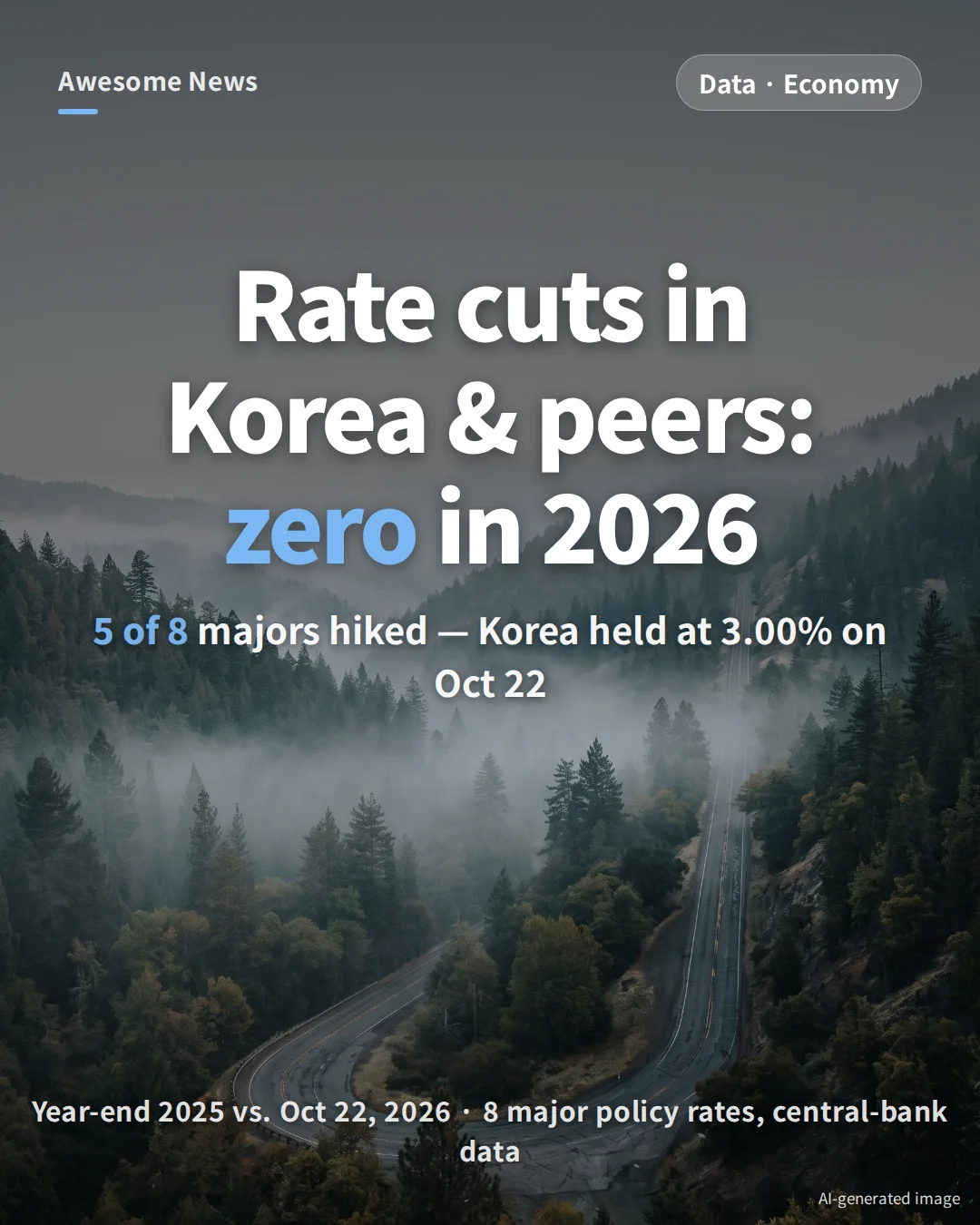
On October 22, 2026, the Bank of Korea’s Monetary Policy Board held its benchmark rate at 3.00%, a unanimous 7-0 decision. But the final line of the statement flagged that the Board will decide on “the timing and pace of further hikes.” Across eight major economies tracked here, five have raised policy rates this year, and none have cut — a sharp reversal from the easing cycle of 2024–25.
Key numbers at a glance
- Bank of Korea held at 3.00% on Oct 22 — unanimous 7-0, with language signaling more hikes ahead.
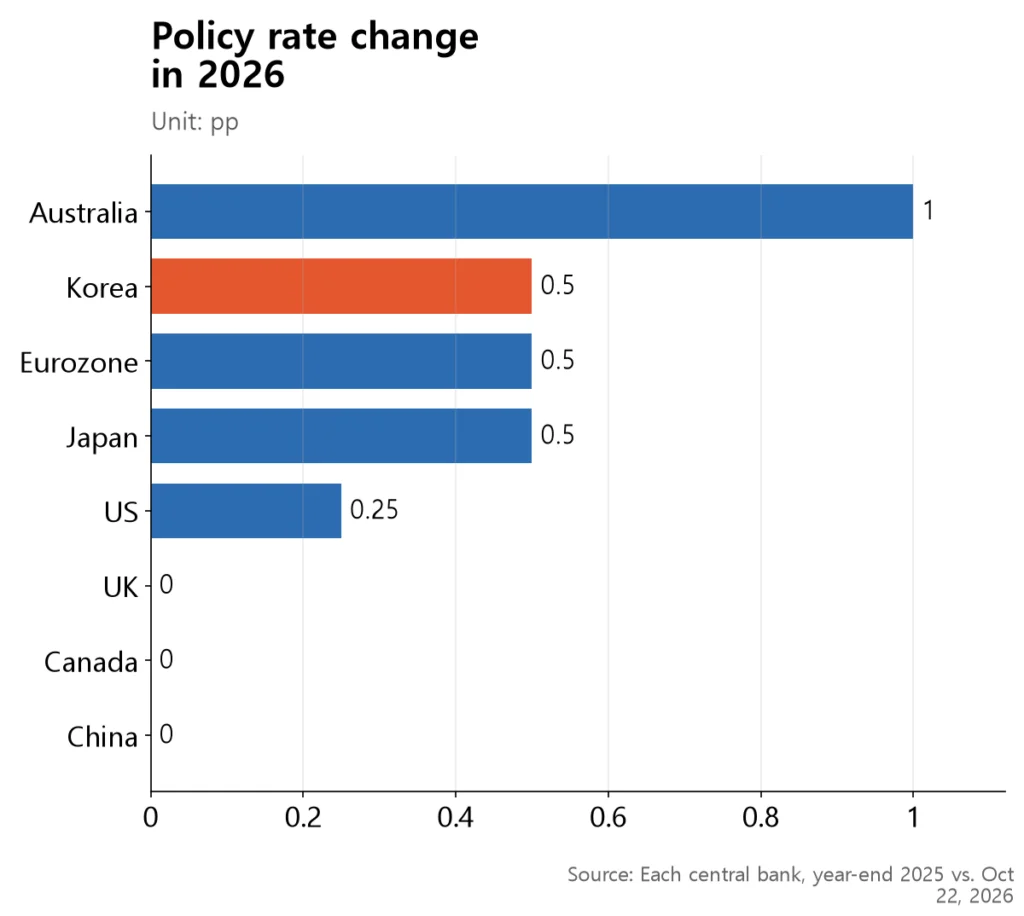
- 5 of 8 majors hiked in 2026, 0 cut — Australia +1.00pp (four moves), Korea / eurozone / Japan +0.50pp, US +0.25pp.
- Korea and the US hiked for the first time in roughly three years — 3 years 6 months for Korea, 3 years 2 months for the US.
- Japan’s 1.25% is its highest since 1995 (uncollateralized overnight call rate, monthly average).
- New mortgage rate hit 4.66% in August 2026 — the highest since November 2022, having risen even while the policy rate was on hold.
Korea: a pause, not a stop

The Bank of Korea left its policy rate at 3.00% on October 22. All seven Board members voted to hold. The rationale: with 0.25pp hikes in both July and August, the Board wanted time to assess the impact of those back-to-back moves.
The signal in the statement is clear. The Board said it will “closely monitor price and growth trends and financial stability, and determine the timing and pace of further hikes.” In other words, this is a breather, not a ceiling.
| Date | Decision | Policy rate |
|---|---|---|
| May 2025 | Cut | 2.50% |
| July 2026 | Hike | 2.75% |
| August 2026 | Hike | 3.00% |
| Oct 22, 2026 | Hold (7-0) | 3.00% |
The Bank’s read on the global backdrop leans toward inflation risk: it expects world inflation to stay elevated on energy prices and supply bottlenecks, long-term government yields have risen sharply on rate-hike expectations, and home prices in the Seoul metropolitan area are picking up again.
The world: five up, three flat, none down

Comparing year-end 2025 with October 22, 2026 using each central bank’s own data, five of eight major economies (Korea, the US, the eurozone, Japan, Australia, the UK, Canada, China) have raised policy rates this year, three have held, and not one has cut.
| Country | End-2025 | Oct 22, 2026 | Change |
|---|---|---|---|
| Australia | 3.60% | 4.60% | +1.00pp (4 hikes) |
| Korea | 2.50% | 3.00% | +0.50pp |
| Eurozone (DFR) | 2.00% | 2.50% | +0.50pp |
| Japan | 0.75% | 1.25% | +0.50pp |
| US (upper bound) | 3.75% | 4.00% | +0.25pp |
| UK | 3.75% | 3.75% | 0 |
| Canada | 2.25% | 2.25% | 0 |
| China (1Y LPR) | 3.00% | 3.00% | 0 |
Australia moved the most aggressively, with four hikes in February, March, May and September totaling 1.00pp. The US Federal Reserve lifted its target range once in September (+0.25pp) — but that single move was its first hike in 3 years and 2 months. In its October statement, the Bank of Korea said global inflation is likely to stay elevated for some time on higher energy prices and supply-chain disruptions.
A seven-year view: peak, trough, and back up

Today’s numbers make more sense inside a seven-year arc. Rates bottomed during the pandemic in 2020, surged in 2022–23, eased back through 2024–25, and have begun climbing again in 2026.
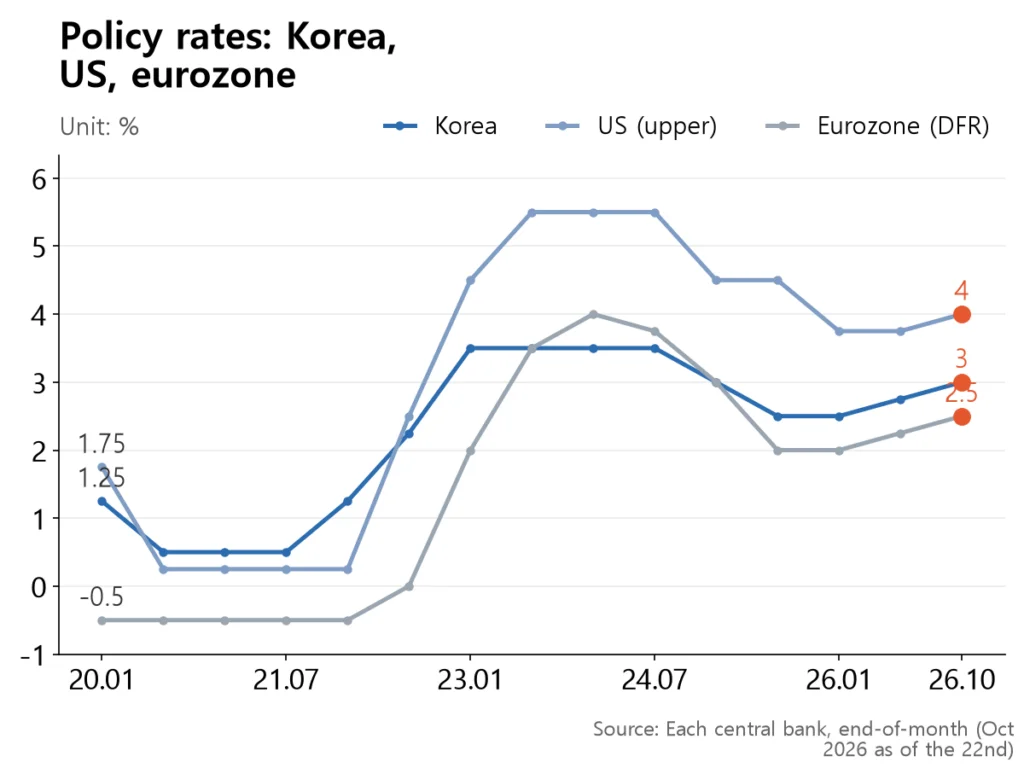
As of October 22, 2026, the US sits at 4.00%, Korea at 3.00%, and the eurozone at 2.50%. From their troughs, the US is +0.25pp higher, Korea +0.50pp, and the eurozone +0.50pp. The Korea-US gap is 1.00pp, still in the US’s favor.
Records: first hike in years, highest rates in decades

The weight of this year’s hikes shows in how long it has been since each central bank last moved up. Japan’s 1.25% is a level not seen since the mid-1990s.
| Country | 2026 moves | Milestone |
|---|---|---|
| Korea | Jul + Aug, +0.50pp | First hike in 3 years 6 months (since Jan 2023) |
| US | Sep +0.25pp | First hike in 3 years 2 months (since Jul 2023) |
| Eurozone | Jun + Sep, +0.50pp | First hike in ~2 years 9 months (since Sep 2023) |
| Japan | Jun + Sep → 1.25% | Highest since 1995 (~31 years) |
| Australia | Four hikes → 4.60% | Highest since 2011 (~15 years) |
Japan’s path is the most dramatic. The Bank of Japan only exited negative rates (−0.1%) in March 2024, and is now at 1.25% just two and a half years later. Australia’s 4.60% is a level unseen since just before the November 2011 cut from 4.75% to 4.50%.
Mortgages: already moved ahead of the policy rate

The policy rate paused on October 22, but mortgage rates have already moved. On Bank of Korea data for new household loans at deposit-taking banks (weighted average, newly extended basis), the rate on new home mortgages rose from 3.87% in May 2025 to 4.66% in August 2026 — the highest reading since November 2022. (The August figure is provisional.)
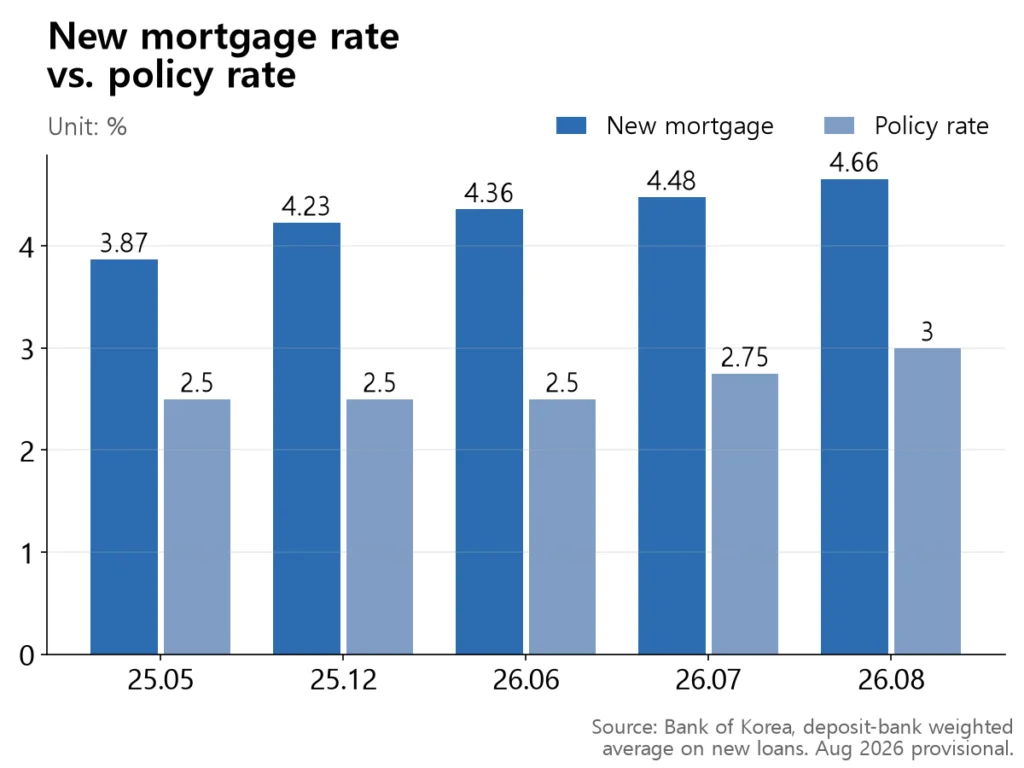
The striking stretch is the year-plus when the policy rate sat still at 2.50%, from May 2025 to June 2026. Even then, new mortgage rates climbed from 3.87% to 4.36% — up 0.49pp (calculated). Market rates on bank bonds and government debt had already baked in expectations of hikes. With the Bank of Korea now flagging “further hikes” in its statement, mortgage rates are worth watching closely.
What’s next: four central banks in three days

Korea’s October 22 call is just the opening act. Over three days starting October 28, four major central banks decide back-to-back, followed by Australia, the UK, China and Korea’s final 2026 meeting. All times below are Korea Standard Time (KST).
| Date (KST) | Central bank |
|---|---|
| Oct 28 (night) | Canada |
| Oct 29 (early morning) | US (FOMC) |
| Oct 29 (night) | Eurozone (ECB) |
| Oct 30 (day) | Japan (BOJ) |
| Nov 3 (day) | Australia |
| Nov 5 (night) | UK |
| Nov 20 (morning) | China (LPR) |
| Nov 26 (morning) | Korea |
How to read these numbers
A few caveats before comparing the figures above head-to-head.
- “Policy rate” is not the same instrument everywhere. The US figure is the upper bound of the fed funds target range; the eurozone’s is the Deposit Facility Rate; China’s is the 1-year LPR; Japan’s is a call-rate level aligned with the policy stance. Raw levels are not directly comparable.
- Dates reflect effective dates. The US decided on Sep 16 and the move took effect Sep 17; Japan decided on Sep 18 and took effect Sep 24 — a 1 to 7 day gap between decision and effective date is common.
- Japan’s “since 1995” uses the uncollateralized overnight call rate, monthly average (June 1995: 1.28%). Australia’s “15-year high” is based on the Reserve Bank of Australia’s own series.
- The 4.66% new mortgage rate for August 2026 is provisional, and is a weighted average of mortgages actually extended by deposit-taking banks — not a quote you can walk into a bank today and receive.
Summary
On October 22, 2026, the Bank of Korea held at 3.00%. The character of the pause matters: the statement’s final line pointed to deciding “the timing and pace of further hikes,” not a stopping point.
Global rates are turning back up. Five of eight major economies hiked this year, and none cut. The US is above its trough for the first time in 3 years 2 months, the eurozone in roughly 2 years 9 months, and Japan now sits at its highest level since 1995. Australia has hiked four times in 2026 alone.
Meanwhile, Korean mortgage rates have already moved. New mortgage rates kept rising even while the policy rate was stuck at 2.50%, and are now at their highest since November 2022. Korea’s next decision lands on November 26 — but four other major central banks (Canada, the US, the ECB and the BOJ) will have gone first, over three days starting October 28. Their calls are worth watching ahead of Korea’s November meeting.

Awesome News on Instagram @awesome_news_kr
This article is the research behind our Korean-language card news. Every morning we turn Korean data and official sources into short visual stories. See it on Instagram →
Sources
- Bank of Korea — Monetary Policy Decision (press release 2026-10-15) (Korean) (2026-10-22)
- Bank of Korea — Bank of Korea Base Rate history (Korean)
- Bank of Korea — Deposit-bank weighted average interest rates on new loans — mortgages, August 2026 provisional (Korean)
- Federal Reserve Bank of New York — Effective Federal Funds Rate (EFFR)
- European Central Bank — Deposit Facility Rate (DFR)
- Bank of Japan — Uncollateralized overnight call rate (FM01 STRDCLUCON) (Japanese)
- Reserve Bank of Australia — Cash Rate
- Bank of England — Bank Rate (IUDBEDR) database
- Bank of Canada — Target for the Overnight Rate (V39079)
- People’s Bank of China / Chinamoney — LPR History
📊 Download the data
Every number in this article’s 7 charts and tables, in one CSV file (opens in Excel or Google Sheets). When you cite it, please name the original source and link to this page.
Download CSV