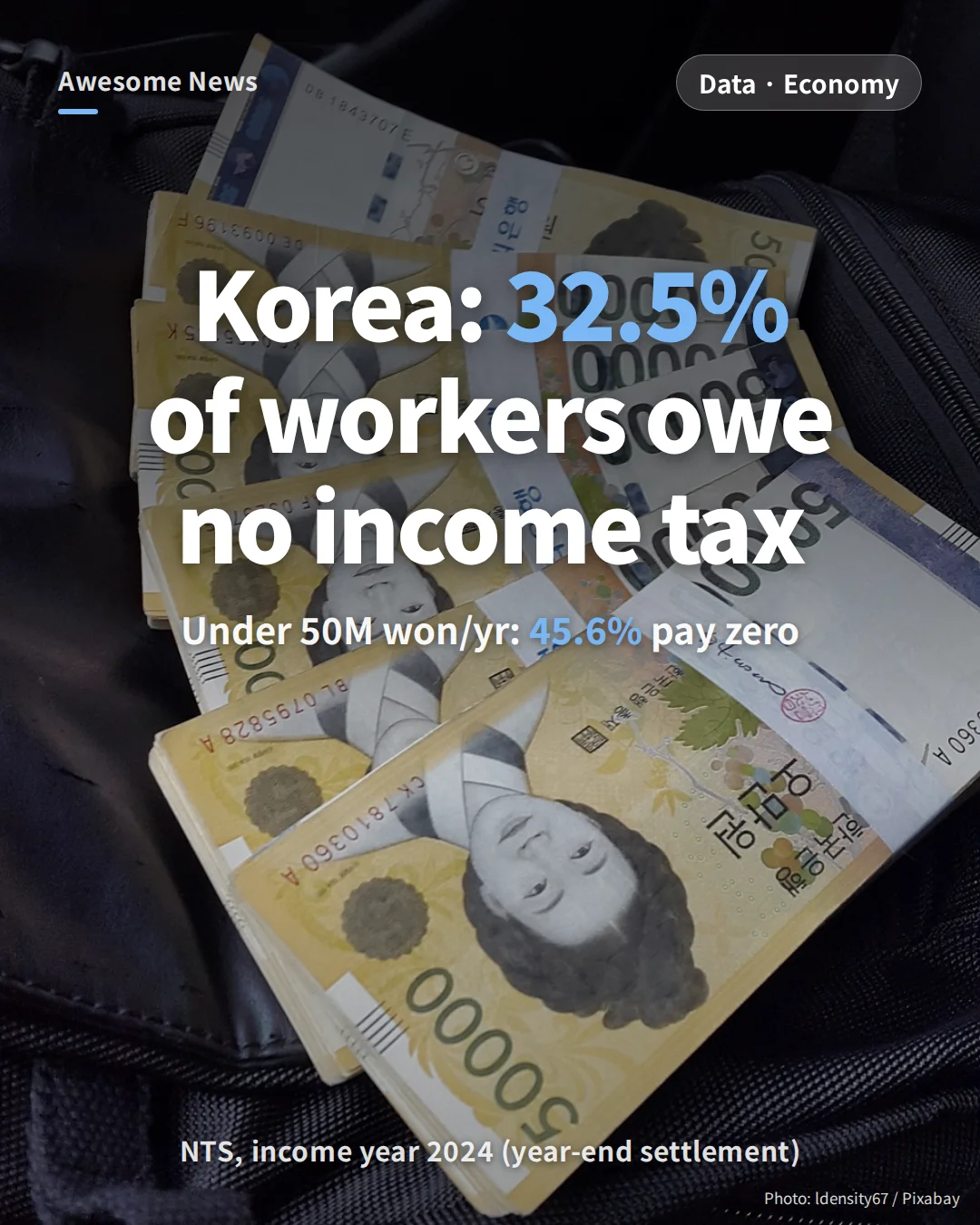
One in three South Korean wage earners pays no income tax at all. According to the National Tax Service (NTS), 6.84 million of the 21.08 million wage earners whose income was reported for 2024 — 32.5% — ended the year-end settlement with a final tax liability of zero. The headline hides a tangle of policy and economics: a 2014 shift from income deductions to tax credits, a decade of nominal wage growth, inflation, and thresholds that have barely moved. This article walks through the 11-year trend, who the non-taxpayers are, how Korea compares abroad, and the debate over indexing the tax code to inflation.
Key numbers at a glance
- 6.84 million out of 21.08 million wage earners (32.5%) paid zero income tax in 2024 (NTS).
- The exempt share fell from 48.1% in 2014 to 32.5% in 2024 — but it has barely moved for three years.
- Among workers earning up to 50 million won/yr, 45.6% were exempt; above 80 million won/yr, only 0.13% were (2023 income, press reports).
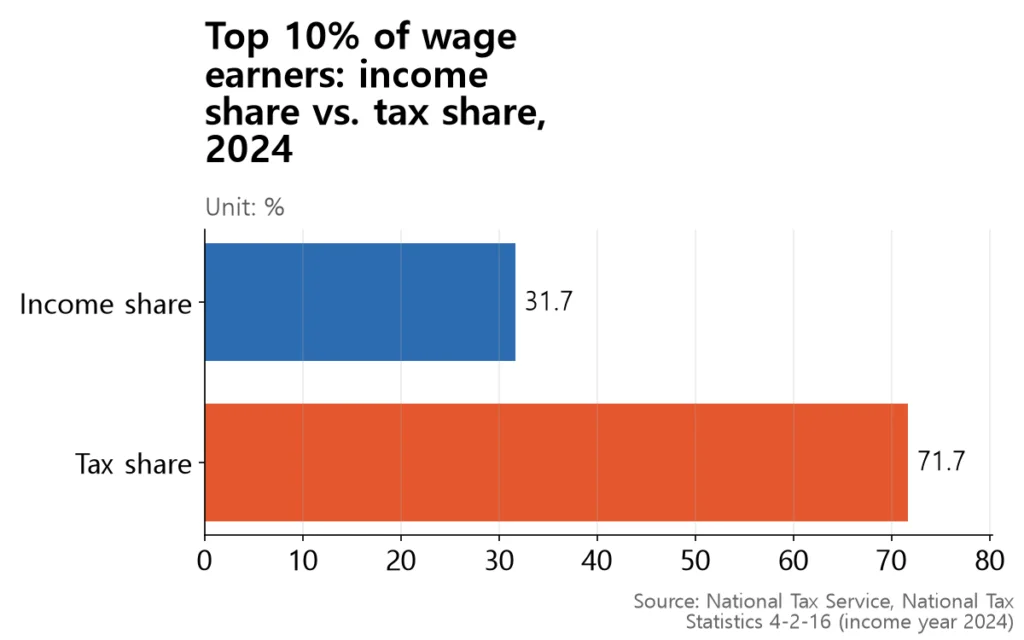
- The top 10% of wage earners took 31.7% of gross income and paid 71.7% of the income tax (2024).
- The 1.5 million won/yr personal deduction has been unchanged since 2009, and the earned-income deduction schedule since 2014.
What “tax-exempt” means here
In the NTS statistics, a “tax-exempt” wage earner is one whose final income tax liability is zero after the annual year-end settlement. It does not mean the person had no earnings — it means that after personal deductions, the earned-income deduction, and various tax credits, nothing was owed in income tax. Other levies (social insurance contributions, VAT and so on) are separate.
The definition itself was once rewritten. Through 2013, “exempt” meant having no taxable base; from 2014, it means owing zero tax. The change arrived alongside a conversion of several income deductions into tax credits, which is why a line connecting 2013 (32.4%) to 2014 (48.1%) overstates the real jump. The series needs that caveat before any reading.
The 11-year trend: 48.1% down to 32.5%
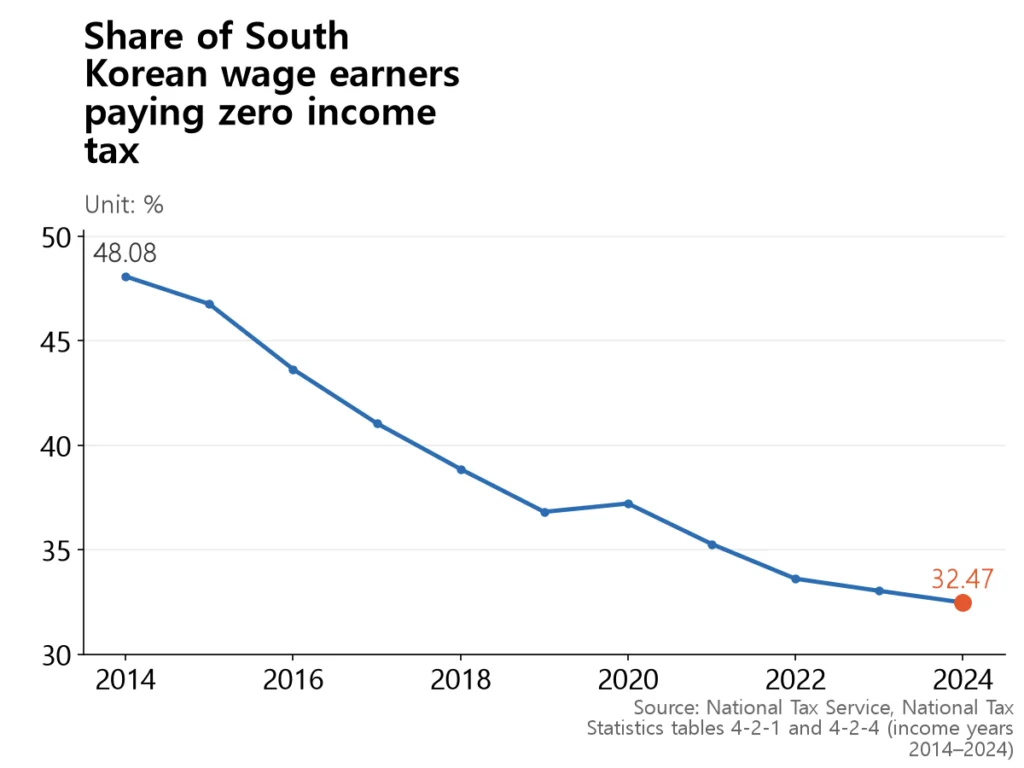
The 2014 peak was lifted by the credit conversion and a follow-up relief package applied retroactively to that income year. The share then slid every year to 36.8% in 2019, briefly rose to 37.2% in 2020, and resumed its decline. For the last three years the drop has been small — 33.6% → 33.0% → 32.5%, or 0.6 and 0.5 points — close to a plateau.
A striking coincidence: the 2024 figure of 32.5% is almost identical to the 32.4% recorded in 2013, the year before the credit conversion. More than a decade of swings has returned the share to roughly where it started.
| Income year | Tax-exempt wage earners | Share | Change (p.p.) |
|---|---|---|---|
| 2014 | 8,023,836 | 48.08% | definition changed |
| 2015 | 8,104,230 | 46.76% | -1.3 |
| 2016 | 7,741,942 | 43.64% | -3.1 |
| 2017 | 7,390,802 | 41.05% | -2.6 |
| 2018 | 7,219,101 | 38.86% | -2.2 |
| 2019 | 7,054,651 | 36.81% | -2.1 |
| 2020 | 7,255,196 | 37.21% | +0.4 |
| 2021 | 7,039,974 | 35.27% | -1.9 |
| 2022 | 6,902,372 | 33.61% | -1.7 |
| 2023 | 6,887,644 | 33.03% | -0.6 |
| 2024 | 6,844,016 | 32.47% | -0.6 |
Who isn’t paying — 45.6% of lower earners, 0.13% of higher earners
The exempt share splits sharply by income. Press reports using 2023 NTS data cite 45.6% of wage earners making up to 50 million won/yr paying no income tax, against just 0.13% of those earning above 80 million won/yr. In practice, almost all non-taxpayers sit in the middle and lower bands; near-everyone in the top bands pays.
The tax bill is just as skewed. NTS decile statistics (table 4-2-16) show that in 2024 the top 10% of wage earners took 31.7% of total gross wage income and paid 71.7% of the income tax. The increase in revenue has been even more concentrated: the National Assembly Budget Office (NABO) finds that 84% of the 34.4 trillion won increase in income tax from 2014 to 2023 — 28.9 trillion won — came from workers earning above 80 million won/yr.
An international table — read with care
A cross-country comparison appears in Korean press coverage, but the figures use different base years and different deduction structures, so they are not strictly comparable. The numbers below are the ones most cited in Korea.
| Country | Base year | Share paying zero income tax | Gap vs. Korea |
|---|---|---|---|
| South Korea | 2024 | 32.5% | — |
| United States | 2019 | 31.5% | -1.0 p.p. |
| Canada | 2017 | 17.6% | -14.9 p.p. |
| Australia | 2018 | 15.5% | -17.0 p.p. |
| Japan | 2020 | 15.1% | -17.4 p.p. |
The government leans on this comparison to argue against inflation-indexing. In a June 2026 briefing, officials said Korea’s exempt share was already higher than that of the United States (27.3%) or Japan (13.7%) — figures that differ slightly from the press-cited numbers above because the government did not specify a base year. Either way, the rule when citing these numbers is to state the base year.
One technical note: the 2020 Korean figure of 37.2% still shows up in some graphics as if it were current, because the related table on e-Nara Indicators stopped updating that year. The latest figure is 32.5% for income year 2024 (6.84 million people), available on the National Tax Statistics Portal (TASIS).
Why the share fell — part 1: frozen thresholds
The first reason more Koreans now owe income tax is that most of the parameters used to calculate it have not been updated for years. Under current law:
- Personal deduction of 1.5 million won/yr per dependent: unchanged from income year 2009 through 2026.
- Dependent income threshold of 1 million won/yr in net income: largely unchanged since the 1990s (loosened once in 2016 for wage-only dependents, to 5 million won/yr gross).
- Earned-income deduction brackets (5 / 15 / 45 / 100 million won/yr) and rates (70 / 40 / 15 / 5 / 2%): unchanged since income year 2014.
- Wage-income tax credit cap of 740,000 won/yr (for gross wages up to 33 million won/yr): unchanged since 2014.
- The 88 million won/yr bracket boundary between the 24% and 35% marginal rates: unchanged since 2008.
That picture is not quite complete. The lower brackets were adjusted once in income year 2023 — from 12 and 46 million won/yr to 14 and 50 million won/yr, the first change in 15 years — and the child tax credit rose in 2025 (250,000 won/yr for one child, 550,000 won/yr for two, plus 400,000 won/yr for each additional child). But as a researcher at the National Assembly Research Service noted in a parliamentary hearing, the 2023 adjustments of +16.7% and +8.7% amounted to only one-third to two-thirds of the 25.5% cumulative inflation over the same period.
Why the share fell — part 2: wages outpaced prices
The second reason is simpler: paychecks got bigger. The Ministry of Employment and Labor’s survey of workplaces with one or more regular employees puts the average monthly nominal wage at 2,904,000 won in 2014 and 4,079,000 won in 2024, a rise of about 40.5%. Over the same decade consumer prices rose roughly 21.2%, so real wages rose about 16%. More workers crossing a frozen tax threshold is the natural result.
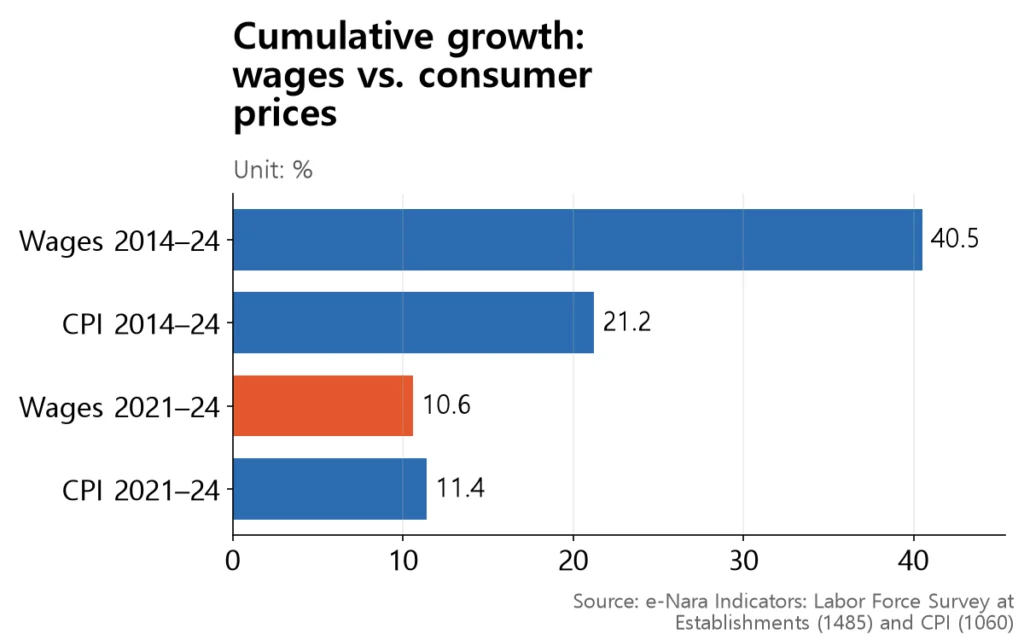
Cut the window shorter and the story reverses. From 2021 to 2024 nominal wages rose 10.6% while prices rose 11.4%, so real wages fell about 0.7%. The exempt share still slid, from 35.3% to 32.5%. That — paying tax on wages that have lost purchasing power — is the strongest argument from those who want the thresholds moved at least in line with inflation.
Other forces also matter. In 2021–22 the number of filers earning above 80 million won/yr jumped, changing the composition of the pool. And the statutory minimum wage rose from 5,210 won/hr in 2014 to 9,860 won/hr in 2024 — up 89.3% in nominal terms, roughly +56% in real terms — pushing many low earners above the exempt line. NABO data show the under-20-million-won/yr group shrank from 7.5 million filers in 2014 to 5.43 million in 2023, while the 20–40-million-won/yr group grew from 4.67 million to 7.27 million.
What the government and researchers say
The Ministry of Economy and Finance (MOEF), the National Assembly Research Service and the Korea Institute of Public Finance (KIPF) read the same numbers slightly differently.
- MOEF (March 2018 clarification) — even without changes, wage growth alone would bring the exempt share back to the pre-2014 level (32.4%) within two or three years.
- National Assembly Research Service (2020) — the decline since 2015 reflects “the effect of nominal wage growth, among others.”
- KIPF, Fiscal Forum, June 2026 (Kim Mun-jeong) — of the 2019–2022 rise in wage income tax, 11–46% by bracket is attributable to “bracket creep from prices”; movement out of lower brackets owed more to new entrants than to creep, so the paper advises caution on inflation indexing.
- Government (June 2026) — opposes indexing, arguing Korea’s exempt share is already above peers’ and that the gains would skew to higher earners.
The KIPF paper summarized in the source material notes that about 1.1 million people moved from the 6% bracket into the 15% bracket, roughly 2.7 times the 400,000 who left the 6% bracket — a sign that new, higher-paid entrants, not bracket creep alone, drove the shift. In Korea’s 22nd National Assembly, both ruling and opposition parties have filed bills to index the brackets to prices, and separate bills would index the personal deduction.
What the OECD says
The OECD’s Taxing Wages 2023 counts 17 member countries that automatically index income-tax brackets to inflation. Korea is classified as a discretionary country, where parliament adjusts thresholds when it chooses. The OECD also notes that indexing to prices does not eliminate fiscal drag when real wages are rising — a caution that “just fix the thresholds and the exempt share will stop falling” is too simple.
How to read these numbers
- Do not draw a straight line from 48.1% in 2014 to 32.5% in 2024. The 2014 peak was pushed up by the credit conversion and a retroactive relief package; the definition of “exempt” also changed that year.
- It has not fallen every year. The share rose in 2020 (37.2%) and has been roughly flat near 33% from 2022 to 2024.
- “Exempt” refers only to income tax. These workers still pay social insurance contributions, VAT and other levies.
- The 45.6% / 0.13% split by income band is from 2023 press reports. Recalculating directly from NTS table 4-2-4 can produce 45.6% or 45.8% depending on how the band is defined.
- International shares use different base years. Always cite them with the year attached.
- 84% of the recent tax-revenue growth came from the 80-million-won+ band. Saying “ordinary workers’ taxes have shot up” overstates what the data show.
Summary
In 2024, 6.84 million of South Korea’s 21.08 million wage earners owed no income tax. The 32.5% figure is both a decade of decline from the 48.1% peak of 2014 and a return to roughly where the share stood in 2013, before the switch to tax credits. Wage growth, a rising minimum wage, and long-frozen parameters such as the 1.5 million won/yr personal deduction and the earned-income deduction schedule all contributed.
The case for inflation-indexing the thresholds is backed by solid numbers — real wages fell between 2021 and 2024, yet the exempt share kept slipping. Against it stands the government’s and KIPF’s view that Korea’s exempt share is already high by international standards and that the main beneficiaries of indexing would be upper-income households. The 32.5% headline is only useful read against both layers.

Awesome News on Instagram @awesome_news_kr
This article is the research behind our Korean-language card news. Every morning we turn Korean data and official sources into short visual stories. See it on Instagram →
Sources
- National Tax Service / KOSIS — National Tax Statistics 4-2-1 Wage Income Tax Filings (TX_13301_A035) (Korean) (income year 2024)
- National Tax Service / KOSIS — National Tax Statistics 4-2-4 Determined Tax by Wage Income Size (DT_13301N_A424) (Korean) (income year 2024)
- National Tax Service / KOSIS — National Tax Statistics 4-2-16 Wage Income Decile Shares (DT_133001N_4216) (Korean) (income year 2024)
- National Tax Service / e-Nara — e-Nara Indicators, Wage Income Tax Filing Status (idx_cd=1126) (Korean)
- Hankyung — One in three salaried workers pays no income tax; exempt share about 33% (Korean) (2025-10-04)
- Hankyung — Top 10% of wage earners paid 71.7% of income tax in 2024 (Korean) (2026-01-05)
- Edaily — Edaily Market-In: trend in wage-income tax exempts (Korean) (2026-01-07)
- National Assembly Budget Office — Recent Drivers of Wage Income Tax Growth (NABO FOCUS No. 105) (Korean) (2025-04-29)
- Korea Institute of Public Finance — Fiscal Forum, June 2026: Kim Mun-jeong, ‘On Indexing Wage Income Tax to Inflation’ (Korean) (2026-06)
- Newspim — MOEF briefing: lower brackets adjusted after 15 years (Korean) (2022-07-21)
- Korea Law Information Center — Income Tax Act, Articles 50, 55, 59 (consolidated text) (Korean)
- Ministry of Employment and Labor / e-Nara — e-Nara Indicators, Average Monthly Wages (idx_cd=1485) (Korean)
- Statistics Korea / e-Nara — e-Nara Indicators, Consumer Price Index (idx_cd=1060) (Korean)
- Asia Business Daily — National Assembly Research Service: 2023 bracket change covered only 1/3 to 2/3 of cumulative inflation (Korean) (2025-07-11)
- Financial News — Government cautious on inflation-indexed income tax (Korean) (2026-06-16)
- OECD — Taxing Wages 2023 (2023)
- National Tax Service — Reference material on the 2023 year-end wage income tax settlement (Korean) (2024-12-19)
- Korea.kr Policy Briefing — MOEF clarification on wage growth and tax-exempt share (Korean) (2018-03-29)
📊 Download the data
Every number in this article’s 5 charts and tables, in one CSV file (opens in Excel or Google Sheets). When you cite it, please name the original source and link to this page.
Download CSV