The Test of Proficiency in Korean (TOPIK) drew 566,665 applicants in 2025, an all-time high and 2.7 times the 2015 total. Of those, 319,192 (59% of the paper-based test) signed up in 88 countries outside South Korea, according to the Ministry of Education and the National Institute for International Education on 29 September 2026. (October 9 is Hangeul Day in Korea, marking the 1446 proclamation of the Korean alphabet; 2026 is the 100th anniversary of the holiday’s first form, ‘Gagyanal.’)
Key numbers at a glance
- TOPIK applicants, 2025: 566,665 — about 210 times the first sitting in 1997 (4 countries, 2,692 applicants; calculated), and 2.7× the 2015 figure
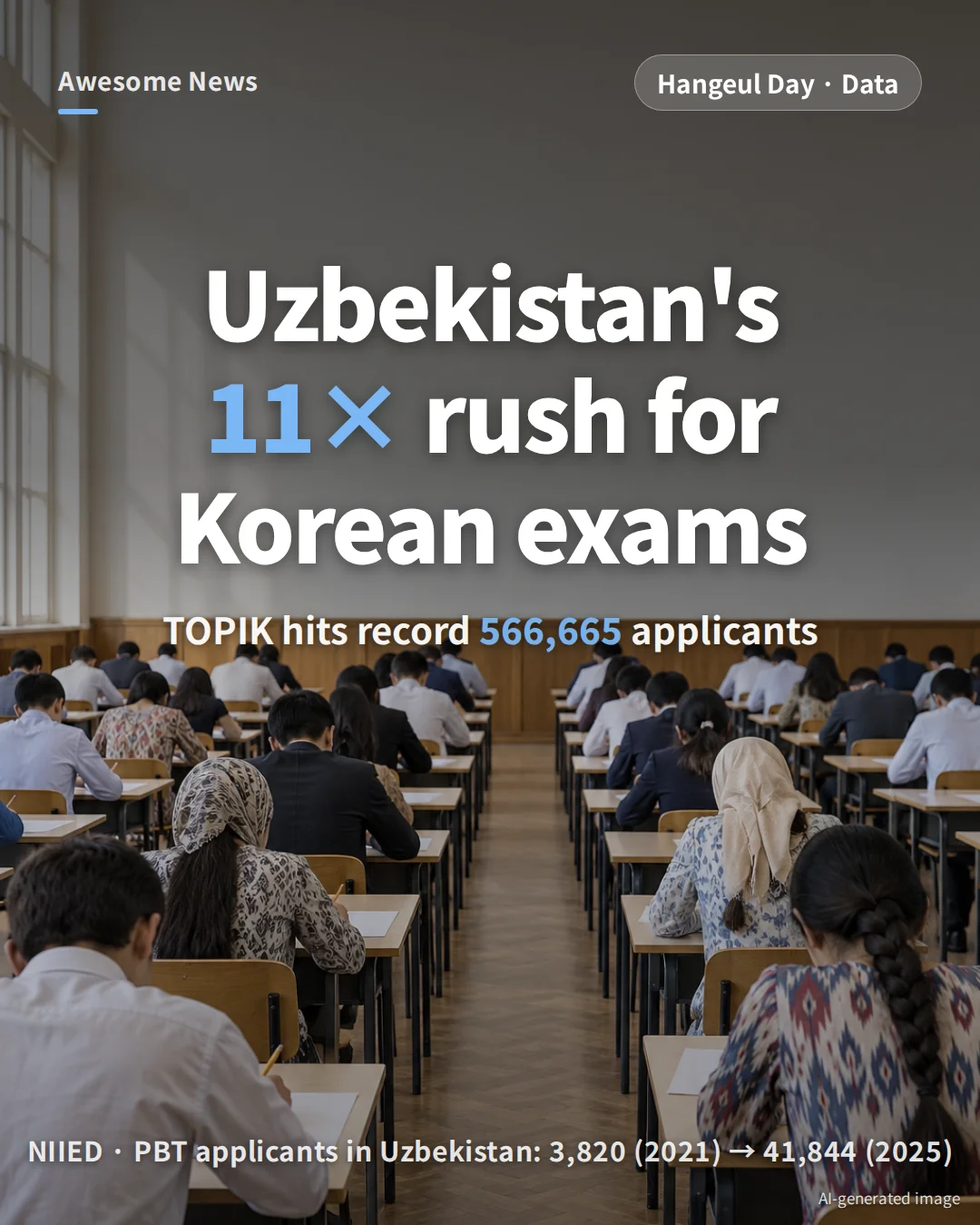
- Uzbekistan: 11× in four years — paper-based applicants rose from 3,820 (2021) to 41,844 (2025)
- Vietnam overtook China for the first time — 83,884 vs. 70,267 on the paper-based test in 2025
- Korean enrollments in US colleges: +38.3% between 2016 and 2021, while total language enrollment fell 16.6% (MLA)
- Sejong Institutes: 273 branches in 89 countries as of June 2026; learners rose from 101,675 (2020) to 239,020 (2025), a 2.4× jump
- 2026 marks 100 years since ‘Gagyanal’ and the 580th anniversary of the alphabet’s proclamation
① TOPIK applicants: 566,665, up 2.7× in a decade
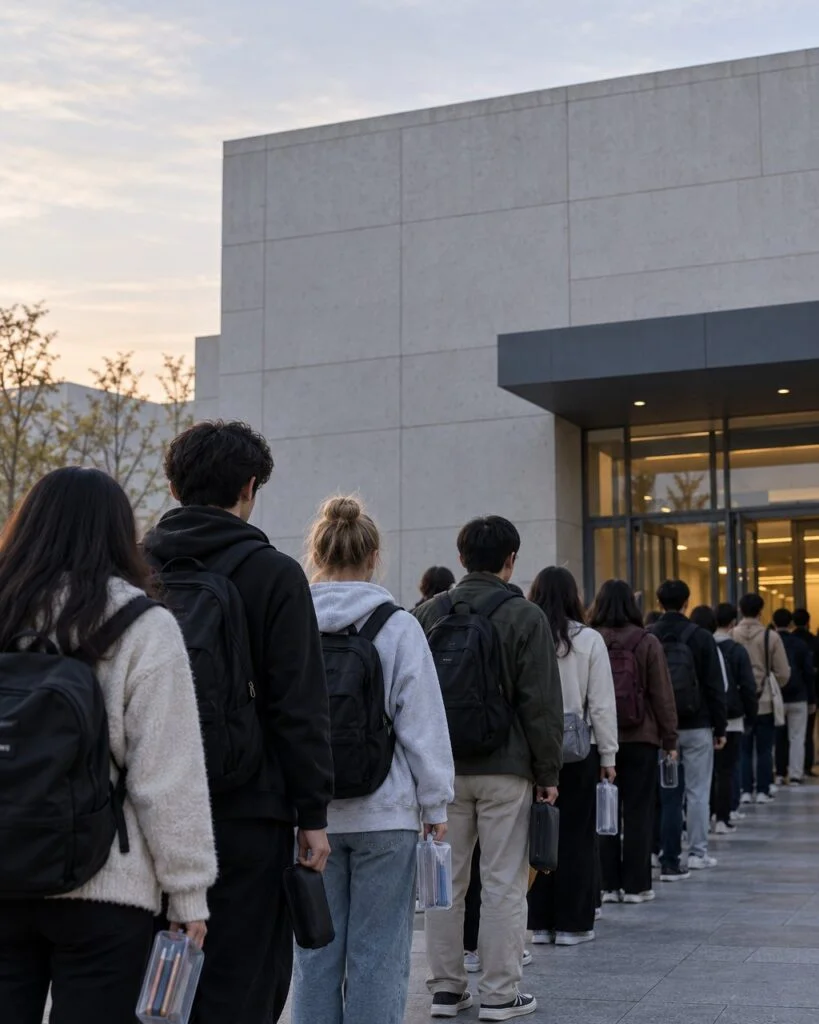
TOPIK, first held in 1997 and now run by the National Institute for International Education, set another record in 2025. The 566,665 total followed roughly 420,000 in 2023 and 490,000 in 2024 — three straight years of record highs.
Momentum has carried into 2026. As of 30 September, 564,606 people in 94 countries and 375 cities had already applied, up 52,319 (+10.2%) on the same date a year earlier. The ministry says it will raise the number of annual sittings to 15 from 2027, move to an AI- and digital-based assessment in 2029, and target 1 million applicants a year by 2030.
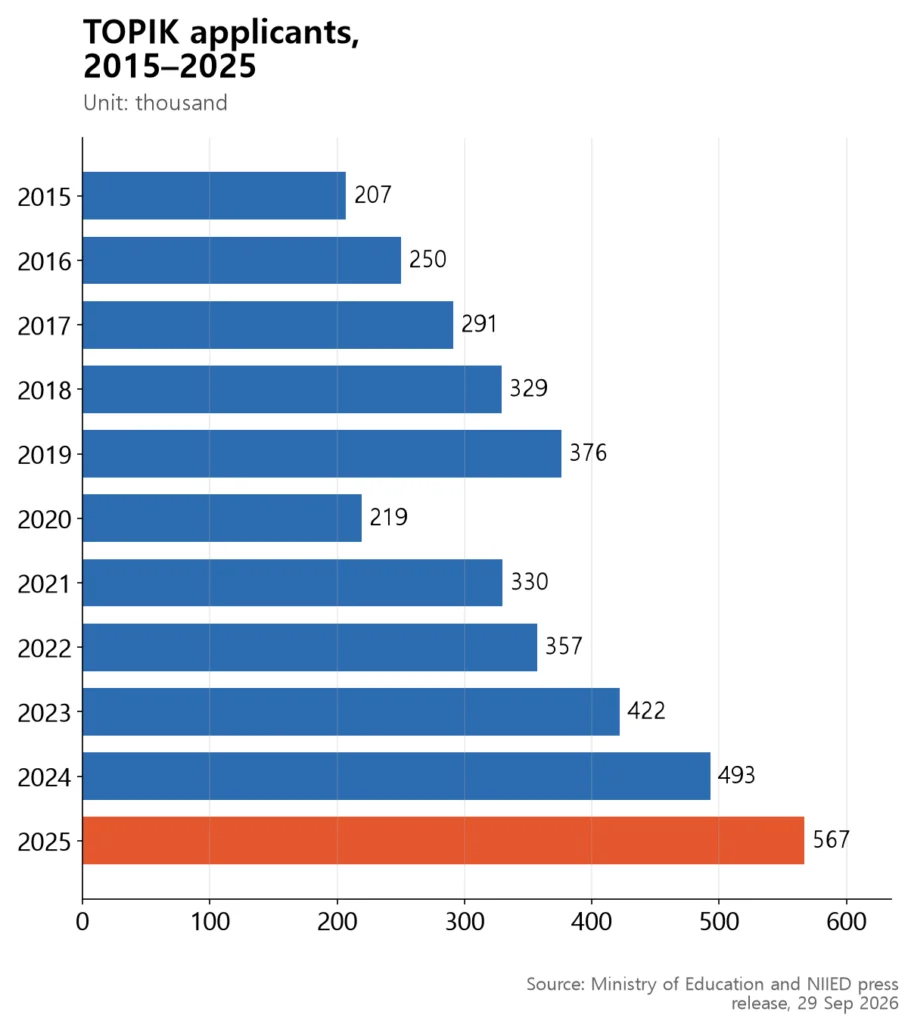
The 2020 dip to 219,000 reflects COVID-19. What matters is the rebound: the 2025 total runs 50.8% above the pre-pandemic 2019 figure (calculated). By mode, 2025 breaks down into 543,600 on the paper-based test (95.9%), 22,531 on the internet-based test (4.0%) and 534 on the speaking test. The IBT, launched in 3 countries in November 2023, expanded to 12 countries and 6 sittings in 2025, with 17 countries planned for 2026.
‘Applicants’ vs. ‘test-takers’ — don’t mix them up
Official figures track applicants (people who signed up), not those who actually sat the exam. In 2025, the paper-based test had 543,600 applicants but 421,046 test-takers; the first 1997 sitting likewise saw 2,692 apply and 2,274 attend. Headlines reporting ‘550,000 test-takers’ usually mean applicants.
② Where they test — Vietnam now ahead of China

On the paper-based test in 2025, the largest testing location was inside South Korea itself (224,408 applicants), mostly foreign residents and overseas Koreans. The next was Vietnam at 83,884, overtaking China (70,267) for the first time. Four years earlier the order was reversed: China had 76,657 applicants, Vietnam 21,192.
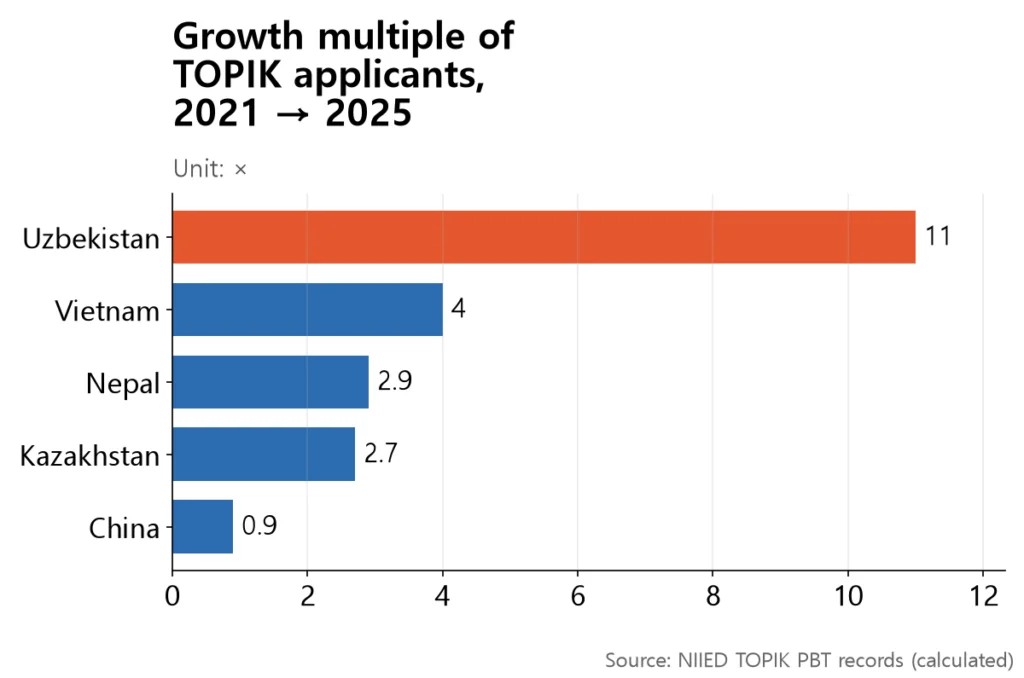
The biggest jump is in Uzbekistan: paper-based applicants rose from 3,820 in 2021 to 41,844 in 2025 — an 11-fold increase. Vietnam quadrupled, Nepal rose 2.9×, Kazakhstan 2.7×. China, by contrast, slipped 8%. The table below lists the top paper-based testing sites in 2025.
| Rank | Location | 2021 applicants | 2025 applicants |
|---|---|---|---|
| 1 | Inside South Korea | 138,822 | 224,408 |
| 2 | Vietnam | 21,192 | 83,884 |
| 3 | China | 76,657 | 70,267 |
| 4 | Japan | 40,957 | 49,290 |
| 5 | Uzbekistan | 3,820 | 41,844 |
| 6 | Mongolia | 11,622 | 12,106 |
| 7 | Taiwan | 9,972 | 11,098 |
| 8 | Myanmar | — | 7,062 |
Note that the EPS-TOPIK, taken by foreign workers under South Korea’s Employment Permit System, is a separate exam. According to the Human Resources Development Service of Korea, 240,220 people sat the EPS-TOPIK across 17 sending countries in 2025, and 50,077 passed (a 20.8% pass rate; calculated). The largest sending countries were Indonesia (48,174), Cambodia (29,753), Sri Lanka (27,654), Nepal (26,804) and Myanmar (26,753).
③ The US: Korean rose while every other language fell

The Modern Language Association (MLA), which tracks non-English language enrollment in US higher education, published its latest survey (fall 2021) in November 2023. Between 2016 and 2021, total enrollments fell 16.6%. Korean rose 38.3%. Only three of the 15 most-studied languages grew: Korean, American Sign Language and Biblical Hebrew.
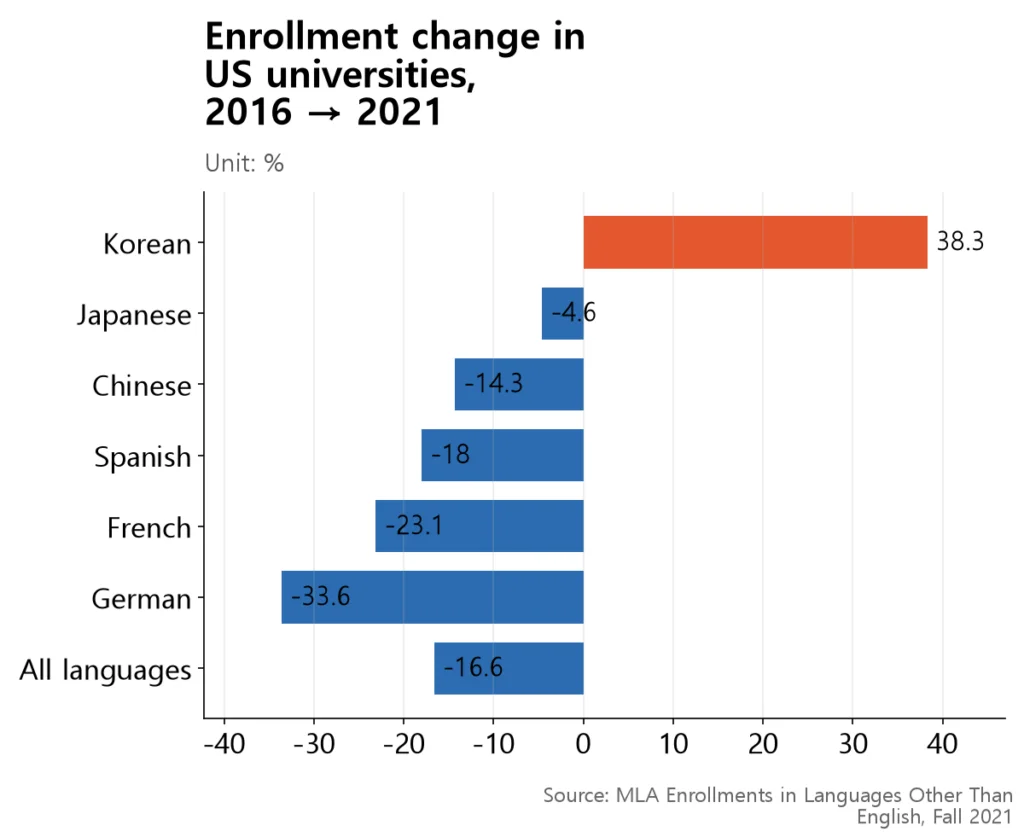
Korean enrollment has grown steadily — from 26 in 1958, to 2,375 in 1990, 13,936 in 2016, and 19,270 in 2021 — and has not fallen once since 1974. In the 2021 survey, Korean overtook Russian to reach 10th place. As the MLA report itself warns, however, Korean is still a ‘small’ language with under 20,000 enrollments, so modest absolute gains look large in percentage terms; the figures also count course registrations, not individual students.
The pattern looks similar on apps. In Duolingo’s annual Language Report, Korean rose from 9th place in 2019 to 6th in 2023, 7th in 2024 and 6th again in 2025. The movement is not strictly monotonic — Italian edged ahead in 2024 — but Korean sits firmly in the global top ten.
④ Sejong Institutes: 273 branches, and still waiting lists

The Sejong Institute, Korea’s public network of overseas Korean-language schools, opened its first branch in Ulaanbaatar, Mongolia, in 2007. On 29 June 2026, 29 new institutes in 23 countries were designated, bringing the total to 273 branches in 89 countries (King Sejong Institute Foundation newsletter, 3 July 2026). Greece, Rwanda and Sri Lanka got their first institutes.
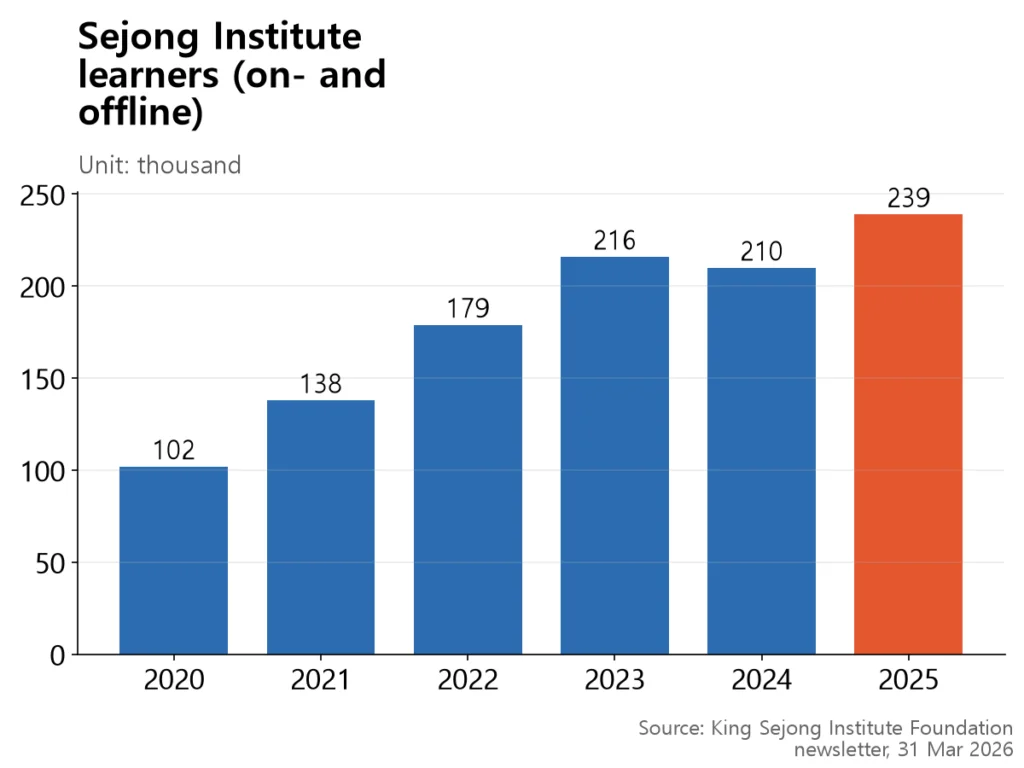
Learners rose from 101,675 in 2020 to 239,020 in 2025, a 2.4× increase in five years. Online enrollment grew faster still, from 25,147 to 115,593 — a 4.6× jump — and made up 48.4% of the total in 2025. After a small dip in 2024 (216,226 → 210,374), the headline figure returned to a record in 2025.
Capacity is clearly stretched. The foundation reports that one institute in Egypt alone has 1,285 people on its waiting list. Competition to open a new Sejong Institute hit 8.5 applicants per slot in 2025 — 94 institutions from 43 countries bidding, the highest ever — up from 3-to-1 in 2020. The foundation’s target is more than 350 branches by 2030.
Countries with the most offline learners
| Rank | Country | 2021 | 2025 |
|---|---|---|---|
| 1 | Russia | 7,557 | 22,410 |
| 2 | Vietnam | 10,333 | 17,821 |
| 3 | China | 6,687 | 8,357 |
| 4 | United States | 3,820 | 7,974 |
| 5 | Uzbekistan | 1,873 | 6,308 |
| 6 | Indonesia | 4,739 | 3,903 |
| 7 | India | 1,722 | 3,329 |
| 8 | Kyrgyzstan | 3,467 | 3,172 |
One caveat: offline learners in Russia leapt from 6,032 in 2024 to 22,410 in 2025 — a 3.7× surge — with no explanation given in the raw dataset. Such a sudden jump is worth flagging before using the single-year number in isolation.
⑤ Why they study: school, work and K-pop
The King Sejong Institute Foundation’s 2025 Korean Language Survey polled 1,323 interested foreigners and 18,128 current learners. Among those with prior study experience, 50.9% named university study in Korea as their main motivation, followed by career development (37.0%). Separately, the foundation told the Asia Business Daily that 53.4% of learners said K-pop or Korean dramas had sparked their initial interest.
A follow-up question on what their Korean study had actually been used for (multiple answers, N=816) found: majoring in Korean locally 46.3%, short-term language programs in Korea 40.2%, degree study in Korea 32.2%, jobs at Korean-affiliated firms at home 22.4%, employment in Korea 16.2%. In other words, the pipeline from K-pop fandom to study and work is visible in the numbers.
253,434 foreigners now studying in Korea
The study-abroad side is also at a record. According to Korea’s Education Basic Statistics, foreign students in South Korea rose from 11,646 in 2001 to 253,434 in 2025, of which 179,190 are enrolled in degree programs. The flow goes the other way too: Koreans studying overseas peaked at 262,465 in 2011 and had halved to 126,980 by 2024. The two lines first crossed in 2022 (166,892 foreign students in Korea vs. 124,320 Koreans abroad). On the latest figures, incoming foreign students are 2.0× the number of Koreans going out (calculated).
Caveats: the foreign-student total includes short-term language-course students; data before 2003 are collected differently and are not directly comparable; and the 2025 figure for Koreans abroad has not yet been released.
⑥ 100 years of Hangeul Day — holiday, dropped, holiday again

On 4 November 1926 — the 480th anniversary of King Sejong’s 1446 proclamation of the Korean alphabet — the Korean Language Research Society (today’s Hangeul Society) declared the first ‘Gagyanal’. 2026 marks the 100th anniversary of that declaration and the 580th year since the alphabet itself was promulgated. The date it is observed today — 9 October — has been added, dropped and re-added as a public holiday, as the National Archives and the Ministry of Government Legislation records show.
| Date | Event |
|---|---|
| 1926-11-04 | First ‘Gagyanal’ declared (480th anniversary of the proclamation) |
| 1928 | Renamed Hangeul Day |
| 1934 | Moved to 28 October (solar calendar) |
| 1945–1946 | Fixed on 9 October after liberation; made a public holiday on the 500th anniversary in 1946 |
| 1949-06-04 | Presidential Decree No. 124 formalises it as a public holiday (not yet a national day) |
| 1970-06-15 | Presidential Decree No. 5038, Art. 2(11): ‘9 October (Hangeul Day)’ |
| 1990-11-05 | Presidential Decree No. 13155 removes it from the list of public holidays (‘too many October holidays’); effective 1991 |
| 2005-12-29 | Act on National Holidays amended (Law No. 7771) — Hangeul Day becomes the 5th national day |
| 2006-10-09 | First 560th-anniversary ceremony held as a national day |
| 2012-12-28 | Presidential Decree No. 24273 restores it as a public holiday; effective 2013 |
| 2026-10-09 | 100th anniversary of ‘Gagyanal’ · 580th year since the alphabet’s proclamation |
A common slip: although many Koreans remember ‘2006’ as the year Hangeul Day became a national day, it was legally reinstated by the law promulgated on 29 December 2005. 2006 was simply the first time the date was celebrated under that status. Similarly, the holiday was dropped by a 1990 decree that took effect in 1991 — which is why both years circulate in different accounts.
⑦ A common myth: ‘the UN says Hangeul is the best writing system’?
Around Hangeul Day each year, Korean social media circulates a claim that UNESCO has ‘officially recognised’ Hangeul as the world’s most scientific script. Nothing of the sort appears on UNESCO’s website, in the Memory of the World nomination for the *Hunmin Jeongeum*, or in Jared Diamond’s much-cited 1994 Discover article. In ‘Writing Right’ (Discover, 1994), Diamond wrote that ‘scholars have called it the world’s best alphabet’ — citing them anonymously — and praised it personally as ‘extremely rational,’ noting features such as consonant shapes modelled on the mouth and tongue during pronunciation.
The UNESCO King Sejong Literacy Prize is also often misread. It was not created *by* UNESCO *for* Hangeul; it was established with funding from the South Korean government in 1989, and is awarded for mother-tongue literacy work, not for promoting Hangeul (three prizes a year, US$30,000 each). The *Hunmin Jeongeum Haerye*, the 1446 commentary on the alphabet, was inscribed on UNESCO’s Memory of the World register in 1997 — that part is true.
Claims that Hangeul ‘ranked first’ in an Oxford University script ranking or in a ‘World Alphabet Olympics’ cannot be verified in any public source. The safe formulation is that scholars have praised the alphabet; the strongest fact-based claim is Diamond’s own observation about consonant shapes mimicking articulatory anatomy.
How to read these numbers
- TOPIK ‘applicants’ ≠ ‘test-takers’. Official statistics and press releases use applicants. The 2025 paper-based test had 543,600 applicants but 421,046 test-takers.
- By-country rankings and multiples are paper-based only. The 22,531 internet-based test applicants in 2025 are not broken down by location in public data.
- Sejong Institute totals from 2020 include online learners. Comparing with pre-2020 (56,000–73,000 offline only) overstates the jump.
- New Sejong Institute designations ≠ net openings. 11 branches were newly designated in 2025, but after closures and mergers the overall count actually fell from 256 to 252.
- MLA counts course registrations, not individual students. The latest survey is fall 2021; the next has not yet been published.
- The ‘2,777 overseas K-12 Korean classes with 236,089 students’ figure is from Ministry of Education data submitted to the National Assembly and reported in the press, not a Ministry press release.
- The 253,434 foreign students in Korea includes short-term language students. Degree-program students number 179,190.
- Duolingo’s Korean ranking is not strictly rising every year. It slipped from 6th to 7th in the 2024 report before returning to 6th in 2025.
What is not yet in the official data
Several commonly asked numbers could not be verified in official sources. Sejong Institute year-by-year learners for 2008–2016 do not appear in foundation, government-briefing or open-data releases — only 2007 (740 learners) and 2017 onward are available. A full official year-by-year TOPIK applicants table for 1998–2016 is not in the Ministry of Education or NIIED originals; press figures mix applicants and test-takers. EPS-TOPIK annual nationwide trends are not posted on the HRDK statistics page, which currently only breaks out 2025 by country. The MLA’s 2024 (or 2025) survey began data collection in autumn 2024 and had not been published as of September 2026.
Summary
Across almost every available indicator — TOPIK applicants (566,665), Sejong Institute learners (239,020), US university enrollments (19,270) and foreign students in Korea (253,434) — the number of people learning Korean is at a record. The composition is shifting too: China is giving way to Vietnam, Uzbekistan and Nepal as the engines of growth. In the year Hangeul Day turns 100, Korean is being taught to a line of students abroad who want it for study and work.

Awesome News on Instagram @awesome_news_kr
This article is the research behind our Korean-language card news. Every morning we turn Korean data and official sources into short visual stories. See it on Instagram →
Sources
- Ministry of Education and NIIED — TOPIK to Shift to AI- and Digital-Based Assessment from 2029 (press release and annexes) (Korean) (2026-09-29)
- National Institute for International Education (NIIED) — TOPIK Overview, History and Administration Records (PBT/IBT/Speaking PDFs) (Korean)
- King Sejong Institute Foundation — The Hallyu-Driven Korean Language Boom — Annual Learner Chart and 2025 Korean Language Survey (Korean) (2026-03-31)
- King Sejong Institute Foundation — 2026 New Sejong Institute Designations (newsletter) (Korean) (2026-07-03)
- Korea Public Data Portal — King Sejong Institute Foundation — Learners by Country, as of 31 Dec 2025 (Korean)
- Korea.kr Policy Briefing (Ministry of Culture, Sports and Tourism) — Policy Wiki: Sejong Institute (Korean)
- Ministry of Culture, Sports and Tourism — Designation of 29 New Sejong Institutes in 2026 (Korean) (2026-06-30)
- Modern Language Association — Enrollments in Languages Other Than English in US Institutions of Higher Education, Fall 2021 (2023-11)
- Duolingo — 2025 Duolingo Language Report (and 2020–2024 editions)
- Human Resources Development Service of Korea — EPS-TOPIK Test Administration Statistics by Country (Korean)
- e-Narajipyo (National Indicators) — International Students in Korea (Indicator 1534, Table 153401; source: KEDI Education Basic Statistics) (Korean)
- UNESCO — UNESCO International Literacy Prizes (King Sejong Literacy Prize)
- UNESCO — Hunmin Chongum — Memory of the World Nomination
- Discover Magazine (Jared Diamond) — Writing Right (1994)
- National Archives of Korea — A Documentary History of Hangeul Day as a Public Holiday (Korean)
- Ministry of Government Legislation — National Legal Information — Act on National Holidays; Regulations on Public Holidays for Government Offices (Korean)
- Hankyung — Overseas Korean Classes up 54% in Four Years (press report of Ministry data submitted to the National Assembly Education Committee) (Korean) (2026-05-10)
- Asia Business Daily — 53.4% of Sejong Institute Learners Drawn by K-pop and Dramas (Korean) (2026-02-25)
📊 Download the data
Every number in this article’s 7 charts and tables, in one CSV file (opens in Excel or Google Sheets). When you cite it, please name the original source and link to this page.
Download CSV