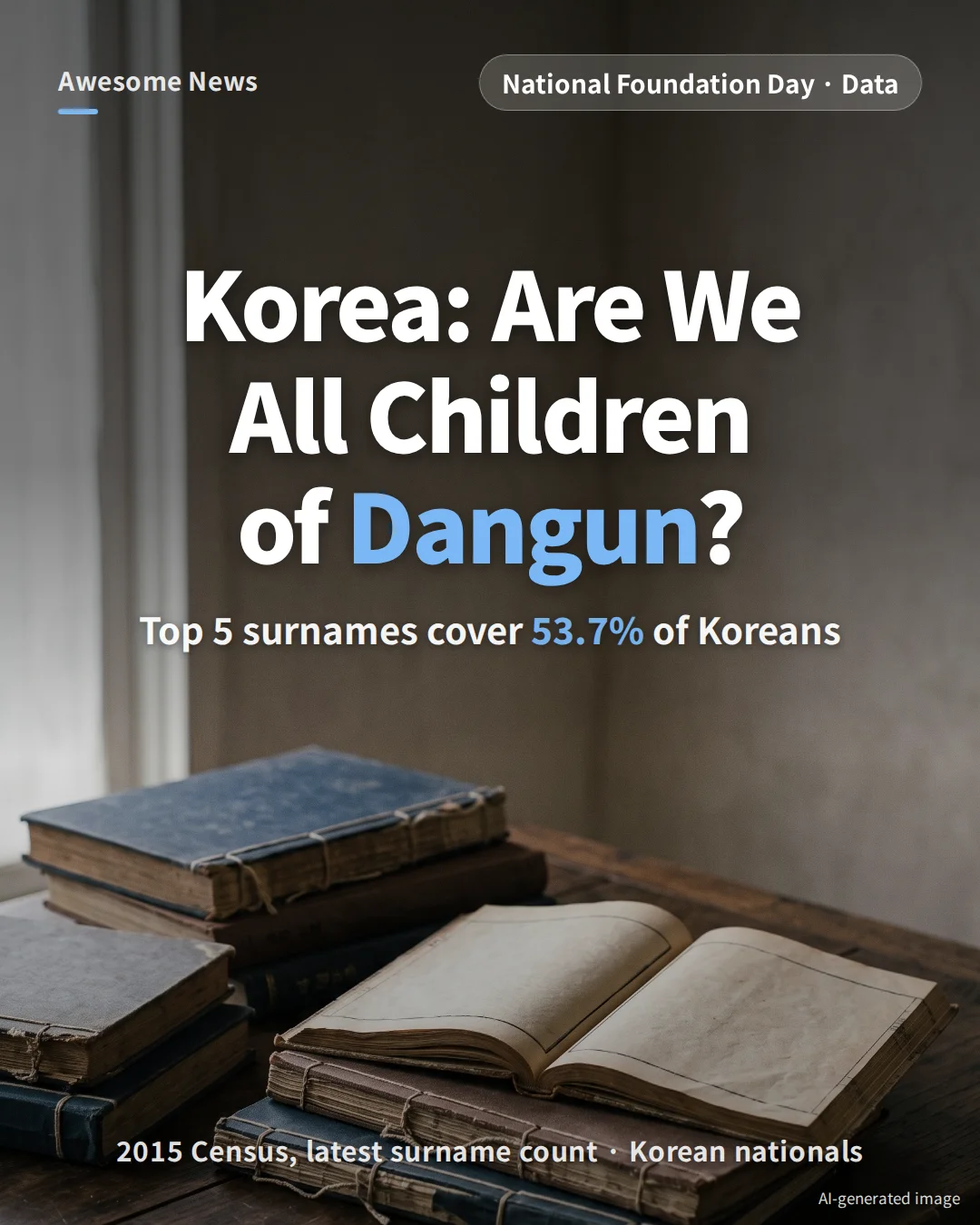
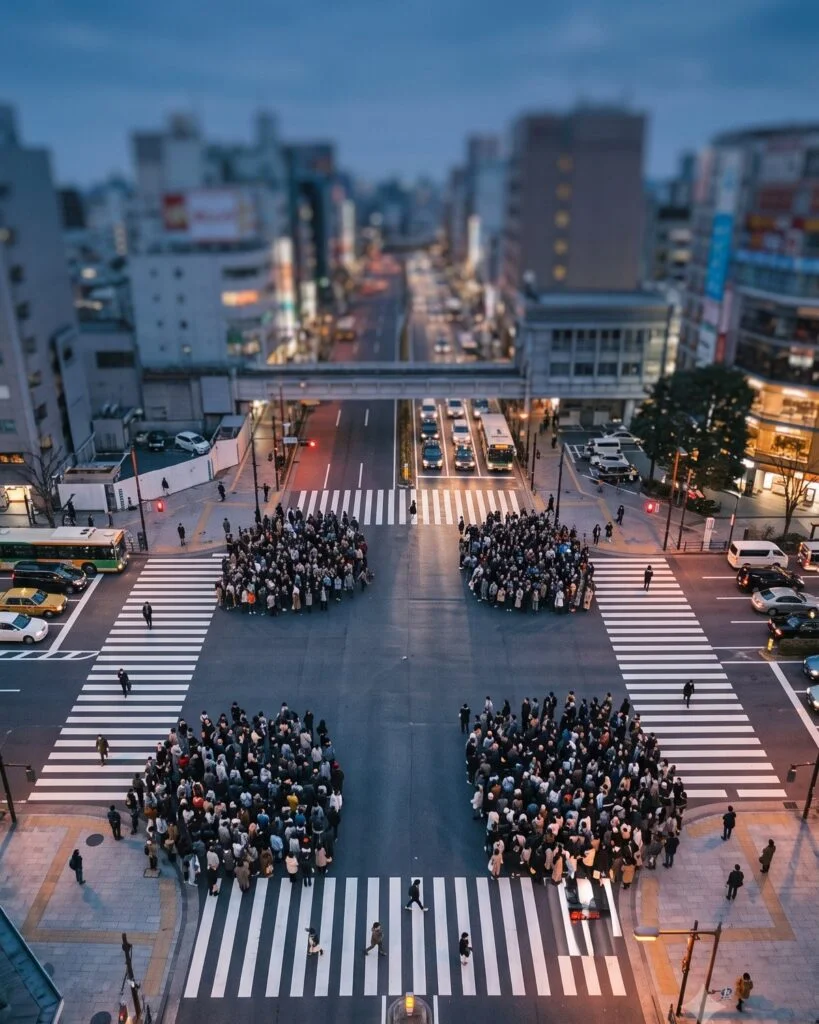
In South Korea, five family names — Kim, Lee, Park, Choi and Jung — cover 53.7% of the population. The country counts 5,582 surnames in total, but 5,050 of them share just 91,107 people between them. The Kim name alone splits into 1,010 clan origins. (October 3 is Gaecheonjeol, South Korea’s National Foundation Day, which marks the mythical founding of the first Korean kingdom by Dangun.)
The numbers below come from South Korea’s 2015 Population and Housing Census, still the most recent official surname count. The 2025 census, released on 28 July 2026, dropped the surname question; sample results are due in late November 2026.
Key numbers at a glance
- 5,582 surnames were recorded in 2015, but just five — Kim, Lee, Park, Choi, Jung — cover 53.7% of Koreans.
- 153 surnames with 1,000 or more people account for 99.8% of the population. The other 5,050 surnames together hold only 91,107 people.
- The Kim surname has 1,010 clan origins (bongwan, counted where at least 5 people share one). The largest, Gimhae Kim, is only 41.7% of all Kims.
- Every Korean gained a surname and a clan seat only after the 1909 civil-registration law. In the early Joseon era, roughly half the population were lower-caste and had no family name.
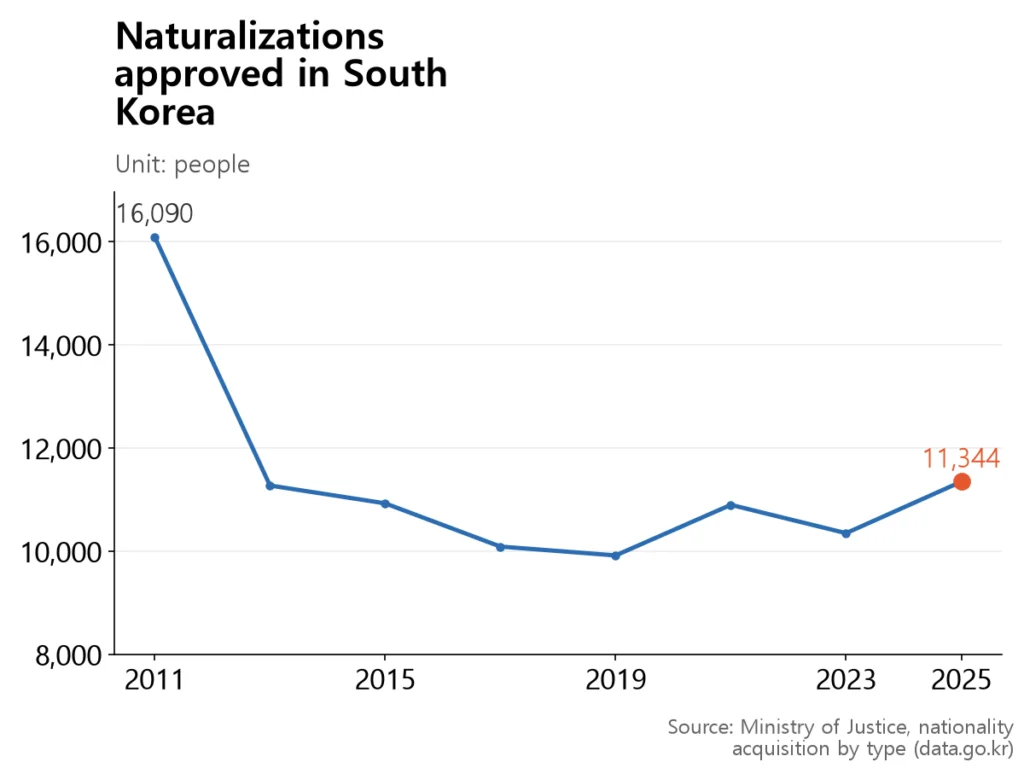
- Around 10,000 people a year still naturalize as Koreans (11,344 in 2025). Courts approved 6,342 new surname-and-clan creations in 2025.
Why surname data is rare
Statistics Korea has published surname and clan-seat (bongwan — the geographic origin a surname branches from) counts only three times, at 15-year intervals: 1985, 2000 and 2015. The 2025 register-based census does not include surnames. Most of the figures below therefore refer to 2015, based on 49.706 million Korean nationals rather than the total resident population.
Five surnames, half the country
In 2015, the Kim surname covered 10.69 million people (21.5%), followed by Lee (7.307 million, 14.7%), Park (4.192 million, 8.4%), Choi (2.334 million, 4.7%) and Jung (2.152 million, 4.3%). Together: 53.7% (calculated).
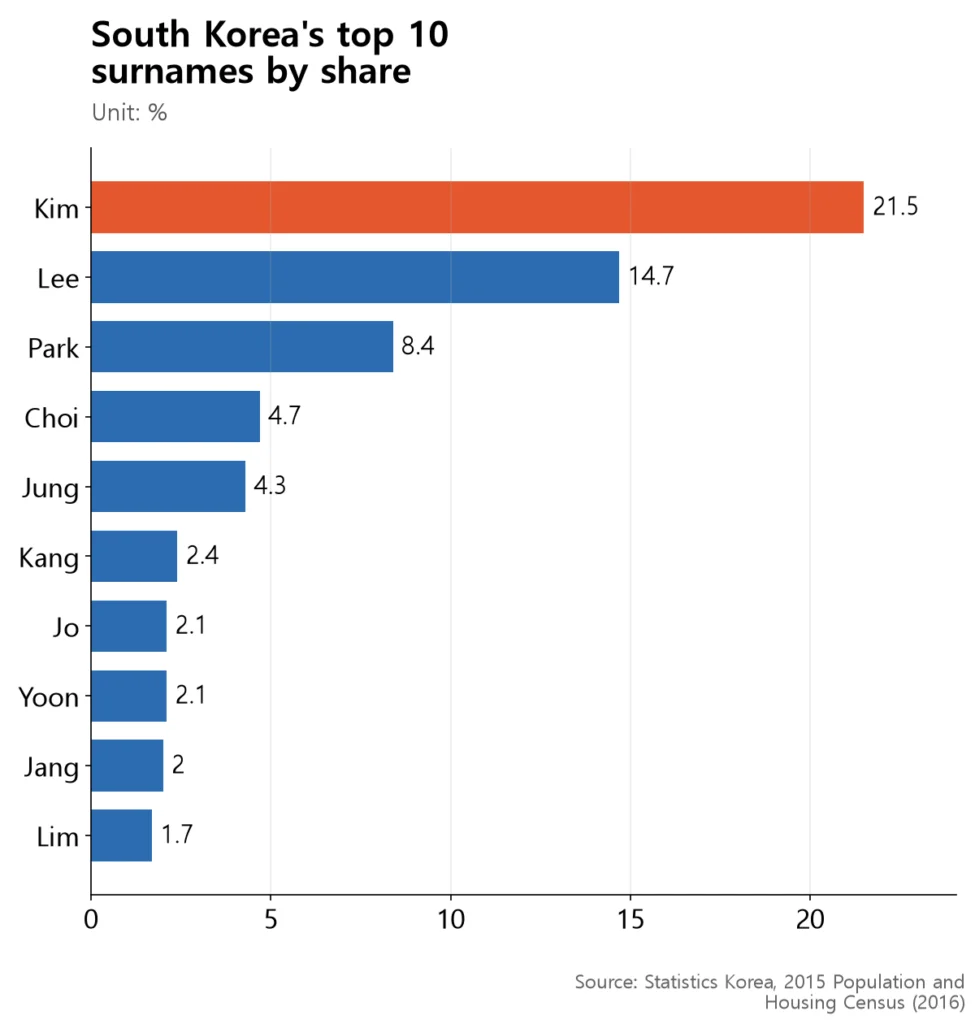
The concentration is not new. The share of the top five has barely moved in 30 years: 54.2% (1985) → 54.0% (2000) → 53.7% (2015), all calculated. Kim’s share went 21.74% → 21.6% → 21.5%. The ranking of the top 10 — Kim, Lee, Park, Choi, Jung, Kang, Jo, Yoon, Jang, Lim — was identical in all three censuses.
Compared with China
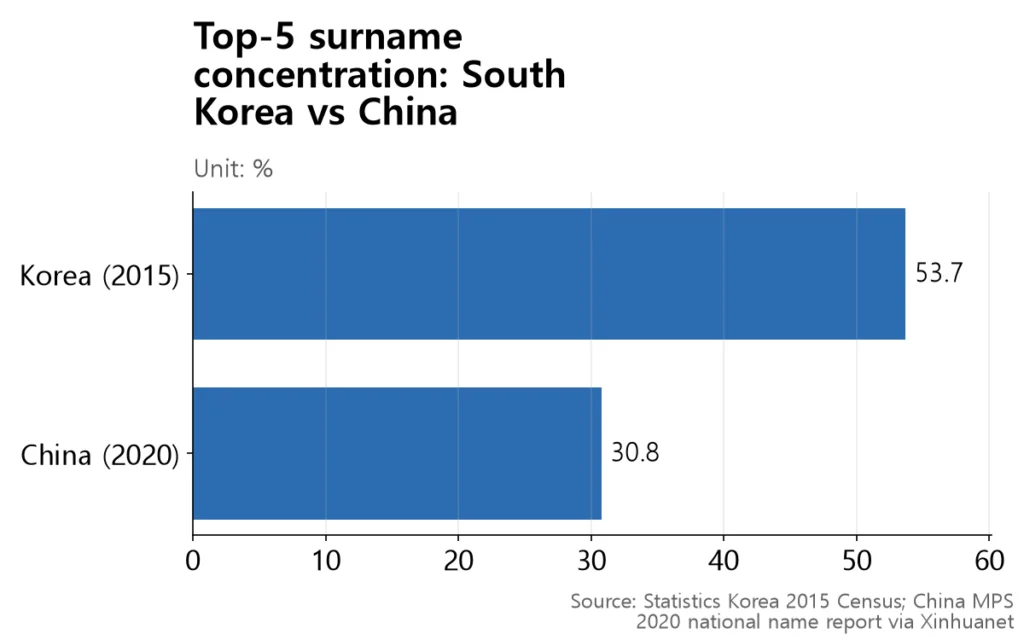
In China, the top five surnames — Wang, Li, Zhang, Liu and Chen — covered 30.8% of registered residents in 2020 (Ministry of Public Security’s national name report, as relayed by Xinhuanet). South Korea’s top-five share is more than 20 percentage points higher, despite a much smaller population.
5,050 surnames, 91,107 people
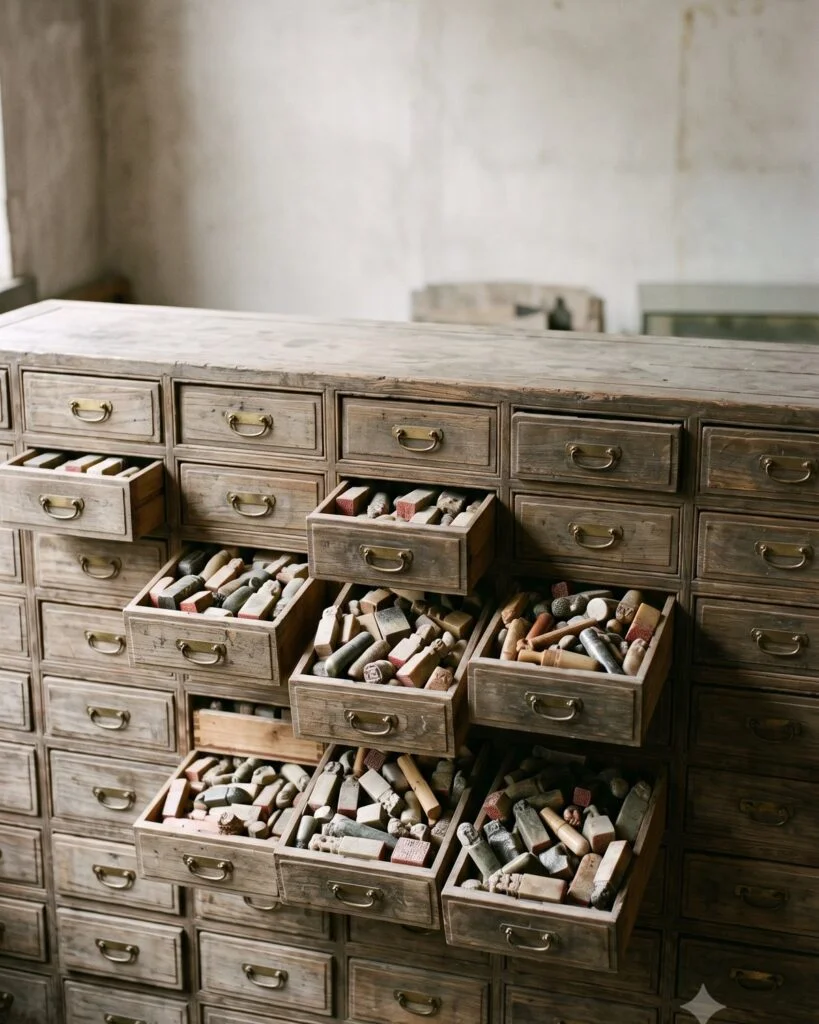
The 2015 count of 5,582 surnames includes 1,507 written in Chinese characters (hanja) and 4,075 written only in Hangul or the Roman alphabet. But just 153 surnames have 1,000 or more people, and together they account for 99.8% of Koreans.
KOSIS microdata (surnames with at least 5 people) sharpens the picture: 532 hanja-based surnames cover 99.82%, while the remaining 5,050 surnames together hold 91,107 people (0.18%).
| Group | Number of surnames | Share of population |
|---|---|---|
| Kim, Lee, Park, Choi, Jung | 5 | 53.7% |
| Next 148 surnames (1,000+ people) | 148 | 46.1% (calculated) |
| Remainder (mostly small or non-hanja) | 5,429 | about 0.2% |
Do not compare raw surname counts across census years. The 2000 total (286) and the 2015 total (5,582) differ 20-fold not because surnames exploded but because the methods changed. The 2000 count excluded naturalized citizens; the 2015 count used full administrative registers and included the 4,075 non-hanja surnames.
Same surname, different roots: 1,010 Kim clans
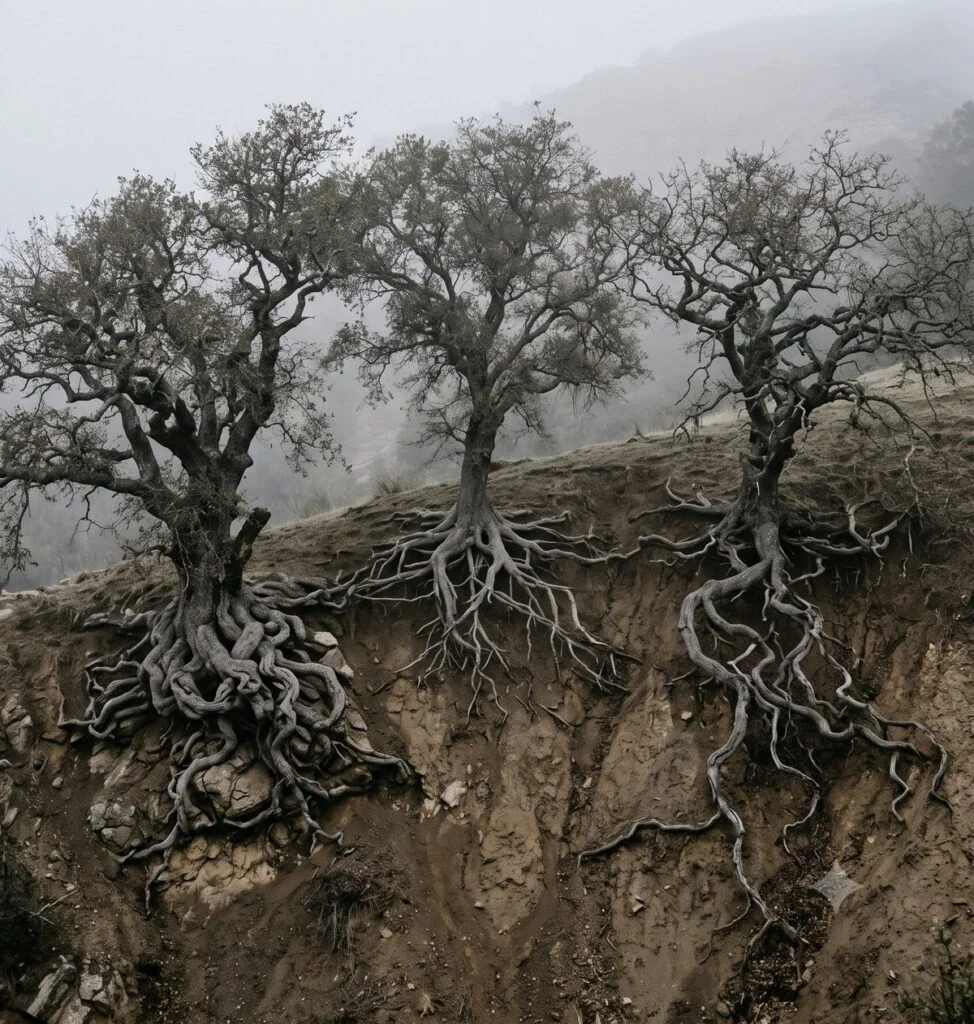
In Korea, two people with the same surname may be genealogically unrelated: identity is a combination of the surname and the bongwan, the ancestral clan seat. The Kim surname alone spans 1,010 bongwan (2015, counted where at least 5 people share each clan seat).
| Surname | Clan seats | Largest clan |
|---|---|---|
| Kim | 1,010 | Gimhae Kim — 4.457 million |
| Lee | 941 | Jeonju Lee — 2.632 million |
| Park | 488 | Miryang Park — 3.104 million |
| Choi | 431 | Gyeongju Choi — 945,000 |
| Jung | 350 | Dongnae Jung — 475,000 |
The single largest surname-clan combination is Gimhae Kim, with 4.457 million people — 9.0% of the population. Roughly one in eleven Koreans belongs to it. Yet even Gimhae Kim makes up only 41.7% (calculated) of all Kims; the rest are unrelated Kims from Gyeongju, Gwangsan and hundreds of other clan seats.
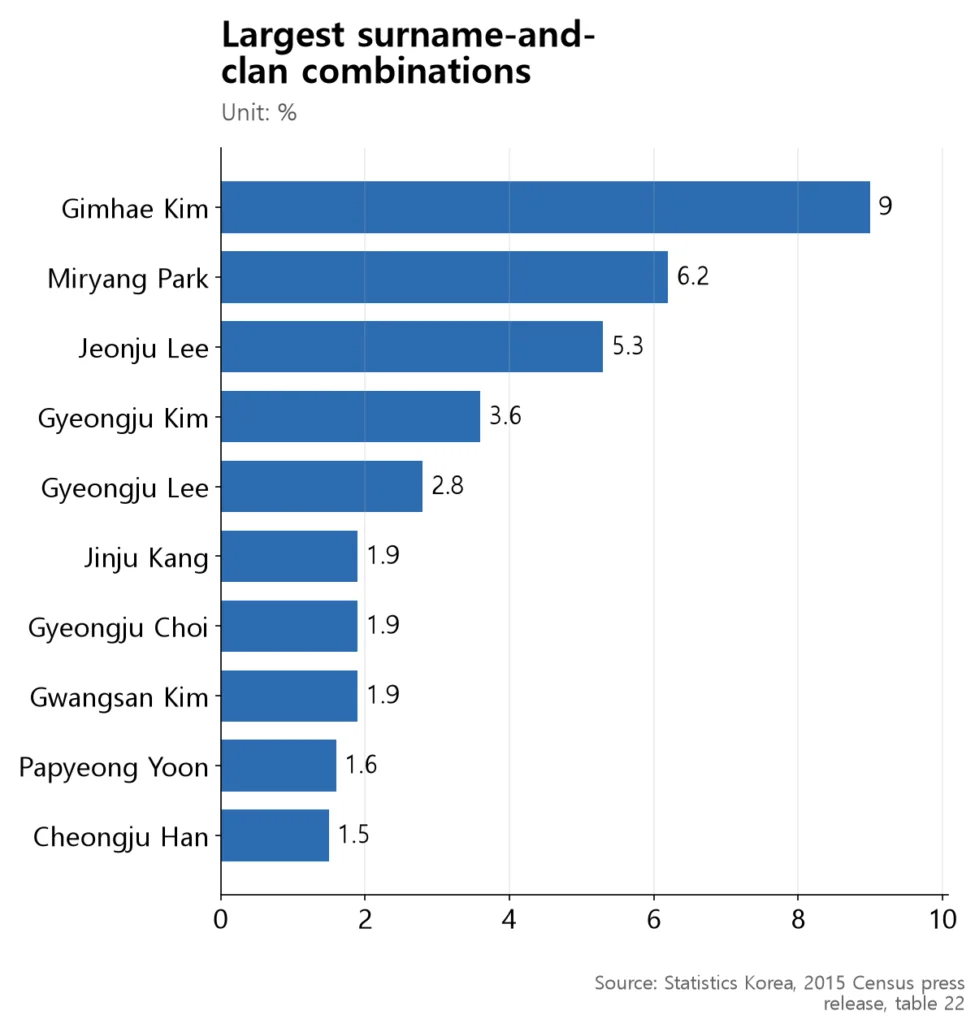
Treating each surname-clan pair as a unit, the number of distinct identities multiplies: 36,744 combinations across 7,543 place names in 2015. The top 20 combinations alone cover 46.4% of the country.
Half of Koreans once had no surname
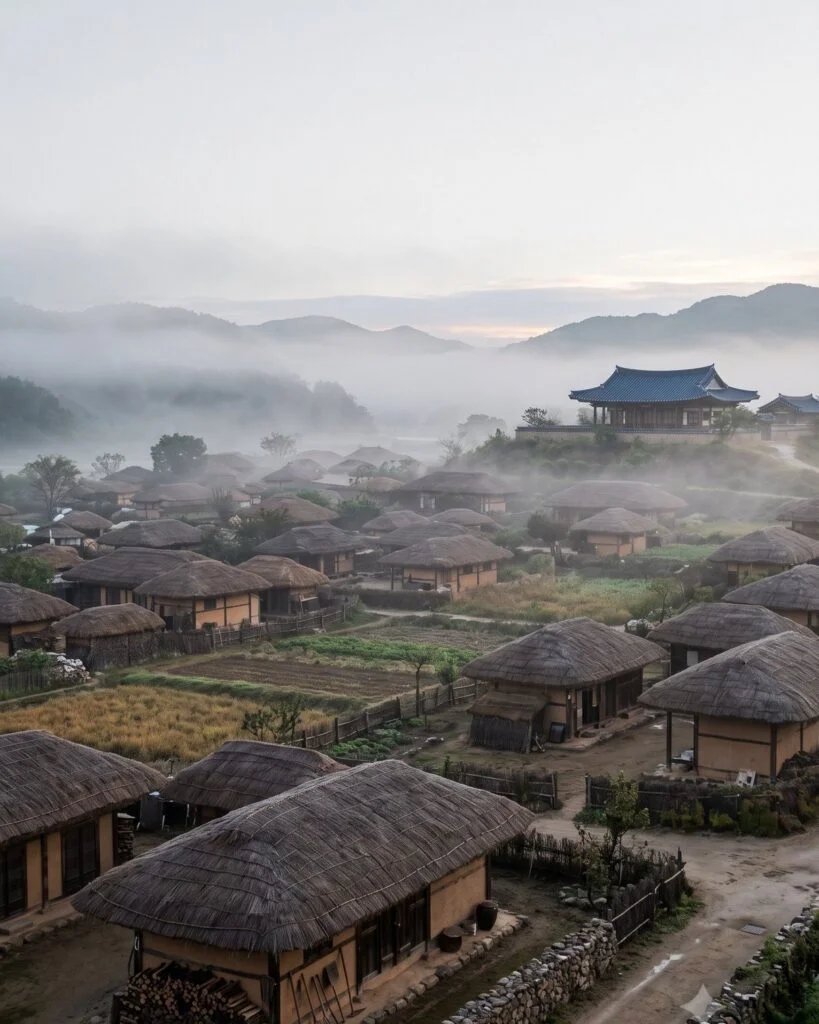
Today it is hard to picture a Korean without a surname, but history ran the other way. The *Encyclopedia of Korean Culture* entry on surnames estimates that in the early Joseon period (15th–16th centuries), lower-caste groups — chiefly slaves (nobi) — made up roughly half of the population, and most of them had no family name.
Surnames spread gradually over the next 300 years. The 1894 Gabo Reform abolished the caste system, and the 1909 Minjeokbeop (civil registration law) finally obliged every household to carry a surname and clan seat. Local clerks and police sometimes assigned names on the spot; former slaves often simply took their master’s.
Daegu household registers: a status inversion
A study of Daegu household registers summarized in *Sinpyeon Hanguksa* vol. 34 (National Institute of Korean History) traces the shift. Over 168 years, yangban (aristocratic) households rose from 9.2% to 70.3%, while slave households collapsed from 37.1% to 1.5%.
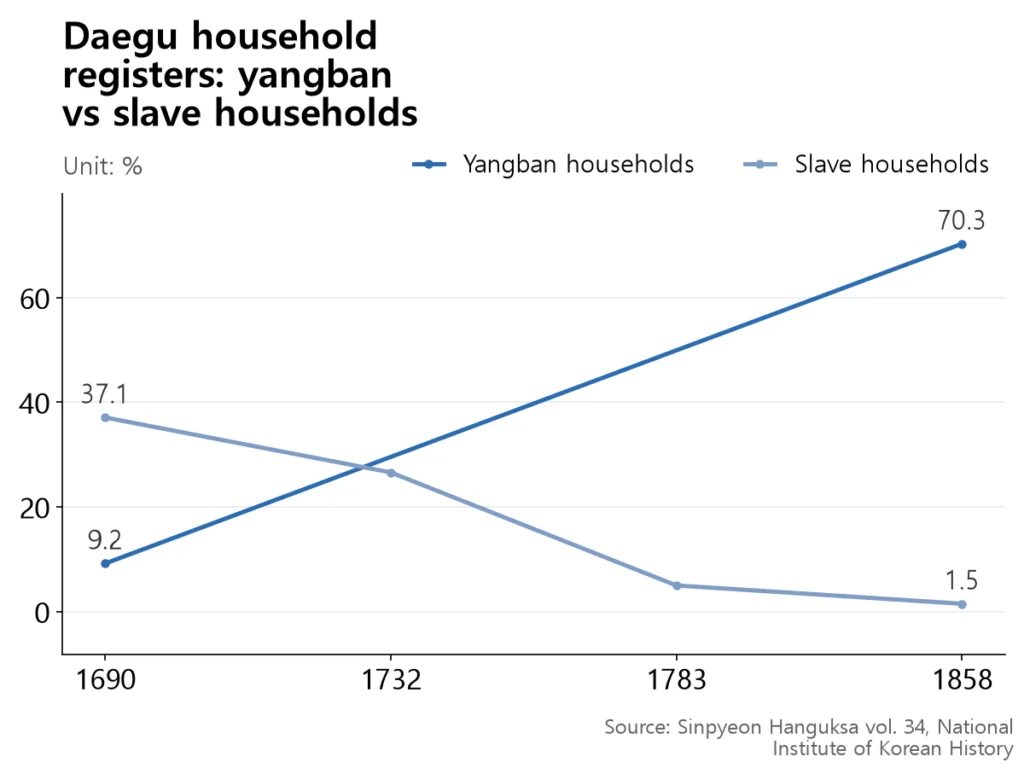
The jump is not a demographic fact so much as a documentary one. The same source estimates the real yangban share at around 23% in the early 19th century. Between 16% and 46% of registered households are thought to have been commoners falsely claiming scholar (*yuhak*) status — a practice called *mochingyuhak*. Forged genealogies were common too, which is why surviving family trees cannot be taken at face value.
New Koreans — and new surnames — still arrive
According to the Ministry of Justice, 169,529 people gained Korean citizenship between 2011 and 2025 (calculated) — around 10,000 a year. The 2025 figure was 11,344.
When a naturalized Korean adopts a Korean-style surname with a new clan seat, the court process is called changseong-changbon (literally ‘create surname, create clan’). The 2026 judicial yearbook records 6,342 approvals in 2025 (6,281 filed, 6,456 processed, 20 denied). This is how clan names like Thai Tae, Mongolian Kim, Daema (Tsushima) Yoon, and German Lee have entered the registry.
Approvals in a given year do not map one-to-one with naturalizations in the same year, but for 2025 the ratio is striking: new surnames (6,342) equal more than half of new citizens (11,344). Creating a family name is no longer an unusual event.
How to read these numbers
- Do not compare surname counts across census years. 275 (1985), 286 (2000) and 5,582 (2015) reflect different definitions.
- Kim’s 1,010 clan seats counts only clans with 5 or more members. Smaller or unclassified clans are tallied separately (about 76,000 people in total).
- The 2000 figures (286 surnames, 4.125 million Gimhae Kims, etc.) are drawn from a 2003 press report of Statistics Korea’s release; the original PDF was not available.
- China’s 30.8% is cited from a Xinhuanet republication, as the primary Ministry of Public Security page was inaccessible.
- ‘Children of Dangun’ is not a statistical claim that can be verified or refuted. This article’s point is only that surname and clan data show many roots, not one. Genetic studies are outside its scope.
- The 2007 UN CERD committee observations on Korea’s emphasis on ‘ethnic homogeneity’ (CERD/C/KOR/CO/14) are referenced through press reports only.
Summary — many roots, one country
The data tell two stories at once. One is extreme concentration: five surnames out of 5,582 cover more than half the country, and that share has not moved for 30 years.
The other is buried diversity. The Kim name alone has 1,010 unrelated roots. Half the early-Joseon population had no family name at all. Every year, roughly 10,000 people become Korean and about 6,000 new surname-clan pairs are created. The idea of a single bloodline leaves little room on the ledger.
National Foundation Day marks the beginning of a country, not a lineage. Read narrowly as ‘whose descendants we are,’ the statistics push back. Read broadly as ‘people who now share one place,’ the 5,582 surnames read like the country’s résumé.

Awesome News on Instagram @awesome_news_kr
This article is the research behind our Korean-language card news. Every morning we turn Korean data and official sources into short visual stories. See it on Instagram →
Sources
- Statistics Korea — 2015 Population and Housing Census — full tabulation press release (Korean) (2016-09-07)
- Statistics Korea KOSIS — KOSIS: Population by surname and clan seat (5+), nationwide 2015, DT_1IN15SD (Korean)
- Statistics Korea KOSIS — KOSIS: Households and population by region, surname and clan seat 1985, DT_1IN85SB (Korean)
- National Data Agency — 2025 Population and Housing Census (register-based) results (Korean) (2026-07-28)
- Maeil Shinmun — Report on surnames and clan seats, 2000 census (Korean) (2003-01-29)
- Kyunghyang Shinmun — Analysis of Korean surnames (Korean) (2004-02-15)
- Gyeongju City Genealogy Library — Surname and clan-seat statistics (Korean)
- Ministry of Justice via data.go.kr — Annual nationality acquisition by type, as of 2025-12-31 (Korean)
- National Court Administration — 2026 Judicial Yearbook (Korean)
- Seoul Economic Daily — Report on changseong-changbon (Korean) (2019-02-04)
- Academy of Korean Studies — Encyclopedia of Korean Culture — ‘Surnames’ (Korean)
- National Institute of Korean History — Woori History Net — Sinpyeon Hanguksa, vol. 34: Late Joseon society (Korean)
- National Institute of Korean History — Woori History Net — Sinpyeon Hanguksa, vol. 39 (Korean)
- Xinhuanet — 2020 National Name Report — top-5 surname shares (Chinese, via Xinhuanet, republished from MPS Household Registration Research Center) (2021-02-08)
- The Korea Times — Koreans Reassess Concept of Blood Purity (cites CERD 2007) (2007-09-02)
📊 Download the data
Every number in this article’s 7 charts and tables, in one CSV file (opens in Excel or Google Sheets). When you cite it, please name the original source and link to this page.
Download CSV