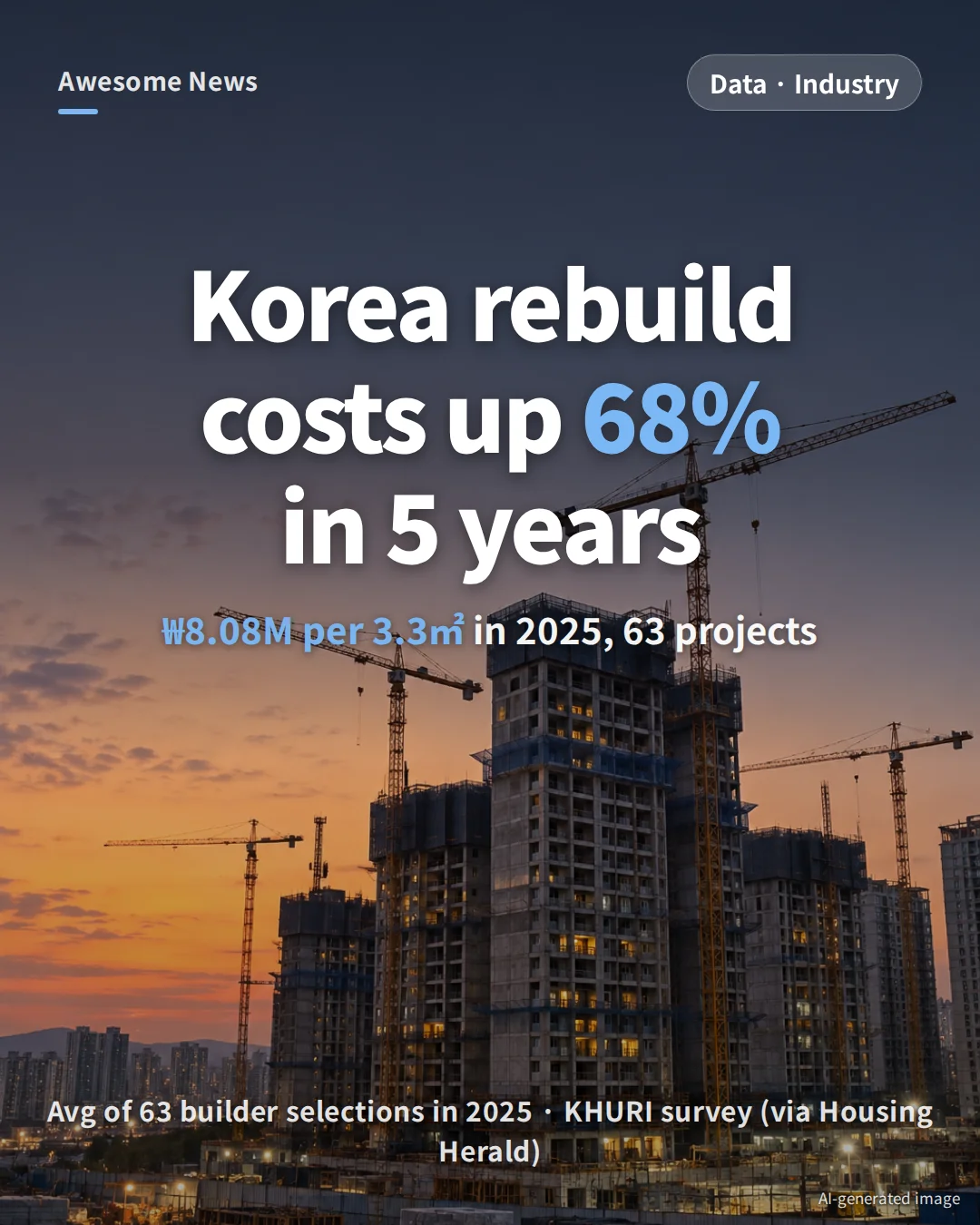
Prices for South Korea’s apartment redevelopment and reconstruction projects jumped 68% in five years. The average contract reached 8.08 million won per 3.3㎡ in 2025, up from 4.80 million won in 2020. Over the same stretch, the official index of building input costs — materials, wages, equipment — rose just 30%. Builder prices climbed more than twice as fast as their inputs.
(The 3.3㎡ unit, called *pyeong* in Korean, is the traditional measure used in Korean real estate and roughly equals the footprint of two single beds. Prices here are per *pyeong* of saleable floor area.)
Key numbers at a glance
- Average contractor price per 3.3㎡: 4.80M won (2020) → 8.08M won (2025), +68%
- Residential construction input index over the same years: +30%
- Seoul average: 8.90M won; Gangnam & Han River sites (12 projects): 9.76M won
- Reconstruction (8.69M) vs. redevelopment (7.79M) — a 900,000-won gap per 3.3㎡
- No-bid awards: 52% of projects in 2020 → 84% in 2025 (53 of 63)
From 4.8 to 8.1 million won per 3.3㎡
The figures come from an annual survey by the Korea Housing-environment Research Institute (KHURI), which compiles contract prices from projects that selected a builder each year. KHURI’s full report is not public; the numbers here are drawn from trade press coverage by *Housing Herald*. The method is a simple average of disclosed prices from bid notices, general-meeting documents and news reports — not an official government statistic.
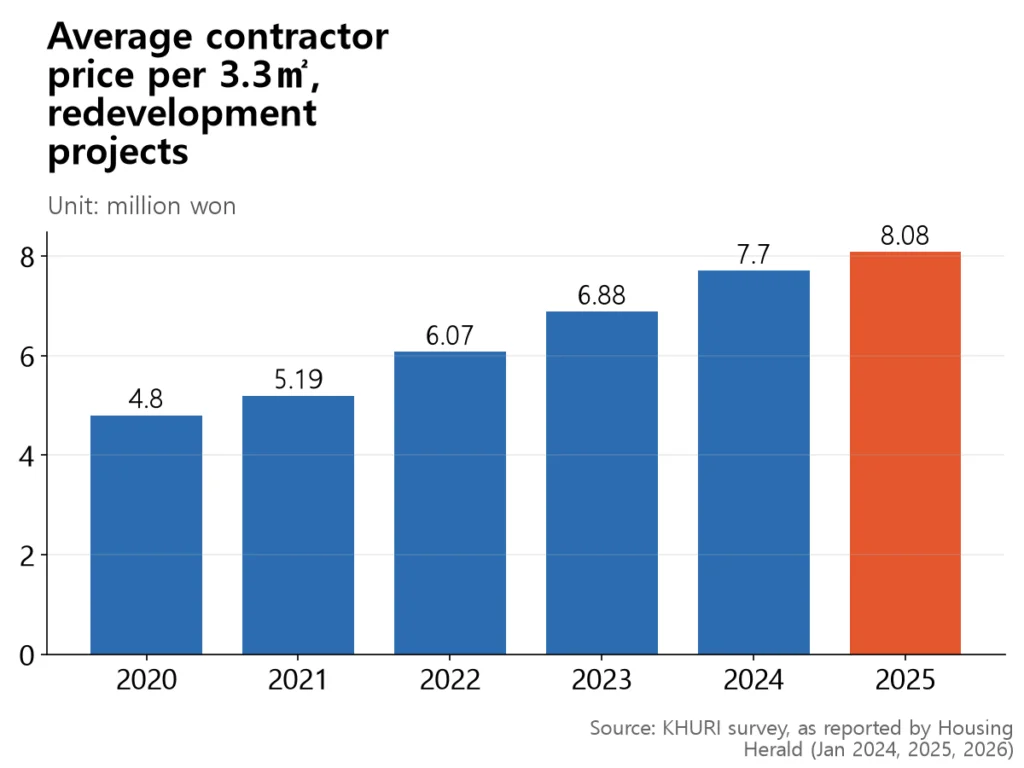
The biggest single-year jump was 2022 (+16.9%), when raw-material prices spiked. Double-digit increases continued through 2023 (+13.4%) and 2024 (+12.0%). The 2025 rise cooled to +4.9% — but prices are still going up even after input costs stopped surging.
Inputs up 30%, contracts up 68%
The Construction Cost Index, published by the Korea Institute of Civil Engineering and Building Technology (KICT), tracks the cost of cement, rebar, labour and other inputs. The residential sub-index rose from 100 in 2020 to 130.07 in 2025 — +30.1%. The overall index rose 31.4%. Rebased the same way, the KHURI average climbs to 168 — a 38-point gap between what builders charge and what their inputs cost.
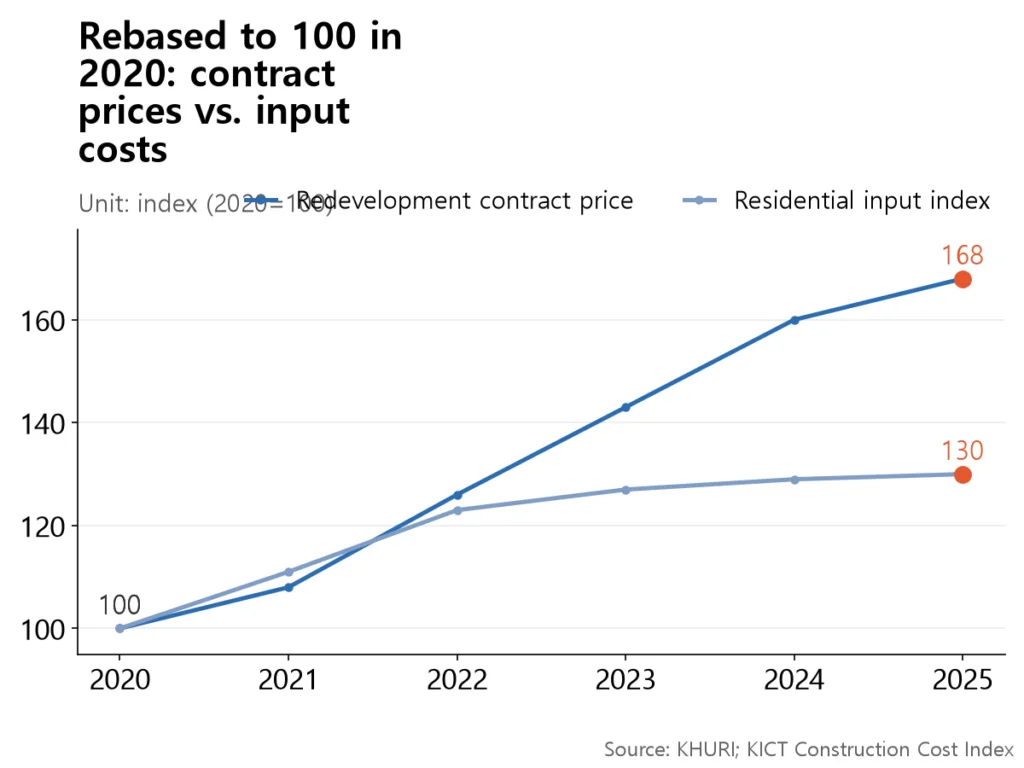
The two lines moved almost in step through 2022, then split in 2023. Input costs decelerated sharply (+3.3% that year, then +1.7% and +1.0%); contract prices kept rising at double-digit rates. Industry explanations include fancier finishes and community amenities, mid-project design changes, and the shift away from competitive bidding described below. A caveat: KHURI’s sample changes each year, so a few ultra-expensive Gangnam towers can pull the average up on their own — not all of the gap is ‘froth’.
Gangnam and the Han River: 9.76M won per 3.3㎡
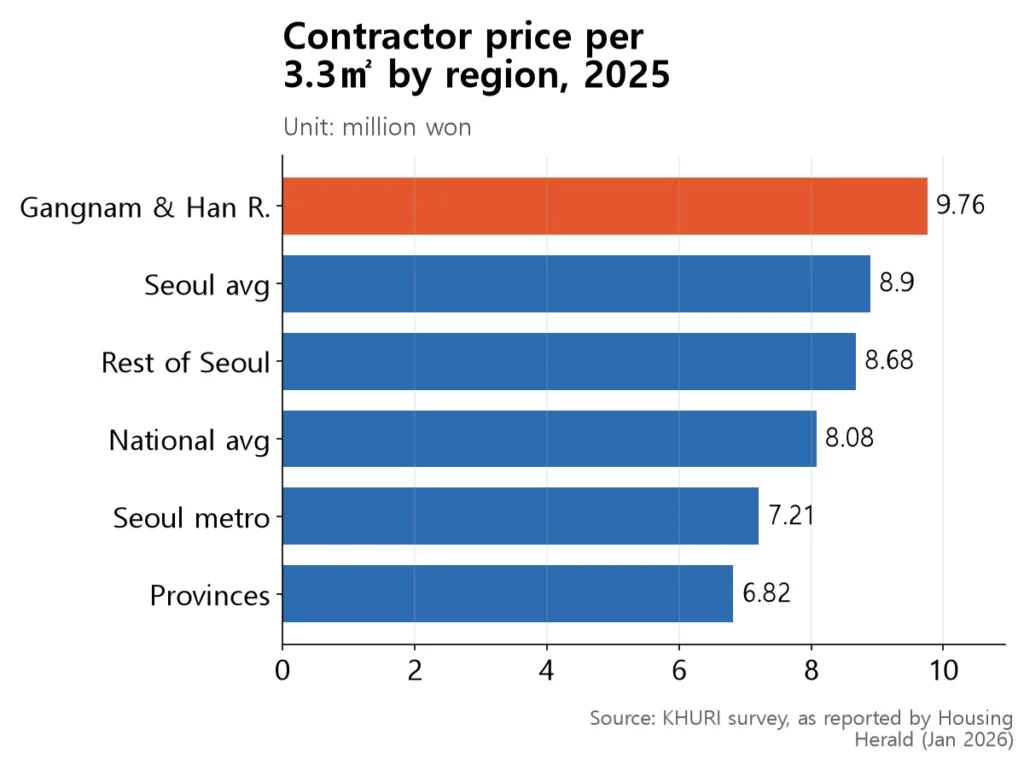
Among the 63 projects that selected builders in 2025, regional gaps are sharp. Seoul averaged 8.90M won per 3.3㎡; the 12 projects in Gangnam and along the Han River averaged 9.76M. The other 13 Seoul sites came in at 8.68M, the wider Seoul metropolitan area at 7.21M, and the rest of the country at 6.82M. The Seoul-vs.-provinces gap is 2.08M won per 3.3㎡; between Gangnam/riverside and the provinces it widens to 2.94M won (calculated).
By type, reconstruction (tearing down and rebuilding old apartment blocks) averaged 8.69M won per 3.3㎡; redevelopment (clearing older low-rise districts) came in at 7.79M — a 900,000-won gap. Reconstruction usually carries higher demolition and underground-structure costs. But in the provinces the order flips (redevelopment 6.85M vs. reconstruction 6.71M), which suggests location matters more than project type. The most expensive single site in Seoul was the Gangnam Wonhyoseong villa redevelopment at 15.50M won per 3.3㎡; the cheapest was Mia 9-2 at 7.20M.
| Segment | Price per 3.3㎡ (million won) |
|---|---|
| Gangnam & Han River (12 sites) | 9.76 |
| Seoul average (25 sites) | 8.90 |
| Rest of Seoul (13 sites) | 8.68 |
| National average (63 sites) | 8.08 |
| Seoul metropolitan area | 7.21 |
| Provinces | 6.82 |
| Reconstruction (18 sites) | 8.69 |
| Redevelopment (27 sites) | 7.79 |
Competitive bidding has nearly vanished

By law, redevelopment associations are supposed to pick a builder through competitive bidding — multiple construction firms submitting rival offers. In 2025, 53 of the 63 projects (84%) instead went to a single builder with no competitor, through what Korean practice calls a no-bid (수의계약) award. In 2020 the share was 52%.
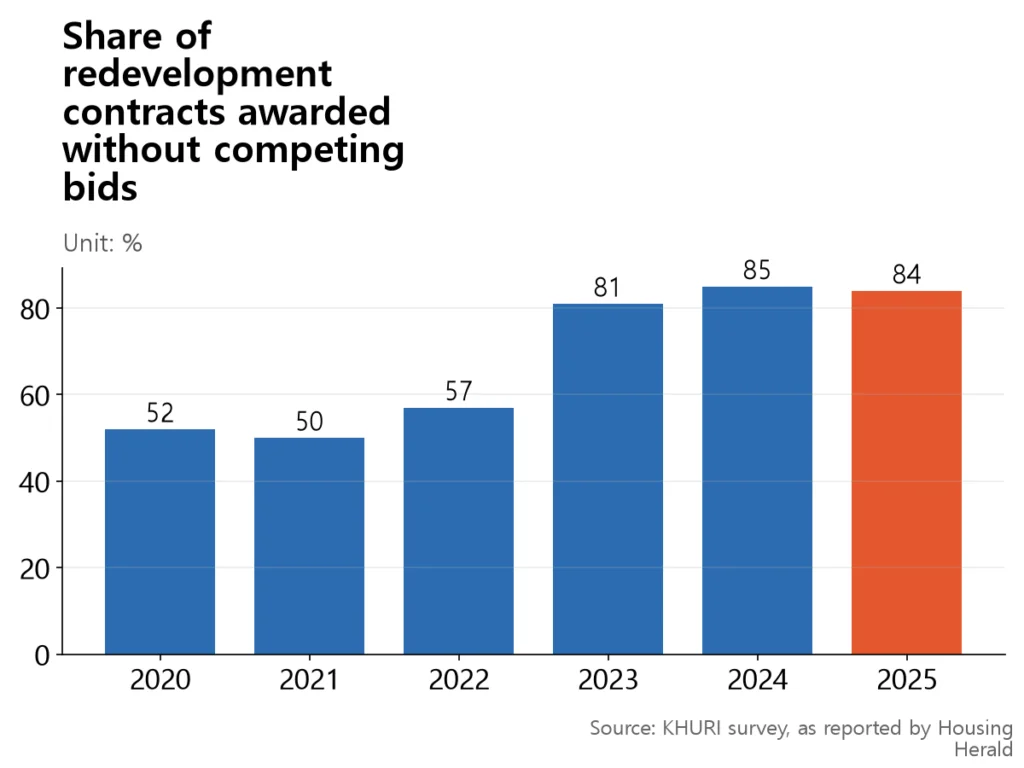
The biggest jump — again — came in 2023, the same year contract prices and input costs started to diverge. With no rival bidder in the room, associations have less leverage on price. Builders blame onerous conditions set by associations, which they say cause competitive tenders to fail; associations blame rising materials and labour costs and longer construction schedules. The trade outlet *Youth Daily* reported that in Seoul, competitive bidding fell from 50% of redevelopment contracts to 16% over five years.
How to read these numbers
The KHURI average is not an official statistic. It is a simple average of disclosed contract prices from projects that selected a builder in a given year, drawn from association documents and press reports. A few Gangnam ultra-high-rises or remodelling projects can swing it noticeably — in 2023, Yeouido Gongjak Apartments alone (10.70M won per 3.3㎡) made trust-managed projects look more expensive on average than association-managed ones.
A second caveat: the year-by-year table in *Housing Herald*’s January 2026 article is shifted by one year against its own January 2024 and 2025 reports. Cross-checking with the earlier reports, 4.80M won is the 2020 figure, not 2021. The series and the ‘+68% over five years’ calculation here use the earlier reports as the baseline (2020–2025). Because the underlying KHURI report is not public, we can’t confirm whether the slip is in the article or the report itself.
Finally, the Ministry of Land’s Basic Building Cost (used in Korea’s price-cap system for new-apartment sales) was updated in September 2026 to 2.328 million won per m². It uses a different floor-area definition (gross above-ground floor area, not saleable) and so should not be compared directly with the per-3.3㎡ redevelopment contract averages above.
Summary
Over five years, South Korea’s redevelopment contract prices rose more than twice as fast as the inputs that go into them, while the number of projects with any competing bid at all collapsed to fewer than two in ten. Whatever is driving the gap — finishes, design changes, or the shift in the bargaining table — will show up in the special assessments paid by apartment owners who redevelop and in the sticker price of the new flats that come out the other side. Input costs have cooled. Contract prices have not.

Awesome News on Instagram @awesome_news_kr
This article is the research behind our Korean-language card news. Every morning we turn Korean data and official sources into short visual stories. See it on Instagram →
Sources
- Housing Herald — 2025 redevelopment contract prices average 8.08M won per 3.3㎡ — up 68% in five years (Korean) (2026-01-15)
- Housing Herald — Redevelopment and reconstruction contracts average 7.70M won per 3.3㎡; Seoul at 8.42M, a record (Korean) (2025-01-20)
- Housing Herald — Last year’s redevelopment contract prices rose 13.4%; Seoul at 7.54M won per 3.3㎡ (Korean) (2024-01-17)
- Korea Institute of Civil Engineering and Building Technology, Cost Research Center — Construction Cost Index, July 2026 (2020=100) (Korean) (2026-07)
- Housing Times — Ministry of Land updates Basic Building Cost for price-cap sales — up 4.07% (Korean) (2026-09-22)
- Youth Daily — Seoul’s redevelopment moves to no-bid awards: competitive bidding falls from 50% to 16% in five years (Korean)
📊 Download the data
Every number in this article’s 5 charts and tables, in one CSV file (opens in Excel or Google Sheets). When you cite it, please name the original source and link to this page.
Download CSV