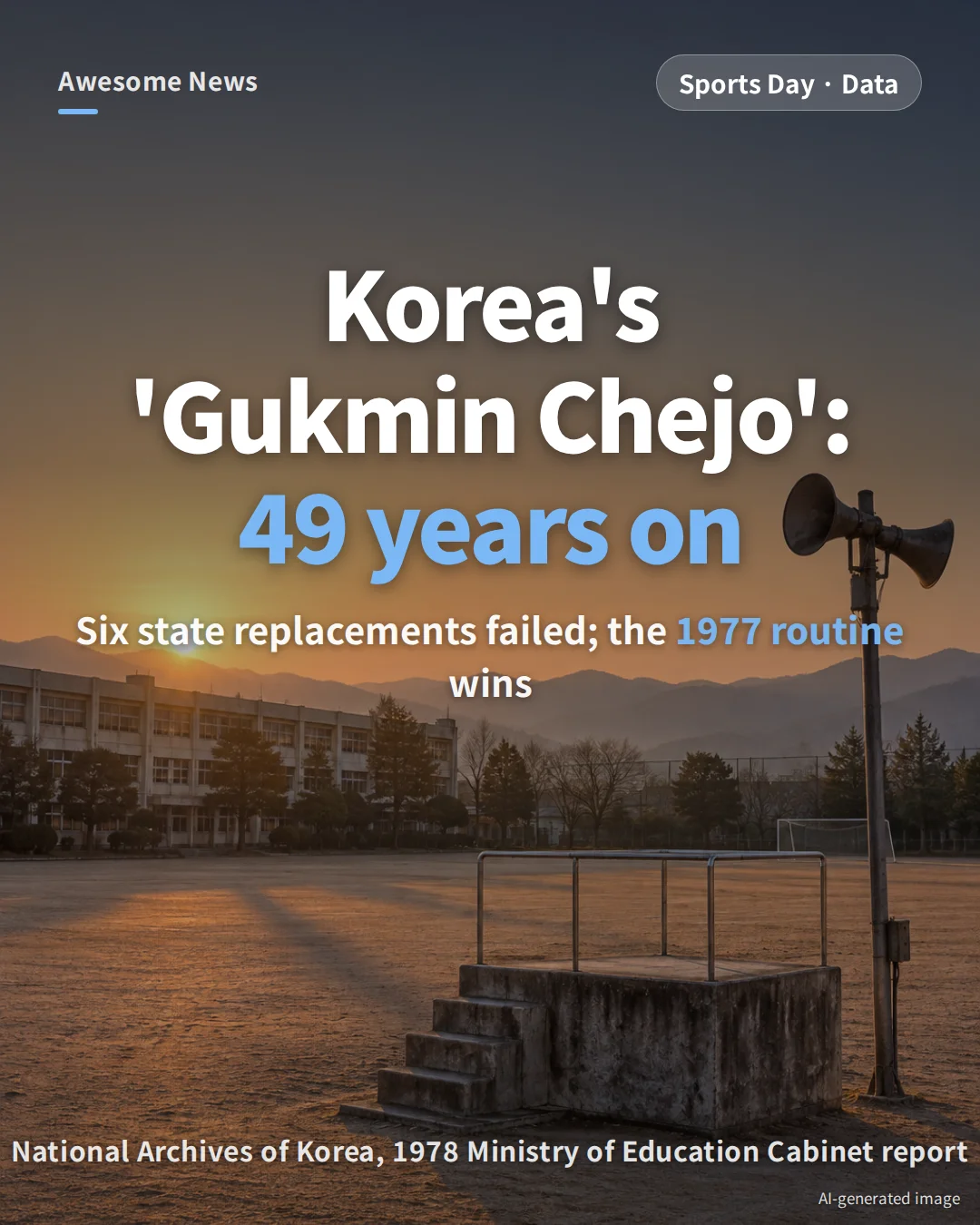
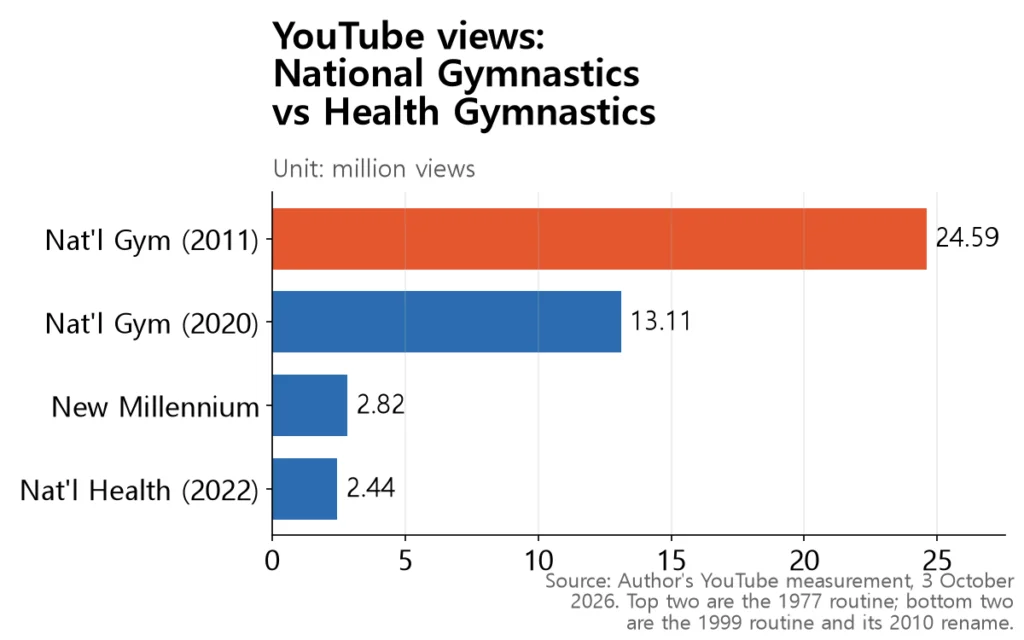
“Gukmin Chejo si~jak!” — “National Gymnastics, begin!” The command Koreans grew up with is now 49 years old, and still the one in use. The routine was written by the Korea Sports Council on 7 March 1977 and rolled out nationwide after the Ministry of Education reported it to the Cabinet in February–March 1978. Six later government routines, from 1982 to 2015, failed to replace it. This piece traces four things from primary records at the National Archives of Korea: the earlier 1961 routine that first bore the name, the 12 moves and music of the 1977 version, the six failed replacements, and why — with no school mandate left — a single YouTube upload has 24.59 million views as of 3 October 2026.
Key numbers at a glance
- The routine Koreans know was set by the Korea Sports Council on 7 March 1977 and pushed out nationwide by the Ministry of Education in 1978 — 12 moves, 4 minutes 30 seconds.
- The name ‘Gukmin Chejo’ (National Gymnastics) first appeared in 1961, for a different 9-move routine for young adults. The Ministry had no budget to distribute it, handed it to the Reconstruction National Movement HQ, and the name became ‘Reconstruction Gymnastics’.
- The music was composed by Kim Hui-jo, a former Army band leader who also wrote the song ‘Jal Saraboseh’. The spoken cadence was recorded by Prof. Yoo Keun-rim of Kyung Hee University, who died in March 2025 at 93.
- The 1978 Ministry report lists one aim as building bodies and minds “as foot soldiers advancing the Saemaul (New Village) Movement“.
- Governments launched six replacement routines from 1982 (Deongdeokkung) to 2015 (Neulpum). None stuck. A 1977-version upload on YouTube had 24.59 million views on 3 October 2026.
The name came first — in 1961

A Ministry of Education file dated 12 July 1961, held at the National Archives, shows a 9-move routine for young adults originally called ‘National Gymnastics’ was issued that year. Two weeks later the Ministry handed distribution to the Reconstruction National Movement HQ. The reason in the document is blunt: the Ministry had no budget. In the handover the name became ‘Reconstruction Gymnastics (young adult version)’.
The routine Koreans actually remember arrived 16 years later. In January 1977 the Korea Sports Council convened an 18-member review committee and set the routine on 7 March 1977. A 5-minute, 16-mm instructional film followed in May. The nationwide government rollout came the next year, when the Ministry of Education reported the plan to the Cabinet in February–March 1978. That is why both ‘1977’ and ‘1978’ turn up as the official year.
| Year | Name | Moves | Note |
|---|---|---|---|
| 1953 | National Health Gymnastics | n/a | Broadcast daily by radio cadence |
| 1961 | ‘National Gymnastics’ → Reconstruction Gymnastics | 9 | First use of the name ‘Gukmin Chejo’ |
| 1977 | National Gymnastics | 12 | The routine Koreans know today |
| 1999 | New Millennium Health Gymnastics | 18 | Blends gugak, taekwondo and mask-dance moves |
| 2010 | National Health Gymnastics | 18 | The 1999 routine, renamed |
The 1977 routine: 12 moves, 4 minutes 30 seconds
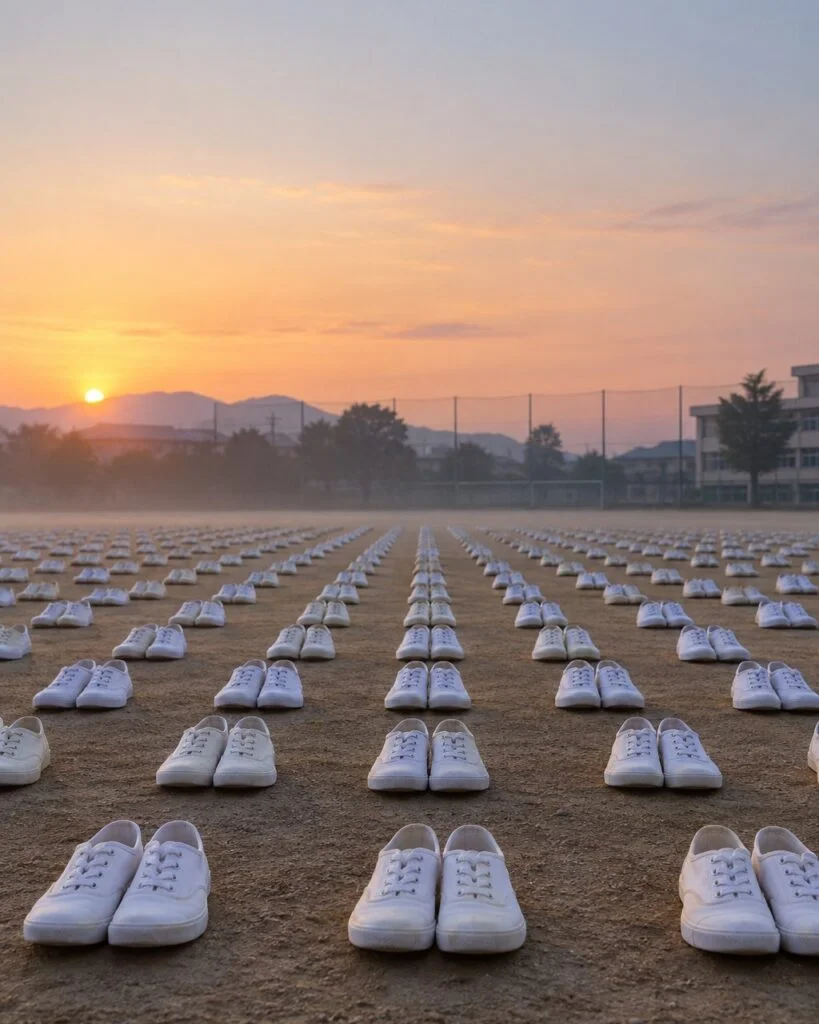
On 25 February 1978 the Education Minister wrote to the General Affairs Office saying he would present the “National Gymnastics distribution plan” to the Cabinet. The reach was wide: warm-ups at any sports event, every school, government agency, company, local government and every outdoor village gathering. The Korea Sports Council ran province-by-province training (one PE teacher each from elementary, middle and high school per city or county), while the Ministry of Culture and Information handled press coverage.
The routine opens with a breathing move and ends with a breathing-down move. There are 12 moves, 16 counts each, and the whole thing runs 4 minutes 30 seconds. The document notes that on the second repetition, the sequence loops from move 10 (jumps) back to move 1 (breathing).
| # | Move | # | Move |
|---|---|---|---|
| 1 | Breathing | 7 | Back and belly |
| 2 | Legs (knee bends) | 8 | Trunk twist |
| 3 | Arms | 9 | Whole body (rowing) |
| 4 | Neck | 10 | Legs (jumps) |
| 5 | Chest | 11 | Arms and legs |
| 6 | Side bends | 12 | Breathing down |
The report also states, in plain language, why the state wrote the routine:
This routine was established to raise the physical standard of the people and foster a cheerful and sound social spirit, so as to build the bodies and minds of foot soldiers advancing the Saemaul (New Village) Movement, and to make exercise part of daily life.
Ministry of Education, ‘National Gymnastics distribution’ (1978), National Archives of Korea (Korean, our translation)
The music and the voice — Kim Hui-jo and Yoo Keun-rim
The 1978 report says only one line about music: it was “commissioned from composer Kim Hui-jo.” Kim Hui-jo (1920–2001) was a former Army band leader and the composer of the song ‘Jal Saraboseh’. Among the routine’s features, the report lists “bright and cheerful music” and “the lively, forward-looking spirit of the people.”
The famous cadence — “Gukmin Chejo-o~ si~jak!” — was recorded by Prof. Yoo Keun-rim of Kyung Hee University. In later interviews he said he directed about 20 gymnasts moving in time with the orchestra and called the cadence himself; he spoke that way only for the recording and took no fee. Yoo died on 11 March 2025 at the age of 93 (Yonhap).
| Role | Who | Note |
|---|---|---|
| Composer | Kim Hui-jo | Wrote ‘Jal Saraboseh’; former Army band leader |
| Cadence | Yoo Keun-rim | Kyung Hee University professor; died March 2025 (93); took no fee |
Six replacements, zero winners
Once the 1977 routine was embedded, the state kept trying new ones: Deongdeokkung (1982), Youth Gymnastics (1987), Healthy-Life Gymnastics (1991), New Millennium Health Gymnastics (1999), Korea Gymnastics (2014) and Neulpum Gymnastics (2015) — six attempts in all. None displaced “Gukmin Chejo si~jak!”
| Year | New routine | Outcome |
|---|---|---|
| 1982 | Deongdeokkung Gymnastics | Failed to catch on |
| 1987 | Youth Gymnastics | Failed to catch on |
| 1991 | Healthy-Life Gymnastics | Failed to catch on |
| 1999 | New Millennium Health Gymnastics | Renamed ‘National Health Gymnastics’ in 2010, then shelved |
| 2014 | Korea Gymnastics | Not adopted (built by Korea Institute of Sport Science; budget 200 million won) |
| 2015 | Neulpum Gymnastics | 350 million won promotion budget; sunk by the 2016 influence-peddling scandal |
The most serious attempt was the New Millennium Health Gymnastics, released in October 1999. Built jointly by the Korea Sports Promotion Foundation’s research arm and public broadcaster KBS, it had 18 moves running about 6 minutes. The music used traditional work-song rhythms, and the moves mixed taekwondo strikes (fist punch, kick, diamond block, knife-hand strike) with mask-dance steps. The National Archives notes the explicit intention: to break away from the earlier routine, which the designers saw as “a reflection of totalitarian military culture” and a “regimented, mobilisation-style” exercise. It went the opposite direction — and lost. After the 2010 rename, the Foundation effectively stopped promoting it.
A 2016 AsiaE article summed up the situation this way: “In schools and government offices, only the 30-year-old National Gymnastics is still used, and only barely.”
Nobody is told to do it. YouTube says 24.6 million views.

Schools no longer require any mandated routine. The Ministry of Education’s ‘2024 School Sports Promotion Basic Plan’ does not mention either National Gymnastics or National Health Gymnastics even once. The Korea Sports Promotion Foundation’s distribution programme has ended; what remains on its website is National Health Gymnastics videos, audio files and posters.
People still remember it. Measured on 3 October 2026, the 1977 routine dwarfs its 1999 successor on YouTube.
On the ground, the routine also persists. A National Archives commentary says the Army’s bare-hand calisthenics are “nearly identical” in moves and sequence to National Gymnastics. Press reports add more: in 2016 the Seoul Government Complex played the music every morning (AsiaE); Incheon’s education office had run the routine daily since June 2009 (Kiho Ilbo, 2014); and Cheongju’s Seowon-gu district office ran it for 10 minutes from 8:40 a.m. (Chungcheong Times). In 2024, a news report carried an office worker’s post saying the whole staff does National Gymnastics 10 minutes before work.
1977 vs 1999 — how the moves differ
Side by side, the two point in opposite directions. The 1977 routine is bare-hand calisthenics with each move named for a body part — breathing, legs, arms, neck, chest. The 1999 routine includes taekwondo move names (diamond block, fist punch, kick, knife-hand strike) and steps drawn from mask dance, and runs about a minute and a half longer (calculated).
| 1977 National Gymnastics | 1999 New Millennium Health Gymnastics | |
|---|---|---|
| Moves | 12 (+ warm-up) | 18 |
| Length | 4 min 30 sec | ~6 min |
| Developed by | Korea Sports Council → Ministry of Education | Korea Sports Promotion Foundation · KBS |
| Music | Composed by Kim Hui-jo (commissioned by the Ministry) | Arranged from traditional work songs |
| Movement style | Body-part calisthenics | Taekwondo, mask-dance, gugak motifs |
A note on 15 October — now ‘Sports Day’, not ‘Physical Education Day’
One date is worth flagging alongside this story. South Korea’s annual commemorative day on 15 October (not a public holiday) has been officially called ‘Sports Day’ since the 10 July 2023 revision of the Commemorative Days Decree — the old name was ‘Physical Education Day’. The legal basis moved from Article 7 of the National Sports Promotion Act to Article 27 of the Sports Framework Act, in force since 11 February 2022. That revision was also the first time the date ’15 October’ was written into primary legislation; before 2022, the date lived only in Article 14 of the 1963 enforcement decree (Cabinet Order No. 1233), dated 18 March 1963.
Why 15 October? No official document explains it. The common story — that it marks the opening of the National Sports Festival — does not match the records. In 1962, the year the law was enacted, the festival opened on 24 October. The festival actually opened on 15 October in only two years, 1949 and 1955, and we found no primary source citing either as the reason. The ‘festival-opening-day’ explanation is popular but unsourced.
How to read these numbers
- ‘1977 release’ vs ‘1978 release’: the Korea Sports Council set the routine on 7 March 1977; the Cabinet-level national rollout was in February–March 1978. Both dates are correct, in different senses.
- The ’10-move Reconstruction Gymnastics’ of 1961 is unverified: a National Archives commentary gives 10 moves, but the 1961 Ministry file the Archives actually holds shows 9. We could not find source paper for the number 10.
- Credits for the 1999 routine: the developer and composer names appear only in press and encyclopedia entries. The Korea Sports Promotion Foundation’s own poster and guide do not list them.
- Army calisthenics vs National Gymnastics: the National Archives only says the moves and sequence are “nearly identical.” Which came from which, and the Army routine’s exact year of adoption, could not be confirmed from primary sources.
- Link to Japan’s radio calisthenics: the 1953 ‘National Health Gymnastics’ is described as “similar in method,” but we found no primary source showing the 1977 routine’s moves were taken from Japanese radio calisthenics.
- Deongdeokkung, Youth, Healthy-Life, Neulpum details: organising bodies and move counts rely on AsiaE (2016) and Kyunghyang Shinmun (2015); we could not find public primary records.
- ‘Ministry of Education banned National Gymnastics in the late 1990s’: that line appears only in a 2014 Kiho Ilbo article; no Ministry memo has been made public.
Summary
National Gymnastics is the routine that outlived the state’s interest in it. The 12-move, 4-minute-30-second version written in 1977 and distributed in 1978 survived six replacement attempts between 1982 and 2015. There is no school mandate left and no government distribution programme — yet one YouTube upload has 24.59 million views. Composer Kim Hui-jo died in 2001; Prof. Yoo Keun-rim, whose voice recorded the cadence, died in 2025. Their music and cadence still start the morning in some offices and government buildings, and on YouTube — even now that ‘Physical Education Day’ is officially ‘Sports Day’.

Awesome News on Instagram @awesome_news_kr
This article is the research behind our Korean-language card news. Every morning we turn Korean data and official sources into short visual stories. See it on Instagram →
Sources
- National Archives of Korea — National Gymnastics distribution (1978, Ministry of Education report to Cabinet with move chart) — original (Korean) (1978-02-25)
- National Archives of Korea — Re: Establishment and distribution of National Gymnastics (1961, Ministry of Education → Reconstruction National Movement HQ) — original (Korean) (1961-07-27)
- National Archives of Korea — Records of Korea — National Health Gymnastics (commentary) (Korean)
- National Archives of Korea — Newsletter No. 140, ‘The Nation’s Calisthenics: National Gymnastics’ (Korean) (2023-09-05)
- Korea Sports Promotion Foundation — National Health Gymnastics guide (poster, manual, audio) (Korean)
- Ministry of Education — 2024 School Sports Promotion Basic Plan (Korean) (2024-04)
- Yonhap News (via Hankyung) — Obituary: Prof. Yoo Keun-rim (Korean) (2025-03-11)
- Maeil Shinmun — Kwon Young-jae’s Daegu Music History: ‘National Gymnastics, begin’ (Korean) (2019-04-03)
- SBS — ‘New Millennium Health Gymnastics’ for 21st-century Koreans (Korean) (2007-07-09)
- SBS — That music we remember — did the New Millennium Health Gymnastics disappear? (Korean) (2018-04-23)
- Kyunghyang Shinmun — Curious how Neulpum Gymnastics became the national routine (Korean) (2015-03-14)
- AsiaE — The fading status of National Gymnastics (Korean) (2016-11-09)
- Kiho Ilbo — Incheon education office echoes ‘National Gymnastics’, a Japanese-era relic (Korean) (2014-06-08)
- National Folk Museum of Korea, Folk News No. 304 — Memories of National Gymnastics (Kim Heon-sik) (Korean) (2024-10)
- Korea Law Information Center — National Sports Promotion Act Enforcement Decree, 1963 original (Korean) (1963-03-18)
- Korea Law Information Center — Sports Framework Act, current version (Korean)
- Korea Law Information Center — Commemorative Days Decree, 2023-07-10 revision (Korean) (2023-07-10)
- Korean Sport & Olympic Committee — Historical opening dates of the National Sports Festival (Korean)
- Korean Sport & Olympic Committee (YouTube) — National Gymnastics with national team athletes (video) (Korean) (2019-08-29)
📊 Download the data
Every number in this article’s 6 charts and tables, in one CSV file (opens in Excel or Google Sheets). When you cite it, please name the original source and link to this page.
Download CSV