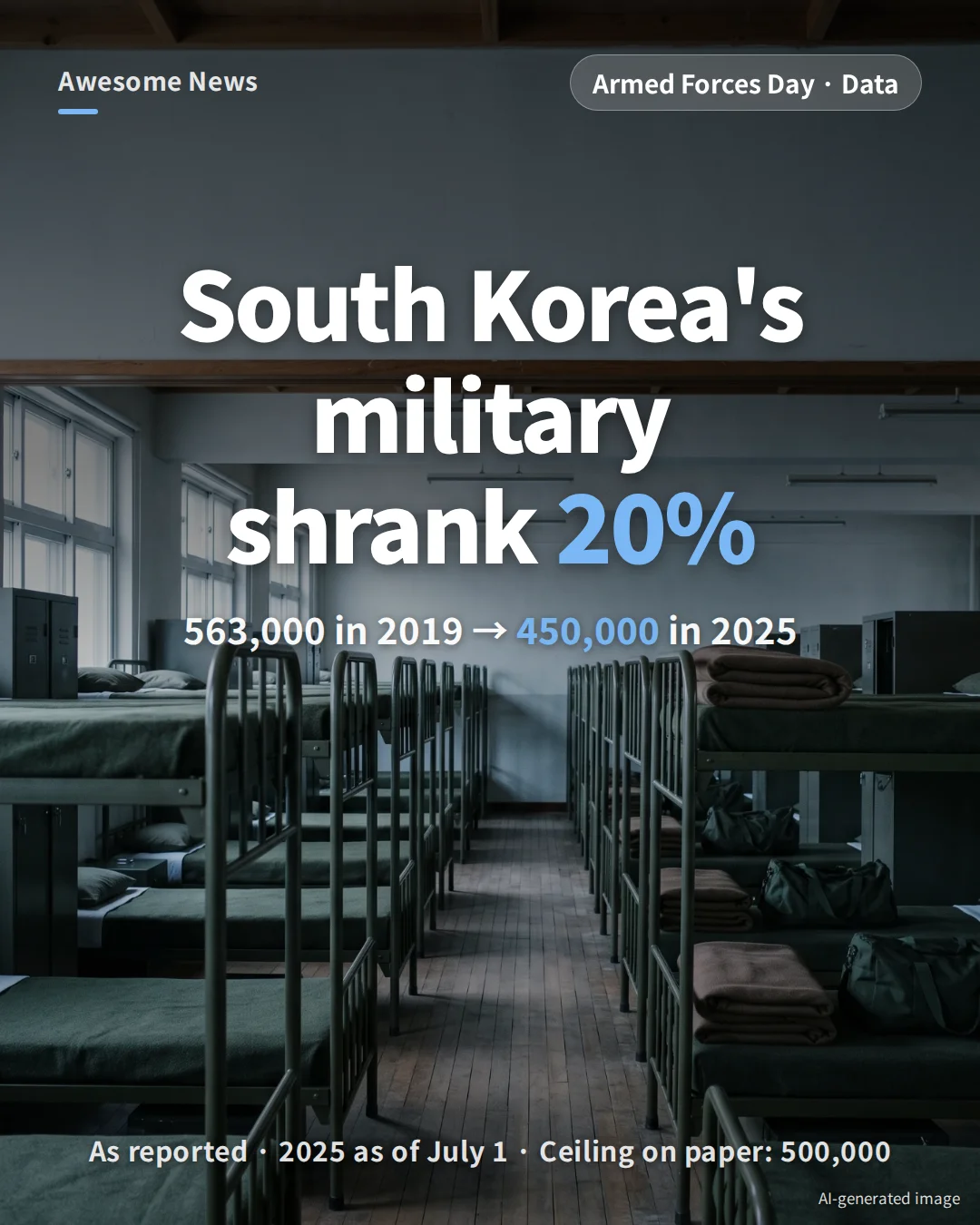
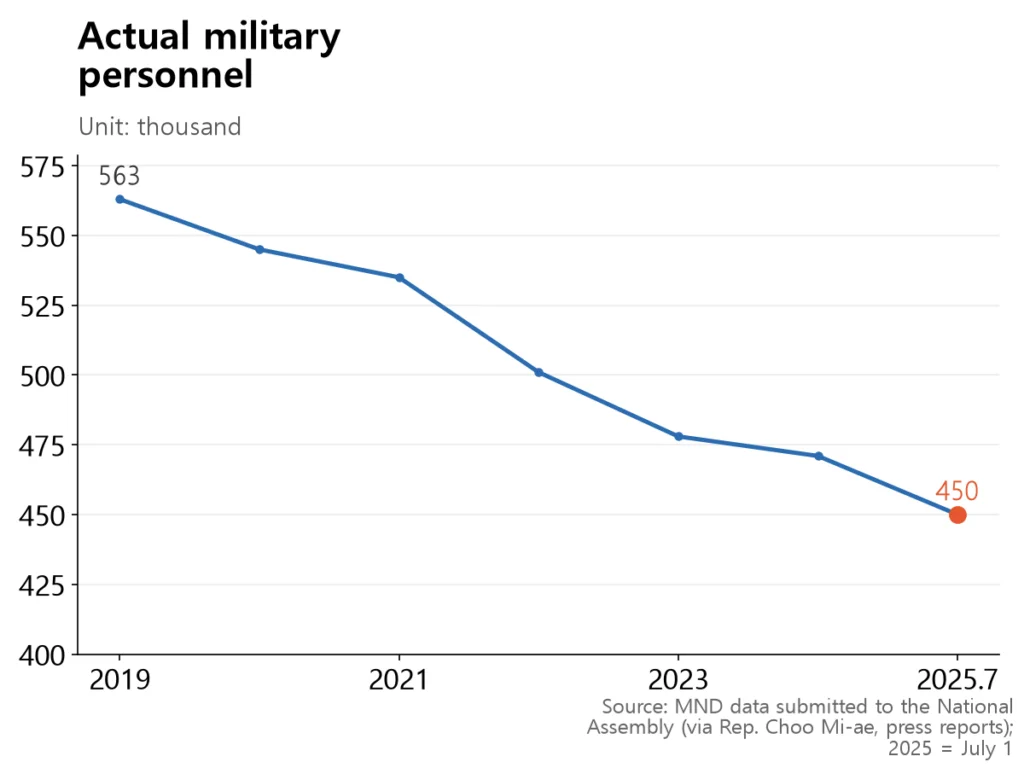
South Korea keeps a conscription system: most able-bodied men serve in the military, usually around age 20. According to Ministry of National Defense figures submitted to the National Assembly (released through the office of lawmaker Choo Mi-ae and reported by Korean media), the country’s actual military strength was about 450,000 as of July 1, 2025. That is 113,000 fewer (−20%) than the 562,600 of 2019. This article explains why the official figure of “500,000” differs from the real headcount, who exactly disappeared (career personnel or conscripts), how much of the drop comes from fewer recruits versus shorter service, and how many 20-year-old men Korea will have in the years ahead.
Key numbers at a glance
- Actual personnel: 563,000 in 2019 → 450,000 in July 2025 (−20%). The authorized ceiling on paper is still 500,000.
- Almost all of the drop was conscripted soldiers: 374,000 → 287,000 (−23.2%) from 2019 to 2023, while officers and NCOs stayed at about 190,000.
- Army conscripts alone fell from 303,000 (2019) to 205,000 (July 2025), a loss of nearly 100,000.
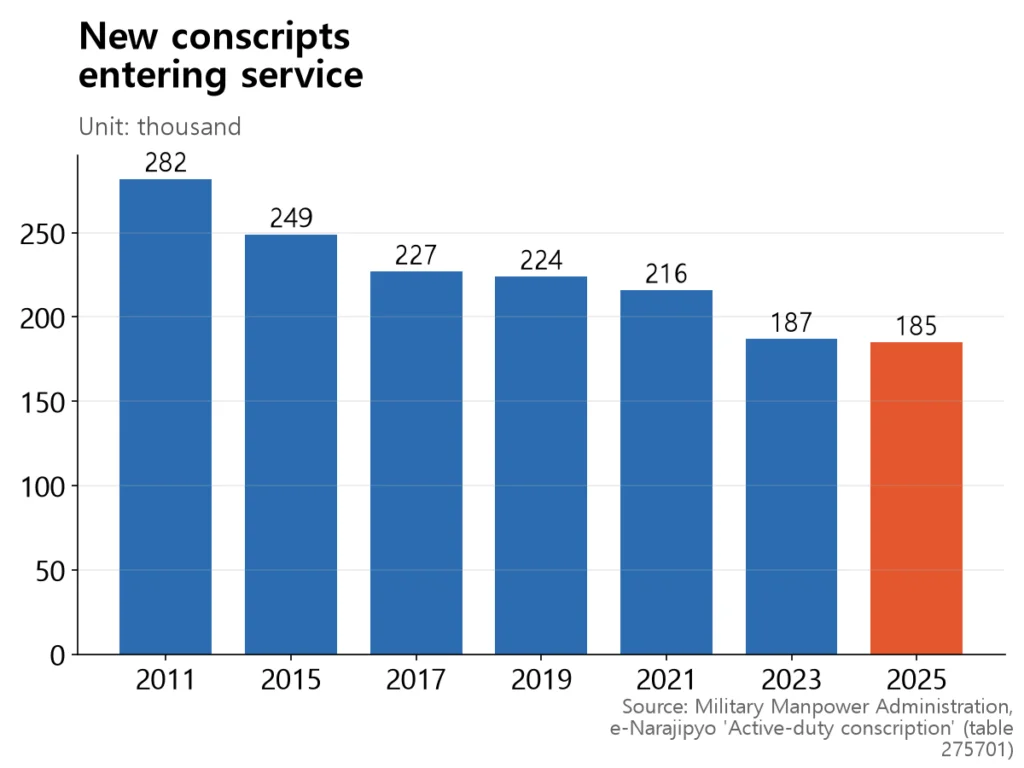
- New conscript intake fell from 282,000 in 2011 to 185,000 in 2025 (−34%), and Army service was cut from 21 to 18 months (phased in from Oct 2018 to Dec 2021).
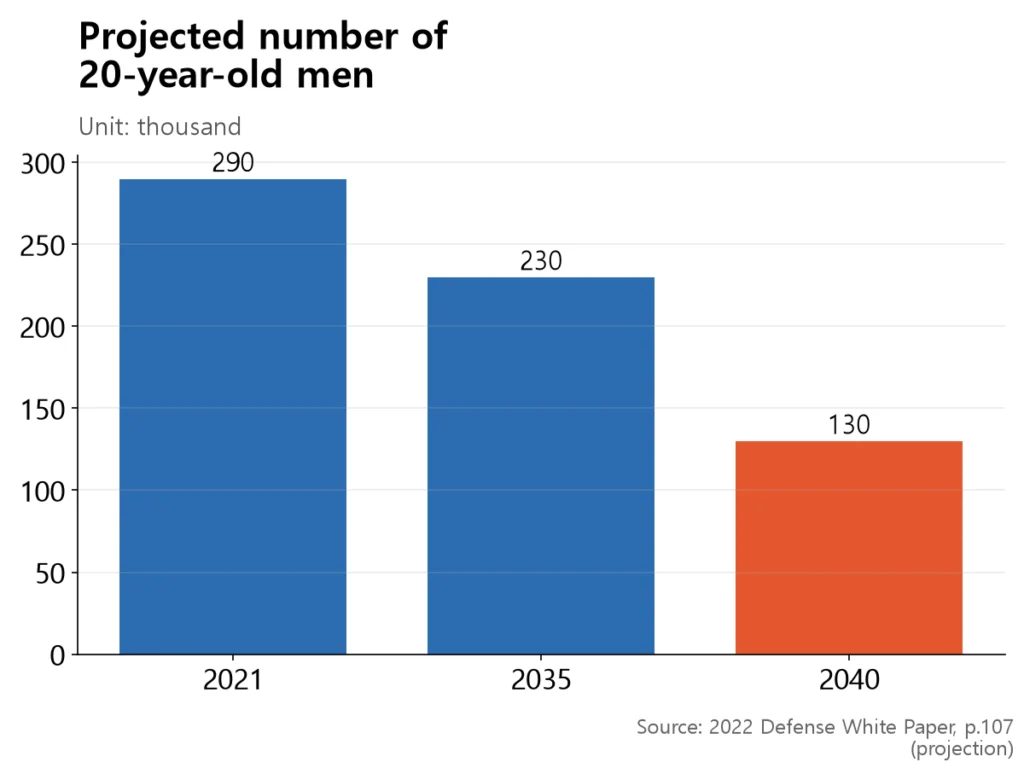
- Men aged 20 are projected to fall from 290,000 in 2021 to 130,000 in 2040 (2022 Defense White Paper).
“500,000” vs. “450,000”: why the two numbers differ
Korea uses three different definitions of troop strength: ① the authorized strength (the “standing force” in the Defense White Paper and mid-term plans — the “500,000” figure), ② the annual average of personnel actually serving (the basis the ministry spokesperson cited on July 25, 2023), and ③ the year-end actual headcount (often used by the Korea Institute for Defense Analyses). For 2022 alone, these give 500,000, 500,700 and 480,000 respectively.
The “450,000” in this article is the second one: personnel actually serving. The authorized ceiling of 500,000 remains in the defense reform plan, but roughly 50,000 fewer people are actually in uniform.
The people who disappeared were mostly conscripts
Break the numbers down and nearly all of the missing personnel are conscripted soldiers. According to data from the Ministry of National Defense and the Military Manpower Administration (as reported), conscripts fell from 374,000 in 2019 to 287,300 in 2023, a drop of 86,700 (−23.2%). Total personnel fell by 85,100 over the same period, so in effect the entire decline was conscripts. Officers and non-commissioned officers (NCOs) stayed at roughly 190,000 (calculated).
| 2019 | 2023 | Change | |
|---|---|---|---|
| Conscripts | 374,000 | 287,000 | −23.2% |
| Officers & NCOs (calculated) | ~189,000 | ~190,000 | Almost unchanged |
| Total personnel | 563,000 | 478,000 | −15.1% |
The Army shows the sharpest change: its conscripts fell from 303,000 in 2019 to 205,000 in July 2025, a loss of about 100,000. Meanwhile, the share of career personnel (officers and NCOs) rose from 31.6% in 2017 to 40.1% in 2022 (Defense White Paper), and a June 2026 ministry seminar reportedly set a target of 63% career personnel and 37% conscripts by 2040.
Ten divisions are gone
Fewer soldiers means fewer units. According to the “Military Strength of North and South Korea” appendix of the Defense White Paper (including the Marine Corps), South Korea’s divisions fell from 46 in 2010 to 36 in 2022. In addition, the 28th Infantry Division was reportedly disbanded in December 2025, with the 5th and 25th Divisions taking over its mission.
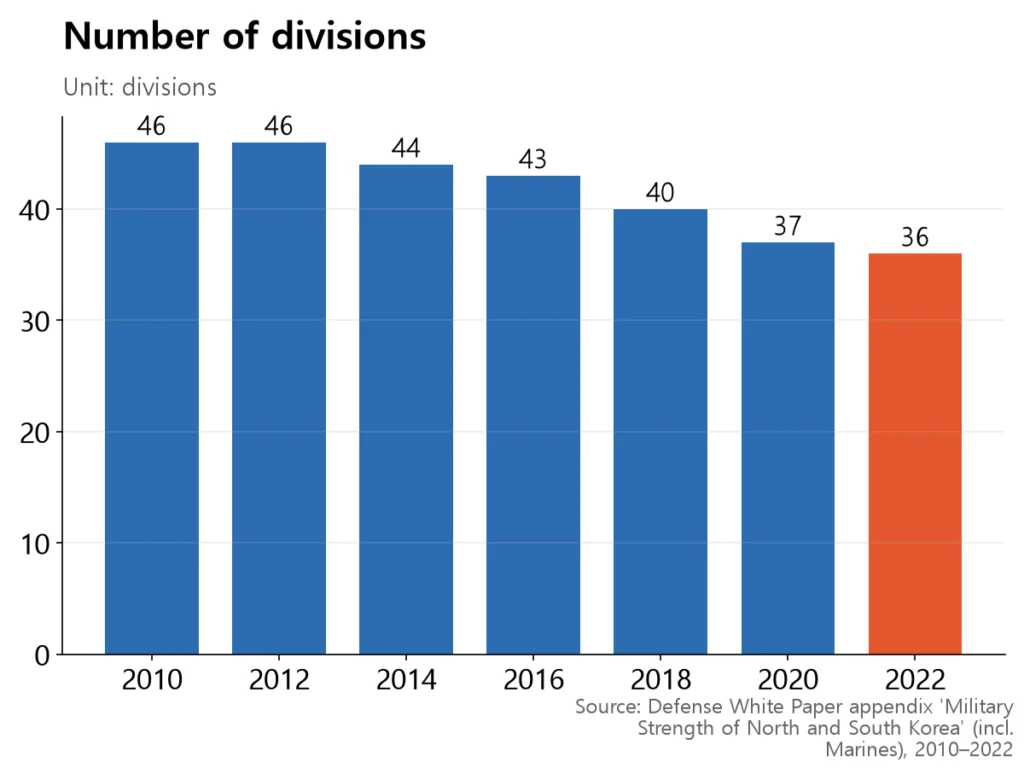
Higher commands were merged too. The First and Third Field Armies were combined into a single Ground Operations Command on January 1, 2019, and the number of Army corps fell from eight to six (2017→2022, Defense White Paper). A separate count by a lawmaker’s office says “division-level or higher units” fell from 59 in 2006 to 42 in 2025; because it counts different units from the White Paper’s 46→36, the two figures should not be combined.
Fewer recruits, and shorter service
Two causes overlap. First, there are simply fewer young men to draft. According to the Military Manpower Administration (e-Narajipyo statistics), new conscript intake fell from 281,969 in 2011 to 184,992 in 2025, down 34%. The number of men taking the military fitness examination fell by nearly 40%, from 365,100 in 2011 to 222,400 in 2025.
Second, each conscript now stays in uniform for less time. Army service was 24 months in 2003 and 21 months in 2011, and settled at 18 months for soldiers discharged from December 14, 2021 (2020 Defense White Paper). The ministry phased in the three-month cut by shortening service by one day every two weeks, starting with soldiers discharged on October 1, 2018.
| Branch | 2003 | 2011 | 2021 onward |
|---|---|---|---|
| Army | 24 months | 21 months | 18 months |
| Navy | 26 months | 23 months | 20 months |
| Air Force | 28 months | 24 months | 21 months |
If service shrinks from 21 to 18 months, then even with the same intake, the number of soldiers serving at any moment falls by 14% (3÷21). Using this simple model (soldiers ≈ intake × service length) to split the gap of 119,000 between 2017 (≈397,000) and 2024 (≈279,000), shorter service explains about 40–50% and lower intake about 50–60%. No official ministry estimate was found, so treat this split as a simple calculation.
Ahead: fewer than half as many young men

The biggest factor is demographics. The 2022 Defense White Paper projects that men aged 20 — the age of enlistment — will fall from 290,000 in 2021 to 230,000 in 2035 and 130,000 in 2040. That would not be enough to fill even today’s conscript ranks of about 280,000.
The Korea Institute for Defense Analyses (KIDA) projects that, if the current system is unchanged, year-end strength will fall below 400,000 by 2038 (press reports). Reported figures vary slightly (396,000 or 386,000), so this article only says “below 400,000”. The ministry plans to respond by raising the share of career personnel (target 63% by 2040), recruiting more women (target: 15.3% of officers and NCOs by 2027), expanding civilian staff and full-time reservists, and adopting unmanned and AI-based surveillance — but many of these are still at the planning or pilot stage.
How to read these numbers
- Don’t mix the three definitions. Authorized strength (500,000), average personnel serving, and year-end headcount are different figures. “450,000” refers to personnel actually serving as of July 1, 2025.
- The reference date varies slightly. 2019–2024 appear to be annual averages, while 2025 is a July 1 snapshot that may change with second-half intake.
- The lawmaker’s-office data is not publicly available in full. Personnel, conscript counts and NCO selection rates come from ministry data submitted to the National Assembly and reported by the press; several outlets cite the same numbers, but the original documents could not be checked directly.
- “Divisions 46→36” and “division-level units 59→42” count different things. The first is the Defense White Paper; the second is a lawmaker’s-office tally.
- “40–50% of the conscript drop is due to shorter service” is a simple calculation based on a steady-state assumption (soldiers ≈ intake × service length). No official ministry estimate was found.
- Lower intake is not only about population. Policy changes also played a part: stricter active-duty fitness standards in 2015–2020 (relaxed again from 2021), the end of alternative-service conversion programs, and fewer commuting reservists.
Summary
In short: over the past six years South Korea’s military shrank by 20% in real headcount, to 450,000, and almost all of the decline was conscripts. Roughly half came from fewer young men entering service, and half from shorter service periods. Ten divisions have already been closed, and by around 2040, when the number of 20-year-old men falls below half of today’s, the government and research institutes agree that even 400,000 will be hard to maintain under the current system. The old phrase “600,000-strong armed forces”, still heard around Armed Forces Day (October 1), no longer describes South Korea’s military on paper or in reality.

Awesome News on Instagram @awesome_news_kr
This article is the research behind our Korean-language card news. Every morning we turn Korean data and official sources into short visual stories. See it on Instagram →
Sources
- Ministry of National Defense — 2010 Defense White Paper (Korean) (2010)
- Ministry of National Defense — 2012 Defense White Paper (Korean) (2012)
- Ministry of National Defense — 2014 Defense White Paper (Korean) (2014)
- Ministry of National Defense — 2016 Defense White Paper (Korean) (2016)
- Ministry of National Defense — 2018 Defense White Paper (Korean) (2018)
- Ministry of National Defense — 2020 Defense White Paper (Korean) (2020)
- Ministry of National Defense — 2022 Defense White Paper (Korean) (2022)
- Ministry of National Defense — 2025 Defense Statistics Yearbook (Korean) (as of 2024-12-31)
- Military Manpower Administration — e-Narajipyo ‘Active-duty conscription’ (table 275701, Korean)
- Military Manpower Administration — e-Narajipyo ‘Military fitness examination’ (table 171801, Korean)
- Statistics Korea — e-Narajipyo ‘Number of births’ (table 142801, Korean)
- National Assembly Budget Office — NABO Fiscal & Economic Statistics Brief No. 9 (Korean) (2024-12-27)
- JoongAng Ilbo — Report on MND data submitted to Rep. Choo Mi-ae: 450,000 in July 2025 (Korean) (2025-08-10)
- Chosun Ilbo — Report on MND data submitted to Rep. Choo Mi-ae: officer and NCO selection rates (Korean) (2025-08-11)
- Asia Economy — Report on 2019–2023 personnel and conscript numbers (Korean) (2024-11-22)
- Herald Economy — Report on KIDA’s 2038 troop projection (Korean) (2023-07-23)
- Newsis — MND spokesperson on the ‘annual average personnel’ basis (Korean) (2023-07-25)
- Newspim — Report on NCO application and selection data from Rep. Heo Young (Korean) (2024-08-20)
- Yonhap News — Report on MND seminar setting a 63% career-personnel target for 2040 (Korean) (2026-06-09)
📊 Download the data
Every number in this article’s 6 charts and tables, in one CSV file (opens in Excel or Google Sheets). When you cite it, please name the original source and link to this page.
Download CSV