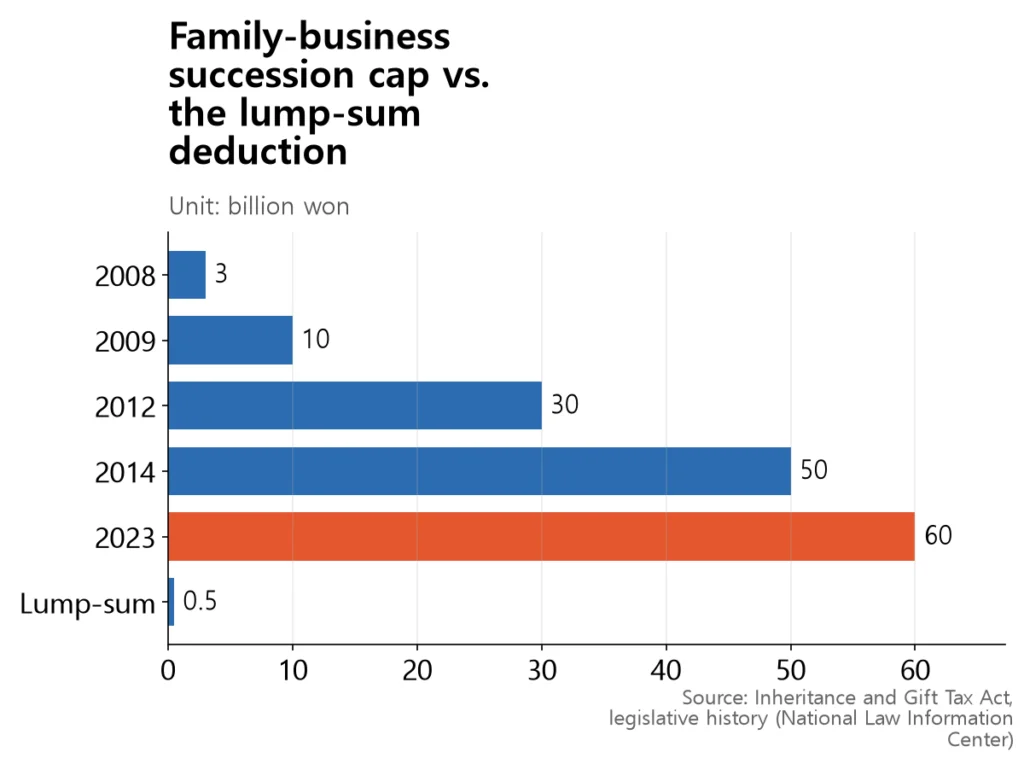
South Korea’s inheritance tax has been the subject of reform bills for 18 years — most of them stuck. Between 2008 and 2024, four attempts to lower the top rate all failed, and a 2014 bid to raise deductions was voted down on the floor. In the same window, the carve-out for family-business successors ballooned 20×, from 3 billion won to 60 billion won, while the lump-sum deduction available to ordinary heirs has stayed at 500 million won since 1997. This piece lays out the 26-year timeline, the 97-to-181 floor vote of December 10, 2024, why rate cuts keep getting labeled a ‘tax break for the rich,’ and what is pending in the Assembly in 2025–2026.
Key numbers at a glance
- Four rate-cut attempts, four failures — 2008 (expired at end of term), 2019 (dropped from committee), 2020 (no deal in subcommittee), 2024 (floor rejection)
- December 10, 2024 floor vote — 281 present: 97 yes, 181 no, 3 abstain (National Assembly official record)
- Only one deduction increase since 2000 — the 2015 bump to the child deduction, from 30 million to 50 million won; most estates use the 500-million-won lump sum, which absorbs five or six children anyway
- Family-business succession cap: 3 billion won (2008) → 60 billion won (2023), a 20-fold jump
- The government’s estate-acquisition-tax conversion bill, announced in March and submitted in May 2025, remains pending
- In 2024–2025 both parties filed deduction-raise bills, but the People Power Party wanted the top rate cut at the same time, the Democratic Party wanted the deductions only, and talks collapsed
Four tries to cut the rate — all stopped

The current inheritance tax rates (10–50%) and brackets were set by a December 1999 amendment and have applied since January 1, 2000. As of October 2026, that is 26 years and 9 months unchanged. Attempts to cut the rate or lift the universal deductions (lump-sum and spousal) have been repeated — but the only one that passed was a 2015 increase to the child and elderly-dependent allowances.
| Year | What was proposed | Outcome |
|---|---|---|
| 2008 | Government bill: top rate 50% → 33% (to match income tax); business succession cap 3B → 10B won | Only the business succession and co-residence home provisions passed in Dec 2008. Rate cut stayed in committee and expired at the end of the 18th Assembly (May 2012) |
| 2014 | Government bill: raise business-succession eligibility from 300B to 500B won in revenue; child/elderly deduction 30M → 50M won | Rejected on the floor — amended version 262 present, 114 yes, 108 no, 40 abstain (press reports) |
| 2015 | Reintroduced only the personal-deduction portion of the 2014 bill | Passed (took effect 2016). The only personal-deduction increase since 2000 |
| 2019 | Opposition member’s bill: lower rate; basic deduction 300M, child deduction 100M won | Dropped — not reflected in the committee’s substitute bill |
| 2020 | Rate cut discussed in the Strategy and Finance Committee’s tax subcommittee | ‘No agreement reached’ — committee asked the Finance Ministry to study the system |
| 2024 | Government bill: top rate 50% → 40%; child deduction 50M → 500M won; abolish the largest-shareholder surcharge | Rejected on the floor (Dec 10, 2024) — 97 yes, 181 no, 3 abstain |
| 2025 | Government bill: switch to an estate-acquisition tax (per-heir deductions, 1B won minimum for spouses) | Pending — Nov 2025 subcommittee deferred to ‘later review’ |
The common complaint that ‘nobody has touched the law’ is wrong. Governments and lawmakers kept filing bills, and other provisions did change often — business-succession relief, the co-residence home deduction, the early-filing credit. What stayed frozen were the rate schedule and the universal lump-sum and spousal deductions.
December 10, 2024 — 97 yes, 181 no

The most recent rate-cut attempt was the Yoon administration’s 2024 amendment (bill 2203525). It would have cut the top rate from 50% to 40%, widened the 10% bracket from 100 million to 200 million won, and raised the child deduction from 50 million to 500 million won. Because it was tagged as a budget-related bill, it bypassed the committee and went straight to the floor, where it was rejected on December 10, 2024.
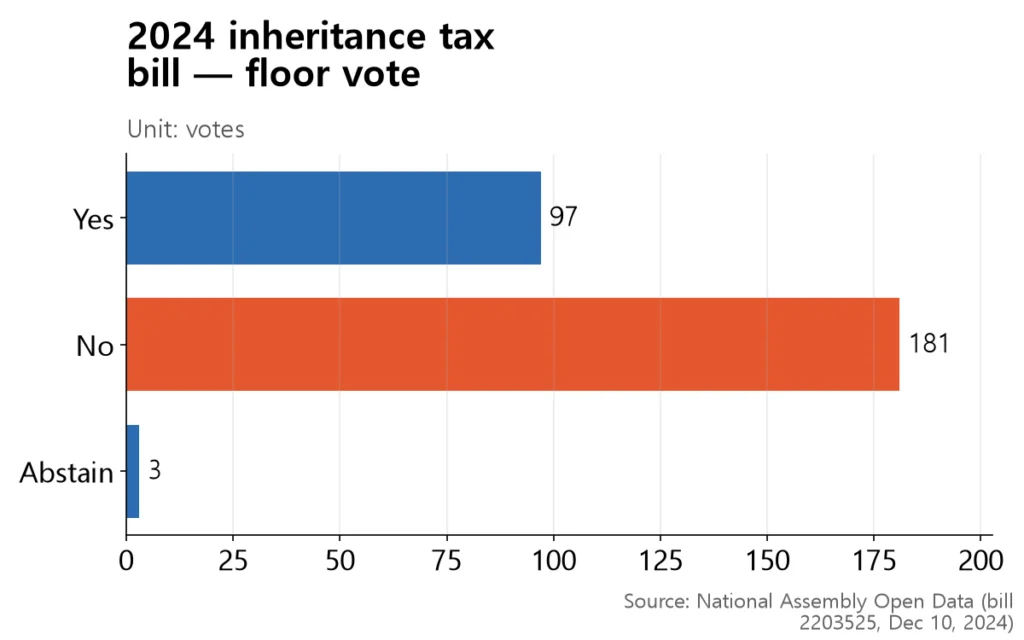
Grouped by party using the Assembly’s open-data API, the breakdown was Democratic Party 161 no, 1 abstain; People Power Party 93 yes, 2 abstain; Rebuilding Korea Party 10 no; New Reform Party 3 yes; Progressive Party 3 no (party affiliations as of now, not at the time of the vote). On the same day, repealing the financial-investment income tax and delaying crypto taxation passed with bipartisan support; the inheritance tax cut and separate dividend taxation went down on opposition votes (as reported by Newspim).
Why opponents say the benefit flows to the top

The Strategy and Finance Committee’s November 2024 review report lays out both sides. Supporters note that prices have risen 1.76× since the rate schedule was last set in 2000, that family-business succession is costly, and that the burden is above the OECD average (for reference, OECD data put inheritance and gift taxes at 2.27% of Korea’s total tax revenue in 2023, against an OECD average of 0.42%). Opponents counter that most of the gain from a rate cut goes to estates above 3 billion won in taxable base, that net-worth inequality (Gini) has risen from 0.584 to 0.606, and that estates under 3 billion won already have a modest 6.9% effective rate against the taxable value.
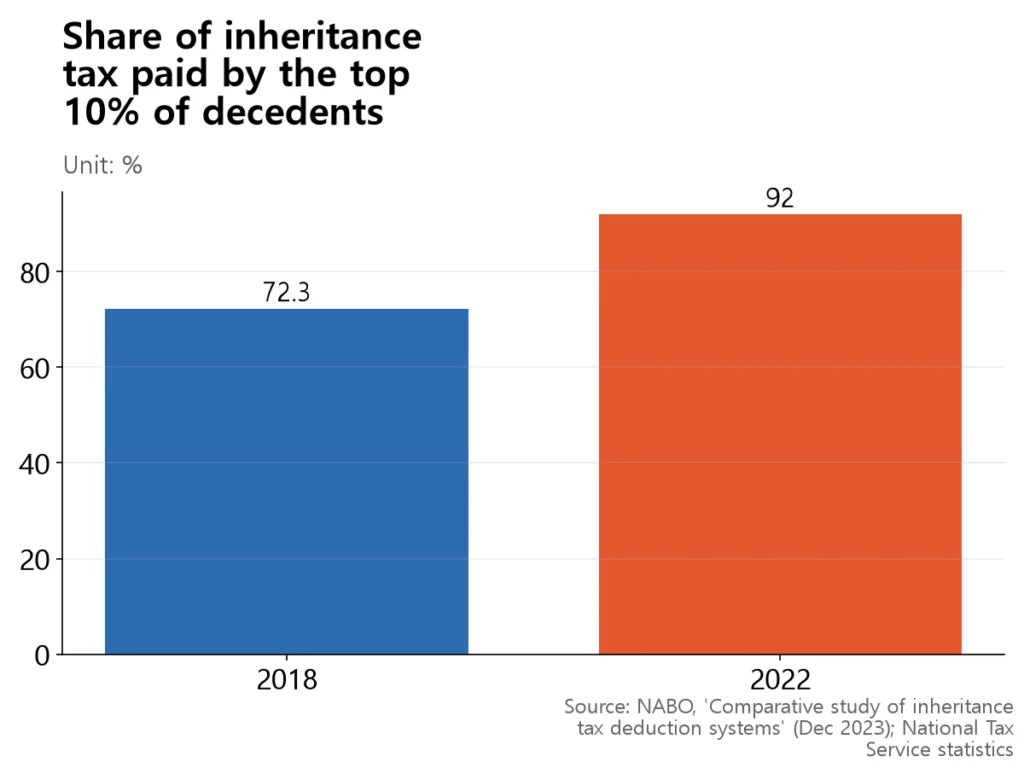
The numbers back up part of the opposition case. In 2022, the top 10% of decedents accounted for 92.0% of all inheritance tax collected, up from 72.3% in 2018 (National Assembly Budget Office commissioned study, Dec 2023). Caveat: 2022 was unusual because a handful of very large estates were assessed that year, so the share is especially skewed.
Raising deductions draws the same critique. A 1-billion-won deduction cuts 500 million won of tax for an estate in the 50% top bracket, but as little as 100 million won for one in the 10% bracket. ‘The deduction looks equal,’ opponents argue, ‘but the marginal rate decides how much it is actually worth.’
2025 — everyone wants to raise deductions, but they split on rates

Lawmakers from both sides filed deduction-raise bills in 2024–2025. From the People Power Party: Kim Eun-hye, Choi Eun-seok, Kweon Seong-dong, Song Eon-seok. From the Democratic Party: Im Gwang-hyeon (lump-sum 800M, spousal 1B won) and Ahn Do-geol (lump-sum 750M, spousal 750M). The consensus was to lift deductions. The dispute was whether to cut the top rate at the same time.
| Position in early 2025 | Deductions | Top rate |
|---|---|---|
| People Power Party | Raise | Cut to 40% in the same package |
| Democratic Party | Raise — 800M lump-sum, 1B spousal | Keep at 50% |
| Outcome | No deal — negotiations collapsed Feb–Mar 2025 | — |
In November 2025 the tax subcommittee reviewed 36 inheritance- and gift-tax bills but passed none of the rate or deduction changes, approving only government proposals such as closing a for-profit corporate pass-through loophole. The estate-acquisition tax conversion was deferred for ‘later review after public hearings and other social-consensus steps, with measures to minimize revenue loss’ (NABO’s 2025 tax law review).
In a September 2025 100-days-in-office press conference, President Lee Jae-myung singled out Rep. Im’s bill and said it should be passed ‘this time.’ Even inside the Democratic Party, however, members pushed back, citing a projected revenue loss of 1.2 trillion won per year and arguing the matter was ‘not something to be settled quickly’ (October 2025 reports).
60 billion for family firms, 500 million for everyone else

While the rate schedule and lump-sum deduction sat still, other parts of the law kept moving. The family-business succession deduction, available to heirs of small and mid-sized companies run for at least 10 years, grew from 3 billion won in 2008 to 60 billion won in 2023 — a 20-fold increase in 15 years.
The reverse happened to the early-filing credit: once 10% of the tax owed in 2016, it was trimmed to 3% in 2019, so the real burden actually rose. Other tightening amendments passed on schedule too — the 2004 comprehensive gift-tax rule, the 2012 ‘work-order funneling’ tax on favored suppliers, and a 2026 provision taxing pass-through inheritances via for-profit corporations. ‘Nothing has changed in the inheritance tax code’ is misleading; it is more accurate to say the rate table and the universal deductions have not changed.
Common misunderstandings
‘Nobody has touched it in 26 years’ is false. Rate cuts were tried in 2008, 2019, 2020 and 2024 — all stopped. The accurate version is ‘repeatedly attempted, repeatedly blocked.’
‘Most of the public wants it eased’ lacks solid polling. Gallup Korea’s regular Daily Opinion survey (Sept 2024, Apr 2025) did not include an inheritance-tax question. A November 2025 online survey of 1,057 respondents commissioned by Joseilbo (conducted by Agendabook) split on the spousal deduction: 39% wanted it raised, 33% cut, 28% abolished. A separate ARS poll of 1,000 people by ResearchView, commissioned by People’s Solidarity for Participatory Democracy, found 55.0% agreeing that ‘the current system allows the inheritance of wealth.’
‘It’s being converted to an estate-acquisition tax’ — not yet. The government’s May 2025 conversion bill (bill 2210618) was still pending as of October 2026, with the subcommittee punting it to ‘later review.’
How to read these numbers
- The 2014 vote tallies (amended 114–108, original 94–123) come from press reports — the 19th Assembly’s party-by-party records are not in the official API, so individual ballots cannot be verified.
- The party breakdown of the 2024 vote uses current affiliations, which may differ from those at the time of the vote.
- The top-10% share of 92.0% for 2022 was pushed up by a cluster of very large estates assessed that year. Compare with 2018 (72.3%) with that in mind.
- The review report cites business-sector surveys (KITA, KBIZ, KEF), which poll companies rather than the general public.
- Revenue-loss figures for the estate-acquisition tax (2–3 trillion won) and for raised deductions (1.2 trillion per year, 3.1 trillion over five years) are NABO and Narasalim Institute estimates; they vary with assumptions.
Summary
Since 2000, all four attempts to cut the rate — and every attempt to raise the universal deductions (lump-sum and spouse) — have been stopped. Opponents keep returning to one argument — the easing’s benefit lands on the richest estates. Supporters return to another — a tax base unchanged for 26 years is now unreasonable. In between, the family-business carve-out became 20 times larger, the early-filing credit was cut, and the ordinary 500-million-won lump-sum deduction has sat since 1997. Neither the 2025 estate-acquisition tax bill nor the 2026 tax-reform package touched the rate table or the universal deductions. The record of the last 26 years is not ‘a tax nobody touched’ but ‘a tax many tried to change and could not.’

Awesome News on Instagram @awesome_news_kr
This article is the research behind our Korean-language card news. Every morning we turn Korean data and official sources into short visual stories. See it on Instagram →
Sources
- National Law Information Center / Ministry of Government Legislation — Inheritance and Gift Tax Act — legislative history (1950–2026) (Korean) (2026-01-01)
- National Assembly of the Republic of Korea — National Assembly bill tracker — bills 1801095, 1911782, 1916828, 2203525, 2210618, 2212657, 2221045 (Korean)
- National Assembly Open Data — Floor vote record for bill 2203525 (Korean) (2024-12-10)
- National Assembly Strategy and Finance Committee — Review report on the Inheritance and Gift Tax Act amendment (Korean) (2024-11)
- National Assembly Strategy and Finance Committee (Expert Adviser Jeong Ji-eun) — Review report on introducing an estate-acquisition tax (Korean) (2025-11)
- National Assembly Budget Office (NABO) — 2025 tax law amendment review (Korean) (2025-12)
- NABO commissioned research — Comparative study of inheritance tax deduction systems (Korean) (2023-12)
- Ministry of Economy and Finance — Press release on the estate-acquisition tax conversion (Korean) (2025-03-19)
- Seoul Shinmun — ‘In 7 years, deduction cap grew 500×’ — inheritance tax easing fails (Korean) (2014-12-03)
- Edaily — DP vs. PPP clash over inheritance tax reform (Korean) (2025-03-05)
- Ajunews — Parties agree on deductions, split on the top rate (Korean) (2025-03-07)
- Newspim — Inheritance tax bill rejected on floor (Korean) (2024-12-10)
- Kyunghyang Shinmun — Raising lump-sum alone would cost 3.0843 trillion won over 5 years — NABO estimate (Korean) (2025-09-14)
- Hankyung — Estate-acquisition tax projected to cost 2–3 trillion won (Korean) (2025-11-28)
- Hankyung — Comment on indexing taxes to inflation (Korean) (2026-09-27)
- Kyunghyang Shinmun / Daum News — President Lee Jae-myung’s ‘no tax up to 1.8 billion won’ remark (Korean) (2025-09-11)
- Taxwatch — Research on inheritance tax easing and the estate-acquisition tax — ‘tax break for the ultra-wealthy’ (Korean) (2025-06-04)
- Joseilbo (commissioned to Agendabook) — Survey on the spousal inheritance deduction (Korean) (2025-11)
- NGO News — People’s Solidarity for Participatory Democracy — inheritance-system opinion poll by ResearchView (Korean) (2025-11-30)
📊 Download the data
Every number in this article’s 5 charts and tables, in one CSV file (opens in Excel or Google Sheets). When you cite it, please name the original source and link to this page.
Download CSV