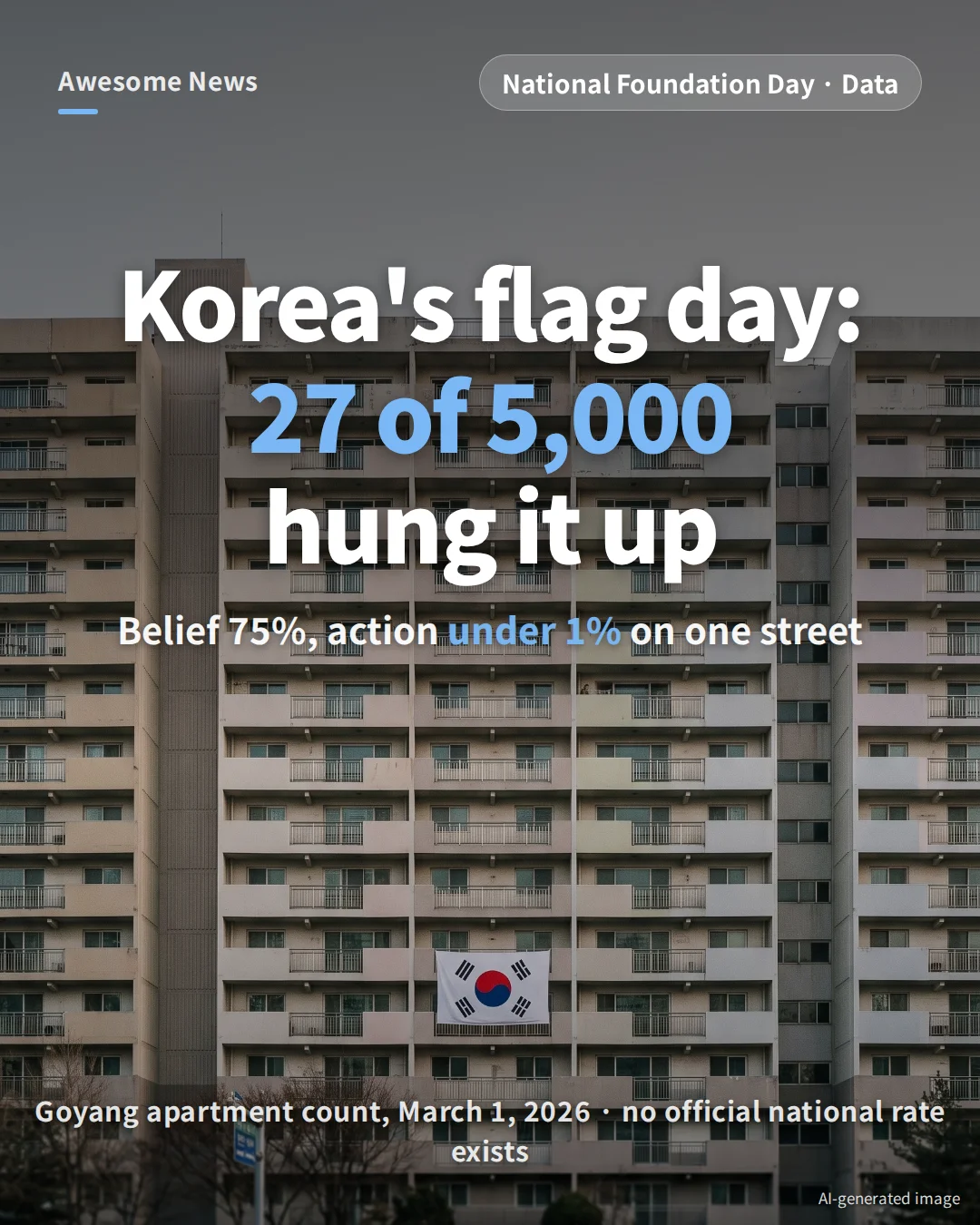
On March 1, 2026 — Korea’s Independence Movement Day — a resident reporter for the Gyeonggi provincial news portal walked through an apartment complex of about 5,000 households in Goyang, near Seoul, and counted the Taegeukgi, Korea’s national flag. Twenty-seven households had hung one. Five complexes in Incheon’s Geomdan new town came in at roughly 1% the same day. (October 3 is Gaecheonjeol, Korea’s National Foundation Day, and another day the flag is traditionally flown.)
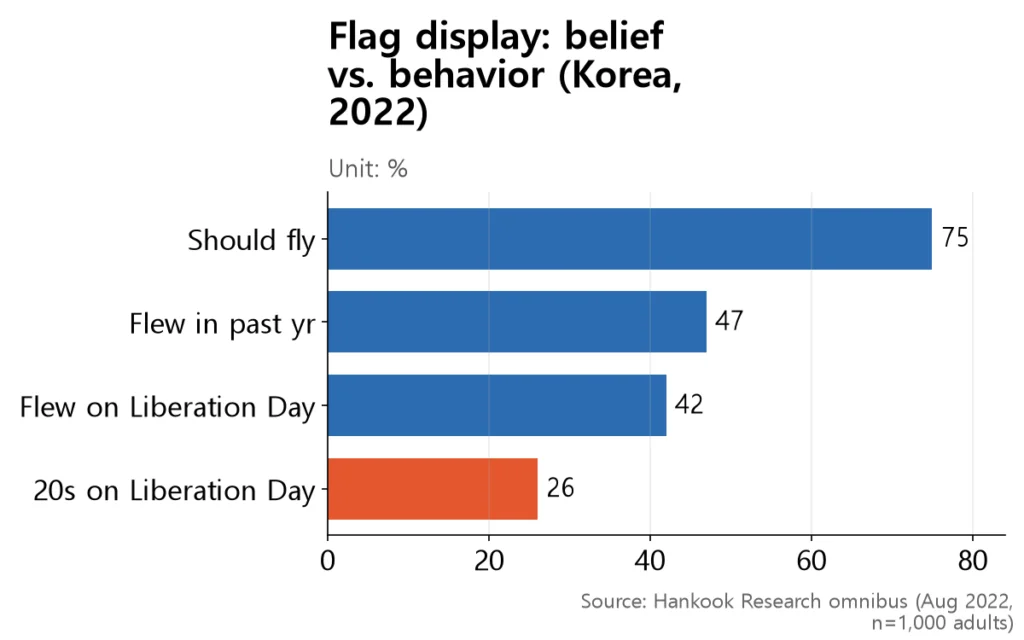
The puzzle is that Koreans still say they ought to hang it. In a 2022 Hankook Research poll, 75% of adults agreed the flag should be displayed on national holidays. Only 47% said they had actually done so in the past year — a 28-point gap between intention and action.
Key numbers at a glance
- 75% of Korean adults say the flag should be flown on national holidays; 47% say they did so in the past year (Hankook Research, 2022).
- Only 26% of Koreans in their 20s hung the flag on Liberation Day; 70% of those aged 18–20 flew it zero times in the past year.
- There is no official nationwide display rate. The last government survey was in 2004–2007 (27.6–31.2% in sampled Seoul-area apartments).
- Top reason for not flying it: ‘no flag at home’ (37%), followed by ‘nowhere to hang it’ (21%).
- In Chuncheon, where the city hands out free flags, apartment display jumped from 11.2% (March 2025) to 50.2% (August 2026).
1. 75% say they should. 47% say they did.
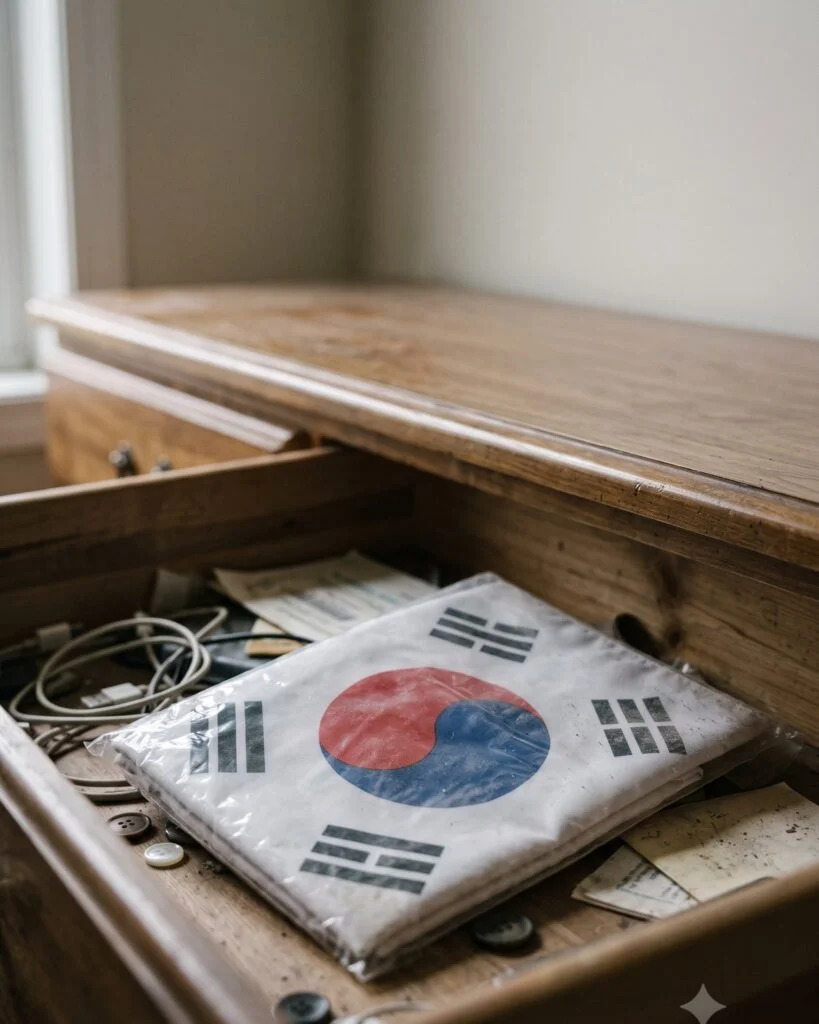
The Hankook Research survey polled 1,000 adults online in August 2022 (margin of error ±3.1 points). Three in four agreed the flag belongs outside the house on national holidays. Fewer than one in two actually hung it in the past year.
The age gap is wider. On Liberation Day 2022, only 26% of respondents in their 20s and 28% in their 30s flew the flag. Seventy percent of those aged 18–20 and 65% of those in their 30s said they had not displayed it even once in the previous year.
Awareness is uneven too. Only about 70% of adults correctly identified Gaecheonjeol as a flag-flying day. For Independence Movement Day (March 1), Liberation Day (Aug 15) and Memorial Day (June 6) the figure is above 95%, but for Armed Forces Day and Hangeul Day it falls to the low 40s. Some people, in other words, simply do not know the day calls for a flag.
2. Nobody actually knows the nationwide rate
There is no official national statistic for flag display in Korea. The Ministry of the Interior and Safety, the e-National Indicators portal, the KOSIS statistics database and the National Archives all lack an annual series. The last government count on record is a 2004–2007 sample survey of Seoul-area apartment complexes by what was then the Ministry of Government Administration — and even that number only survives as a figure quoted in a 2008 Kyeonggi Ilbo article, drawn from documents the ministry submitted to the National Assembly.
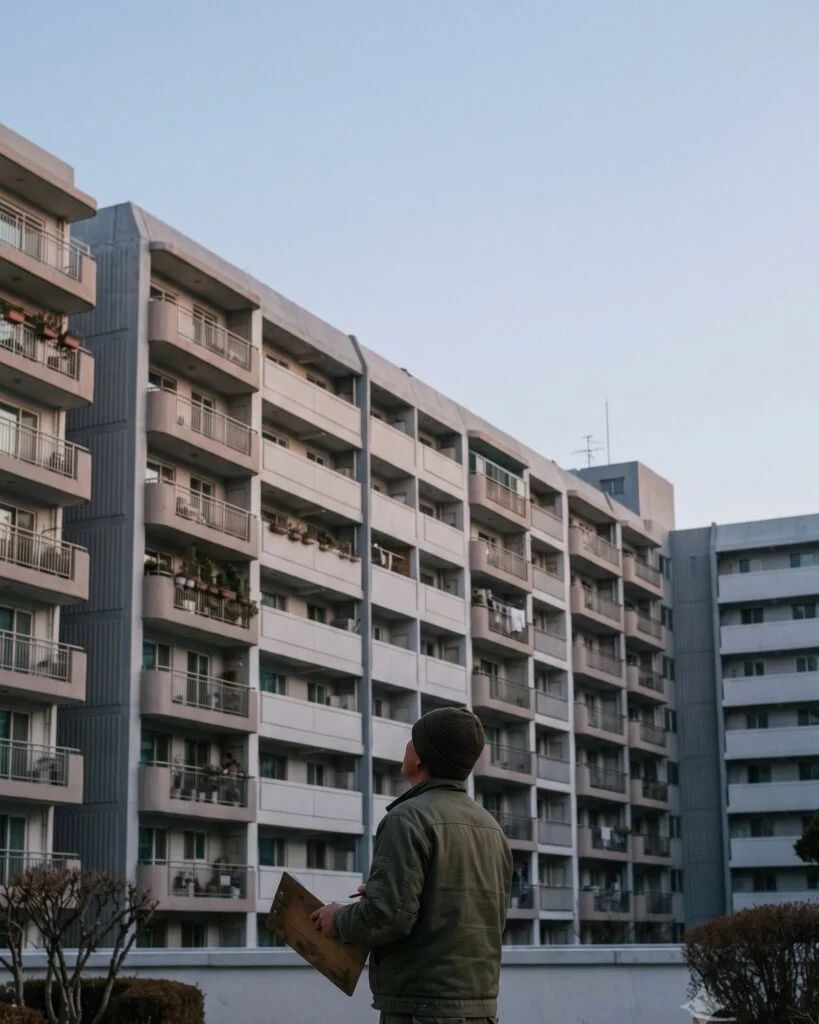
Everything since has come from newspapers, civic groups and local resident reporters eyeballing a particular neighborhood. On the same holiday, counts range from under 1% to over 50%, depending on which block you walk.
| Date | Location (who counted) | Display rate |
|---|---|---|
| Aug 15, 1991 | Gaepo civil-servant apts / SNU faculty apts, Seoul (PM’s audit team) | 42% / 6% |
| Aug 15, 1997 | 28 regions, ~46,000 households (Saemaul leaders assoc.) | 66% |
| 2004–2005 holidays | Seoul-area apartment sample (Ministry of Interior) | 28.3% / 27.6% |
| Mar 1, 2006 | Ilsan, Goyang — 22,456 households (Ministry of Interior) | 27.8% |
| Oct 3, 2006 | Ansan — 11,575 households (Ministry of Interior) | 31.2% |
| Aug 15, 2007 | Seocho-gu, Seoul — 16,944 households (Ministry of Interior) | 29% |
| Jun 6, 2013 | Sejong Cheotmaeul (residents) | under 10% |
| Mar 1, 2019 | Chuncheon — 41 complexes, 3,351 units | 25.3% |
| Mar 1, 2024 | Chuncheon — 41 complexes, 3,351 units | 12.5% |
| Oct 3, 2025 | Chuncheon (Taegeukgi Display Assoc.) | 29.8% |
| Mar 1, 2026 | Geomdan, Incheon — 5 complexes, ~5,000 households | ~1% |
| Mar 1, 2026 | Juyeop/Kintex area, Goyang — ~5,000 households | ~0.5% (27 units) |
| Aug 15, 2026 | Chuncheon — 35 complexes, 3,060 units | 50.2% |
Putting the ministry’s old 27.6–31.2% next to the ~1% readings from new-town Goyang and Incheon makes it look like display rates have collapsed. In reality the surveys measured different places with different methods. No one can honestly give a single national figure.
3. Many households can’t hang one, even if they want to
When Hankook Research asked non-displayers why, the top answer was logistical rather than ideological.
| Reason for not flying the flag | Share |
|---|---|
| No flag at home | 37% |
| Nowhere suitable to hang it | 21% |
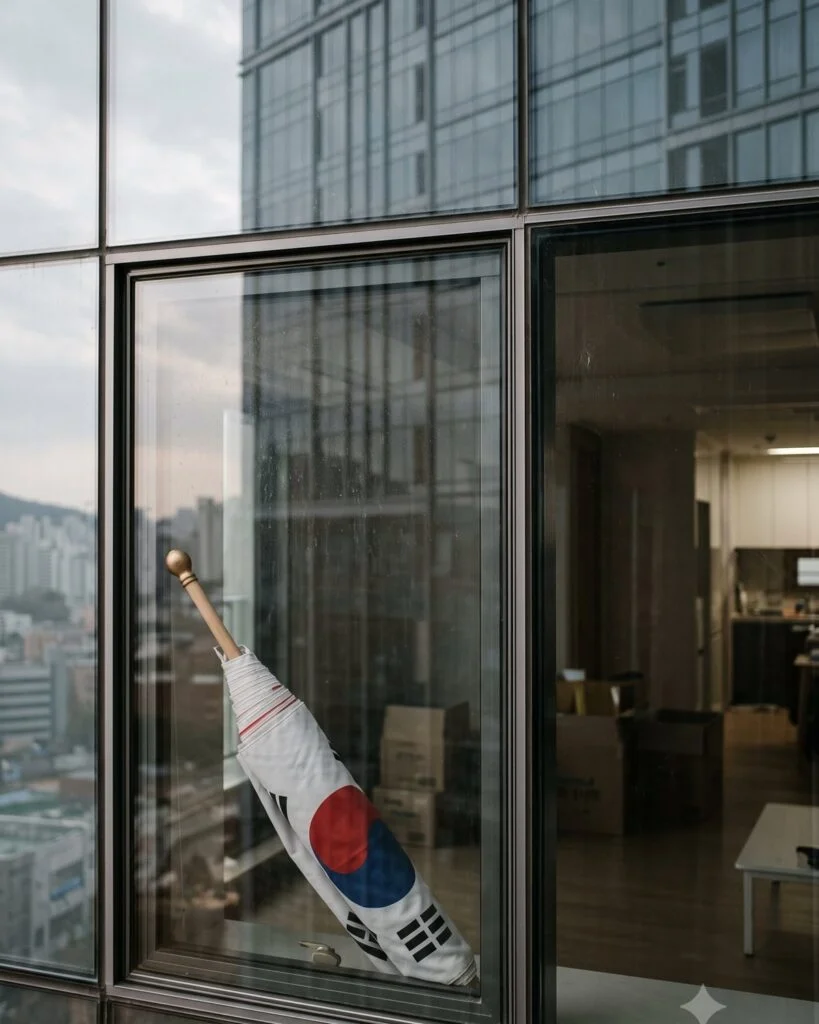
The ‘nowhere to hang it’ answer has a physical cause. Flag-pole brackets on apartment balcony railings have only been mandatory in new buildings since 1991. Roughly 20% of Korean apartments were built before that, and mixed-use high-rises typically have no exterior railing at all and therefore no bracket. The current housing construction regulation (Article 18, clause 4) still requires brackets only on ‘units with a railing exposed to outside air’ (Ministry of Government Administration, 2014, as reported by Money Today).
Sellers tell the same story. Flag wholesalers quoted by Korean media on Aug 15, 2026 said Liberation Day sales were more than ten times higher a decade ago. Chinese-made flags sell for about a third of the Korean-made price of 4,000–5,000 won, and even those are not moving (News1). The figure is industry testimony, not an official sales statistic.
4. Hand them out, people hang them: Chuncheon’s experiment
If the main obstacle is really ‘no flag at home,’ giving flags away should fix it. Chuncheon, a city of about 290,000 in Gangwon province, has been handing out Taegeukgi to residents who come in to register a change of address or a marriage. The local Taegeukgi Display Association has been counting the apartment complexes on each national holiday since.
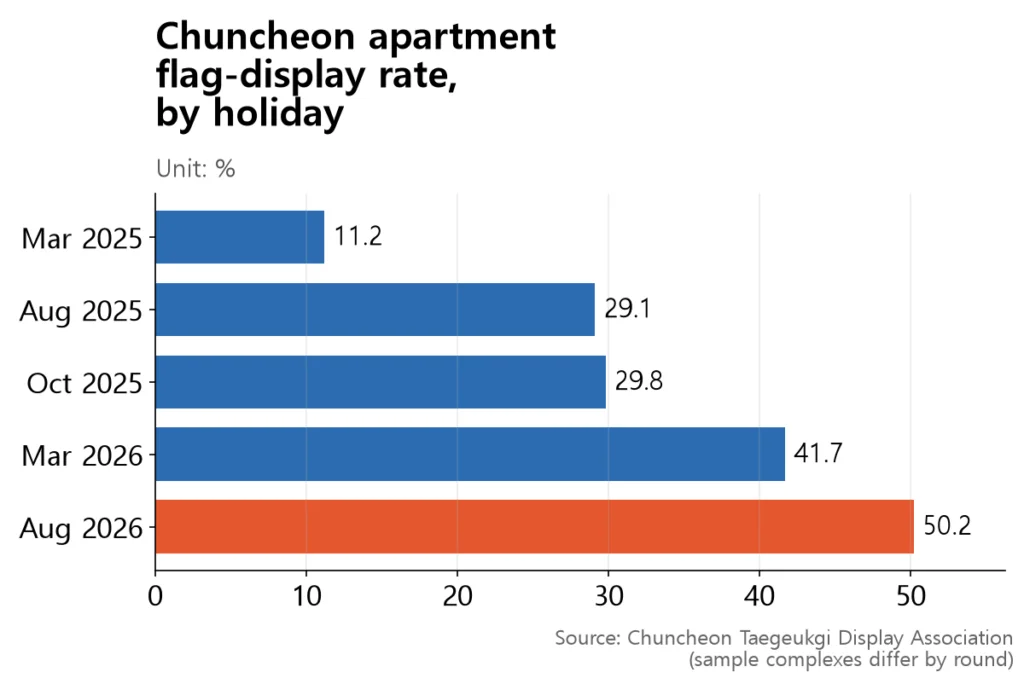
Before the giveaway, the trend had been going the other way. A different local group counting the same 41 complexes and 3,351 units found display rates fell from 25.3% on the March 1 centenary in 2019 to 12.5% on March 1, 2024 (Herald Economy). The upswing in the chart above began after the city started distributing free flags.
A more extreme case: at the Museong apartment in Chilgok county, North Gyeongsang province, 188 of 192 households (about 98%) displayed the flag on March 1, 2025, after an intensive local campaign (Kookmin Ilbo). It is one building; it cannot be generalized.
The Chuncheon data have caveats of their own. The counting organization changed, and the number of surveyed complexes shifted from 41 to about 30 to 35. Still, the direction is clear: supply the flag and more households fly it.
5. There is no fine for not flying it
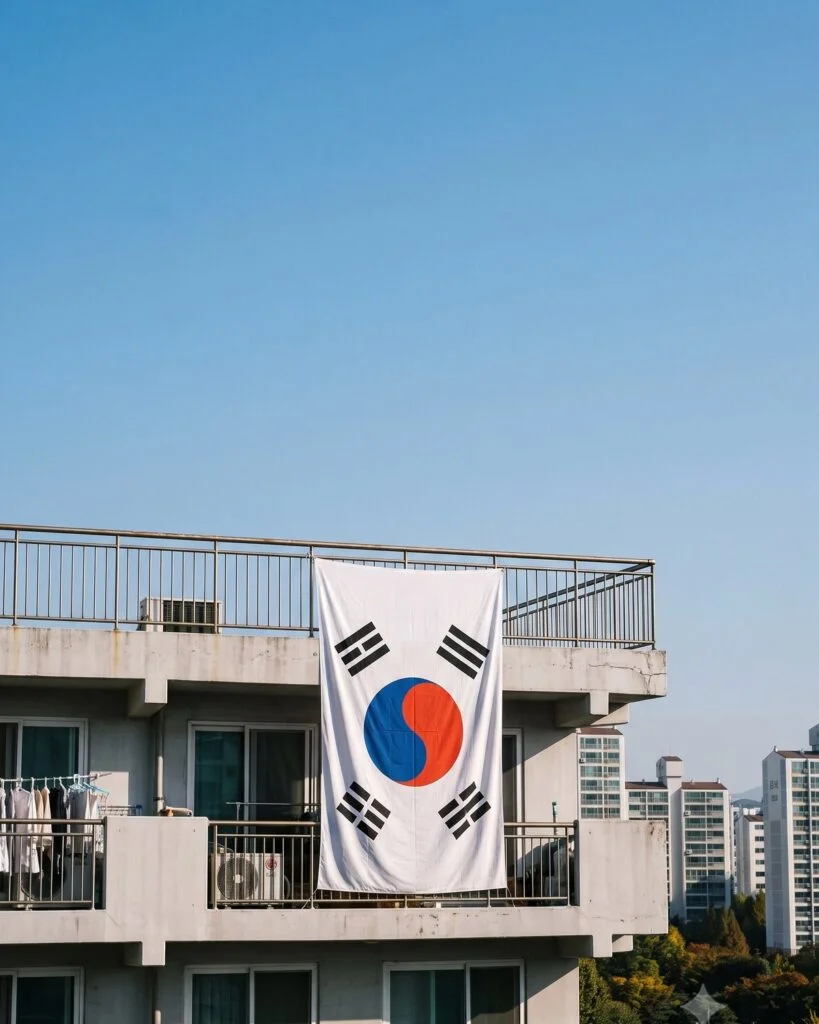
Reading Korea’s National Flag Act end to end, there is no provision for a fine or any penalty on households that fail to display the flag. Article 5(1) says only that ‘all citizens shall respect and cherish the national flag.’ Year-round display is required only at government, local-authority and public-institution buildings (Article 8(3)); schools and military bases must fly it during daylight hours.
Damaging the flag is a different matter. Article 105 of the Criminal Act punishes anyone who damages, removes or defiles the flag with the intent to insult the Republic of Korea with up to five years in prison or a fine of up to 7 million won. Not displaying the flag and vandalizing it are legally distinct.
| Who | What the law says |
|---|---|
| Households | No obligation. ‘Respect and cherish’ only (Flag Act, Art. 5) |
| Central and local government, public institutions | Must display year-round at offices (Art. 8) |
| Hours on Gaecheonjeol (today) | Raise at 7 a.m., lower at 6 p.m. (Enforcement Decree, Art. 12) |
| Placement | Center of the gate or balcony rail, or left side as seen from outside (Enforcement Decree, Art. 18) |
Other countries work the same way. The United States does not mandate household display either: 4 U.S.C. §6(d) only says the flag ‘should be displayed’ on listed days. In a June 2026 Gallup survey of 1,001 American adults, 43% said they fly the Stars and Stripes at home on holidays — down from 59% just after the 1991 Gulf War, but identical to the 1986 figure. The age gap mirrors Korea’s: 25% among those aged 18–34 versus 57% among those 55 and older.
How to read these numbers
- No single ‘South Korean display rate’ exists. The values in the big table are one-off counts in different places using different methods.
- The gap between the survey (47%) and street counts (mostly 10–30%) likely reflects social-desirability bias — people over-report civic behavior in self-reports.
- The 2004–2007 ministry figures are known only through a 2008 Kyeonggi Ilbo report citing documents submitted to parliament; the raw data have not been located.
- Chuncheon’s jump comes from the Display Association’s own analysis. Free flag distribution is a plausible cause, but not the only possible one.
- A separate 2022 survey item found 35% think the Taegeukgi’s image turned negative after it was adopted by far-right rallies. That is an image question, not a measured driver of display rates.
Summary
In one line: three in four Koreans still believe the flag belongs outside on national holidays, more than a third don’t own one, and when the flag is handed to them they tend to put it up. Nobody will fine you for leaving the pole in the closet today — but if you’ve got one, the rule is raise at 7 a.m., lower at 6 p.m., and hang it on the left side as seen from the street. October 3 is the day the sky opened.

Awesome News on Instagram @awesome_news_kr
This article is the research behind our Korean-language card news. Every morning we turn Korean data and official sources into short visual stories. See it on Instagram →
Sources
- Hankook Research (via Polinews) — Public Opinion in Public Opinion — Taegeukgi Perception Survey (Korean) (2022-09-21)
- The Fact — Liberation Day, the ‘flag holiday’ — what’s the display rate? (Korean) (2026-08-15)
- Kyeonggi Ilbo — Report citing Ministry of Interior flag-display survey submitted to the National Assembly (Korean) (2008-08-15)
- Hankook Ilbo — Liberation Day flag display at Gaepo and SNU faculty apartments (Korean) (1991-08-17)
- Hankook Ilbo — Liberation Day flag-display survey, 28 regions (Korean) (1997-08-16)
- Sejong Post — Memorial Day flag display at Sejong Cheotmaeul (Korean) (2013-07-01)
- Herald Economy — Chuncheon March 1 apartment flag survey, 2019 vs 2024 (Korean) (2024-03-01)
- Yonhap News (via Nate) — Chuncheon Taegeukgi Display Association March 1 count (Korean) (2026-03-01)
- Supple — Chuncheon Liberation Day apartment display 50.16% (Korean) (2026-08-15)
- Financial News (via Nate) — Geomdan new town, Incheon — March 1 flag count (Korean) (2026-03-01)
- Gyeonggi provincial news portal — Juyeop and Kintex apartments, Goyang — March 1 flag count (Korean) (2026-03-03)
- Kookmin Ilbo — Chilgok Museong apartment March 1 flag campaign (Korean) (2025-03-02)
- Money Today — Mandatory flag brackets on apartments — reported (Korean) (2014-12-21)
- News1 (via Daum) — Liberation Day flag sales decline — industry testimony (Korean) (2026-08-15)
- Korea Law Information Center — National Flag Act and Enforcement Decree, Public Holidays Act, Criminal Act, Housing Construction Standards Regulation — current text (Korean) (accessed 2026-09-29)
- Gallup — American Pride Falls to New Low (flag-flying share 43%) (2026-06-29)
- Cornell Law School LII — 4 U.S.C. §6 Time and occasions for display
📊 Download the data
Every number in this article’s 5 charts and tables, in one CSV file (opens in Excel or Google Sheets). When you cite it, please name the original source and link to this page.
Download CSV