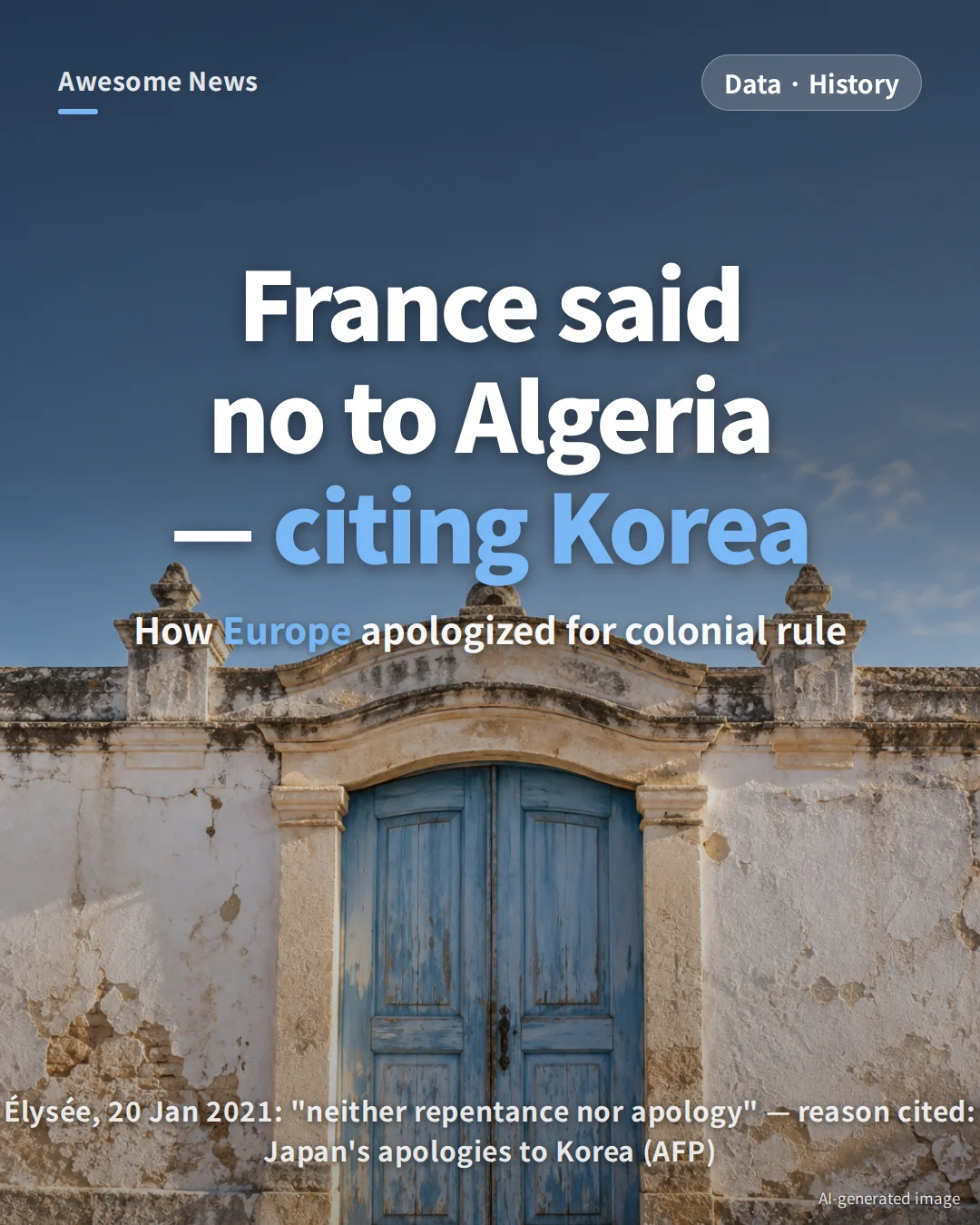
On 20 January 2021, the French presidency received the Stora Report on the memory of the Algerian War — and on the same day declared there would be “neither repentance nor apology” (*ni repentance ni excuses*). The stated reason was striking: the report cited Japan’s apologies to Korea and China as a case where saying sorry had not brought reconciliation. This article compares, country by country, how long colonial rule actually lasted, which European powers apologized, which only expressed “regret,” what they called the money they paid — and where South Korea’s own apology record fits in.
Key numbers at a glance
- Length of direct colonial rule: Algeria 132 years, Indonesia 149 years (state rule 1800–1949), India 89 years (British Crown), Korea 35 years (40 if counted from the 1905 Eulsa Treaty).
- The longer the rule, the less likely an apology — France issued a formal refusal on Algeria (2021); Belgium and the British Crown have gone only as far as “regret.” The countries that did apologize (Italy on Libya, Germany on Namibia) ruled for only about 30 years.
- Germany pledged €1.1 billion over 30 years to Namibia, labelled “reconstruction and development aid” — explicitly “no legal claim for compensation.” As of October 2026, the joint declaration is still unsigned.
- Italy–Libya US$5 billion over 20 years (“friendship and cooperation”); UK–Kenya £19.9 million to 5,228 Mau Mau victims (settlement, legal costs included); Japan–Korea 1965 — US$300 million in grants + US$200 million in loans (“economic cooperation”).
- South Korea has multiple Japanese apology documents — Kono (1993), Murayama (1995), Kim Dae-jung–Obuchi (1998), the 2015 comfort women agreement — but the two governments still disagree over legal responsibility for compensation.
The day France refused to say sorry to Algeria
On 20 January 2021 the Élysée received historian Benjamin Stora’s report — 22 recommendations on how France should address the memory of the Algerian War (1954–1962) and its colonial rule. What the presidency announced that day was “neither repentance nor apology.” According to AFP, the justification was a passage in the report itself: that Japan’s apologies to Korea and China had not produced reconciliation.
What came next is revealing. On 20 September 2021, President Macron said he “asked forgiveness” — but only of the Harkis, Algerians who had fought on the French side. There was no apology to the Algerian people as a whole. His 2017 campaign line calling colonization “a crime against humanity” never became official policy. So the question in this piece is: how far has Europe actually gone in apologizing for its own colonial past?
First, how long was colonial rule?
The trickiest step in any comparison is where to start counting. The Dutch “350 years in Indonesia” is an inflated figure that begins with the 1602 chartering of the East India Company; Portugal’s “500 years in Angola” lumps in centuries when Lisbon held only coastal outposts. The chart below uses the stricter benchmark: years of direct rule by the state.
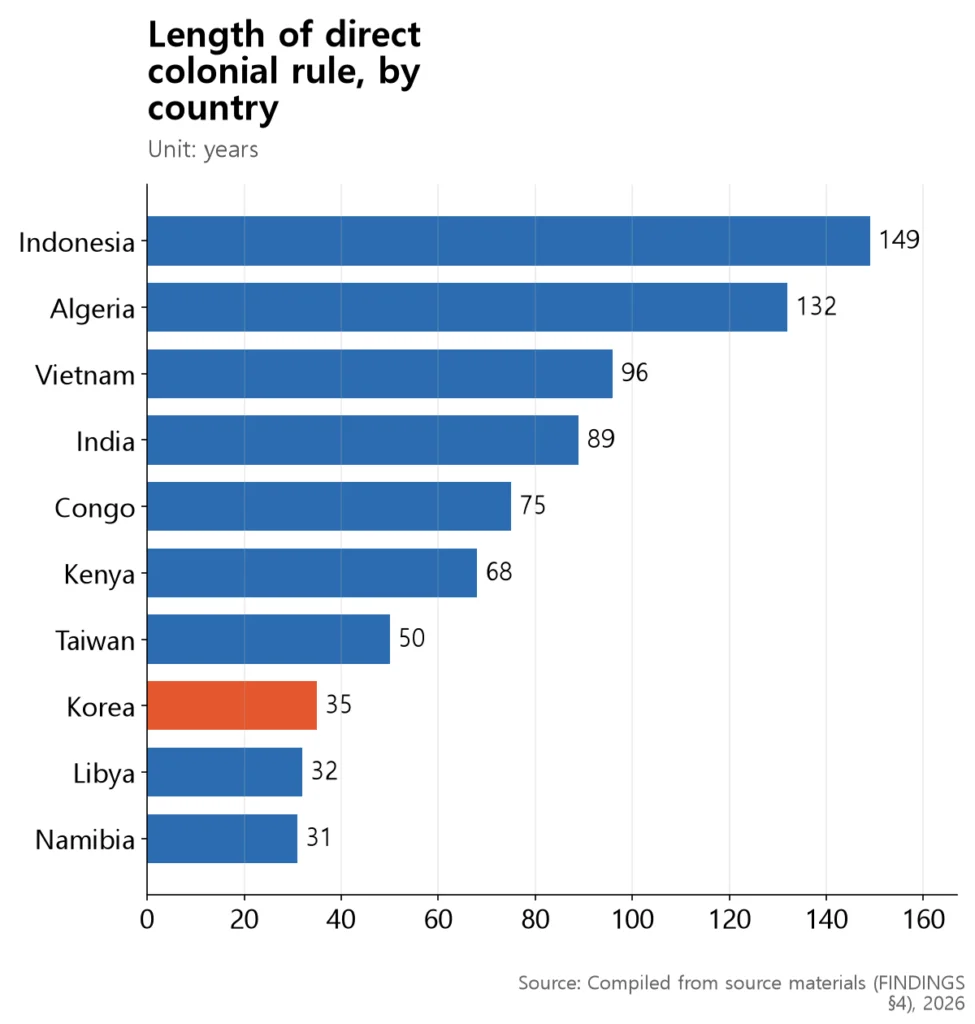
Korea’s figure is 35 years — from the 1910 annexation to liberation in 1945. Starting from the 1905 Eulsa Treaty, it becomes 40. The common phrase “36 years of Japanese rule” is actually 34 years and 11 months (29 Aug 1910 – 15 Aug 1945), rounded up on both ends. Among the ten countries compared, Korea’s rule was on the shorter side.
The longer the rule, the rarer the apology
Did the long periods of rule lead to apologies? Within this sample, the pattern runs the other way — the longer the rule, the rarer the formal apology. Even the Netherlands, which ruled the longest here (149 years over Indonesia), apologized only for slavery and for violence in the independence war. The trend only applies to the cases below, and each country has its own reasons for saying what it did or did not say.
| Victim country (colonizer) | Length of rule | Formal apology? |
|---|---|---|
| Algeria (France) | 132 years | Formally refused (2021) |
| DR Congo (Belgium) | 75 years | No — King’s “deepest regret” (2020) |
| Kenya (United Kingdom) | 68 years | No — government “sincerely regrets” (2013) |
| Libya (Italy) | 32 years | Apology (2008) |
| Namibia (Germany) | 31 years | Apology, asked forgiveness (2021, unsigned) |
Two points sit just outside the table. The Netherlands only in 2023 recognized Indonesia’s independence as of 17 August 1945 — “fully, without reservation” — rather than 1949, as it had long maintained. And France is in fact the country that received money from Haiti: 150 million gold francs in 1825 as the price of independence recognition (reduced to 90 million in 1838). In 2025 Macron called this “unjust,” but offered no apology and no reparations.
“Apology” and “regret” are not the same word
The word European monarchs and governments reach for most often is not “apology” but “regret.” Regret carries no legal admission of wrongdoing. The British government made the distinction unusually explicit — the same 2013 statement that announced the Mau Mau settlement in Kenya said London “sincerely regrets” the abuses and in the next breath “continues to deny legal liability.”

| Who | When | Wording |
|---|---|---|
| Belgian King → Congo | 2020 | “deepest regrets” (plus profonds regrets) |
| UK government → Kenya | 2013 | “sincerely regrets” |
| King Charles → Kenya | 2023 | “greatest sorrow and the deepest regret” |
| German Foreign Minister → Namibia | 2021 | “asks for forgiveness” (um Vergebung bitten) |
| Dutch King (slavery) | 2023 | “apology (excuses), as King and as part of the government” |
Belgium shows the political weight of the word. The Chamber of Representatives’ special committee on the colonial past wound up in 2022 without reaching a conclusion on a parliamentary apology resolution. The argument against was blunt: “an apology opens the door to reparations claims.” Belgian courts took a different route. In 2024 the Brussels Court of Appeal ruled that the forced separation of mixed-race children born in the Congo between 1948 and 1952 was a crime against humanity and ordered compensation for five women; the Court of Cassation confirmed the ruling in May 2026.
Even when money changed hands, it wasn’t called “reparations”
If apology is hard, is money easier? Not really. The countries that did pay carefully avoided calling the payment “reparations”. The names shift to “reconstruction and development,” “friendship and cooperation,” “settlement,” “education fund,” or “economic cooperation.”

| From → To | Amount | Label used |
|---|---|---|
| Germany → Namibia | €1.1 billion over 30 years | Reconstruction and development aid |
| Italy → Libya | US$5 billion over 20 years | Friendship and cooperation |
| UK → Kenyan victims | £19.9 million (5,228 victims, legal costs included) | Settlement (liability denied) |
| Netherlands (slavery) | €200 million | Education fund |
| Japan → South Korea (1965) | US$300 million (grants) + US$200 million (loans) | Economic cooperation |
The Germany–Namibia case has an eerie resemblance to the 1965 Korea–Japan deal. Germany’s foreign ministry statement (28 May 2021) acknowledged the 1904–1908 killings of the Herero and Nama as “genocide from today’s perspective,” yet attached to the €1.1 billion the line: “no legal claim for compensation can be derived from this.” Draft language that “all financial aspects are settled” echoes Article 2 of the 1965 Korea–Japan agreement — “settled completely and finally.” And five years on, as of October 2026, the joint declaration is still unsigned — Namibia’s parliament has not ratified it, blocked by affected community leaders and the opposition.
The US$300 million grant portion of the 1965 Korea–Japan deal was also not paid in cash. Article 1 of the agreement specifies that it be delivered as “products of Japan and services of Japanese nationals” over ten years. The treaty itself is formally titled the “Agreement on the Settlement of Problems Concerning Property and Claims and on Economic Cooperation.”
In the light of the immeasurable suffering caused by the genocide, we ask for forgiveness from the descendants of the victims … Given the nature of this support, no legal claim for compensation for past events can be derived from it.
Statement by Germany’s Federal Foreign Office, 28 May 2021 (Foreign Minister Heiko Maas) — paraphrased from the Korean rendering
South Korea — the apology texts exist, so why no closure?
It is often said “Japan has never apologized.” On paper, that is wrong — Japan has issued more apology documents to South Korea than any European colonizer did to its former colonies. But the reverse claim — “Japan has apologized and paid, case closed” — is also one-sided. The dispute is not over whether apologies were made, but over legal liability for compensation and the consistency of what Japanese officials said afterwards.
| Year | What | Key wording |
|---|---|---|
| 1993 | Kono Statement | Acknowledges military involvement in recruiting and running comfort stations; “apology and remorse” |
| 1995 | Murayama Statement | On colonial rule and aggression: “deep remorse” and “heartfelt apology” |
| 1998 | Kim Dae-jung–Obuchi Joint Declaration | “Deep remorse and heartfelt apology” for damage and suffering caused by colonial rule |
| 2010 | Kan Statement | Colonial rule was imposed “against the will of the Korean people” |
| 2015 | Comfort women agreement | Apology and remorse in the Prime Minister’s name, one-off ¥1 billion from Japan’s budget, “final and irreversible” |
| 2018 | Korean Supreme Court ruling, forced labor | Japan calls it a “breach of the agreement”; Korea holds that “consolation money for wrongful acts falls outside the agreement” |
The ¥1 billion figure attached to the 2015 agreement does not appear in Japan’s official English-language release (it says only “a one-off contribution from the budget”). The ¥1 billion comes from the Japanese-language press conference and media coverage on both sides. The Reconciliation and Healing Foundation set up in 2016 was dissolved in July 2019; the balance was about 5.8 billion won. South Korea did not formally scrap the agreement itself.
In October 2018 the Supreme Court of Korea finalized damages against Nippon Steel for forced wartime labor, holding that “consolation money for wrongful acts tied directly to colonial rule falls outside the 1965 agreement.” Japan called it “a clear breach of Article 2.” In March 2023 the South Korean government announced a solution in which a foundation under the Ministry of the Interior would pay the court-ordered amounts and delayed interest instead of the Japanese firms, funded by voluntary contributions from domestic companies. Of the 15 plaintiffs, 11 accepted; Yang Geum-deok, one of the survivors, accepted in October 2024. Some families refused and are still pursuing enforcement against assets of a Mitsubishi subsidiary (first-instance ruling in their favor, February 2025).
This is the context the Stora Report had in mind when it cited “apologies that did not lead to reconciliation.” The report, however, did not explore in detail why — whether apologies are inherently ineffective, or whether the problem was that they were decoupled from money and legal liability. France’s use of this precedent was itself contested at the time.
Most of Europe stopped at “regret” too
Line the six cases up on one page and the pattern becomes clear: colonial apology and reparations are not a uniquely Korea–Japan problem — most former colonial powers have ducked them.

| How far | Country (target) |
|---|---|
| Apology + money | Germany (Namibia, unsigned); Italy (Libya) |
| Apology, limited scope | Netherlands (slavery; independence-war violence) |
| Regret + money | UK (Kenya) |
| Regret only | Belgium (Congo); UK (India) |
| Formal refusal | France (Algeria) |
Even the two “apology + money” cases are not closed. The Germany–Namibia joint declaration remains unsigned as of October 2026, and affected community representatives and the opposition have filed a High Court suit to annul it as “insufficient.” The US$5 billion Italy–Libya programme was effectively suspended by the 2011 Libyan civil war, and former Prime Minister Berlusconi himself reportedly described its purpose as “fewer illegal migrants, more oil.”
How to read these numbers
- “Length of colonial rule” can double depending on when you start counting. The Dutch “350 years in Indonesia” and Portugal’s “500 years” are inflated; Korea’s commonly cited “36 years” is 34 years 11 months on the strict 29 Aug 1910 – 15 Aug 1945 reading.
- Germany’s €1.1 billion is not “reparations.” Berlin’s official label is “reconstruction and development aid,” and the joint declaration is still unsigned. The phrase “uncapped €1.1 billion” appeared only in search summaries and is not used here.
- It is wrong to say the UK apologized to Kenya. London expressed regret and paid a settlement but denied legal liability. The £19.9 million includes legal costs, so dividing it by the 5,228 victims to quote a “per person” amount is misleading.
- “Macron apologized to Algeria” is also wrong. The 2021 request for forgiveness was directed at the Harkis, Algerians who fought on the French side; the formal refusal on Algeria itself still stands.
- The 1952 Luxembourg Agreement between Germany and Israel (DM 3.5 billion) is not colonial reparations. It is compensation for the Holocaust, a different category, and has been excluded from this comparison.
Summary
Put the tables side by side and one thing is clear. The longer the colonial rule, the rarer the formal apology; even countries that paid money avoided calling it “reparations”; and most European monarchs and governments stopped at the word “regret.” South Korea sits on the shorter end for length of rule and the longer end for apology texts received — yet “reconciliation” stalls precisely where the two governments part ways on how those apologies tie to money and legal responsibility. France pointed at exactly that gap to justify its own refusal. Across Europe’s cases, the lesson repeats: an apology is where this kind of reckoning starts, not where it ends.

Awesome News on Instagram @awesome_news_kr
This article is the research behind our Korean-language card news. Every morning we turn Korean data and official sources into short visual stories. See it on Instagram →
Sources
- German Federal Foreign Office (Auswärtiges Amt) — Statement by Foreign Minister on Namibia, 28 May 2021 (2021-05-28)
- GPIL, University of Bonn — Reconciliation without reparation: the German–Namibian Joint Declaration on our colonial past (2023)
- The Namibian — President optimistic on genocide reparations deal by 2026 (2026-04)
- UK Government (gov.uk) — Statement to Parliament on settlement of Mau Mau claims (2013-06-06)
- MERIP (Gazzini) — Assessing Italy’s ‘Grande Gesto’ to Libya (2009)
- RNZ — Italy apologises to Libya (2008)
- AFP (via Le360 and TelQuel) — French presidency: “neither repentance nor apology” on the Algerian War (2021-01-20)
- worldjpn, Database of Japanese Politics and International Relations — Agreement on the Settlement of Problems Concerning Property and Claims and on Economic Cooperation (English text) (1965-06-22)
- Ministry of Foreign Affairs of Japan — Kono Statement on the result of the comfort women investigation (1993-08-04)
- Ministry of Foreign Affairs of Japan — Murayama Statement on the 50th anniversary of the war’s end (1995-08-15)
- Ministry of Foreign Affairs of Japan — Japan–Republic of Korea Joint Declaration — A New Partnership towards the 21st Century (1998-10-08)
- Cabinet of Japan — Statement by Prime Minister Naoto Kan on the centenary of the annexation of Korea (2010-08-10)
- Ministry of Foreign Affairs of Japan — Announcement by Foreign Ministers of Japan and the Republic of Korea on comfort women (2015-12-28)
- Ministry of Foreign Affairs of Japan — Statement by Foreign Minister on the Korean Supreme Court ruling on forced labor (2018-10-30)
- Newsis (Korean) — Government announces third-party payment solution on forced labor (2023-03-06)
- Financial News (Korea) — First-instance win in enforcement against a Mitsubishi subsidiary (Korean) (2025-02-18)
- Royal House of the Netherlands — King’s address apologizing for slavery (2023-07-01)
- VRT — Belgian Chamber Special Committee on the Colonial Past ends without conclusion (2022-12-19)
- Amnesty International and others — Joint statement on the Court of Cassation ruling in the Belgian mixed-race children case (2026-05-25)
📊 Download the data
Every number in this article’s 6 charts and tables, in one CSV file (opens in Excel or Google Sheets). When you cite it, please name the original source and link to this page.
Download CSV