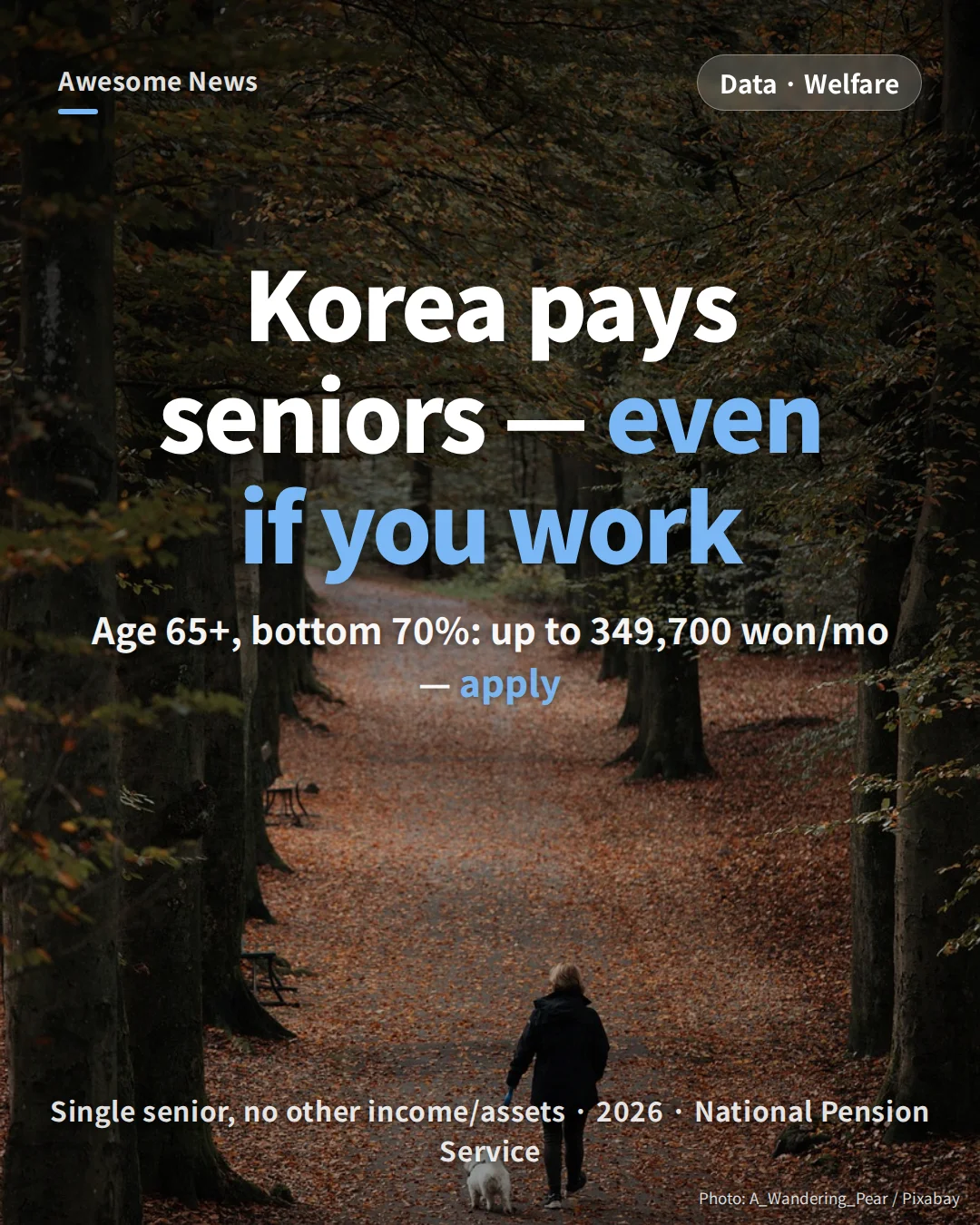
South Korea’s Basic Pension (기초연금) is a tax-funded cash benefit for seniors — not a contributory scheme. You can receive it even if you still work, and even if you never paid National Pension contributions. It covers the bottom 70% of Koreans aged 65 and over by income. In 2026 the cap is 349,700 won per month for a single recipient and 559,520 won for a couple. A 2027 budget plan would split recipients into income tiers, but the gap between the top and bottom tiers is only about 30,000 won a month.
Key numbers at a glance
- Age 65+ in the bottom 70% by income — National Pension contributions not required (fully tax-funded)
- 2026 maximum: 349,700 won/month single; 559,520 won/month per couple (20% reduction each)
- Income eligibility (recognized income): 2.47 million won/month single, 3.952 million won/month couple
- A single senior with no other income or assets can earn up to about 56.26 million won/year in salary and still qualify (calculated)
- You must apply — benefits begin only after you file, starting one month before your 65th birthday month. Payments arrive on the 25th of each month.
1. Who qualifies and how much — 2026
The Basic Pension is not the National Pension (국민연금). The National Pension pays out contributions you made during your working life; the Basic Pension is paid from general taxes to seniors who meet an income test, regardless of contribution history. You can receive both at the same time.
Eligibility rests on two conditions: ① age 65 or older, and ② recognized income (소득인정액 — a figure that combines monthly income with an imputed monthly value from housing, cars and savings) below a government threshold. In 2026 that threshold is 2.47 million won/month for a single senior and 3.952 million won/month for a couple.
| Single senior | Couple | |
|---|---|---|
| Monthly maximum | 349,700 won | 559,520 won (each cut 20%) |
| Income threshold | ≤ 2.47 million won/month | ≤ 3.952 million won/month |
| Payment date | 25th of each month, own bank account | 25th of each month, own bank account |
The 349,700 won cap is a 2.1% inflation uplift from 342,510 won in 2025. When both spouses receive the benefit, each is cut by 20% to 279,760 won, for a combined 559,520 won.
2. You can still work — wages are counted at roughly half
Many seniors skip the application because they assume a paycheck disqualifies them. The official formula is far more generous: 1.16 million won/month is deducted up front, and an additional 30% is deducted from the remainder.
For a pre-tax salary of 3 million won/month, counted income is (3,000,000 − 1,160,000) × 0.7 = 1.288 million won/month (calculated) — well below the 2.47 million won single threshold. With no other income or assets, that senior qualifies.
With no other income and no home, the theoretical ceiling is a salary of about 4.69 million won/month, or 56.26 million won a year. Owning a home with an official assessed value of 300 million won still leaves room for an annual salary somewhere between 43 million and 47 million won, depending on where you live.
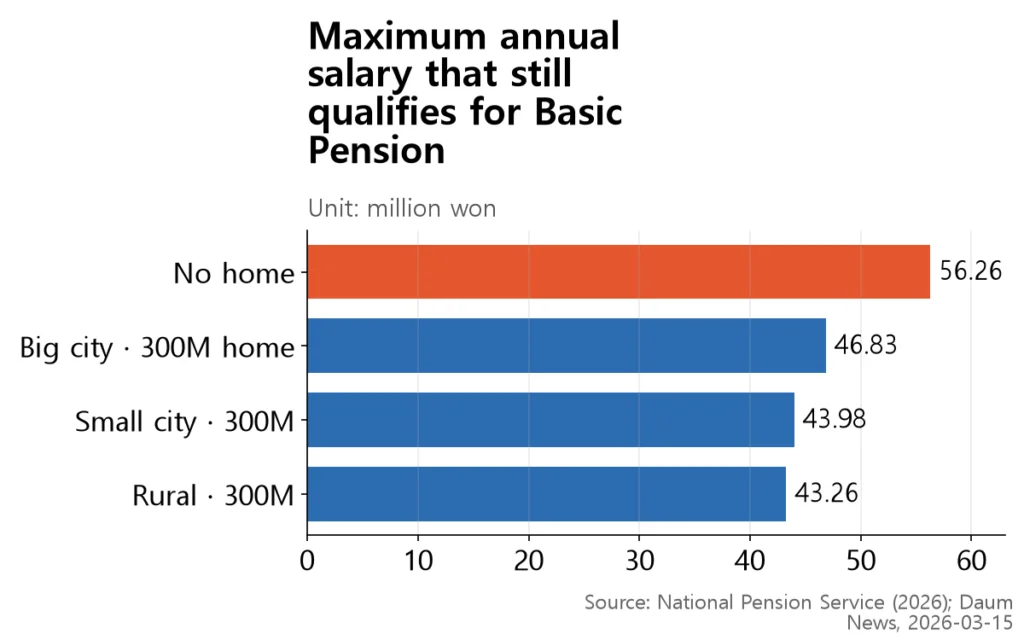
The same 300 million won home yields a higher qualifying salary in Seoul than in a rural county because of the basic asset deduction (기본재산액 공제). Before property is converted to imputed income, a fixed amount is deducted — and that deduction depends on where you live.
| Region | Basic asset deduction | What counts |
|---|---|---|
| Big city | 135 million won | Special/metropolitan cities + special cities over 1 million people |
| Small/medium city | 85 million won | ‘Si’ (cities) within provinces |
| Rural | 72.5 million won | ‘Gun’ (counties) within provinces |
The 62.5 million won gap between big-city and rural deductions, converted at the standard 4% annual imputation rate, equals about 208,000 won/month in counted income (calculated). The result: a Seoul retiree who moves to a village can lose the benefit on the same house. Financial assets have a separate deduction of up to 20 million won.
3. The 2027 plan: tiered payments — but the gap is only 30,000 won
In September 2026 the cabinet approved a 2027 budget plan that would split the Basic Pension by income tier. The bottom 30% would get more, the middle would get a cost-of-living bump, and the 45–70% tier would be frozen at the 2026 amount.
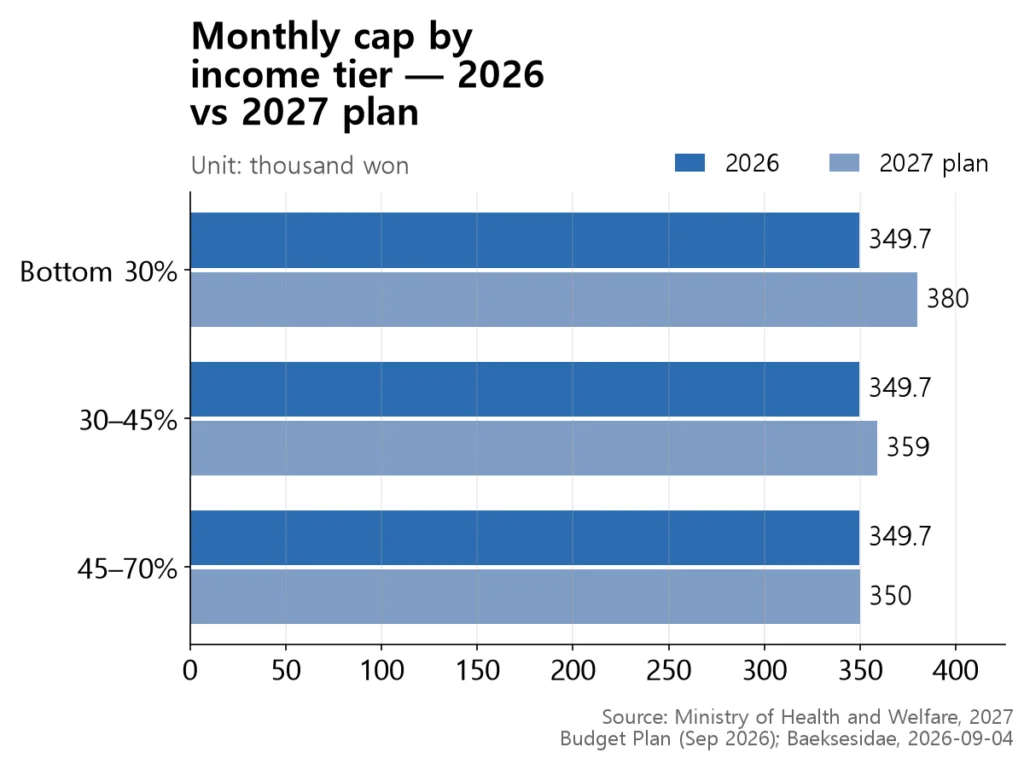
The ‘tiered’ label is modest in practice. The gap between the bottom 30% (3.48 million recipients) and the 45–70% tier (2.9 million recipients) comes to just 30,000 won/month. The 45–70% tier would end up roughly 9,000 won/month short of what simple inflation indexing would have given them.
The couple reduction would also ease. For about 2.34 million couples in the bottom 45%, the per-spouse cut would drop from 20% to 10%. A bottom-30% couple would see combined benefits rise from 560,000 won to 684,000 won; a 30–45% couple from 560,000 won to 646,000 won. About 110,000 recipients of occupational pensions (civil servants, private-school teachers, military) and their spouses in the bottom 45% — previously excluded — would newly qualify.
The government timeline is April 2027 for the tiered amounts and softer couple cut, and July 2027 for occupational-pension households. All of it depends on the National Assembly passing the amendment. Total spending would rise from 23.1 trillion won in 2026 to 25.7 trillion won (+11%).
The problem of the ‘give-and-take-back Basic Pension’ — in which recipients of the Basic Livelihood Security benefit see their benefit cut by the same amount — is not addressed in this reform plan.
Oh Kun-ho, Co-chair, My Welfare State (Kyunghyang Shinmun, 2026-09-01) (Korean, our translation)
One widely discussed change was dropped. Replacing the ‘bottom 70%’ rule with a ‘standard median income’ test — which would have shrunk the eligible pool — is not part of this budget plan.
4. If your National Pension is large, you lose some — but never all
You can collect both pensions at once, but if your National Pension exceeds 150% of the Basic Pension cap — 524,550 won/month — a ‘linkage reduction’ kicks in and shaves the Basic Pension.
The cut has a floor. No matter how large your National Pension, your Basic Pension cannot fall below 50% of the cap, or 174,850 won/month. The floor is set by Article 5(5) of the Basic Pension Act.
5. You have to apply — where, when, how
The Basic Pension is opt-in. It does not start automatically at age 65. Many eligible seniors still miss out simply because they never filed.
- When: starting one month before the month of your 65th birthday
- Where: your local community service center (행정복지센터), the nearest National Pension Service branch, or online at Bokjiro
- Payment: the 25th of each month, deposited into the recipient’s own bank account
- Help lines: National Pension Service 1355; Health and Welfare Call Center 129
Bokjiro’s benefits simulator lets you check in advance. Enter wages, assets and any National Pension amount, and it returns an estimate that already accounts for deductions and reductions.
How to read these numbers
- Figures like ‘56.26 million won/year’ and ‘46.83 million won/year’ are theoretical maxima for a single senior with no other income, no financial assets and no debt. Real cases vary widely.
- The 2027 reform is still a proposal. It requires passage of the budget and an amendment to the Basic Pension Act.
- ‘Bottom 70% by income’ is a target the government uses to set the threshold (Basic Pension Act, Article 3). Actual take-up is lower.
- Assets gifted to adult children can still count as the senior’s own assets for a defined period (‘other gifted assets’). This is a separate rule from the principle that a child’s own wealth is not counted in a parent’s eligibility.
Summary
The Basic Pension is not just for the destitute. Seven in ten Koreans aged 65 and over qualify. You can still earn a salary, still receive the National Pension, still own a modestly valued home — and still collect. The 2027 plan would tilt payments slightly toward lower incomes, but with a top-to-bottom gap of only 30,000 won/month it will not do much to shrink senior poverty. Above all, this is a benefit you must claim. Remind an aging parent, or a family member nearing 65, to apply.

Awesome News on Instagram @awesome_news_kr
This article is the research behind our Korean-language card news. Every morning we turn Korean data and official sources into short visual stories. See it on Instagram →
Sources
- National Pension Service — National Pension On-air — 2026 Basic Pension: What’s Changing (Korean) (2026)
- Kyunghyang Shinmun — 2027 Budget: Basic Pension eligibility stays at bottom 70% (Korean) (2026-09-01)
- Baeksesidae — Bottom 30% of Basic Pension recipients to get 30,000 won/month more from April 2027 (Korean) (2026-09-04)
- Daum News — Basic Pension in Seoul, cut off after moving to the countryside (Korean) (2026-03-15)
- Ministry of Health and Welfare / Korea Social Security Information Service — Bokjiro — Basic Pension guide and benefits simulator (Korean)
📊 Download the data
Every number in this article’s 4 charts and tables, in one CSV file (opens in Excel or Google Sheets). When you cite it, please name the original source and link to this page.
Download CSV