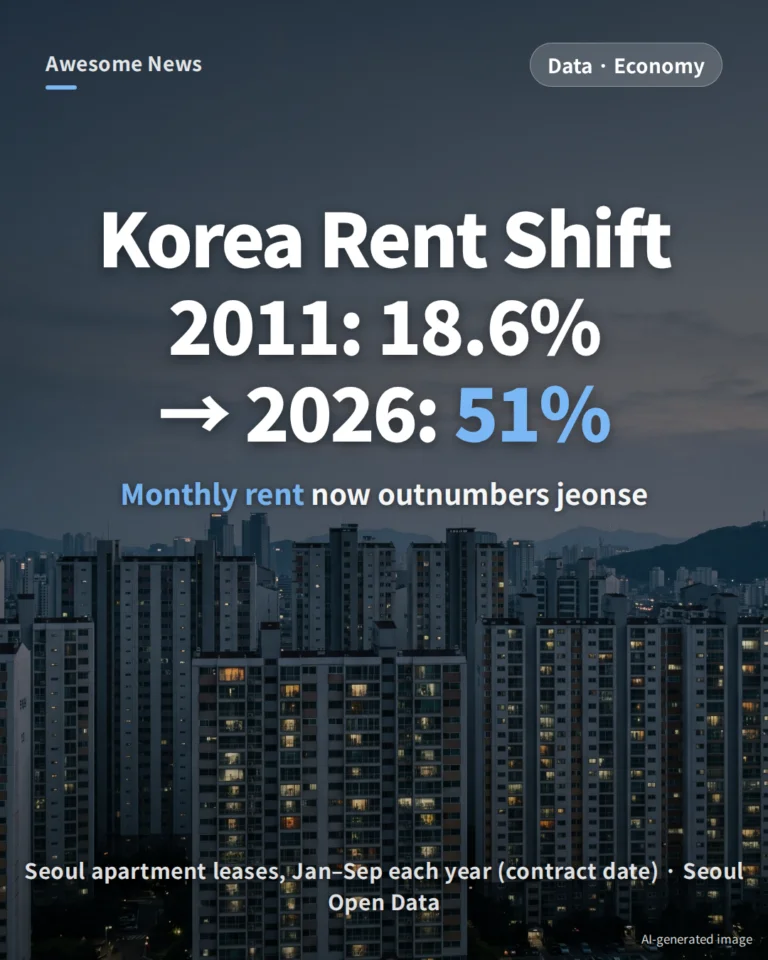
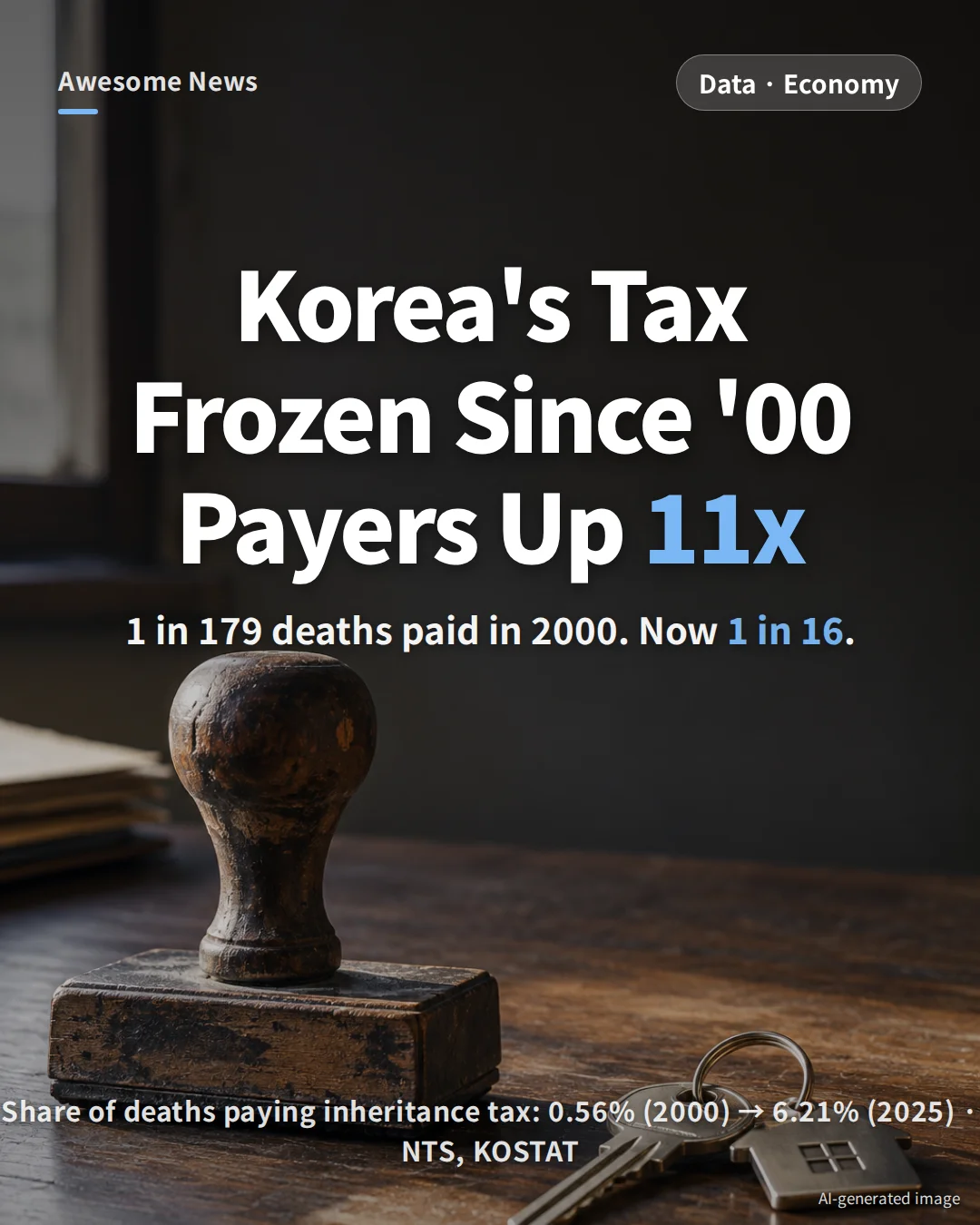
South Korea’s inheritance tax code has barely changed in a generation, but the number of people paying it has multiplied eleven-fold. In 2000, roughly 1 in 179 deaths (0.56%) triggered an inheritance tax bill. In 2025, it was 1 in 16 (6.21%). This piece looks at ① when the rates and deductions stopped moving, ② how far prices and Seoul apartment values have risen since, ③ how the number of taxpayers, the share, and the average bill have shifted, ④ how Korea compares with other OECD countries, and ⑤ why repeated reform attempts have failed.
Key numbers at a glance
- Rate schedule: 10 / 20 / 30 / 40 / 50% (bands of 100 million / 500 million / 1 billion / 3 billion won). Enacted December 1999, in force since January 2000 — unchanged for 26 years and 9 months.
- Lump-sum deduction of 500 million won and a minimum 500-million-won spouse deduction: in force since January 1997 — unchanged for 29 years and 9 months (in 2016 only the personal deductions moved, e.g. per-child and elderly deductions from 30 to 50 million won).
- Share of deaths that pay inheritance tax: 0.56% (2000) → 6.21% (2025), an 11.1-fold rise. Seoul alone reached 15.94% in 2025 (press reports).
- Taxable decedents: 1,389 (2000) → 22,524 (2025, a record high, 16.2×). Total assessed tax: 513.7 billion → 8.93 trillion won (17.4×).
- Average tax per case: 370 million → 397 million won in nominal terms (+7%); but 682 million → 397 million won in 2025 prices (−42%). The newcomers are small ‘one-home’ estates.
When the law stopped moving
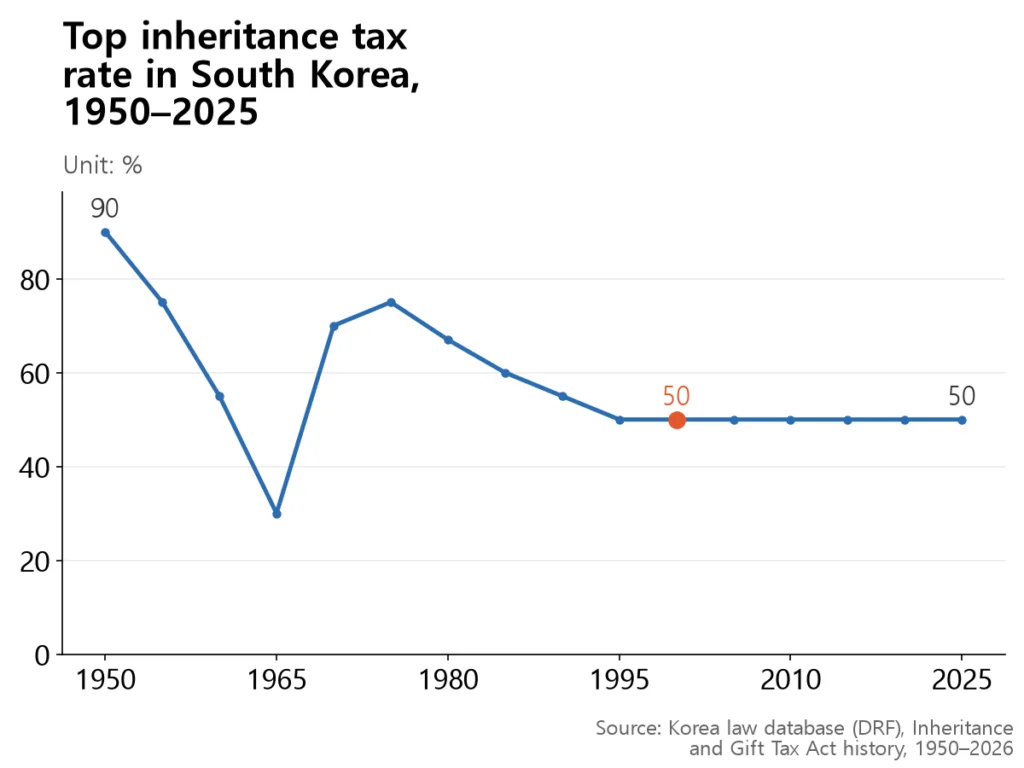
The current rate schedule — 10% up to 100 million won of taxable base, 20% up to 500 million, 30% up to 1 billion, 40% up to 3 billion, and 50% above 3 billion won — took effect on 1 January 2000 under Law No. 6048. Between 1950 and 1999, Korea revised the rate table 13 times. It has not revised it since. As of October 2026 there is no scheduled version in the pipeline either (per Korea’s official law database).
The top rate has swung widely before. It was 90% when the tax was created in 1950, dropped as low as 30% in 1961, climbed back to 75% in 1975, and sat briefly at 40% in 1996 before the 1997 overhaul raised it to 45% and the 1999 revision set it at the current 50%.
Deductions unchanged since 1997
The deduction structure took its current shape in a December 1996 overhaul that entered force on 1 January 1997. That revision introduced the 500-million-won lump-sum deduction and set the spouse deduction at ‘actual inherited share within statutory limits, up to 3 billion won, with a floor of 500 million won.’ Those headline numbers — 200 million basic, 500 million lump-sum, 500 million minimum / 3 billion maximum for spouses — have not moved in 29 years and 9 months. In 2016 the per-child and elderly-dependant allowances rose from 30 to 50 million won, but for most estates (which elect the lump-sum option), the change is barely felt.
| In force from | Basic | Lump-sum | Spouse (min–max) | Per child |
|---|---|---|---|---|
| 1991 | 60 million won | — | 100 million + add-ons | 20 million won |
| 1994 | 100 million won | — | 100 million + add-ons | 20 million won |
| 1997 | 200 million won | 500 million (new) | 500 million – 3 billion | 30 million won |
| 2016 | 200 million won | 500 million | 500 million – 3 billion | 50 million won |
| 2026 | 200 million won | 500 million | 500 million – 3 billion | 50 million won |
One quiet change *did* raise effective burdens without touching the rate table: the early-filing credit fell from 10% (1997–2016) to 7% in 2017, 5% in 2018 and 3% from 2019 onward. A revision promulgated in late 2025 for 2026 implementation also left the rate schedule and the lump-sum/spouse deductions untouched, tightening only workarounds such as inheritances routed through for-profit entities.
What ‘500 million won’ used to be worth
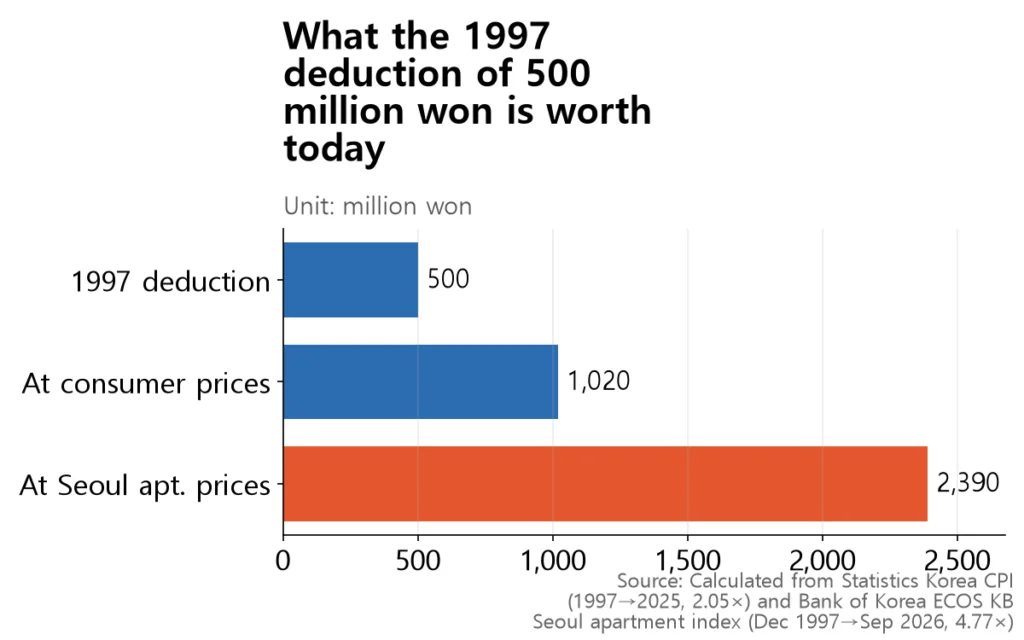
The same ‘500 million won’ is not the same money. Korea’s consumer price index (2020=100) rose from 57.0 in 1997 to 116.6 in 2025 — a 2.05× increase. The KB Seoul apartment price index rose 4.77× between December 1997 and September 2026 (Bank of Korea ECOS).

Converted into today’s money, the 500-million-won deduction from 1997 is worth roughly 1.02 billion won at consumer prices, or about 2.39 billion won if indexed to Seoul apartment prices (calculated). Meanwhile, the average Seoul apartment sold for 1.625 billion won in September 2026, with a median of 1.313 billion won (KB). Even with a surviving spouse and children — a combined deduction of 1 billion won — inheriting a single Seoul apartment is now enough to create a taxable base.
Eleven times as many payers in 25 years
Static law plus rising assets produces more taxpayers. The share of deaths that resulted in an inheritance tax assessment rose from 0.56% in 2000 to 6.21% in 2025 — an 11.1-fold increase. Roughly 1 in 179 deaths in 2000; roughly 1 in 16 today. The share doubled in just the five years after 2020 (3.34%).
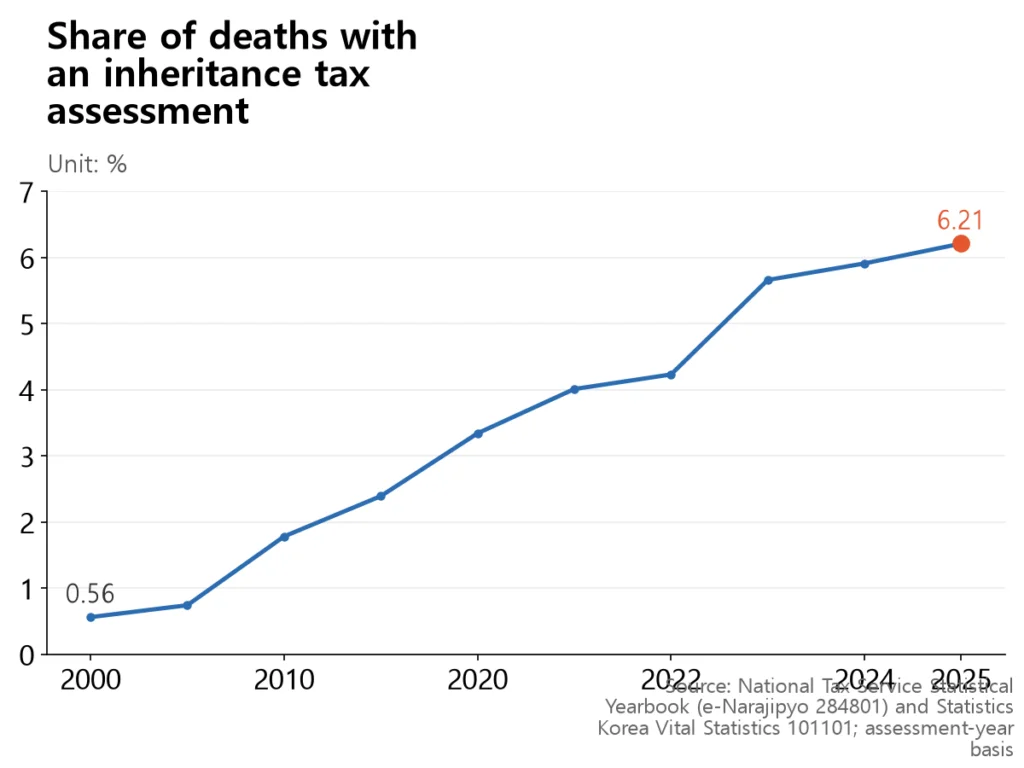
In headcount, taxable decedents went from 1,389 in 2000 to 22,524 in 2025 (16.2×), and total assessed tax from 513.7 billion to 8.93 trillion won (17.4×). A February 2026 Ministry of Economy and Finance briefing citing ‘5.9% of 2024 decedents’ used the same denominator (assessments ÷ deaths in the same year) and matches our 2024 figure of 5.91%.
In Seoul, roughly 1 in 6
The geographic split is wide. According to Money Today and Hankyung reporting, Seoul’s taxable share in 2025 was 15.94% — 8,383 taxable estates against 52,592 deaths — more than 2.5 times the national rate. Add neighbouring Gyeonggi (6,322 taxable estates) and the Seoul metropolitan region accounts for about 65% of all taxable estates. Seoul’s share was 4.12% in 2010, so it has roughly quadrupled in 15 years (press reports citing NTS data; the National Tax Service has not yet published official regional tables). Even so, nine out of ten estates nationwide still owe nothing — the idea that ‘everyone pays now’ is not borne out by the data.
The average bill has actually fallen
A 17-fold rise in total revenue does *not* mean a 17-fold rise per estate. The average assessed tax per taxable estate went from 370 million won in 2000 to 397 million won in 2025 — up only 7% in nominal terms. Adjusted to 2025 prices, that is a fall from 682 million to 397 million won, roughly −42% (calculated).

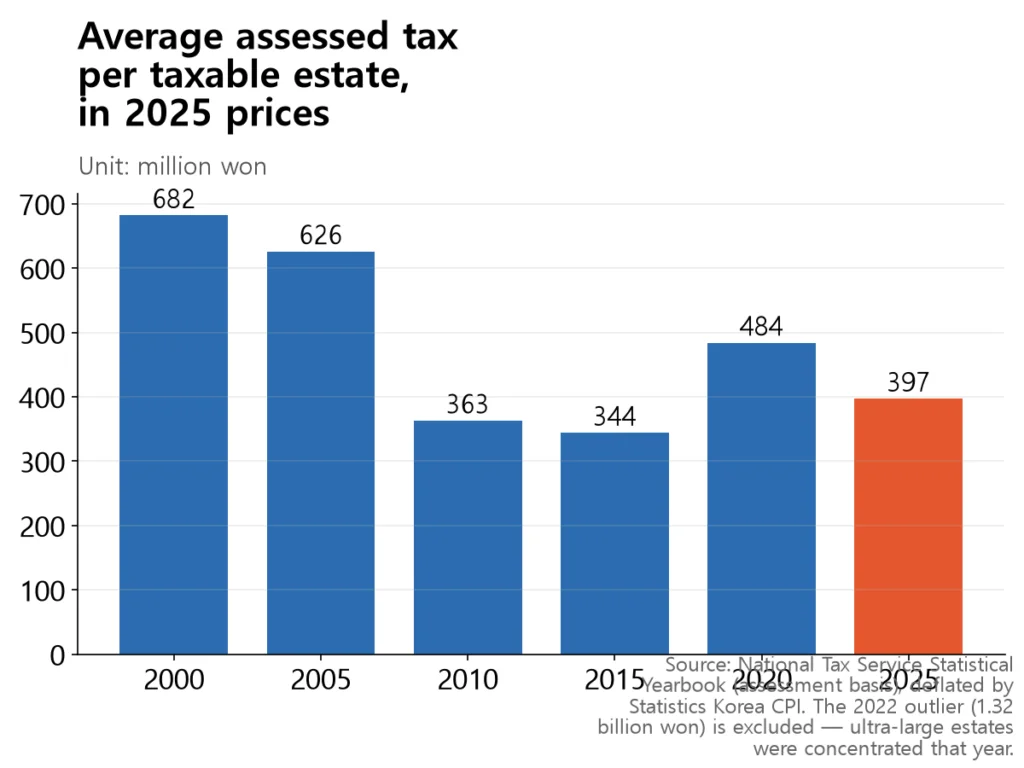
National Assembly disclosures of NTS data show that 76.8% of taxable decedents in 2025 (17,294 people) had a taxable base of 1 billion won or less, with an average bill of just 50.63 million won. This bottom-three-quarters group accounts for only 9.8% of total revenue (about 875.6 billion won). The bulk of the money still comes from the very top: a National Assembly Budget Office analysis of 2022 data found that the top 10% paid 92.0% of all assessed inheritance tax. In short, the tax has shifted from a ‘rich-only tax’ to a ‘rich tax plus a one-home middle-class tax’ (bracket-level and Seoul figures via press reports citing data obtained by Rep. Lee Kwang-jae’s office from the NTS).
OECD’s heaviest reliance, and years of failed reform
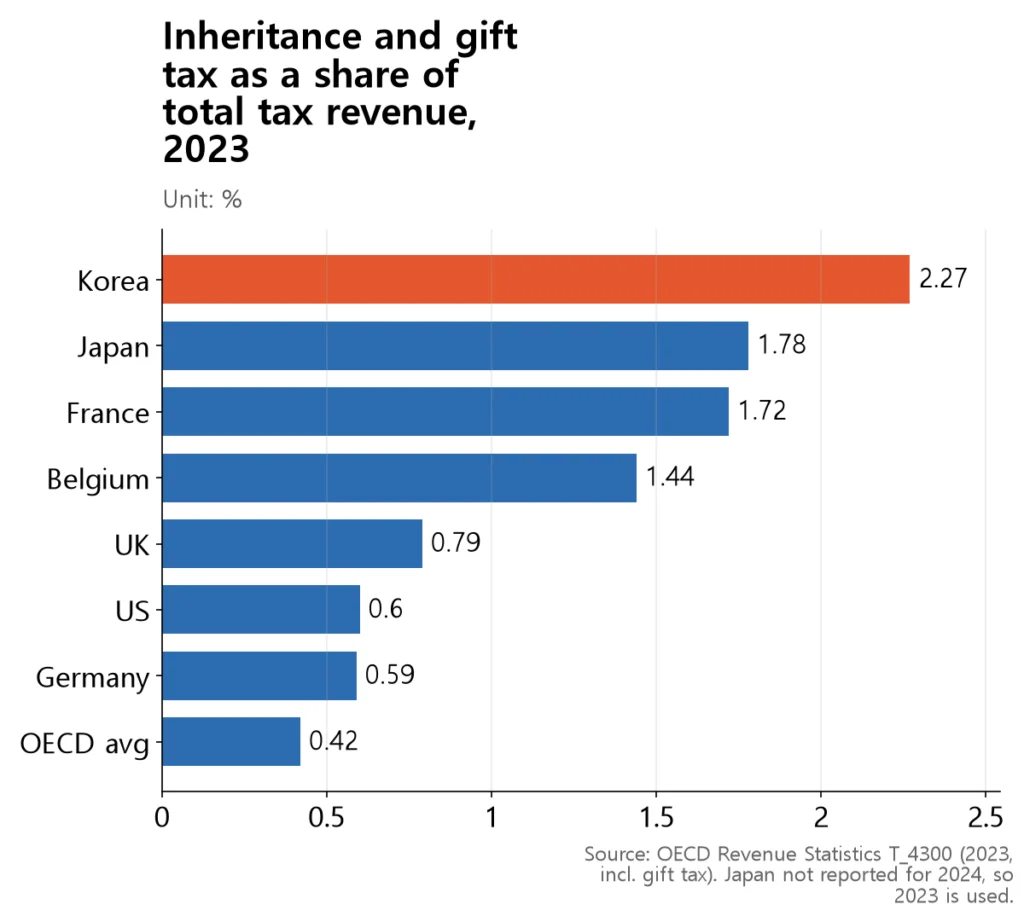
Within the OECD, Korea now relies on inheritance and gift tax more than any other member. These taxes make up 2.27% of total tax revenue in Korea (2023), versus an OECD average of 0.42% — more than five times the average. The share was 0.73% in 2000, so it has roughly tripled in 25 years. As a share of GDP, Korea’s 0.61% is second only to France’s 0.76%.

Rate cuts and higher deductions have been attempted repeatedly — and have repeatedly failed to pass. ① In 2008, the Lee Myung-bak administration proposed cutting the rate band to 6–33%; the bill was abandoned at the end of its term after a ‘tax cuts for the rich’ backlash. ② In 2014, the Park Geun-hye government’s package of higher child and elderly-dependant deductions, bundled with an expanded family-business exemption, was voted down on the floor (only the dependant portions passed a year later). ③ On 10 December 2024, the Yoon Suk-yeol administration’s package to cut the top rate from 50% to 40% and raise the child deduction to 500 million won was defeated: 281 present, 97 for, 181 against, 3 abstained. ④ A March 2025 Finance Ministry proposal to switch to an *inheritor-level* (recipient-based) tax was tabled in May but shelved after the change of government. ⑤ The National Assembly’s tax subcommittee closed its November 2025 session without touching rates or deductions. ⑥ In September 2026, Rep. Lee Kwang-jae said he would push a system that automatically indexes deductions to inflation ‘during this regular session’ — not yet law (press reports).
How to read these numbers
- Check the denominator. Our ‘taxable share’ uses assessments in year t ÷ deaths in year t, the same method used by the Finance Ministry and major outlets. The National Assembly Budget Office’s 2023 report uses a different base (all decedents the NTS has information on, taxable or not), which yields 4.52% for 2022. The two should not be mixed.
- Numbers are assessment-year figures, not death-year. Dividing by prior-year deaths instead gives 6.28% for 2025 — essentially the same picture.
- The 2022 per-case average of 1.22 billion won is distorted by a handful of ultra-large estates (the top 10% that year paid 92% of the total). We drop it when showing the trend.
- The Seoul 15.94%, the 76.8%-under-1-billion-won share, and the 50.63-million-won average all come from press reports citing NTS data; the National Tax Service has not yet published region- or bracket-level taxable-share tables.
- Inheritor-level taxation, a 40% top rate and inflation-indexed deductions are not law. They have been proposed, introduced or discussed in press reports. No scheduled version exists in the official law database as of October 2026.
Summary
The rate table stopped moving in 2000; the 500-million-won deduction has stood since 1997. In the meantime consumer prices roughly doubled and Seoul apartment prices rose almost fivefold. The result: inheritance tax has broadened from a tax on a small wealthy minority to one that catches middle-class households inheriting a single Seoul apartment, and the number of payers has multiplied eleven-fold in 25 years. The average bill, however, has become *lighter*, and the top decile still supplies most of the revenue (92% in 2022). The code stayed put; apartment prices raised the tax instead. What sits before the National Assembly now is the government’s inheritor-level tax bill (submitted May 2025, still pending) and several lawmakers’ bills to raise the deductions; indexing to inflation has only been floated in remarks. Why the law has not changed for 26 years (the 2008 bill lapsed; the 2014 and 2024 bills were voted down) is the subject of the next piece.

Awesome News on Instagram @awesome_news_kr
This article is the research behind our Korean-language card news. Every morning we turn Korean data and official sources into short visual stories. See it on Instagram →
Sources
- Korea Ministry of Government Legislation — National Law Information Center — Inheritance and Gift Tax Act, Articles 18–21, 26 and 69, legislative history (Law No. 6048 et al.) (Korean) (1950–2026)
- National Tax Service, National Tax Statistical Yearbook / e-Narajipyo — Inheritance tax: number of taxable decedents and total assessed tax (Table 284801) (Korean) (1997–2025)
- Statistics Korea, Vital Statistics / e-Narajipyo — Birth and death statistics (Table 101101) (Korean) (1995–2025)
- Statistics Korea, Consumer Price Survey / e-Narajipyo — Consumer Price Index (Table 422601, 2020=100) (Korean) (1990–2025)
- Bank of Korea ECOS — KB housing sales price index (901Y062; P63ACA, P63AC) (Korean) (Jan 1997 – Sep 2026)
- OECD — Revenue Statistics — Taxes on estate, inheritance and gift (T_4300, T_4310) (2000–2024)
- National Assembly Budget Office — A comparative study of deduction systems under different inheritance-tax regimes (Korean) (2023-12)
- Ministry of Economy and Finance — Legislative notice: introducing an inheritor-level (recipient-based) inheritance tax (Korean) (2025-03-19)
- Ministry of Economy and Finance — 2026 tax revision package — detailed version (Korean) (2026-08-03)
- Hankyung — 30 years untouched: an outdated inheritance tax catches one-home middle-class families (Korean) (2026-09-27)
- Money Today — 16% of Seoul decedents paid inheritance tax — only 4% a decade ago (Korean) (2026-09-21)
- Ilgan NTN — 2024 inheritance-tax taxable share at 5.9% — easing wealth transmission (Korean) (2026-02-10)
- Newspim — Inheritance and gift tax amendment defeated on the floor (281 present, 97 for, 181 against) (Korean) (2024-12-10)
📊 Download the data
Every number in this article’s 6 charts and tables, in one CSV file (opens in Excel or Google Sheets). When you cite it, please name the original source and link to this page.
Download CSV