The face most people picture when they worry about YouTube is a teenager in a school uniform. Korean data say the opposite is closer to the truth. The share of people who use YouTube is already nearly identical for teens and those in their 50s, and the generation whose daily video time has grown the fastest over the past five years is Koreans in their 50s and 60s. This piece pulls together 2024–2025 figures from Statistics Korea’s Time Use Survey, the Korea Communications Commission’s 2025 Broadcasting Media Usage Survey, the Korea Press Foundation’s media surveys, the Reuters Digital News Report 2025, and the Ministry of Culture’s 2025 reading survey.
Key numbers at a glance
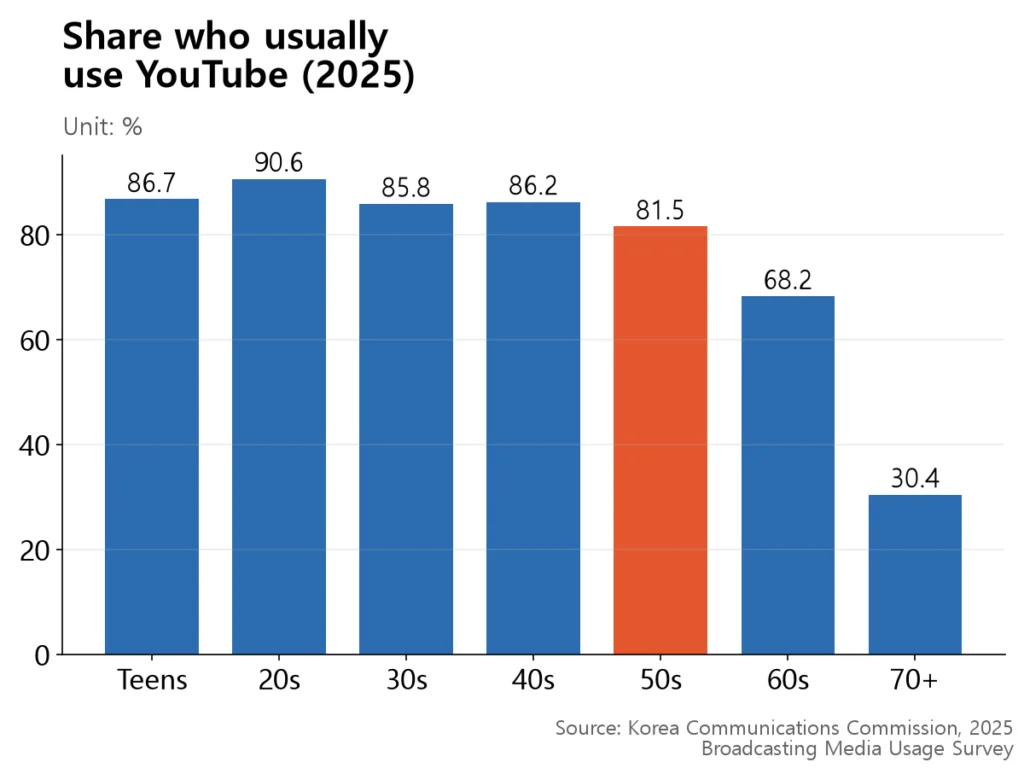
- YouTube use (2025): teens 86.7%, 20s 90.6%, 50s 81.5%, 60s 68.2% — through the 50s, Koreans use YouTube almost as much as teens (KCC).
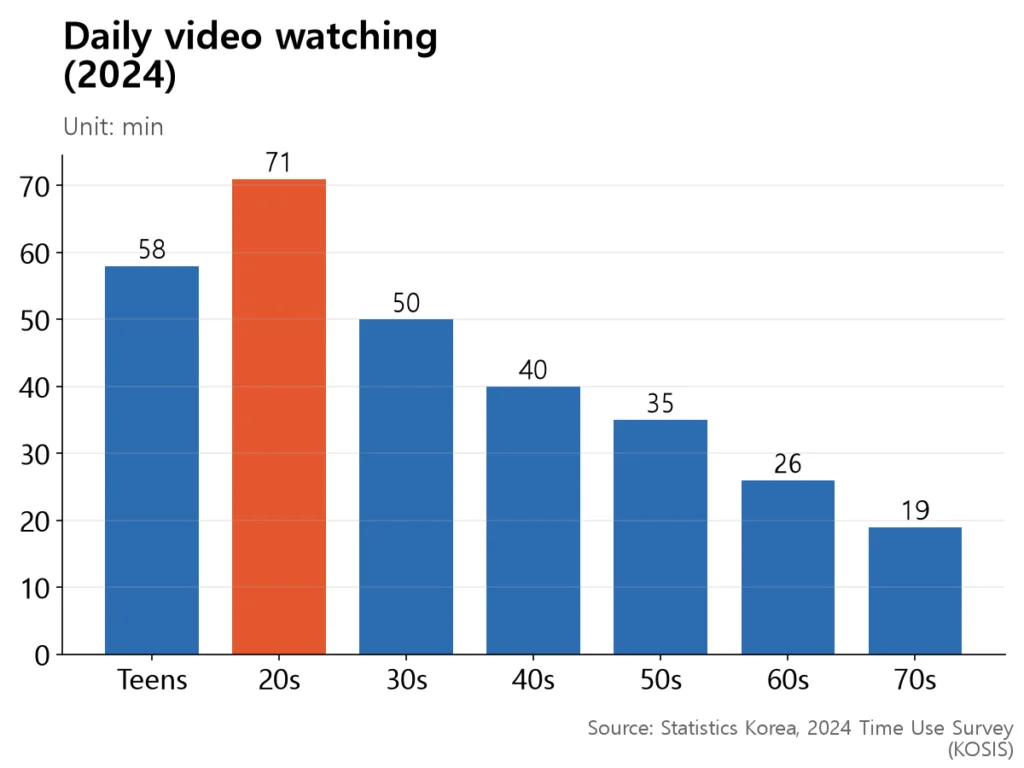
- Daily video watching (2024): teens 58 min, 20s 71 min, 50s 35 min, 60s 26 min — per person, younger still watch longer (Statistics Korea).
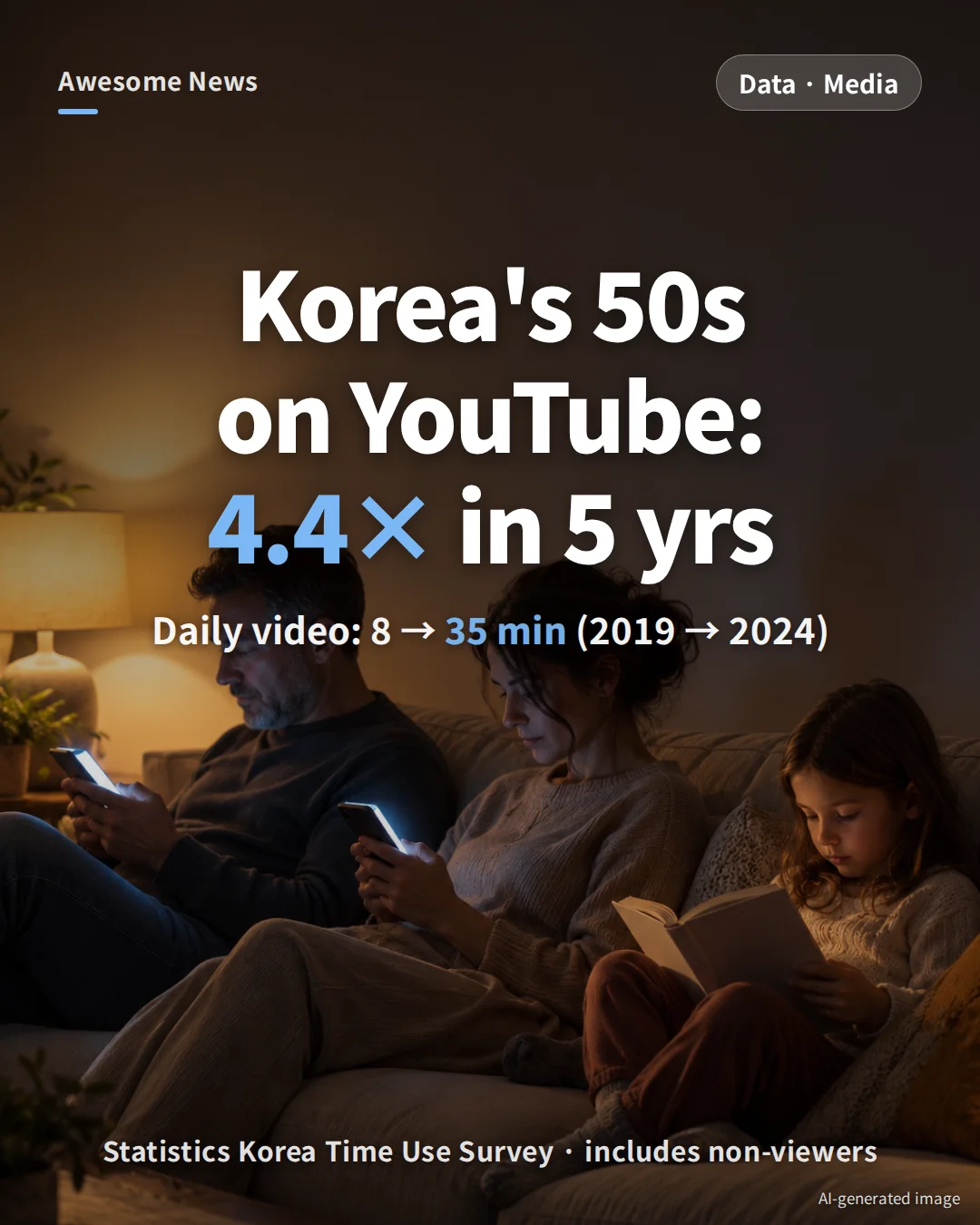
- Five-year change (2019 → 2024): teens 1.5×, 50s 4.4× (8 → 35 min), 60+ 5.5× (4 → 22 min). The fastest shift is among older adults.
- Live TV + video (2024): teens 85 min, 50s 142 min, 60s 178 min, 70s 229 min (calculated) — older adults still spend the most time in front of a screen.
- Watched news on YouTube (2025): 50s 61%, 60+ 53% — nearly double the 48-country average of 31% for people in their 50s (Reuters Digital News Report).
By the 50s, 8 in 10 use YouTube

The Korea Communications Commission’s 2025 Broadcasting Media Usage Survey (in-person interviews with 8,320 people aged 13+) finds that the share who ‘usually use’ YouTube is 86.7% for teens, 90.6% for 20s, 85.8% for 30s, 86.2% for 40s and 81.5% for 50s. The gap between teens and 50s is just 5.2 percentage points (calculated). Use drops to 68.2% in the 60s and to 30.4% among those 70 and older.
A separate adult-only poll points the same way. In the Korea Press Foundation’s 2025 Media Users Survey (6,000 adults 19+, past-week basis), weekly YouTube use was 93.6% in the 19–29 group, 89.9% in the 30s, 87.7% in the 40s, 81.9% in the 50s, 73.2% in the 60s and 50.0% at 70+. Two different surveys, almost the same number for Koreans in their 50s.
Daily minutes still tilt young

Statistics Korea’s 2024 Time Use Survey tells a different story on duration. Average daily ‘video watching’ time came to 58 minutes for teens, 71 minutes for 20s, 50 minutes for 30s, 40 minutes for 40s, 35 minutes for 50s, 26 minutes for 60s and 19 minutes for 70s (day-of-week average, including those who did not watch at all). The share of people who logged any video that day also tilts young: 54.6% of teens, 39.6% of 50s, 31.3% of 60s.
One caveat: the Time Use Survey asks respondents to record their primary activity in 10-minute slots. YouTube watched out of the corner of an eye during a meal or on the move gets logged as ‘eating’ or ‘transport’ and never counted as video. That is why these minutes come out lower than the OTT figures from the KCC survey or the ‘daily use’ numbers from the Press Foundation. Minutes from different surveys should not be compared directly.
The fastest shift: Koreans in their 50s and 60s

Compared with 2019 Time Use Survey figures, daily video time went from 39 to 58 minutes among teens (1.5×), but from 8 to 35 minutes in the 50s (4.4×) and from 4 to 22 minutes among those 60 and older (5.5×) (calculated). The share of people 60+ who logged any video on a given day jumped from 4.6% to 25.0% — more than fivefold.
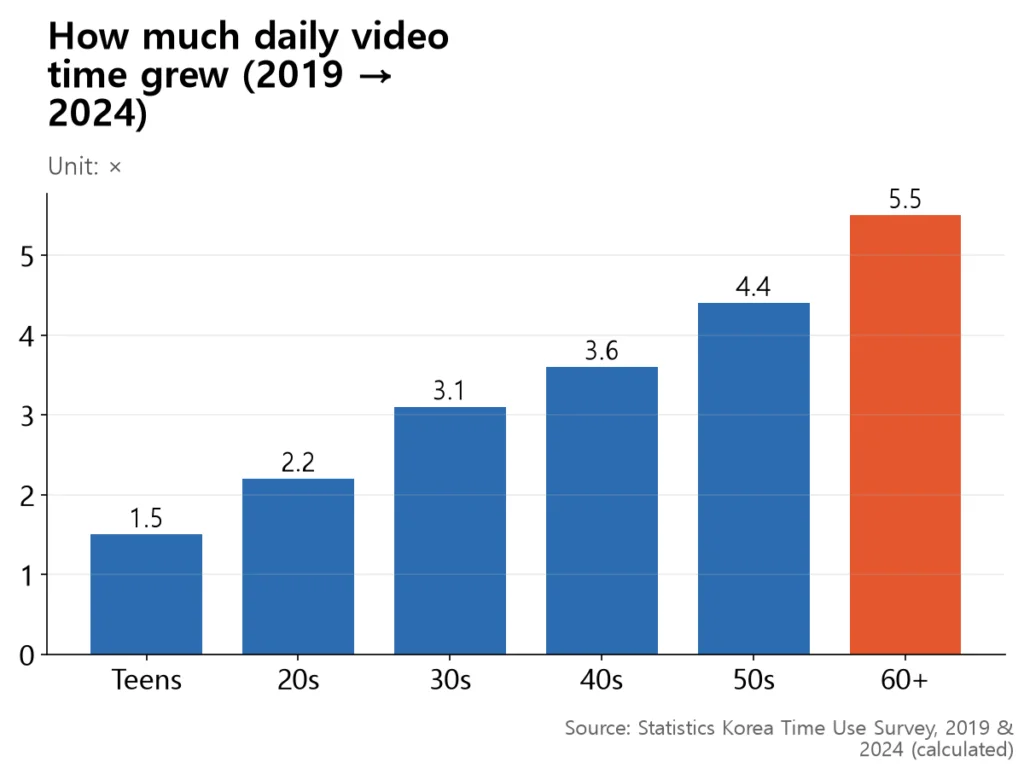
One important footnote: the 5.5× figure is for the combined 60+ group, because the 2019 survey did not publish 60s, 70s and 80+ separately. The 60s alone cannot be isolated. Still, the direction is clear — the older the age band, the steeper the shift into video.
Add TV and older adults spend more time on screen

‘Older adults watch more YouTube than teenagers’ is wrong if you only count video. Add live TV and the picture flips. Live TV runs 27 minutes a day for teens and 29 minutes for 20s, versus 107 minutes for 50s, 152 minutes for 60s and 210 minutes for 70s. The combined ‘TV + video’ daily total (calculated) comes to 85 minutes for teens, 142 for 50s, 178 for 60s and 229 for 70s.
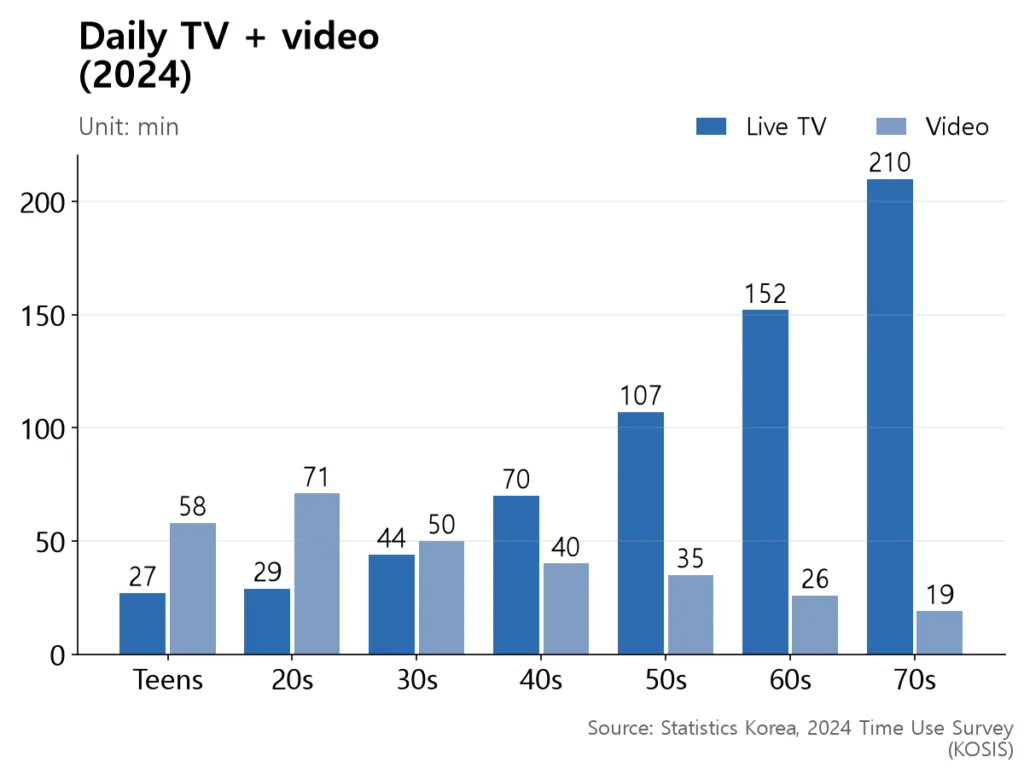
In total screen time, Koreans in their 70s put in 2.7× the daily minutes of teens (calculated), and 50-somethings 1.7×. But the backbone of older adults’ screen time is still TV: in the 50s, TV runs three times longer than video (107 vs 35 minutes); in the 70s, eleven times (210 vs 19). What is happening looks less like a full switch and more like YouTube stacking on top of TV.
61% of Koreans in their 50s get news on YouTube

The Reuters Institute Digital News Report 2025, Korea edition (published by the Korea Press Foundation) says 61% of Koreans in their 50s and 53% of those 60 and older watched, read or shared news on YouTube in the past week. The lowest share was Koreans in their 30s at 32%. On news consumption via YouTube, older Koreans are more active than people in their 20s and 30s.
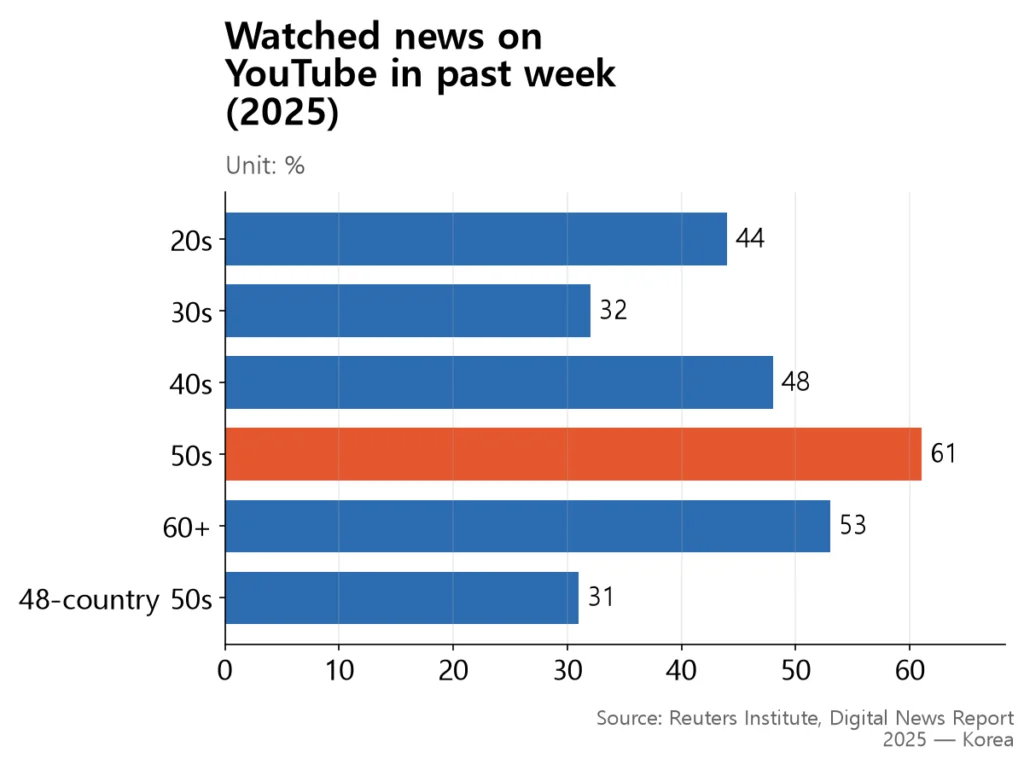
One warning. The Digital News Report is an online survey of internet users. Older people who rarely go online are under-represented, which tends to push the senior numbers up relative to other sources. In the same 2025 cycle, the Press Foundation’s face-to-face Media Users Survey found that only 24.6% of those in their 60s and 11.9% of those 70+ had used online video for news. The two sets of figures should not be plotted on the same chart.
Reading time: still 7 minutes a day

Where did the extra video time come from? Looking at adults 19 and older in the Time Use Survey, 2019 to 2024: daily reading held at 7 minutes, live TV fell by 6 minutes, and video tripled from 13 to 39 minutes.
| Daily average (adults 19+) | 2019 | 2024 | Change |
|---|---|---|---|
| Video watching | 13 min | 39 min | ~3× |
| Reading books | 7 min | 7 min | No change |
| Live TV | 113 min | 107 min | −6 min |
The share of adults who read ‘at least one book’ in the past year is slipping fastest among older groups. The Ministry of Culture’s 2025 Reading Survey reports that reading rates for people in their 50s fell from 36.9% (2023) to 26.9% (2025) — down 10.0 percentage points in two years. The 60+ rate drifted from 15.7% to 14.4%. Readers in their 20s (ages 19–29) are the highest among adults at 75.3%, with e-book reading up at 59.4%. The ‘young people don’t read’ cliché runs the opposite way in these numbers.
A caveat on the ‘7 minutes’. The Time Use Survey average includes people who didn’t read at all that day. The share of adults (19+) who logged any reading was 8.8% in both 2019 and 2024. In other words, about nine in ten didn’t open a book that day — it does not mean everyone reads 7 minutes a day.
How to read these numbers
- ‘Video watching’ in the Time Use Survey is not a YouTube-only count. The category is simply ‘video watching’. Writing ’50s YouTube up 4×’ is wrong — the 4.4× multiple is for that whole category.
- Do not compare minutes across surveys. For teens, the Time Use Survey (ages 10–19, 2024) gives 58 minutes of video a day, while the Korea Press Foundation’s youth survey (grades 4–12, 2025, online video platforms) gives 200.6 minutes. The Time Use Survey is a diary that records only the main activity, so video watched on the side is undercounted.
- ’60s alone up 5.5×’ is wrong. 2019 did not break out the 60s, so the only comparable multiple is for the combined 60+ group.
- ‘People 50+ watch the most YouTube’, as in some commercial reports, is a total-volume effect. Lumping everyone from 50 upward into one bucket makes the group large; per person, teens and 20-somethings still watch the longest.
- More video does not, by itself, prove ‘adults are losing literacy’. These figures show these trends moving at the same time — not one causing the other.
Summary
The feeling that ‘YouTube is a kids’ thing’ holds up if you look only at usage rates and per-person daily minutes: teens and 20-somethings still watch the most video per day. Zoom out five years, though, and the generation that moved into video the fastest was Koreans in their 50s and 60s. Add TV to video and older adults’ daily screen time is already roughly double that of teens. The share who get news on YouTube is twice the global average for the same age. The adults who worry about kids on smartphones may be the ones living through the biggest shift.

Awesome News on Instagram @awesome_news_kr
This article is the research behind our Korean-language card news. Every morning we turn Korean data and official sources into short visual stories. See it on Instagram →
Sources
- Statistics Korea — 2024 Time Use Survey (KOSIS tables DT_2019_004_1TM1021X · DT_2019_005_1TM1022X) (Korean) (2025-07-28)
- Korea Communications Commission — 2025 Broadcasting Media Usage Survey Report (Korean) (2025)
- Korea Press Foundation — 2025 Media Users Survey — Tables (Korean) (2025-12-31)
- Korea Press Foundation · Reuters Institute for the Study of Journalism — Digital News Report 2025 — Korea Edition (Media Survey Vol. 11 No. 3) (Korean) (2025-06-17)
- Ministry of Culture, Sports and Tourism — 2025 National Reading Survey — Press Release (Korean) (2026-03-06)
📊 Download the data
Every number in this article’s 6 charts and tables, in one CSV file (opens in Excel or Google Sheets). When you cite it, please name the original source and link to this page.
Download CSV