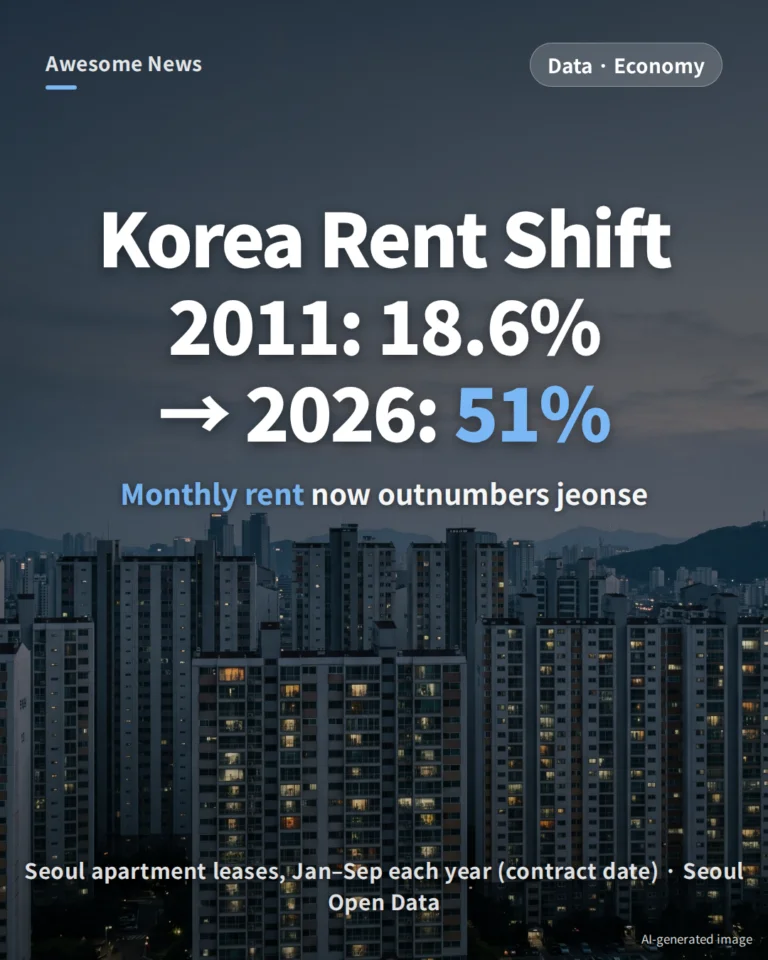
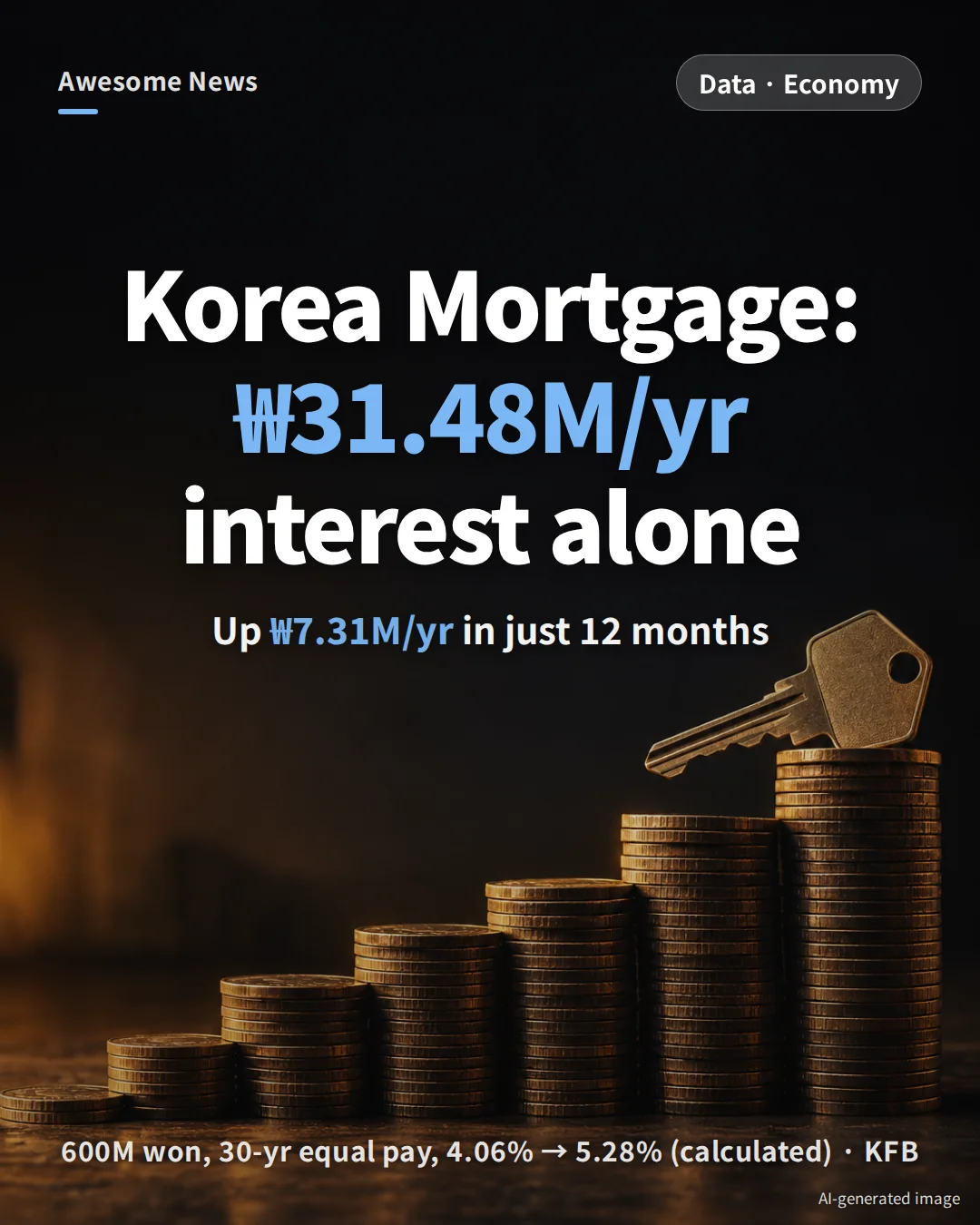
Borrow 600 million won over 30 years in equal monthly payments, and the interest alone in year one comes to 31.48 million won. A year ago, at the five big banks’ actual average rate of 4.06%, the same loan cost 24.17 million won in first-year interest — a 7.31 million won jump in twelve months (calculated). This piece unpacks why bank bond yields moved first, how big Seoul homebuyer loans have become, what the US is doing in parallel, and what another one-percentage-point rise would mean for a Korean borrower.
Key numbers at a glance
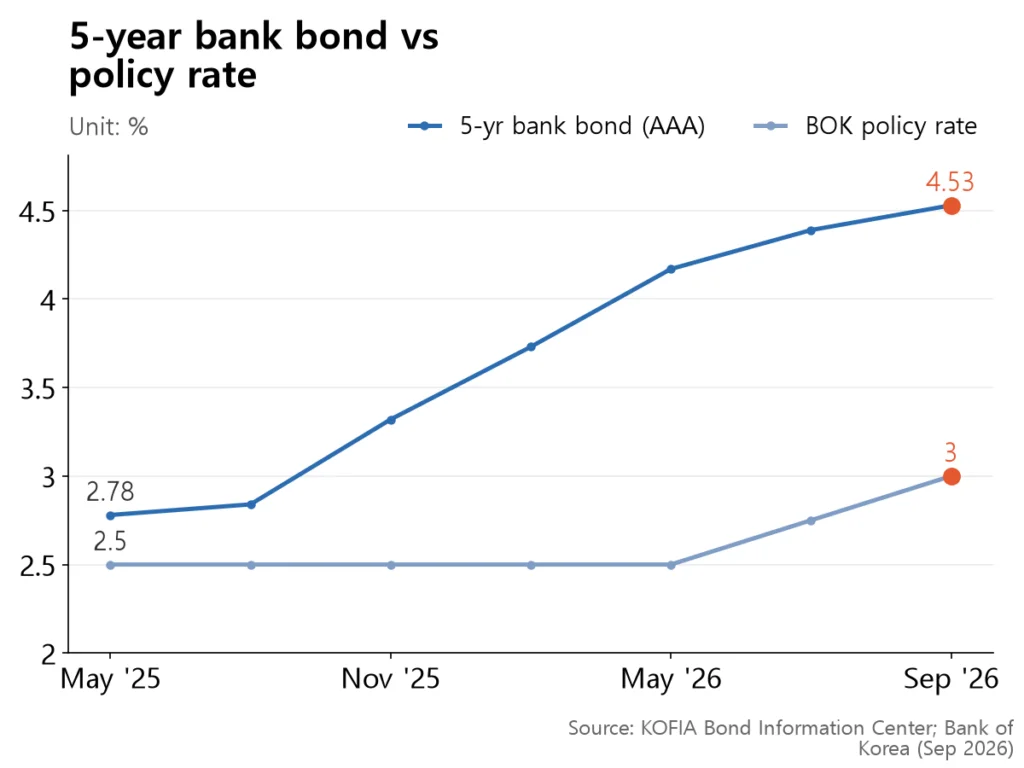
- 5-year AAA bank bond yield rose from a 2.78% monthly average in May 2025 to 4.53% in September 2026 — three to four times the move in the Bank of Korea policy rate (2.50% → 3.00%).
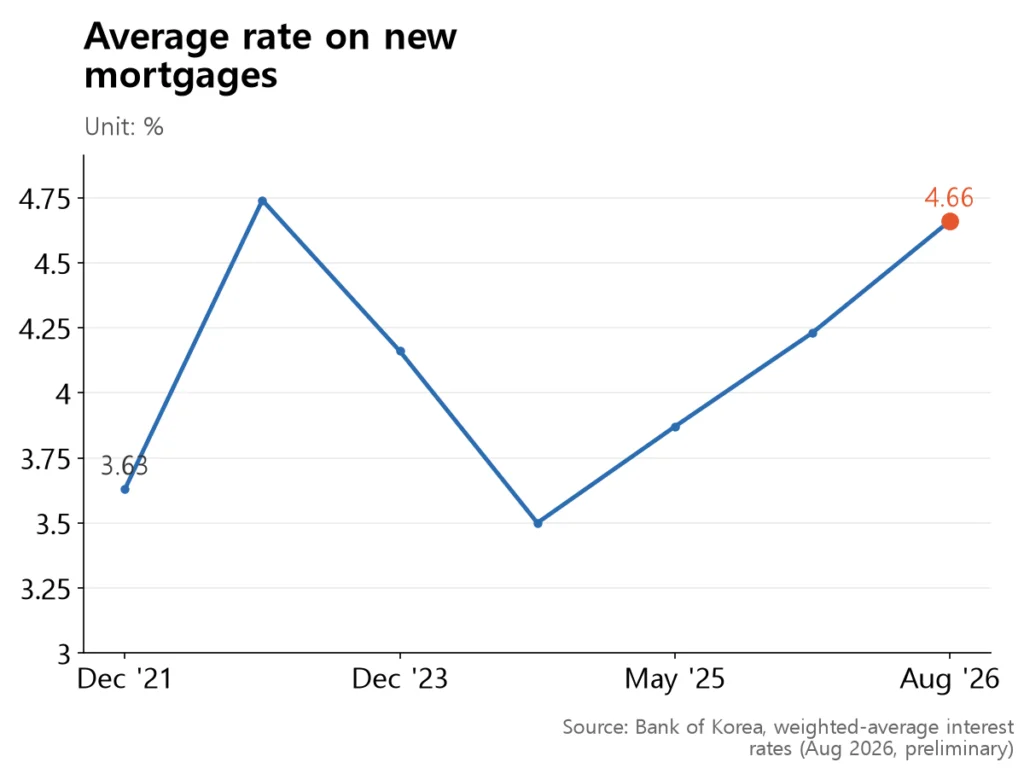
- New mortgages, weighted average: 4.66% in August 2026 (preliminary), the highest since November 2022 (4.74%).
- September 2026 posted rates at the five largest banks: fixed 4.97–6.91%, variable 4.29–6.29%. Only the lowest variable offers still start with a 4.
- Seoul buyers who used bank credit: 29.5% borrowed 600 million won or more (July–August 2025 financing filings).
- US context: the 10-year Treasury hit 5.26% on Sep 29, a near 19-year high; the 30-year mortgage rate is back above 7%.
- A 600 million won, 30-year mortgage costs 7.31 million won more in first-year interest at 5.28% than at 4.06% — and another 6 million won on top if rates rise one more point (calculated).
Why rates moved: the bond market ran first

Korean banks cannot fund every mortgage from deposits. They issue bank bonds to raise the rest, and those bond yields are the root of mortgage pricing. Fixed-rate mortgages track the 5-year bank bond; variable-rate loans track COFIX, the industry’s cost-of-funds index.
Over the past 18 months, that root has moved a lot. The 5-year AAA bank bond rose from a 2.78% monthly average in May 2025 to 4.53% in September 2026. Over the same period, the Bank of Korea’s policy rate sat at 2.50% for more than a year before stepping up to 2.75% on July 16, 2026 and to 3.00% on August 27 — a cumulative 0.5 point. Market rates got there first, and farther.
Why are bond yields running? Maturities are stacked. As reported by Hankyung, the fourth quarter of 2026 alone will see 68.6 trillion won of bank bonds and 20.9 trillion won of credit-card and other specialty finance bonds mature, 89.5 trillion won in total, 26% more than the 70.8 trillion won of Q4 2025. Press reports put total financial-sector bond maturities through the first half of 2027 at around 260 trillion won. Banks and card issuers refinancing that stack must offer higher coupons to clear the market.
One caveat worth stating plainly: those 90-trillion and 260-trillion-won figures are bond maturities for the lenders, not household loan maturities. They affect what new mortgages cost; they are not loans households must themselves repay.
In Seoul, a 600 million won loan is now common

Rising rates matter more when principal is bigger. A Ministry of Land, Infrastructure and Transport dataset of mandatory home-purchase financing filings (July–August 2025, released by Rep. Jung Joon-ho’s office) covers 4,470 Seoul buyers who used bank credit. The distribution of their total loan amounts looks like this.
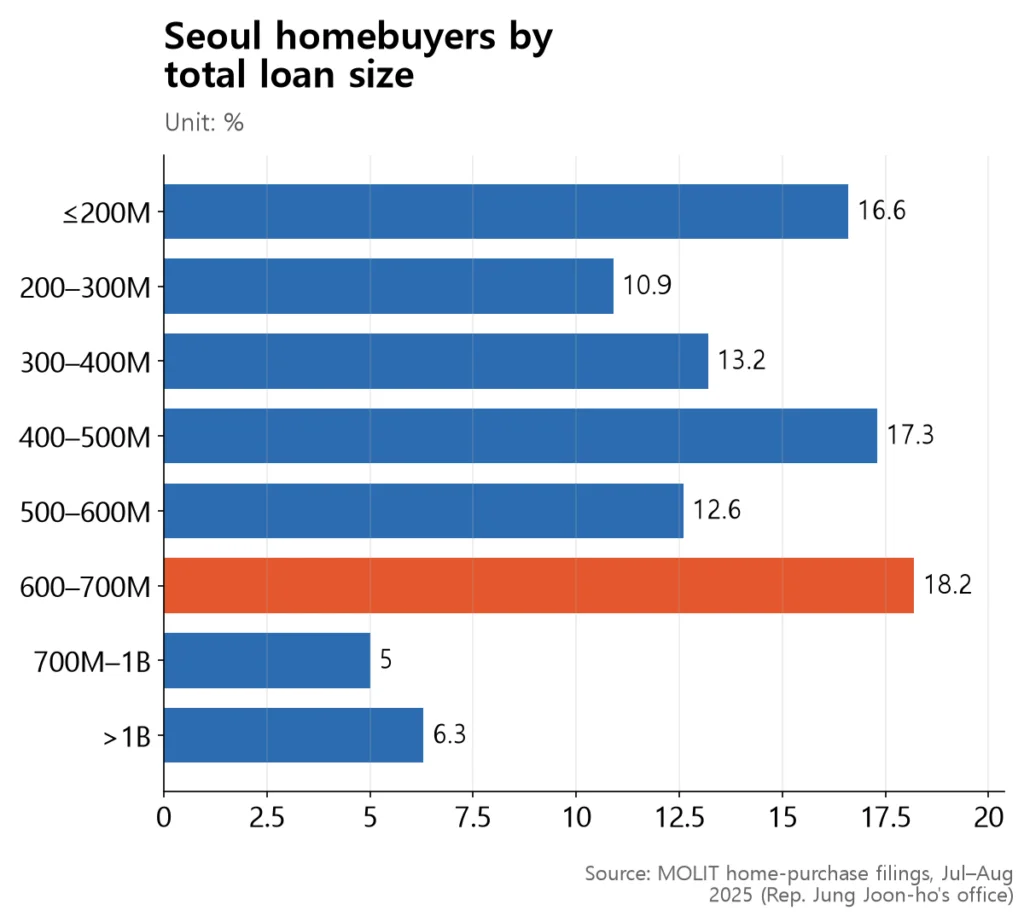
The single largest bucket is 600 to 700 million won (18.2%) — in other words, loans that max out Seoul’s current 600 million won cap for homes priced at 1.5 billion won or less. The median bucket is 400 to 500 million won, and 29.5% of buyers borrowed 600 million won or more (the sum of the top three brackets).
Bank of Korea household-debt statistics show the same drift. The average new mortgage per borrower living in Seoul climbed from 139.73 million won in 2015 to 329.38 million won in 2025 — roughly 2.4 times in a decade, and well above the 216.01 million won national average. Note the caveat: these figures classify loans by the borrower’s residence, not by where the collateral sits or whether it is an apartment.
The end of the 4-handle on fixed rates

The weighted average rate on mortgages actually originated by commercial banks (Bank of Korea data) was 4.66% in August 2026 (preliminary) — the highest since November 2022, which peaked at 4.74%. After drifting down into the 3s, the series has risen for five straight months and is now within a hair of that peak.
If a 3-point-something rate on a branch poster has caught your eye, the posted-rate tables tell a different story. The Korea Federation of Banks’ September 2026 disclosure (posted Sep 18–21, apartment loans with amortizing payments) at the five largest commercial banks looks like this.
| Bank | Variable | Fixed (incl. hybrid) |
|---|---|---|
| KB Kookmin | 4.85–5.75 | 5.15–5.65 |
| Shinhan | 4.29–5.69 | 4.97–6.37 |
| Hana | 4.50–5.70 | 5.30–6.50 |
| Woori | 4.41–5.61 | 5.71–6.91 |
| NH NongHyup | 4.49–6.29 | 5.27–6.87 |
| 5-bank range | 4.29–6.29 | 4.97–6.91 |
Only the floor of the variable range still starts with a 4. Every fixed-rate offer begins at 4.97% or higher, and Woori and NongHyup’s upper caps now sit in the high 6s. Compounding the exposure, about two-thirds of mortgage volume originated in July 2026 was variable-rate (68.1%, the highest share since February 2014), so new borrowers feel market-rate moves almost immediately.
The US is pulling in the same direction

This is not just a Korean story. The US 10-year Treasury yield reached 5.26% on September 29, its highest since June 2007 — nearly 19 years. Freddie Mac’s 30-year fixed mortgage rate (PMMS) stood at 7.03% on September 24, back above the 7% line. The Federal Reserve itself lifted its policy rate by 25 basis points on September 16 to 3.75–4.00%, its first increase in three years and two months.
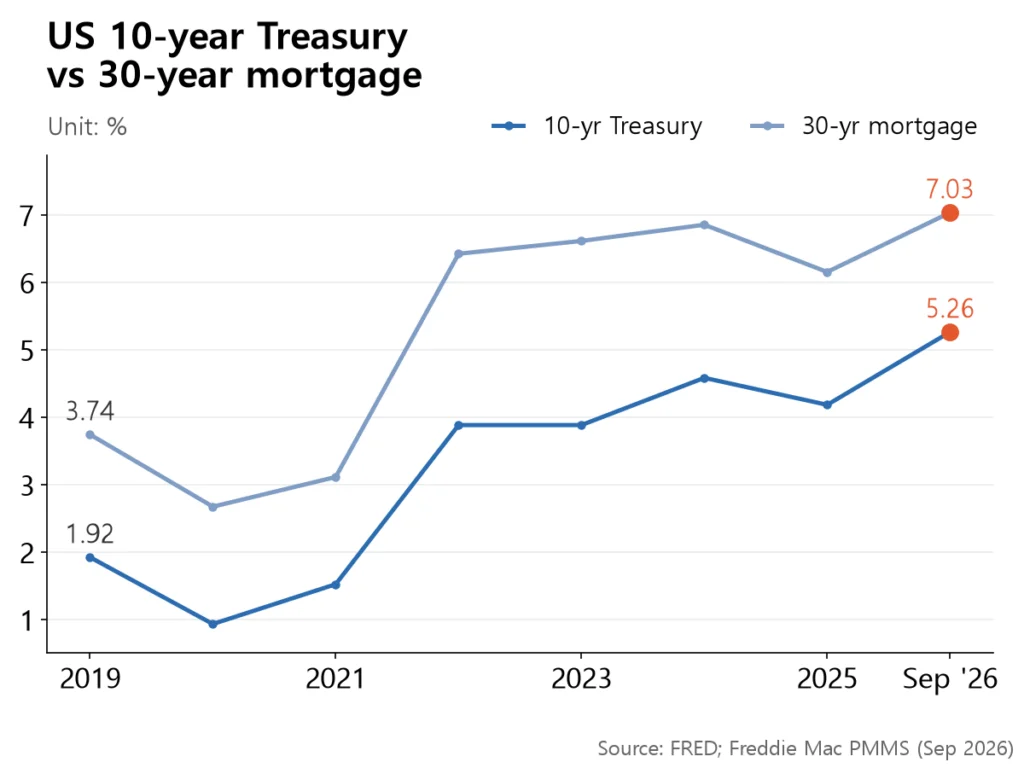
The 10-year Treasury anchors global rates. When it rises, Korean government and bank bonds get dragged along: Korea’s 10-year government bond went from 2.56% on April 30, 2025 to 4.41% on September 30, 2026. That partly explains why Korean market rates have moved three to four times as much as the policy rate this cycle (5-year bank bond +1.96 points, 10-year government +1.84 points, policy rate +0.50 points).
What a 600 million won loan actually costs now

Translating the rate moves into a borrower’s wallet: a 30-year mortgage with equal monthly payments, year-one interest and total payment at two reference rates. The ‘last year’ rate is the five-bank actual average for August 2025 originations (4.06%, Korea Federation of Banks). The ‘now’ rate is the five-bank average of the lowest posted fixed offers in September 2026 (5.28%).
| Loan size | A year ago at 4.06% | Now at 5.28% | Increase |
|---|---|---|---|
| 300M won | 17.31M/yr (interest 12.08M) | 19.95M/yr (interest 15.74M) | +2.63M (interest +3.66M) |
| 600M won | 34.62M/yr (interest 24.17M) | 39.89M/yr (interest 31.48M) | +5.27M (interest +7.31M) |
For a 600 million won borrower, first-year interest jumps from 24.17 to 31.48 million won — 7.31 million won extra in a year. Monthly payments climb from 2.89 to 3.32 million won. A 300 million won borrower still pays 3.66 million won more in year-one interest.
If rates rise another full point from here (to 6.28%), first-year interest on the 600 million won loan rises to 37.48 million won — another 6 million won on top. Bank of Korea data submitted to the National Assembly (reported via Rep. Han Chang-min’s office) estimate that a one-point rise in loan rates adds about 13.1 trillion won per year to Korean households’ interest burden.
How to read these numbers
A few traps worth noting before quoting any of this at a dinner table.
- The ’90 trillion’ and ‘260 trillion’ won maturities are financial-sector bonds, not household loans. They are the lenders’ own debt coming due, not mortgage principal that borrowers must repay. They affect the price of new credit, not the stock of existing credit.
- ‘60% of mortgages are fixed’ does not mean ‘locked for 30 years’. Bank of Korea data put the fixed share of outstanding bank mortgages at 61.7% in August 2026 (65.6% at end-2025). But Korea’s ‘fixed’ bucket includes periodic-reset loans (rate reprices every five years) and hybrid loans (fixed for a set period, then variable). When reset day arrives, the new rate is whatever the market says.
- The 4.66% BOK figure and the 3-handle branch poster are not the same thing. The 4.66% is a weighted average of actual originated rates (after preferentials and surcharges). The poster rate is the floor for a borrower who qualifies for every discount.
- There is no official time series of mortgage principal coming up for reset. Neither the Bank of Korea’s ECOS database nor the Financial Stability Report publishes it. Press reports do estimate that about 12.9 trillion won of 5-year fixed mortgages originated by the four largest banks in September 2021–August 2022 will reprice over the coming year.
- ‘329 million won average mortgage in Seoul’ is by borrower residence. It does not tell you where the collateral is, whether it is an apartment, or whether the loan funded a purchase. ‘Average Seoul-apartment buyer’ is a misreading of the series.
Summary
In short: bond yields moved first, mortgage rates are catching up. Korea’s 5-year bank bond climbed from 2.78% to 4.53% in 18 months; the US 10-year Treasury is above 5% for the first time in nearly two decades. The average new Korean mortgage is at 4.66%, the highest since November 2022, and posted fixed rates at the five big banks run 4.97–6.91%. The era of 4-handle fixed offers is effectively over.
In Seoul, loans of 600 million won are now the single most common size. On that balance over 30 years, first-year interest has gone from 24.17 million won at 4.06% to 31.48 million won at 5.28% — 7.31 million won more in a single year — with another 6 million won on top if rates rise one more point. Because outstanding mortgages reprice on their own schedule (typically every five years), if your reset is coming up, now is a good time to check your current rate and reset date with the lender.

Awesome News on Instagram @awesome_news_kr
This article is the research behind our Korean-language card news. Every morning we turn Korean data and official sources into short visual stories. See it on Instagram →
Sources
- Bank of Korea — Weighted-average interest rates of financial institutions, August 2026 (Korean) (2026-09-30)
- Bank of Korea — Financial Stability Report, September 2026 (Korean) (2026-09)
- Bank of Korea — Household debt by borrower, Q2 2026 (Korean) (2026)
- Bank of Korea — Household credit, Q2 2026 (Korean) (2026)
- KOFIA Bond Information Center — Bond mark-to-market yields: 5-yr AAA bank bond, 1-yr private sector, government bonds (Korean) (2026-09-30)
- Korea Federation of Banks consumer portal — Household loan rate comparison and apartment mortgage disclosures (Korean) (2026-09)
- Korea Federation of Banks — COFIX disclosure, August 2026 (Korean) (2026-09-15)
- Hankyung — Press reports on 260-trillion-won financial-sector bond maturities (Korean) (2026-09-29)
- Ministry of Land, Infrastructure and Transport / Office of Rep. Jung Joon-ho — Analysis of Seoul home-purchase financing filings, Jul–Aug 2025 (Korean) (2025)
- Bank of Korea / Office of Rep. Han Chang-min — Estimate of household interest burden from a 1-point loan-rate rise (Korean) (2026)
- FRED (Federal Reserve Bank of St. Louis) — DGS2 / DGS10 / DGS30 / MORTGAGE30US / MORTGAGE15US / DFEDTARU time series (2026-09-29)
- Freddie Mac — Primary Mortgage Market Survey (PMMS) (2026-09-24)
- US Federal Reserve — FOMC rate decision press release (monetary20260916a) (2026-09-16)
📊 Download the data
Every number in this article’s 6 charts and tables, in one CSV file (opens in Excel or Google Sheets). When you cite it, please name the original source and link to this page.
Download CSV