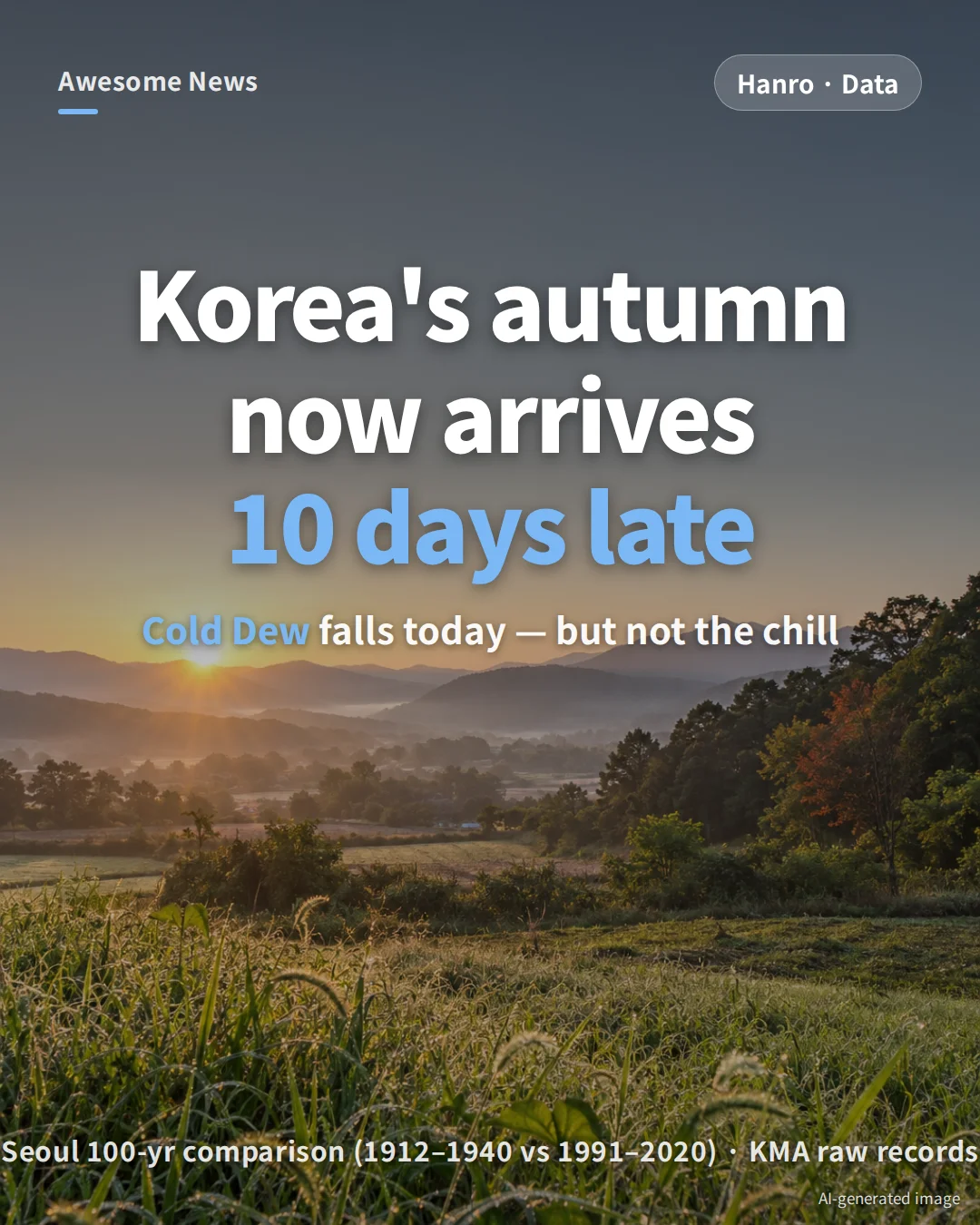
Hanro (寒露, ‘Cold Dew’) is the 17th of Korea’s 24 solar terms. In 2026 it falls on October 8. But the weather Seoul used to see on Hanro a century ago — an average of 14.7°C — now shows up on October 18, ten days later. This piece explains what Hanro is, why its date barely moves, how Joseon-era officials used it, and what 113 years of Korea Meteorological Administration (KMA) records say about the climate behind it. (Hanro is a traditional East Asian seasonal marker, not a public holiday.)
Key numbers at a glance
- Hanro is defined by solar longitude 195° — in 2026 it lands on October 8, and across 1904–2030 it is always October 8 or 9.
- The 24 solar terms are solar, not lunar — they only feel lunar because old Korean calendars printed lunar dates alongside them.
- Average temperature around Hanro in Seoul rose from 14.7°C in 1912–1940 to 17.2°C in 1991–2020, a 2.5°C gain in a century (calculated from KMA daily records).
- Years when Seoul’s Hanro morning low fell below 10°C dropped from 65% to 14%.
- Autumn shortened from 73 to 62 days; summer stretched from 98 to 130 days (KMA 113-year climate report).
1. What Hanro actually is
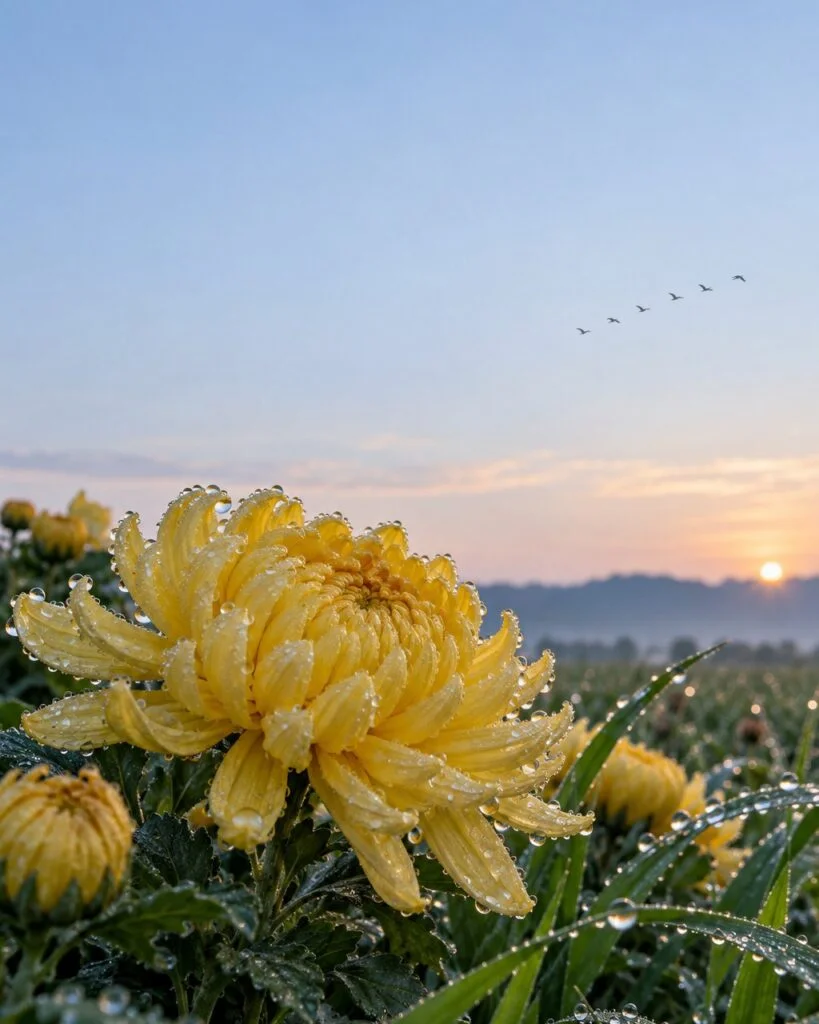
Hanro means literally ‘cold dew’ — the moment when dew begins to meet cold enough air to turn, soon, into frost. The National Folk Museum’s encyclopedia of Korean seasonal customs defines it as ‘the period just before dew hardens into frost’. The next solar term, Sanggang (‘Frost Descent’), falls on October 23.
The *Xuanming* calendar recorded in the *History of Goryeo* splits each Hanro fortnight into three five-day stretches: in the first, wild geese arrive and settle; in the second, sparrows plunge into the water and become clams; in the third, chrysanthemums bloom yellow. Joseon’s *Chiljeongsan Naepyeon* (1442) carried a very similar description.
| Attribute | Detail |
|---|---|
| Characters | 寒 (cold) + 露 (dew) |
| Order | 17th of 24 solar terms |
| Solar longitude | 195° |
| Previous term | Chubun / Autumn Equinox (Sep 23) — 15 days, 6h 24m earlier |
| Next term | Sanggang / Frost Descent (Oct 23) — 15 days, 3h 8m later |
| 2026 date | October 8 (KASA 2026 Calendar Almanac) |
2. The solar terms follow the sun, not the moon
A common misconception is that the 24 solar terms are lunar. They are solar. The Encyclopedia of Korean Culture explains that the spring equinox is set at solar longitude 0°, and a new term is marked every 15° around the sun. On the Gregorian calendar the dates barely budge; on the lunar calendar they drift.
That is why Hanro falls on October 8 or 9 every year from 1904 through 2030. In 2016–2026 the Gregorian date was October 8 each time, but the matching lunar date ranged from August 17 (2025) to September 13 (2022), because a lunar year is about 11 days shorter than a solar one.
| Year | Gregorian | Lunar date that day |
|---|---|---|
| 2016 | Oct 8 | Lunar 9/8 |
| 2020 | Oct 8 | Lunar 8/22 |
| 2022 | Oct 8 | Lunar 9/13 |
| 2024 | Oct 8 | Lunar 9/6 |
| 2025 | Oct 8 | Lunar 8/17 |
| 2026 | Oct 8 | Lunar 8/28 |
The lunar flavour comes from history. Joseon’s *Siheon* calendar was a lunisolar system that printed both counts on the same page, and each term was named after a lunar month — Hanro, for example, was called ‘the term of the 9th lunar month’. An entry in the Veritable Records of King Seongjong (1475) notes exactly that.
3. Joseon used Hanro as a farming deadline
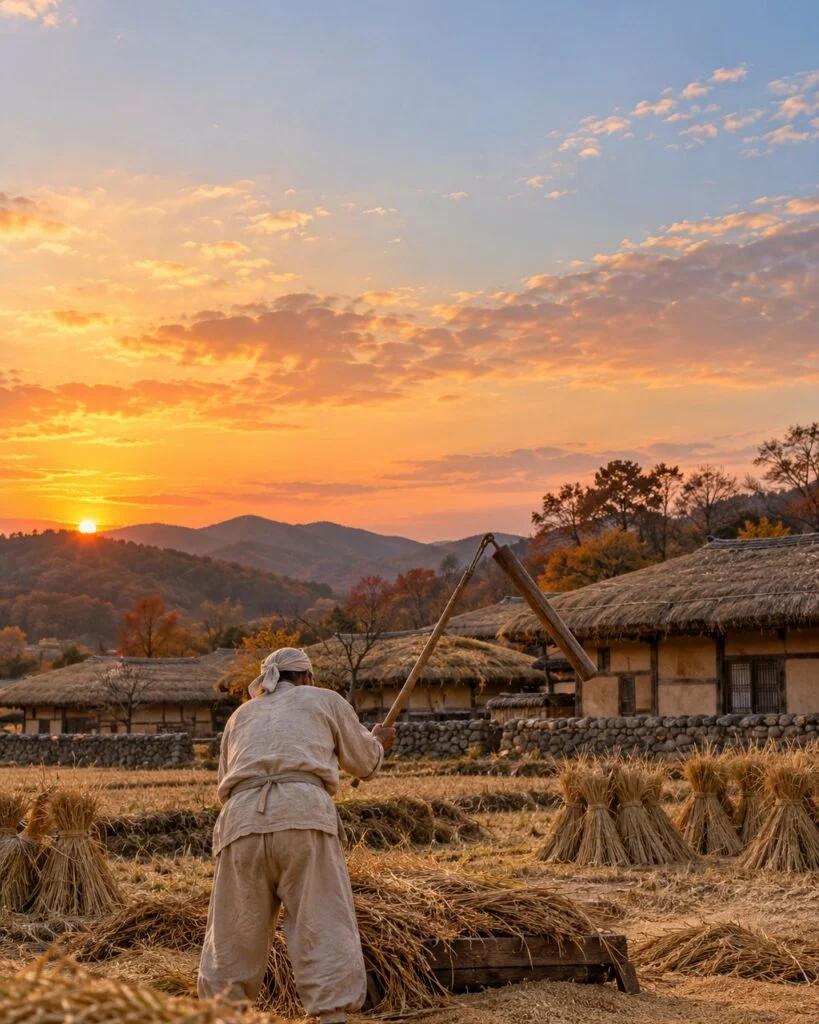
The 24 solar terms originated in observations of weather, plants and animals in the Yellow River basin before the common era (UNESCO Intangible Heritage, 2016). In Korea they moved through the Baekje *Wonga* calendar (from 445 CE), the Unified Silla *Xuanming* (c. 830), the Goryeo *Shoushi* (1309), and were codified in Joseon’s *Chiljeongsan Naepyeon* (1442). In 1653, at the suggestion of the official Kim Yuk, King Hyojong adopted the *Siheon* calendar, which made solar-term calculations much more precise.
Of the three Veritable Records entries that mention Hanro, two treat it as a farming deadline. In 1798 King Jeongjo, ordering buckwheat planted in Hwaseong, worried aloud:
From sowing to harvest takes about 100 days, yet only some 80 days remain until Hanro — the crop will not ripen in time.
Veritable Records of King Jeongjo, 22nd year (1798), 6/5 (Korean, our translation)
A military land-management record from Ganggye in 1809 states that ‘the day of entering to guard is Gogu, the day of withdrawing is Hanro — the old precedent’. The folk-customs encyclopedia summarises Hanro as the moment ‘when threshing is in full swing, because the harvest must be finished before the chill deepens’. A common proverb — *’autumn grain ripens in the cold dew’* — captures the same feel.
The names, however, were coined for the north-China climate of the Zhou dynasty, and do not always fit Korea. The best-known mismatch is the proverb *’Great Cold froze to death visiting Little Cold’*: despite the names, Sohan (Little Cold) is colder than Daehan (Great Cold). KMA’s own 1991–2020 average across six Korean stations put Sohan at 0.8°C and Daehan at 0.9°C.
4. Temperatures do not plunge on Hanro
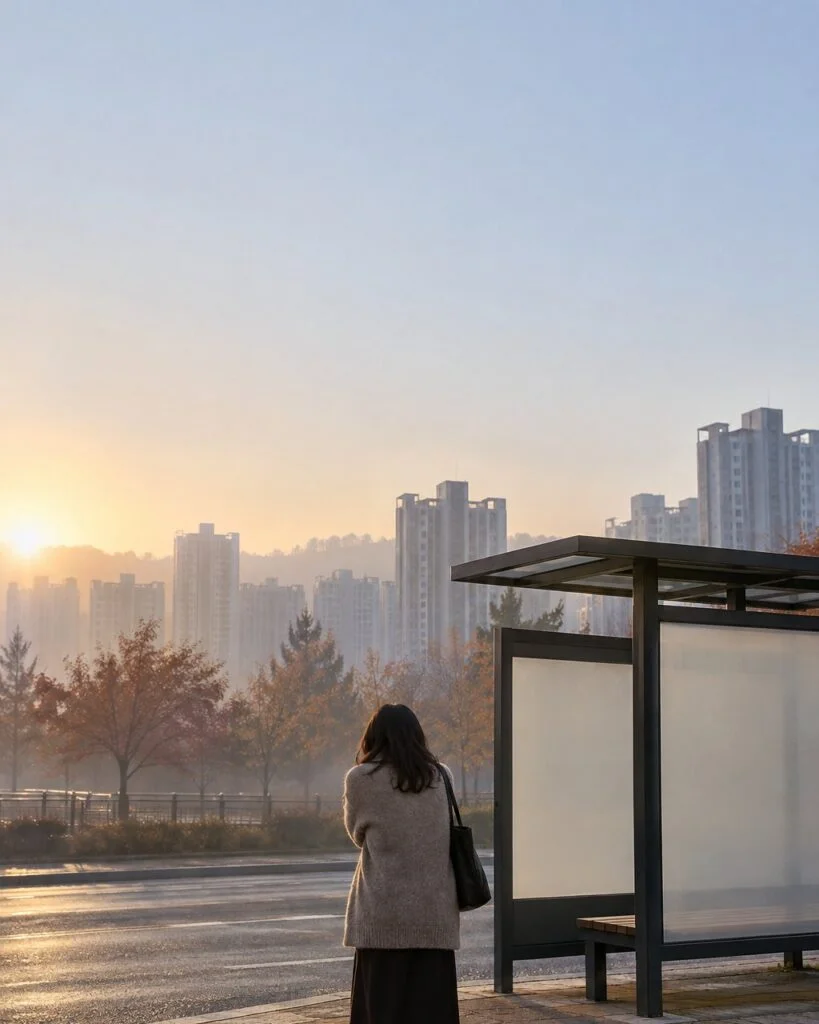
The idea that ‘the cold starts at Hanro’ is only half right. KMA’s official 1991–2020 daily normals for Seoul show the average temperature drifting down 20.1°C at Chubun → 17.3°C at Hanro → 13.9°C at Sanggang — roughly 3°C every fortnight. Hanro is not a cliff; it is the middle of a long, even descent.
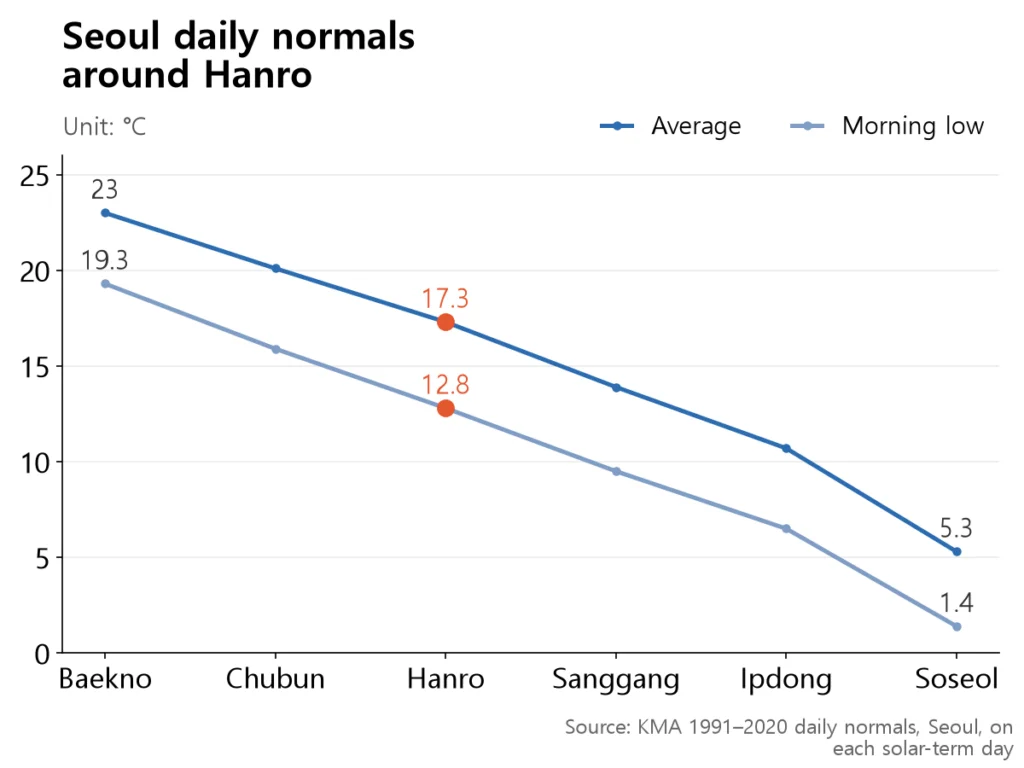
The drops between consecutive terms are strikingly even: Baekno→Chubun −2.9°C, Chubun→Hanro −2.8°C, Hanro→Sanggang −3.4°C, Sanggang→Ipdong −3.2°C. The steepest fortnight is actually Ipdong→Soseol at −5.4°C, meaning the real cold snap arrives in early November. At Hanro the morning normal is still 12.8°C, with first frost in Seoul normally on October 28 and first ice on November 3 — two to three weeks away.
5. 100 years, 2.5°C warmer
We pulled every daily record from KMA’s open data portal for Seoul station (ID 108), 1907–2025, and averaged the seven days centred on Hanro by decade. The mean rose from 14.2°C in the 1910s to 17.2°C in the 2020s so far. The morning low rose even more sharply — from 8.1°C in the 1920s to 13.6°C in the 2020s, a jump of more than 5°C.
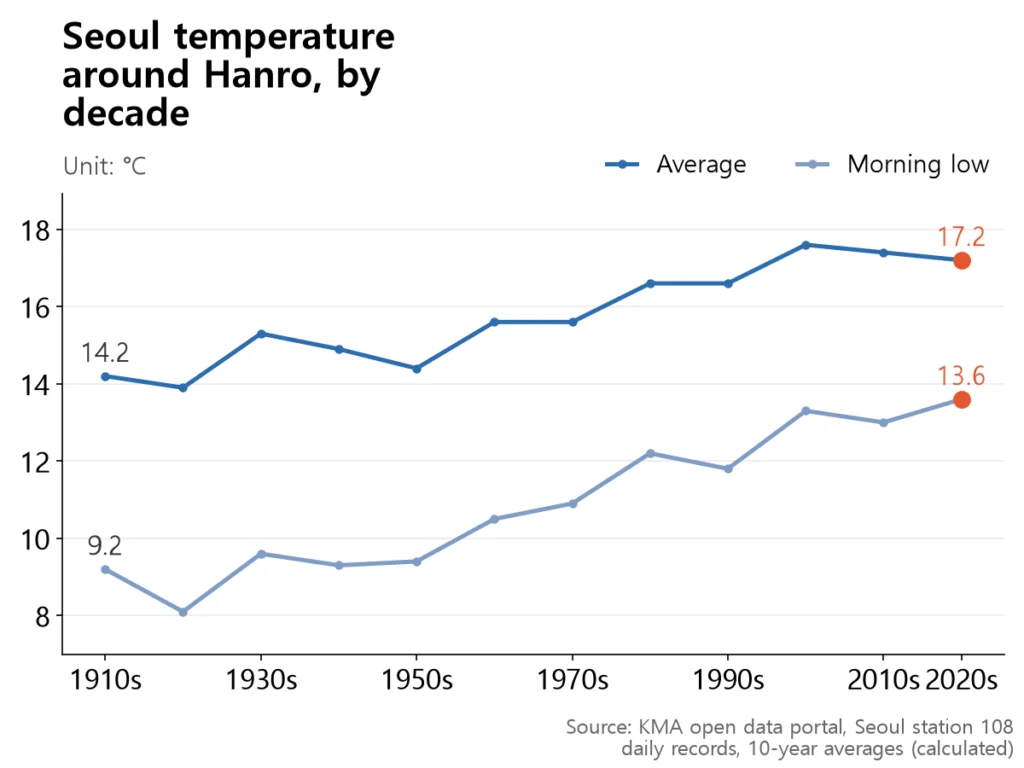
Comparing fixed windows, Seoul’s Hanro-week average went from 14.7°C in 1912–1940 to 17.2°C in 1991–2020, and the morning low from 9.1°C to 12.7°C — a per-century trend of +3.5°C for the mean and +5.0°C for the low (calculated). Daegu and Jeonju saw similar jumps; coastal Mokpo warmed less. KMA’s own six-station analysis, using a slightly different definition, found Hanro warming from 15.9°C to 17.9°C (+2.0°C) — the two sets of numbers should not be stitched together.
| Station | 1912–1940 avg / low | 1991–2020 avg / low | Trend per century (avg / low) |
|---|---|---|---|
| Seoul | 14.7 / 9.1 | 17.2 / 12.7 | +3.5 / +5.0 |
| Daegu | 15.5 / 10.2 | 17.8 / 13.0 | +3.1 / +4.1 |
| Busan | 17.5 / 13.9 | 19.3 / 16.2 | +2.5 / +3.2 |
| Incheon | 15.6 / 11.3 | 17.3 / 13.4 | +2.3 / +3.0 |
| Gangneung | 15.2 / 10.7 | 17.0 / 13.0 | +2.4 / +3.2 |
| Mokpo | 17.2 / 13.3 | 18.1 / 14.2 | +1.6 / +1.9 |
Put another way, the Seoul temperature of an old Hanro — the 15.0°C nine-day average of 1912–1940 — now typically shows up on October 18. Daegu and Busan are shifted by the same ten days. KMA’s six-station study came to the same conclusion for Hanro (+10 days), and found Sanggang shifted by +14 days and Ipdong by +9.
The share of Hanro days when Seoul’s morning low fell below 10°C has collapsed too: 22 of 34 years (65%) in 1907–1940, only 5 of 35 years (14%) in 1991–2025. The warmest Hanro on record was 2017 at 23.0°C (high 28.7°C), followed by 2025 at 21.9°C (high 28.0°C). The coldest was 1911 at 9.0°C, and the chilliest morning low — 2.9°C — came in 1928.
6. Autumn is shrinking, summer is spreading
If Hanro has slipped ten days, the whole season has moved with it. KMA’s 113-year climate report, published in December 2025, redefined ‘felt’ seasons from nine-day running means at six long-running stations. Autumn shortened from 73 days to 62; summer swelled from 98 days to 130.
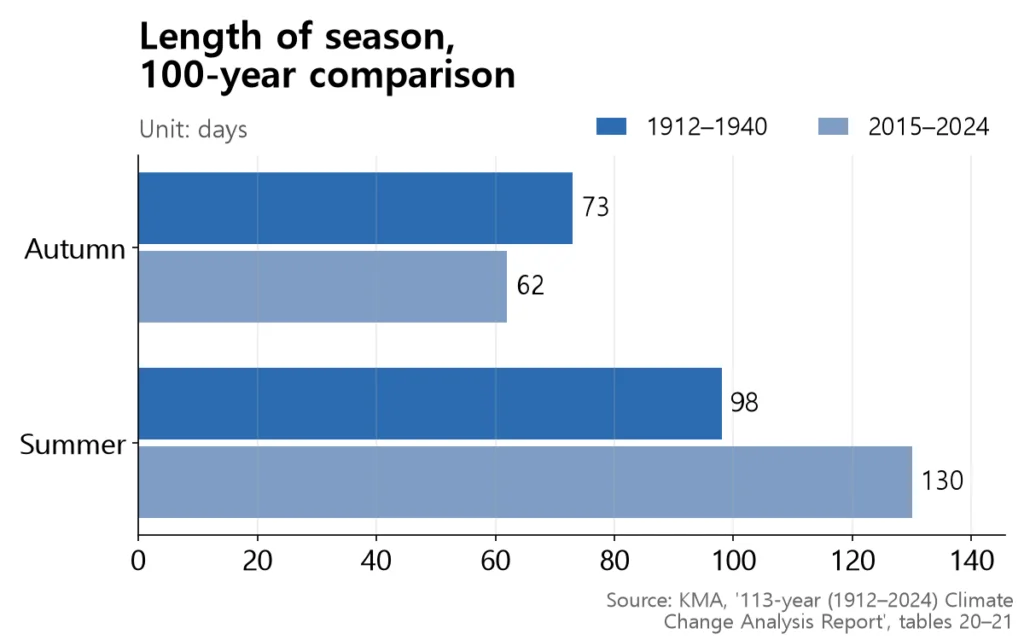
The start of autumn has slipped from September 17 to October 2, a fortnight later. Autumn now barely begins a week before Hanro itself. Spring has moved the other way (March 18 → February 27), leaving a year that feels half-summer and half-everything-else.
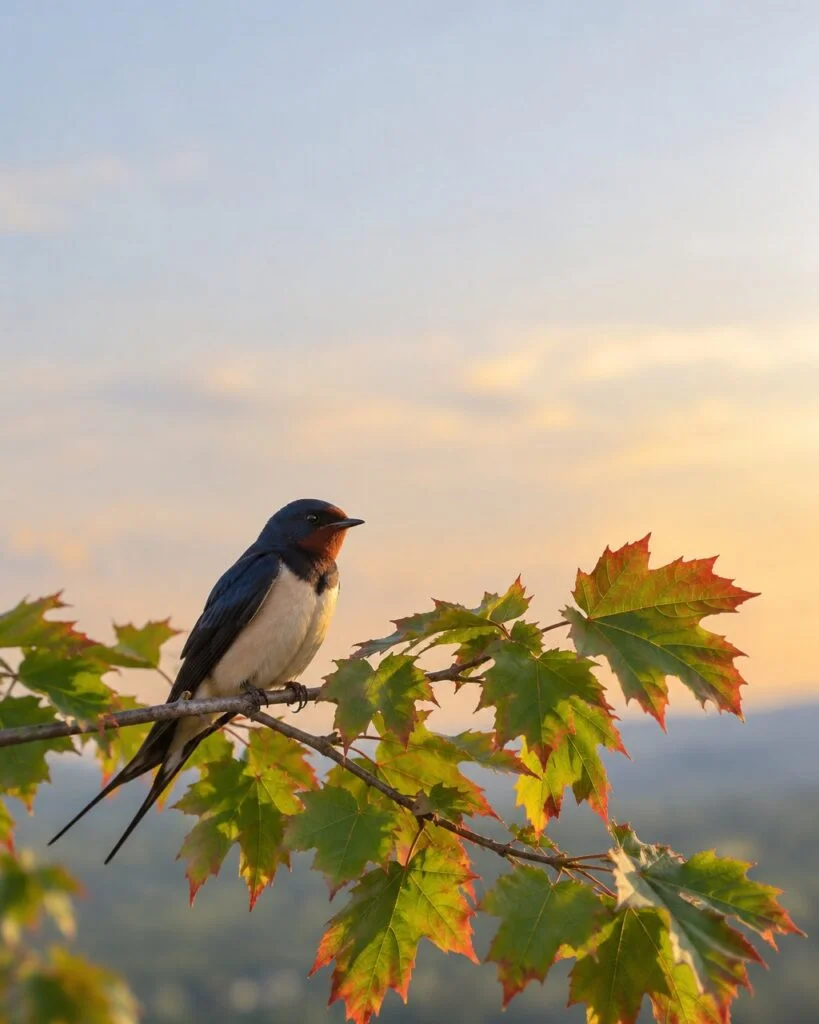
Frost and ice are also arriving later. Seoul’s first day with a sub-zero minimum (a proxy for first frost) has slid from an average of October 29 in 1912–1940 to November 17 in 2016–2025, nearly three weeks. KMA’s six-station frost-days count fell from 93.9 to 67.8 days per year. Foliage is late too: autumn colour peaked in Mount Seoraksan 4 to 12 days later than normal in each of the past five years (Gangwon Regional Office of Meteorology). An old saying — *’after Hanro, even the swallows head south’* — now holds true about ten days late.
7. How to read these numbers
- The 24 solar terms are solar, not lunar. They only share the page with lunar dates in old almanacs.
- ‘Hanro brings the cold’ is a myth. The normals fall by roughly 3°C each fortnight; the steepest drop is in early November.
- Do not mix differently defined temperatures. Seoul Hanro-week (day ±3) 14.7→17.2°C; KMA six-station term-period 15.9→17.9°C; official daily normals 16.1 (1961–90) → 17.3°C (1991–2020) are three different measures.
- First sub-zero minimum is not first frost. Frost is measured at ground level and can form when the air stays above 0°C. The long-run first-frost series was not freely downloadable, so we used the sub-zero proxy.
- Old Seoul records contain site-change and urbanisation effects. KMA estimates the urbanisation contribution at 3–11% at observing points. These numbers are not pure climate signal.
- Chrysanthemum pancakes and hill-climbing are *Jungyangjeol* customs (lunar 9/9) — in 2026 that falls on October 19, close to Hanro but not the same day.
Summary
Hanro is a signpost Korea’s ancestors planted in the calendar: *dew is about to turn to frost — hurry.* Because the sun fixes its position, no reform of the calendar can move it far from October 8. But a century of observations tells a plain story: the weather no longer keeps up with the date. The air that used to greet an old Hanro now arrives in mid-October, and the first frost waits until early November. The term has not moved; the season has.

Awesome News on Instagram @awesome_news_kr
This article is the research behind our Korean-language card news. Every morning we turn Korean data and official sources into short visual stories. See it on Instagram →
Sources
- Korea AeroSpace Administration / Korea Astronomy and Space Science Institute — 2026 Calendar Almanac (Weollyeok Yohang) (2025-06-30)
- Korea Astronomy and Space Science Institute — Monthly astronomical events (lunar dates)
- Korea Meteorological Administration, Open Data Portal — 24 solar terms — daily observations query
- Korea Meteorological Administration, Open Data Portal — Korea climate normals (daily 1991–2020)
- Korea Meteorological Administration — Climate change has shifted Korea’s four seasons and 24 solar terms (press release) (Korean) (2021-04-27)
- Korea Meteorological Administration — 113-year (1912–2024) Climate Change Analysis Report for Korea (Korean) (2025-12)
- Korea Meteorological Administration — 2024 autumn climate characteristics — first frost, first ice (press release) (Korean) (2024-12-05)
- Gangwon Regional Office of Meteorology — Gangwon foliage and weather card news (Korean)
- National Folk Museum of Korea — Encyclopedia of Korean Seasonal Customs — Hanro, Sanggang, Jungyangjeol (Korean)
- Academy of Korean Studies — Encyclopedia of Korean Culture — Solar terms, Calendar systems, Siheon calendar, Pyeonggi (Korean)
- National Institute of Korean History — Veritable Records of the Joseon Dynasty — Seongjong year 6, Jeongjo year 22, Sunjo year 9 (Korean)
- UNESCO — The Twenty-Four Solar Terms (Intangible Cultural Heritage of Humanity, 00647) (2016)
- NASA Jet Propulsion Laboratory — Horizons System (solar longitude calculation)
📊 Download the data
Every number in this article’s 6 charts and tables, in one CSV file (opens in Excel or Google Sheets). When you cite it, please name the original source and link to this page.
Download CSV