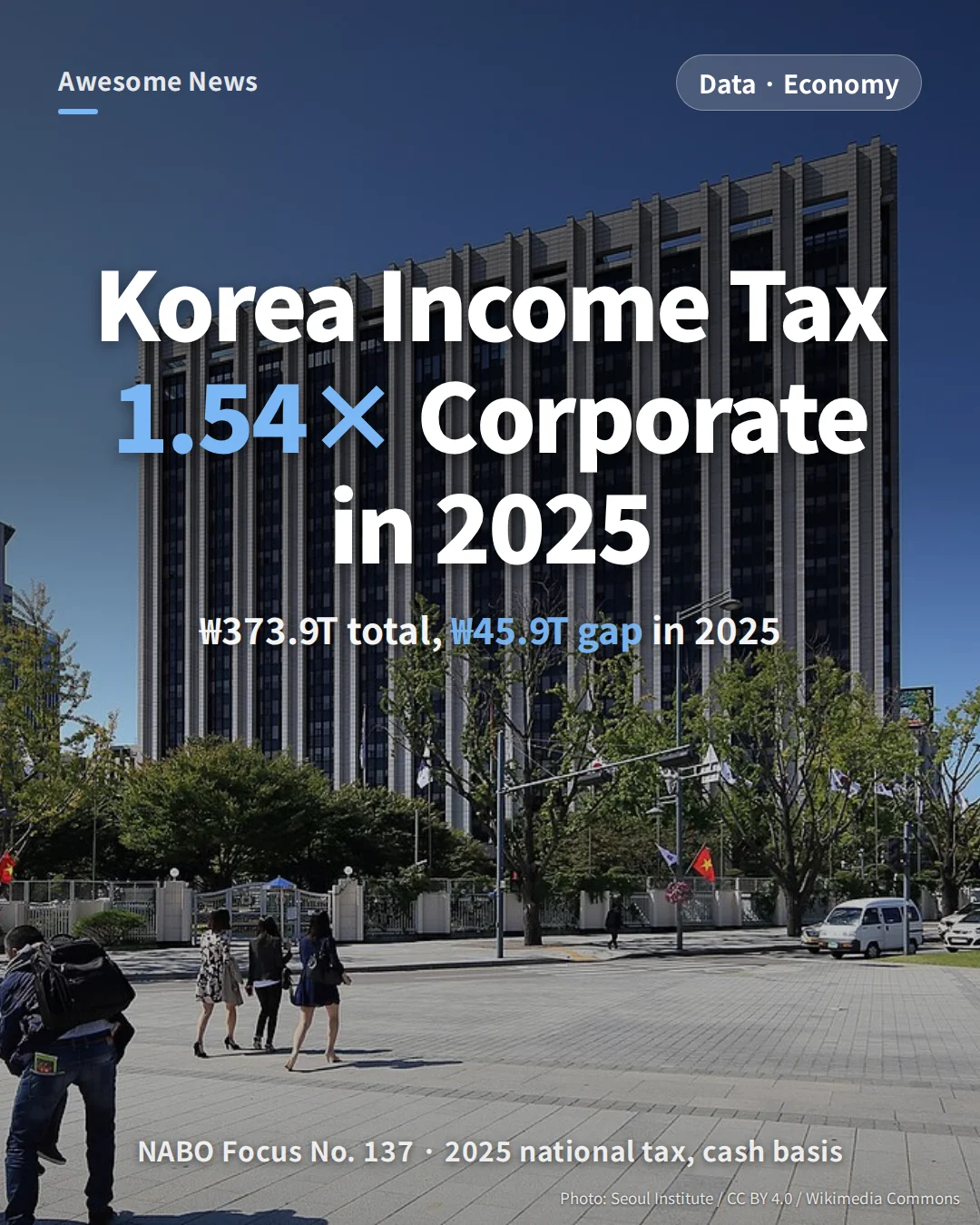
South Korea’s central government collected 373.9 trillion won in national taxes in 2025 — up 37.4 trillion (+11.1%) from a year earlier, ending two straight years of decline. The headline looks like a corporate-earnings story, but the breakdown tells a different one: personal income tax (130.5 trillion) outstripped corporate tax (84.6 trillion) by 45.9 trillion won, a 1.54× gap, and salaried workers’ withholding alone accounted for most of that lead.
Key numbers at a glance
- Total national tax 373.9 trillion won in 2025, up 37.4 trillion (+11.1%) from 336.5 trillion in 2024
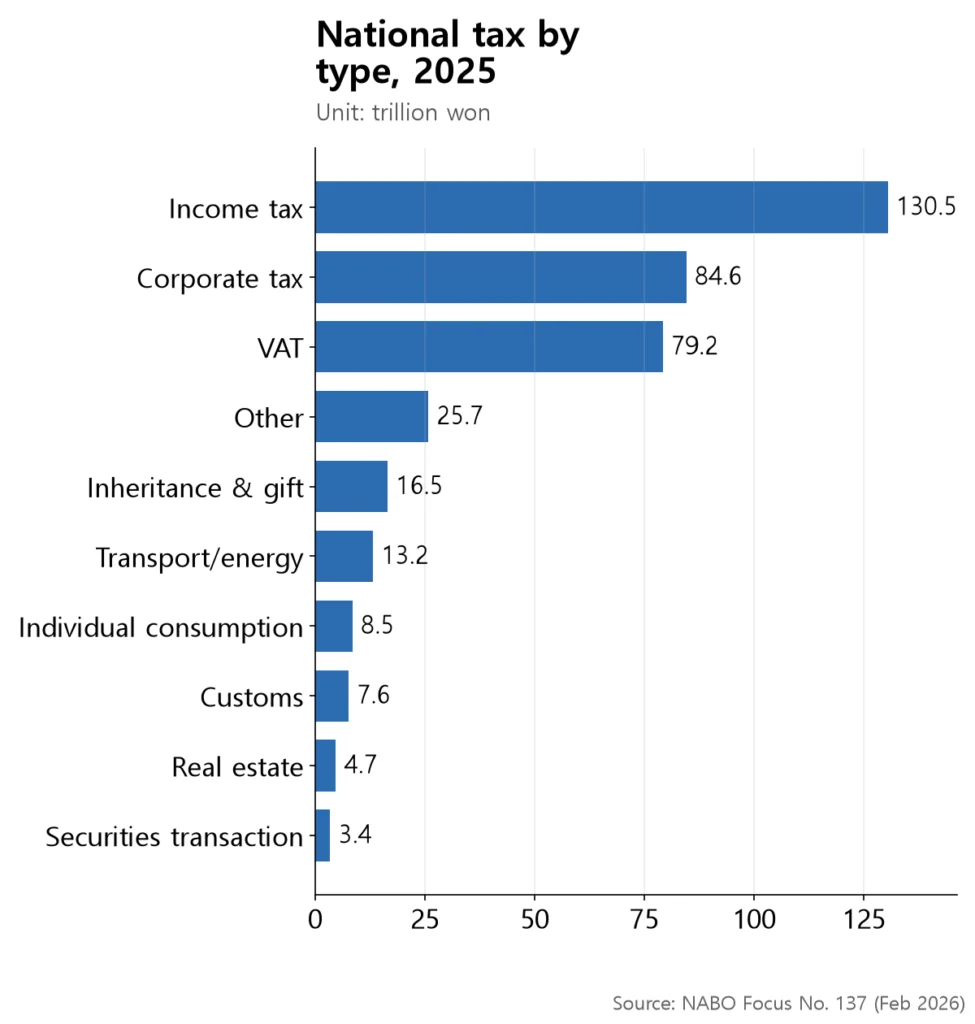
- Personal income tax 130.5T vs corporate tax 84.6T — gap of 45.9 trillion won (1.54×)
- Wage-withholding tax alone 68.4 trillion won, equal to 81% of all corporate tax (calculated)
- Corporate tax jumped +22.1 trillion (+35.3%) on a one-year lag — reflecting 2024 AI-chip profits
- VAT fell -3.1 trillion (-3.7%), not because consumption shrank but because refunds rose
373.9 trillion won: a two-year slump reversed
National tax is what the central government collects, excluding local taxes such as acquisition and property tax. Receipts slipped from 344.1 trillion won in 2023 to 336.5 trillion in 2024, then rebounded to 373.9 trillion in 2025. The National Assembly Budget Office (NABO) notes that this came in 1.8 trillion won (+0.5%) above the 2025 supplementary budget target of 372.1 trillion — essentially on plan at the headline level.
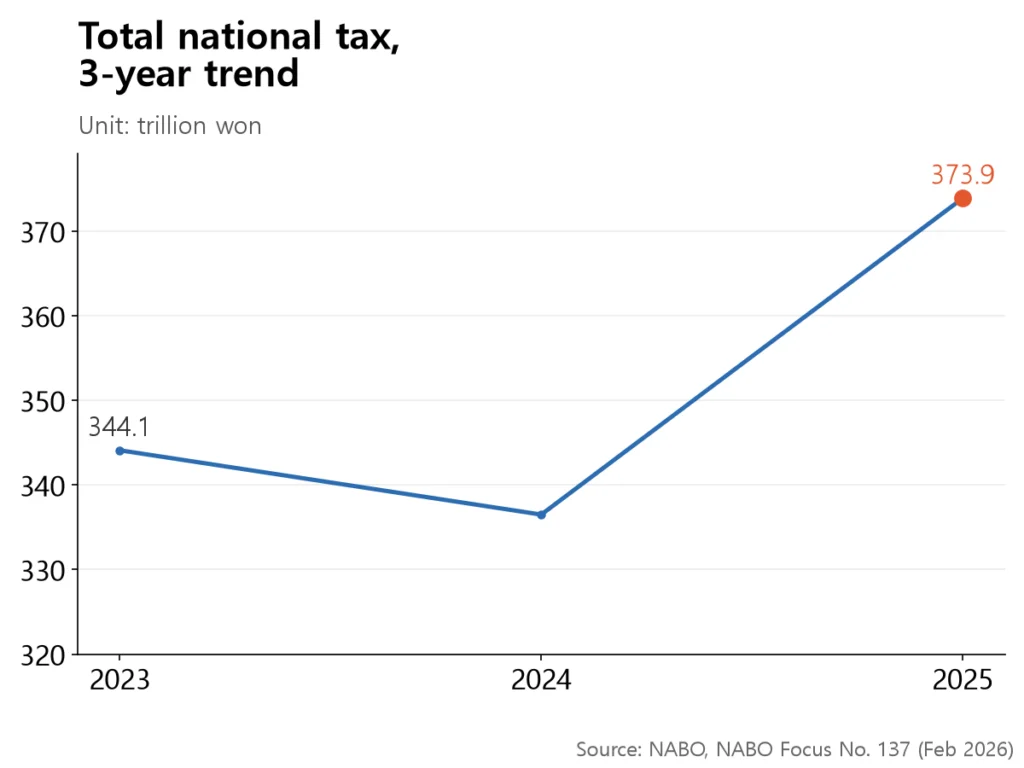
2024 was a year of shortfall — collections came in 30.8 trillion won (-9.1%) below the original budget. 2025 ran the other way, with corporate and personal income tax both beating target and pulling the total up.
Income tax 130.5T vs corporate tax 84.6T — a 45.9T gap
In 2025, personal income tax reached 130.5 trillion won and corporate tax 84.6 trillion, a gap of 45.9 trillion (calculated), or 1.54×. The common assumption that companies pay far more than individuals doesn’t hold here — income tax has outrun corporate tax every year for the past three.
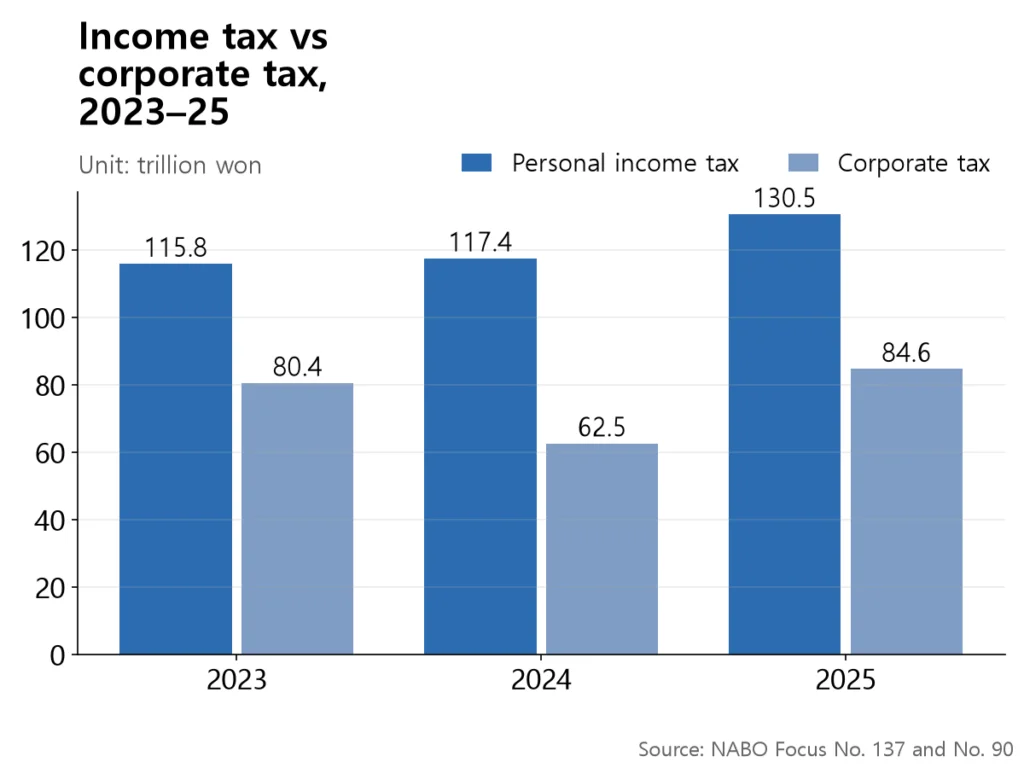
The gap was widest in 2024, when corporate tax collapsed to 62.5 trillion — only about half of personal income tax (117.4 trillion), a ratio of 1.88×. The 2025 corporate rebound narrowed the ratio back to 1.54×, but income tax still leads.
The weight of wage withholding: 68.4 trillion won
Personal income tax splits into several lines. The biggest by far is wage-withholding tax — the amount deducted monthly from salaries — at 68.4 trillion won. That single line equals 81% of total corporate tax (84.6 trillion, calculated). Next come comprehensive income tax (21.3 trillion), capital-gains tax (19.9 trillion) and interest-income tax (7.0 trillion).
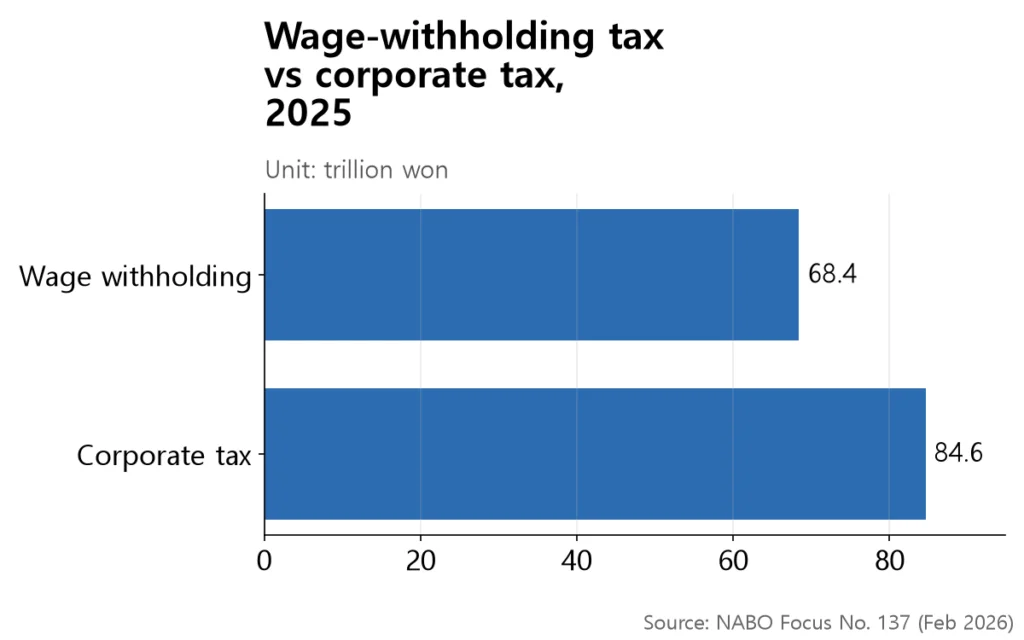
NABO attributes the 7.4 trillion won (+12.1%) rise in wage-withholding to a larger payroll — wage earners grew from 22.04 million to 22.32 million — and higher pay, with regular wages up 3.1% and special payments up 4.5%. Capital-gains tax added 3.2 trillion as overseas-stock gains and home sales both increased.
Corporate tax +22.1T: a one-year lag and AI chips
Corporate tax rose 22.1 trillion won (+35.3%). Within that, self-assessed filings jumped from 39.4 to 60.9 trillion — a 21.5 trillion (+54.5%) swing that drove nearly the whole increase. The key caveat: corporate tax is paid in the year *after* the profits were earned, so there is a one-year lag between the economy and the receipts.
NABO points to listed-company earnings as the driver: pre-tax net income across all industries rose +83.5% in 2024, with the electronics and electrical sector surging on AI-semiconductor demand. In other words, the 2025 corporate-tax figure is really the scorecard for 2024 corporate profits.
Tax-by-tax, three-year table
| Tax | 2023 | 2024 | 2025 |
|---|---|---|---|
| Personal income tax | 115.8 | 117.4 | 130.5 |
| — Wage withholding | 59.1 | 61.0 | 68.4 |
| — Capital-gains tax | 17.6 | 16.7 | 19.9 |
| — Comprehensive income tax | 21.4 | 19.5 | 21.3 |
| Corporate tax | 80.4 | 62.5 | 84.6 |
| Value-added tax (VAT) | 73.8 | 82.2 | 79.2 |
| Inheritance & gift tax | 14.6 | 15.3 | 16.5 |
| Transport, energy & environment tax | 10.8 | 11.4 | 13.2 |
| Individual consumption tax | 8.8 | 8.7 | 8.5 |
| Customs duties | 7.3 | 7.0 | 7.6 |
| Securities transaction tax | 6.1 | 4.8 | 3.4 |
| Comprehensive real-estate tax | 4.6 | 4.2 | 4.7 |
| Total national tax | 344.1 | 336.5 | 373.9 |
Note one re-ordering in the table: in 2024 the top three were income tax (117.4) > VAT (82.2) > corporate tax (62.5). In 2025 the second and third places flipped — income tax (130.5) > corporate tax (84.6) > VAT (79.2).
Why VAT fell — not a consumption story
VAT slipped from 82.2 to 79.2 trillion won, down 3.1 trillion (-3.7%). That looks like weak consumption, but NABO says it isn’t: the drop came from larger VAT refunds driven by rising capital investment and exports, both of which generate refundable input-tax credits. Nominal private consumption actually rose.
Elsewhere, securities transaction tax fell from 4.8 to 3.4 trillion won (-1.3 trillion, -27.7%) after a rate cut, while transport-energy-environment tax rose from 11.4 to 13.2 trillion (+1.8 trillion, +16.2%) as the government partly rolled back its flexible fuel-tax discount.
How to read these numbers
- These are cash-basis receipts (not accrual). Budget comparisons use the 2025 supplementary budget of 372.1 trillion won.
- Central government only. Local taxes (acquisition, property, vehicle, etc.) are not included.
- Corporate tax lags the economy by one year because it is paid on the prior year’s profits — the 2025 surge is really a 2024 story.
- Total receipts beat the supplementary budget by 1.8 trillion, but VAT missed by -4.2 trillion (-5.2%), the largest shortfall by tax type.
- 2026 figures are expected in roughly the same format around February 2027.
Summary
At the surface, 2025’s 373.9 trillion won in receipts reads as a corporate-earnings rebound. Underneath, the structure has not changed: personal income tax (130.5T) has outrun corporate tax (84.6T) for three years running, and more than half of that income tax — 68.4 trillion won — is wage withholding from salaried workers. Corporate tax’s late jump reflects 2024’s AI-chip boom working through a one-year lag; VAT’s dip reflects bigger refunds, not weaker spending. Each line has its own backstory.

Awesome News on Instagram @awesome_news_kr
This article is the research behind our Korean-language card news. Every morning we turn Korean data and official sources into short visual stories. See it on Instagram →
Sources
- National Assembly Budget Office (NABO) — NABO Focus No. 137: 2025 National Tax Receipts and Reasons for Change by Tax Type (Korean) (2026-02-12)
- National Assembly Budget Office (NABO) — NABO Focus No. 90: 2024 National Tax Receipts and Reasons for Change by Tax Type (Korean) (2025-02-11)
- Ministry of Economy and Finance, Tax Analysis Division — 2025 Annual National Tax Receipts (Korean) (2026-02-10)
📊 Download the data
Every number in this article’s 5 charts and tables, in one CSV file (opens in Excel or Google Sheets). When you cite it, please name the original source and link to this page.
Download CSV