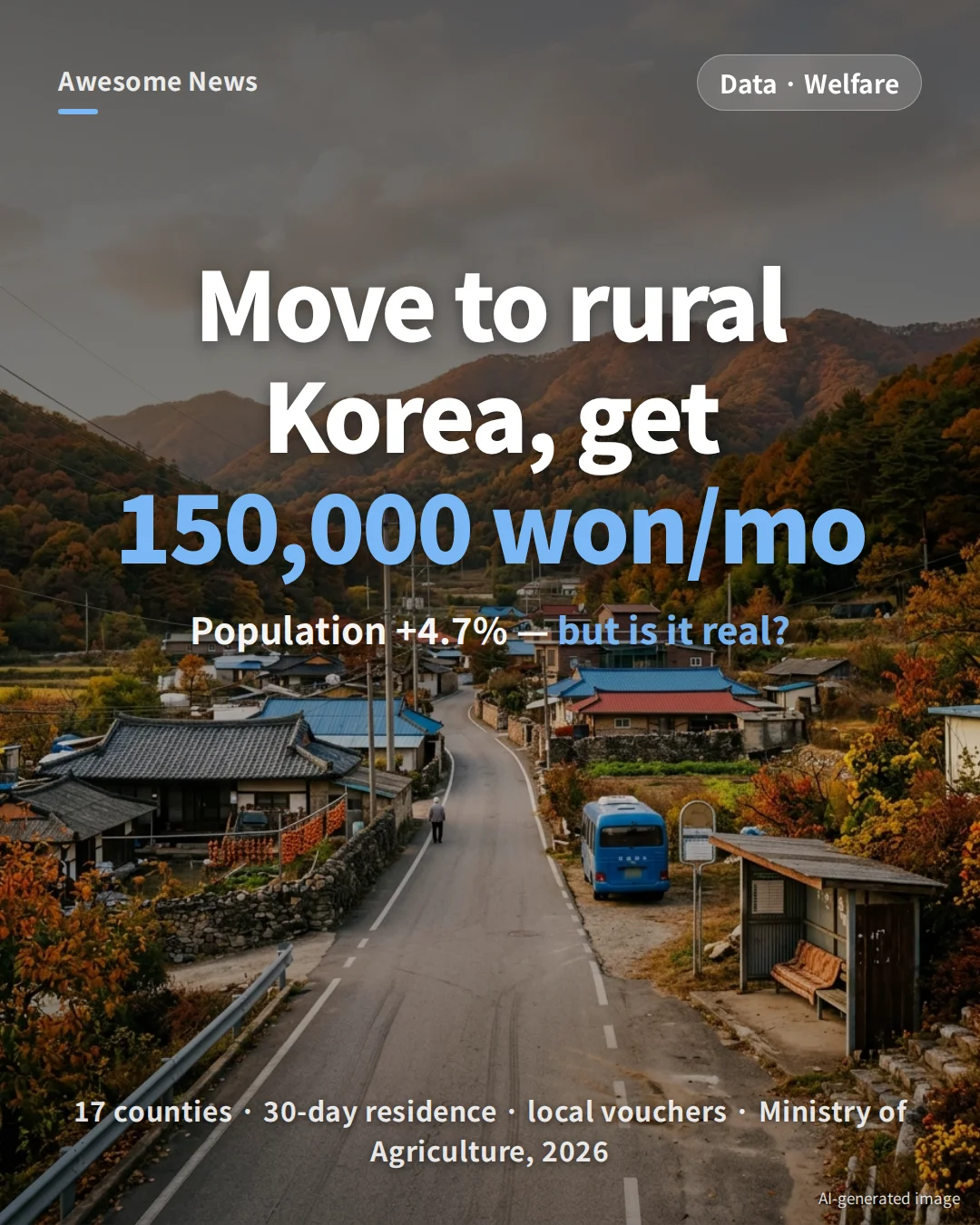
South Korea is paying every resident of 17 depopulating rural counties 150,000 won a month in local-currency vouchers, with no income or asset test. The scheme — the Ministry of Agriculture’s ‘rural basic income’ pilot — began in February 2026 in 10 counties, grew to 17 after a supplementary budget, and is slated to reach 35 counties in 2027 if the National Assembly approves.
A ‘county’ (*gun*) in Korea is a mostly rural administrative unit, smaller and less urban than a city (*si*). The pilot runs for two years (2026–2027), after which the government is to decide whether to continue.
Key numbers at a glance
- Who: residents of 17 designated depopulating counties in 2026. Must have at least 30 days of registered residence plus actual presence.
- How much: 150,000 won per person per month in local-currency vouchers. Gurye, Boseong and Cheongsong top it up to 200,000 won; Boeun pays 160,000 won.
- Budget: 304.7 billion won in 2026 (234.1 billion main + 70.6 billion supplementary) → 1,165.8 billion won in the 2027 budget bill (+282.6%).
- Expansion: 17 → 35 counties (proposed); national-government share rises from 40% to 50%. The 18 new counties have not yet been selected.
- Debate: the government cites a 4.7% population rise in the first 10 counties; critics say residents are simply moving in from neighbouring counties, and that county co-funding is squeezing other welfare programs.
What the money is
Rural basic income was a campaign pledge of President Lee Jae-myung and is listed as item 70-5 of his government’s national agenda. Payments go to everyone registered in an eligible county, regardless of income or wealth.
The Ministry of the Interior designates 89 ‘depopulating areas’ (cities, counties and districts combined); of these, 69 are counties and only counties can apply for the pilot. Residents of eligible cities or urban districts get nothing. Payments are made in local-currency vouchers, not cash.
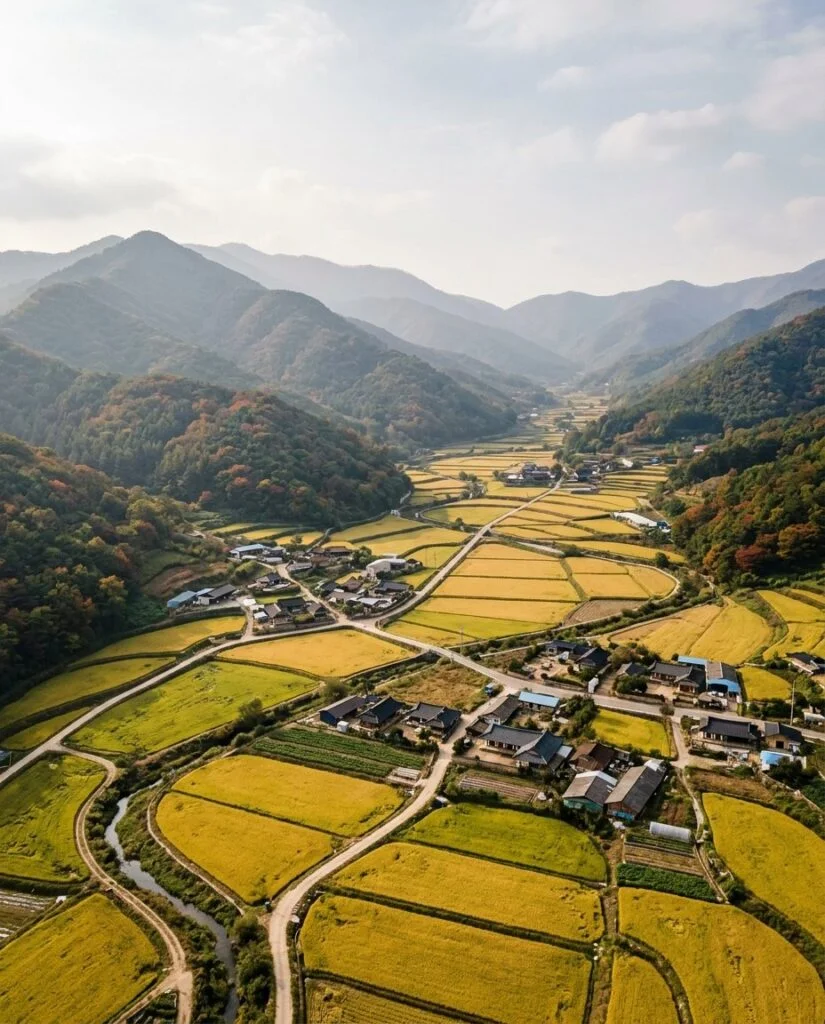
The 17 counties receiving payments now
Ten counties were picked in the first two rounds and began paying in February 2026. A third round of seven more was selected on June 11 after an April supplementary budget; most started paying in late August (Muju on September 10). The list, by province:
| Province | From February (10) | From late August (7) | Count |
|---|---|---|---|
| Gyeonggi | Yeoncheon | — | 1 |
| Gangwon | Jeongseon | Hwacheon | 2 |
| Chungbuk | Okcheon | Boeun | 2 |
| Chungnam | Cheongyang | — | 1 |
| Jeonbuk | Sunchang, Jangsu | Jinan, Muju | 4 |
| Jeonnam-Gwangju | Gokseong, Sinan | Gurye, Boseong | 4 |
| Gyeongbuk | Yeongyang | Cheongsong | 2 |
| Gyeongnam | Namhae | — | 1 |
| Total | 10 | 7 | 17 |
Some counties top up the national payment from their own budgets. Gurye, Boseong and Cheongsong pay 200,000 won a month and Boeun pays 160,000 won, according to a ministry release dated August 25, 2026. The same program thus pays different amounts depending on the county.
Who qualifies, and how the vouchers can be spent
To qualify, a person must have been registered in the county for at least 30 days before applying and actually live there. People who work in Seoul or attend university elsewhere are counted as residents only if they are physically in the county at least three days a week (for students, only during vacation periods). New arrivals who stay 90 days are paid three months of back payments. Foreign nationals and active-duty conscripts are excluded.
- Amount: 150,000 won per person per month, as local-currency vouchers (not cash).
- Expiry: residents of *myeon* (the smallest rural tier) have 6 months to spend each payment — three months longer than residents of *eup* (small towns).
- Cross-use: *myeon* residents can spend at clinics, pharmacies and private academies in the local *eup* as well.
- Capped sectors: gas stations, convenience stores and Hanaro Mart (an agricultural co-op chain) are limited to 50,000 won per use (the original release does not specify the time window).
The most common complaint from the first wave was that *myeon* villages have too few shops that accept the vouchers (Ministry of Agriculture, March 25, 2026). The money is there, residents say; the places to spend it are not.
The government’s headline: ‘4.7% more people’
On June 11, 2026 the Ministry of Agriculture reported that the first 10 counties had seen population rise by 4.7% and the number of new vendors signed up to accept the vouchers rise by 13.7%. On paper the pilot is meeting its stated goals of attracting residents and boosting local commerce.
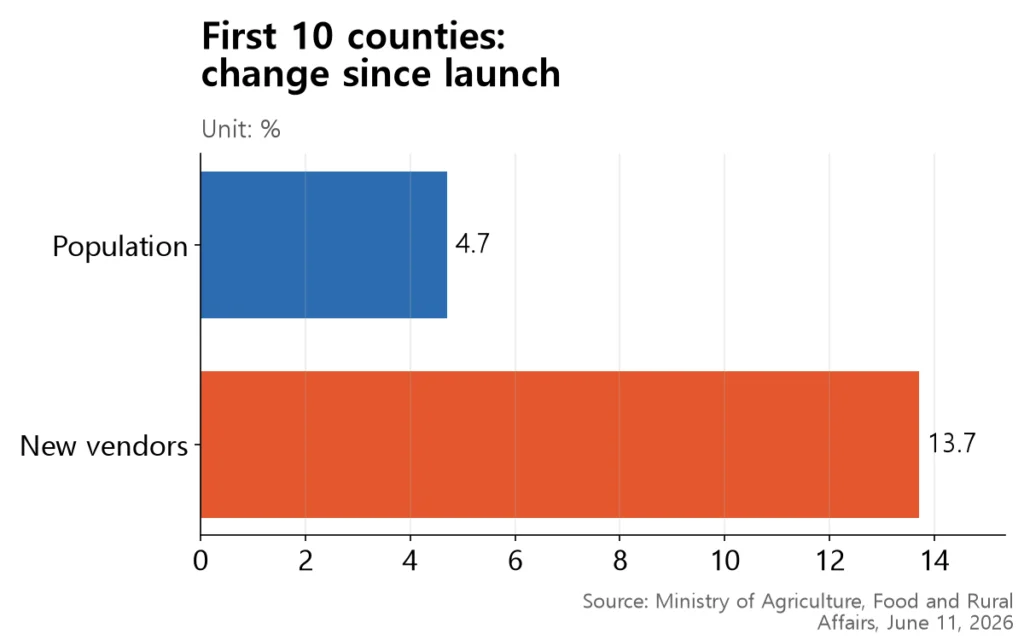
A big caveat sits behind those numbers. The government has not yet shown whether the new residents moved in from neighbouring counties for the voucher, or came to stay. Regional outlets (Nongmin Shinmun, Oct 28 2025; Seoul Shinmun, Oct 23 2025) have warned the scheme could become a zero-sum contest among depopulating counties, each pulling residents from the next.
The 2027 budget: 304.7 → 1,165.8 billion won
The government’s 2027 budget bill asks for 1,165.8 billion won — about 3.8 times the 304.7 billion won budgeted for 2026 (main plus supplementary) (calculated). The ministry’s own figure is +282.6%.
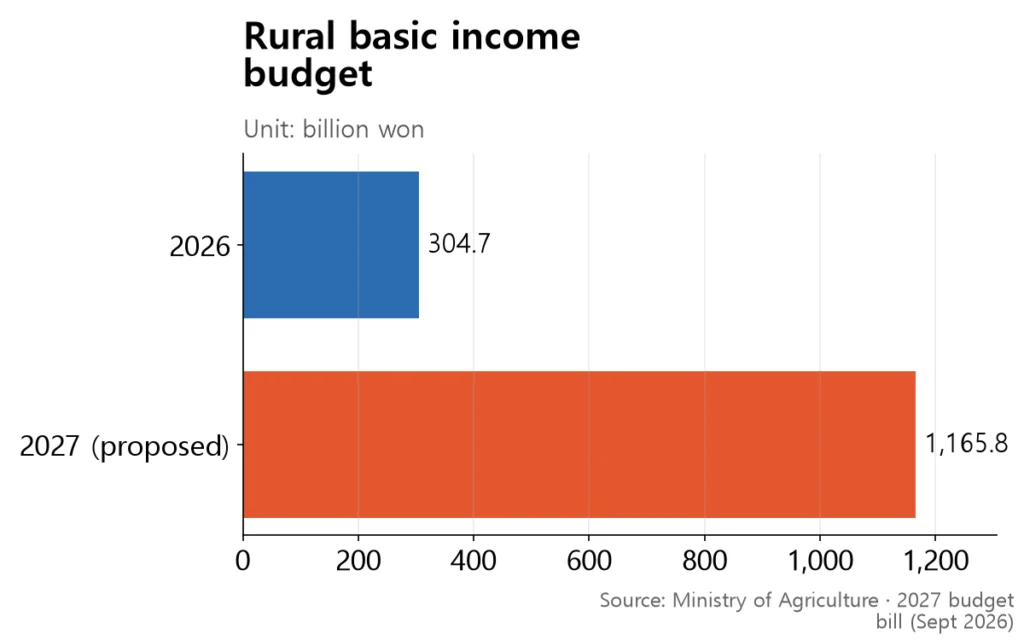
This is a proposal, not law. The National Assembly has yet to review it, and the 18 new counties have not been selected. Press reports mention Damyang and Haenam as possible applicants, but ‘all 35 will be paid in 2027’ is premature.
Where the money will come from is still being discussed. One single-sourced report (News1, Aug 20 2026) says the government is considering semiconductor windfall tax receipts and a future-response fund; we could not obtain the original document. The Korea Rural Economic Institute has estimated that extending the program nationwide would cost 5 trillion won a year (Asia Economy op-ed, July 2 2026).
Who actually pays — and the ‘cannibalisation’ debate
The scheme is not purely national money. In 2026 the split is 40% national government, 30% province, 30% county. The 2027 bill shifts this to 50% / 25% / 25%. The problem is that the counties themselves are the poorest participants.
| Group | Fiscal self-reliance ratio (avg.) |
|---|---|
| The 17 counties | 9.6% |
| National average | 48.6% |
The 17 counties cover on average 9.6% of their own budgets from local revenue — about one-fifth of the national norm. Having to find another 30% from already-thin coffers has led some to cut other benefits. Sunchang reportedly scaled back a child allowance and a farmer allowance; Yeongyang cut its farmer allowance and a welfare fund to pay the match (Chosun Ilbo, Sept 21 2026).
Critics have labelled this ‘cannibalisation’: if the new 150,000-won voucher is being funded by cutting existing support for children and farmers, the net effect looks less like additional help and more like redistribution.
How to read these numbers
- Both ’17’ and ’10’ are correct. Ten counties started in February, seven more in late August after a supplementary budget. Figures of ’11’ or ’12’ circulating on some blogs do not match ministry releases.
- ’35 counties in 2027′ is still a proposal. It needs parliamentary approval, and the 18 new counties have not yet been chosen.
- The ‘4.7% population rise’ is a real government figure, but the comparison window has not been clearly disclosed; interpretation depends on it.
- This is not the same as the Local Extinction Response Fund (2022–2031, about 1 trillion won a year), which goes to local governments as a block grant, not to individuals.
- Payment is in local-currency vouchers, not cash, with per-use caps of 50,000 won at gas stations, convenience stores and Hanaro Mart.
Summary
Rural basic income is the most direct cash-like transfer any Korean population policy has tried: it goes to every resident of eligible counties, with no means test. The early indicators look positive, but it is not yet clear whether the new residents moved in to stay or simply switched their address from the next county over. And the 30% county share — borne by the country’s poorest local governments — is already forcing some to cut programs for children and farmers to afford it.
Whether the two-year pilot survives will depend on how honestly the government can answer one question after it ends: did people change their address, or did they change their life?

Awesome News on Instagram @awesome_news_kr
This article is the research behind our Korean-language card news. Every morning we turn Korean data and official sources into short visual stories. See it on Instagram →
Sources
- Kyunghyang Shinmun (via Nate) — 150,000 won monthly basic income for rural residents staying ≥3 days a week (Korean) (2026-02-10)
- Newspim (via Nate) — [What’s new in 2026] 150,000 won/month rural basic income in 10 depopulating areas (Korean) (2025-12-31)
- Asia Economy — [2027 budget] Rural basic income expanded from 17 to 35 counties; national share 40→50% (Korean) (2026-09-01)
- Nongmin Shinmun (via Nate) — [2027 budget] Rural basic income coverage expanded to 35 counties (Korean) (2026-09-01)
- Chosun Ilbo (via Nate) — Report on county co-funding of rural basic income (data from lawmaker Jeon Jong-deok) (Korean) (2026-09-21)
- Ministry of Agriculture, Food and Rural Affairs — Rural basic income pilot: 5 press releases (nos. 576914, 577112, 577418, 578154, 578841) (Korean) (2026-02-10 ~ 2026-08-25)
- Korea Policy Briefing — Next year’s Local Extinction Response Fund to focus on projects with population impact (Korean)
- Ministry of the Interior and Safety — Designation of depopulating areas (Korean)
- Nongmin Shinmun — Report on fairness concerns from counties left out (Korean) (2025-10-28)
📊 Download the data
Every number in this article’s 4 charts and tables, in one CSV file (opens in Excel or Google Sheets). When you cite it, please name the original source and link to this page.
Download CSV