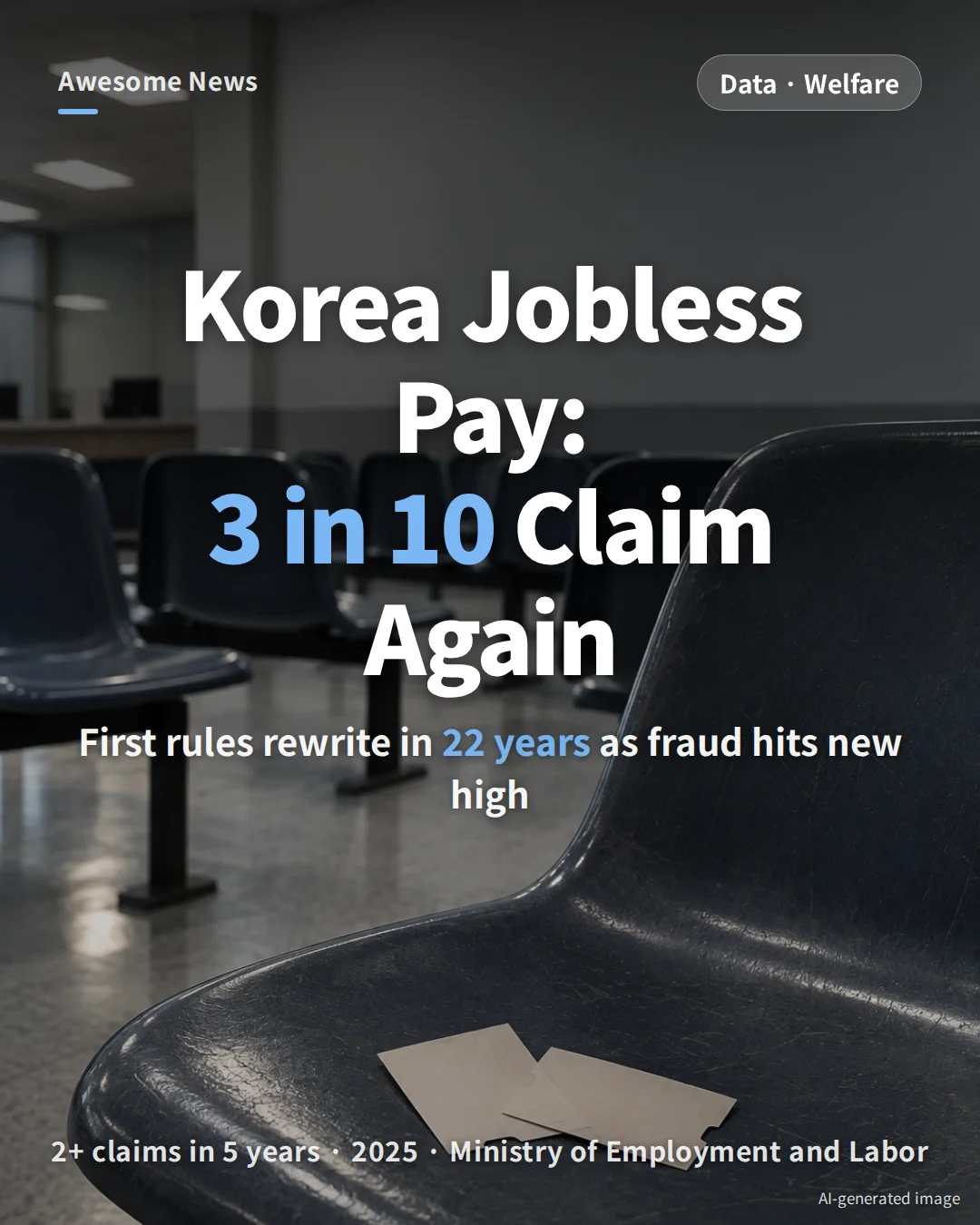
In 2025, 1,722,000 people collected South Korea’s unemployment benefit (called *gujik geupyeo*, or job-seeking allowance). 496,000 of them — 28.8% — had already received it at least once in the previous five years. The pool of total recipients has shrunk since 2020, but the share of repeat claimants has risen for three straight years. On September 1, 2026, the government approved its first major overhaul of how the benefit is paid out since the five-day workweek was introduced in 2004 — 22 years ago. This post walks through the scale of repeat claims, the fraud numbers, what the reform changes, and the one piece still stuck in parliament.
Key numbers at a glance
- 496,000 repeat claimants in 2025 — 28.8% of all recipients. Up from 445,000 (25.1%) in 2021, rising three years in a row.
- 33.2 billion won in fraudulent payouts (2025) — about 24% higher than the 26.8 billion won in 2022, and a five-year peak. Still just 0.27% of total payouts.
- Total benefit paid: 12.37 trillion won in 2025 — a five-year high, up three years running.
- Daily rate cut from 7 days/week to 6 days/week under the reform (approved Sept 1, 2026). Total amount and 120–270 day entitlement are unchanged.
- A separate bill to cut benefits for people claiming 3+ times in 5 years was re-approved by the Cabinet in 2024 but still sits in the National Assembly.
That ‘10,000 benefit addicts’ story was from 2021 — the yardstick has changed
In early 2021 a South Korean paper ran a story claiming there were ‘10,000 unemployment-benefit addicts’ who preferred collecting money to working. That figure counted people who had claimed five or more times in five years. The Ministry of Employment and Labor’s latest figures, provided to lawmakers in 2026, use a different definition — two or more claims in five years. The two numbers measure different things, so comparing 10,000 (old) to 496,000 (new) and saying claims rose 48-fold is wrong. They are not the same indicator.
The reason policymakers worry about repeat claims is money. South Korea’s unemployment-insurance account ran a 1.8 trillion won deficit in 2025. If the fund keeps leaking, either premiums go up or payout rules change. The government itself notes that most repeat claimants cycle through short-term contract jobs, so *repeat claim* is not the same as *fraud*.
496,000 repeat claimants — up three years in a row
Data the Ministry of Employment and Labor gave Rep. Kim So-hee’s office (reported by Financial News and Bridge Economy on August 13, 2026) show that the number of people claiming the benefit two or more times within five years moved like this: 445,000 (2021) → 437,000 (2022) → 474,000 (2023) → 490,000 (2024) → 496,000 (2025). That is three straight years of increases. Meanwhile total recipients fell from 1,775,000 in 2021 to 1,722,000 in 2025 — a drop of 53,000 — so the repeat share climbed from 25.1% to 28.8%. Roughly 3 in every 10 recipients.
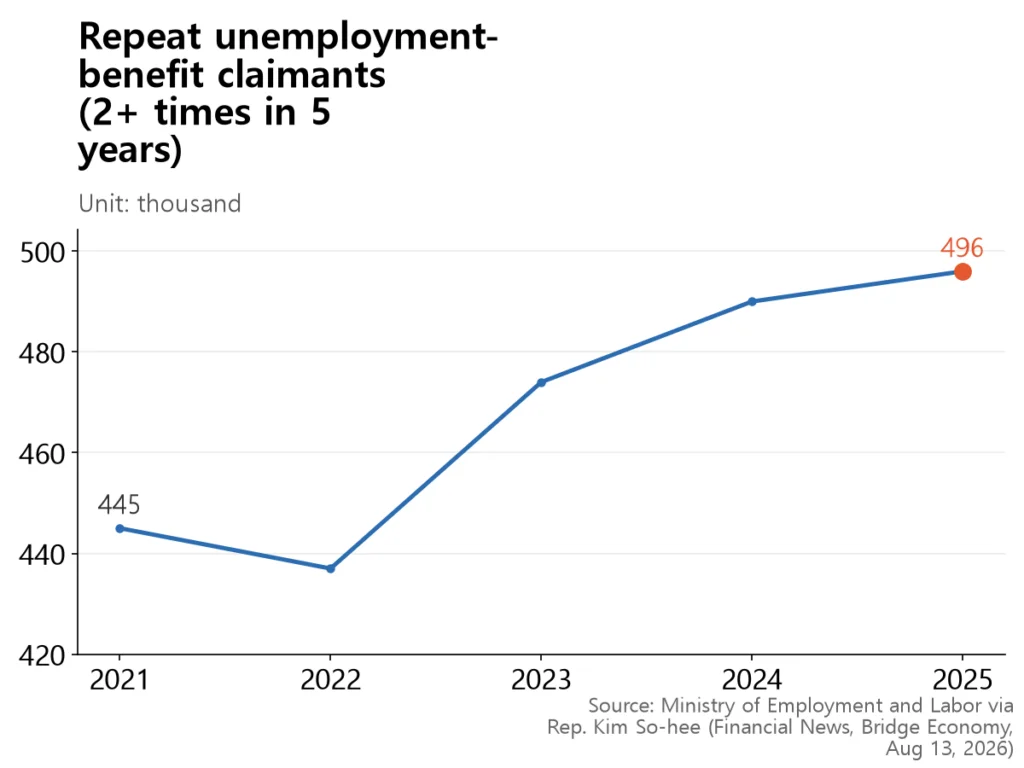
These figures come from a ministry response to a lawmaker’s inquiry, as reported in the press. The underlying statistical table has not been published separately.
33.2 billion won in fraud — the largest in five years

Fraudulent payouts rose from 26.8 billion won in 2022 to 33.2 billion won in 2025, a 23.9% increase and the highest level in five years (News1, June 23, 2026, citing data to Rep. Kim Seung-su’s office). By case count, however, 2021 is still the peak: 25,751 (2021) → 23,869 (2022) → 22,892 (2023) → 24,419 (2024) → 25,109 (2025). So the money is at a five-year high, but the number of incidents is not. The ministry ordered recovery of 62.7 billion won in 2025 (including penalty surcharges of up to five times the fraud amount). Across the past five years, 2,162 people were caught twice or more, for a total of 6.17 billion won.
Total benefit outlays have also climbed: 12.06 trillion won (2021) → 10.91 (2022) → 11.31 (2023) → 11.74 (2024) → 12.37 trillion won in 2025. Recipients are down 53,000 from 2021, but outlays are higher — largely because the statutory minimum daily benefit keeps rising.
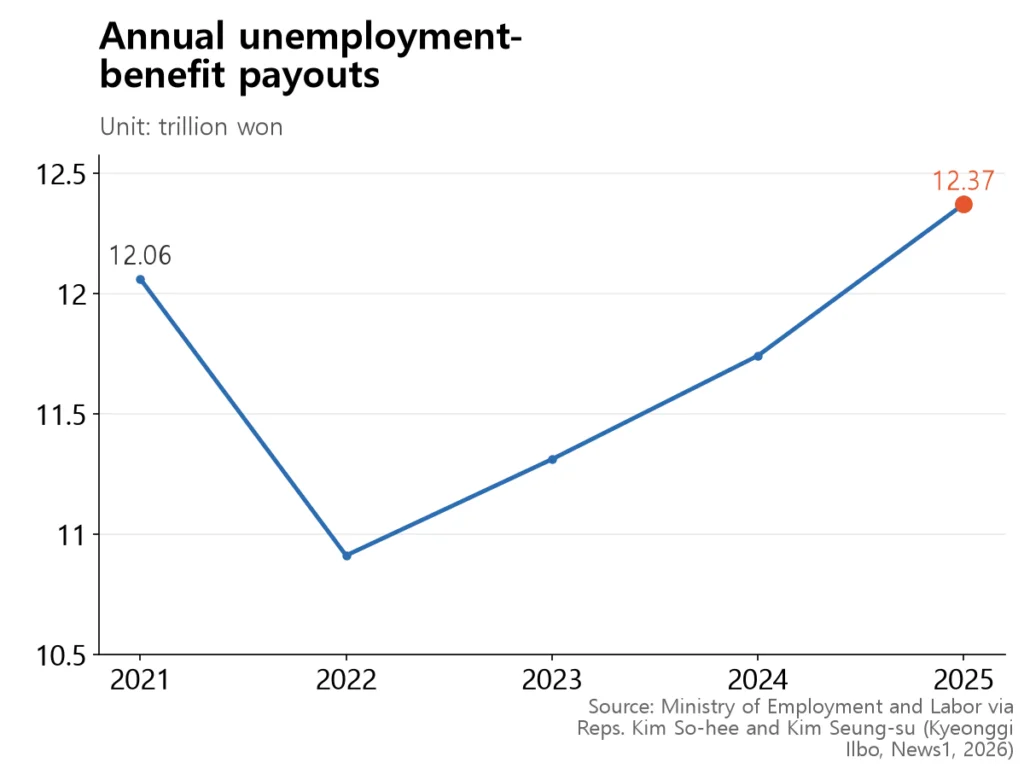
Put next to total outlays, fraud equals about 0.27%. The absolute number has grown, but the share remains small — a context worth keeping in mind.
The 22-year overhaul: paying for 6 days a week, not 7

On September 1, 2026 the ministry’s Employment Insurance Committee approved the Employment Insurance System Reform Plan. The core change: the daily unit will shift from 7 days per week to 6 days per week. When the benefit was created in 1995, Korea still had a six-day workweek. The five-day workweek began in 2004, but payouts kept running on a seven-day basis. That left some claimants receiving more per month than full-time minimum-wage workers earned — a reversal flagged by the Board of Audit and Inspection in October 2025.
Important caveat: total entitlement and the 120–270 day duration do not change. The daily rate goes down, but the number of weeks a person collects goes up to compensate. So this is not a *cut* in the benefit — it is a *stretch* of the same amount over a longer period.
| Item | Current | Reform plan | Note |
|---|---|---|---|
| Daily unit | 7 days/week | 6 days/week | Excludes unpaid rest day |
| Total amount & duration | 120–270 days | Unchanged | Payment stretched longer |
| Upper daily cap | Flat 68,100 won | 103% of minimum | Prevents cap-floor reversal |
| Early-reemployment bonus cutoff | Monthly income 5.74M won+ | 3.00M won+ | Based on re-employed income |
| Unemployment-account premium rate | 1.8% | 2.0% | From 2027; workers & firms each pay 0.9→1.0% |
Press reports described the change as cutting the monthly payout from 1,980,000 won to 1,760,000 won. Those figures mix two different years’ baselines: 1.98M won is the 2026 minimum daily benefit of 66,048 won × 30 days, while 1.76M won applies the 2027 minimum wage of 10,700 won (Asia Economy, Sept 1, 2026). On a like-for-like basis, the monthly amount falls to roughly 6/7 of the current level, the duration lengthens by the same ratio, and the total entitlement of 9.9 million won stays the same.
Workers’ paychecks will feel the premium side. From 2027, the unemployment-insurance premium rate rises from 1.8% to 2.0% — workers and employers each pay 1.0% instead of 0.9%. For someone earning 3,000,000 won a month, that works out to an extra 3,000 won deducted every month (calculated). This rate covers only the unemployment-benefit account; the separate employment-stability and vocational-training account is paid solely by employers.
Separately, the early-reemployment bonus will no longer be available to those whose new job pays 3,000,000 won or more per month, down from the current 5,740,000 won threshold. Four categories of platform-type workers will be brought under employment insurance from January 2027. The government aims to pass the enabling laws within 2026, so the effective date for most of these measures is still open.
The piece most people care about — repeat-claim cuts — is still in parliament

Since 2021 the government has pushed a bill to reduce payouts for anyone claiming the benefit three or more times within five years. The schedule would cut 10% on the third claim, 25% on the fourth, 40% on the fifth, and 50% from the sixth claim onward, while stretching the waiting period to up to four weeks. First introduced in 2021, the bill lapsed when the 21st National Assembly’s term expired. The Cabinet re-approved it on July 16, 2024 and sent it back to the Assembly (Policy Briefing). Rep. Kim So-hee filed a tougher version in December 2025. As of 2026 it has yet to pass, and this post could not verify the current committee status.
The bill carves out an exception: low-wage workers and day laborers are not counted against the three-strikes rule. That is because people who cycle through short contracts in the low-wage labor market would be squeezed by a repeat-claim penalty — undermining the point of the benefit, which is to keep workers afloat between jobs. That is why critics of the September reform plan say the biggest piece — repeat-claim reduction — is still missing.
How to read these numbers
- Repeat claim ≠ fraud. Many repeat claimants cycle through short-term contract jobs; the government’s own penalty bill excludes low-wage and day labor.
- The reform is still a *plan*. It takes effect only when the law and subordinate rules are rewritten. Treat it as ‘about to change,’ not ‘already changed.’
- ‘1.98M → 1.76M won’ mixes two baseline years. The total entitlement (9.9M won) is the same; what changes is a stretch from about 5 months to 5.8 months.
- A 2019 reform broke the time series. Comparing figures from before October 2019 with later ones can mislead because duration and amount formulas changed.
- Fraud peaks differ by metric. 2025 is the five-year high in won, but 2021 (25,751 cases) still leads on case count.
Summary
Unemployment benefits are the bridge between a lost job and a new one. Right now, three in every ten people on that bridge have crossed it at least once in the past five years, maintenance costs (payouts) and leaks (fraud) are both at five-year highs, and the government has tabled its first big redesign in 22 years to realign payouts with the five-day workweek and to raise the premium rate. The one piece that addresses the root of repeat claims — reducing payouts for serial claimants — is still asleep in parliament. Half of the bridge rebuild is still ahead.

Awesome News on Instagram @awesome_news_kr
This article is the research behind our Korean-language card news. Every morning we turn Korean data and official sources into short visual stories. See it on Instagram →
Sources
- Ministry of Employment and Labor — Monthly Labor Market Trends from Employment Administration Statistics, August 2026 (Korean) (2026-09-07)
- Ministry of Employment and Labor — Employment Insurance System Reform Plan (Korean) (2026-09-01)
- e-National Indicators — Employment Insurance Spending (Indicator 1508) (Korean)
- Financial News — Repeat unemployment-benefit claimants reach 496,000 — a five-year high (Korean) (2026-08-13)
- Bridge Economy — 29% claimed unemployment benefit again within 5 years (Korean) (2026-08-13)
- News1 — Unemployment-benefit fraud reaches 33.2 billion won, up 24% in three years (Korean) (2026-06-23)
- Daum News (exclusive) — Exclusive: Last year’s benefit fraud of 33.2 billion won — an all-time high (Korean) (2026-04-08)
- Asia Economy — Monthly unemployment benefit cut from 1.98M to 1.76M won; premium rate 1.8% → 2% (Korean) (2026-09-01)
- Hankyung — Monthly unemployment benefit 1.98M → 1.76M won (Korean) (2026-09-01)
- Korea Policy Briefing — Benefit reductions by number of claims; low-wage and vulnerable workers excluded (Korean) (2024-07)
- JoongAng Ilbo — ‘Who would work when you get paid to rest?’ — 10,000 unemployment-benefit addicts (Korean) (2021-01 (approx.))
📊 Download the data
Every number in this article’s 3 charts and tables, in one CSV file (opens in Excel or Google Sheets). When you cite it, please name the original source and link to this page.
Download CSV