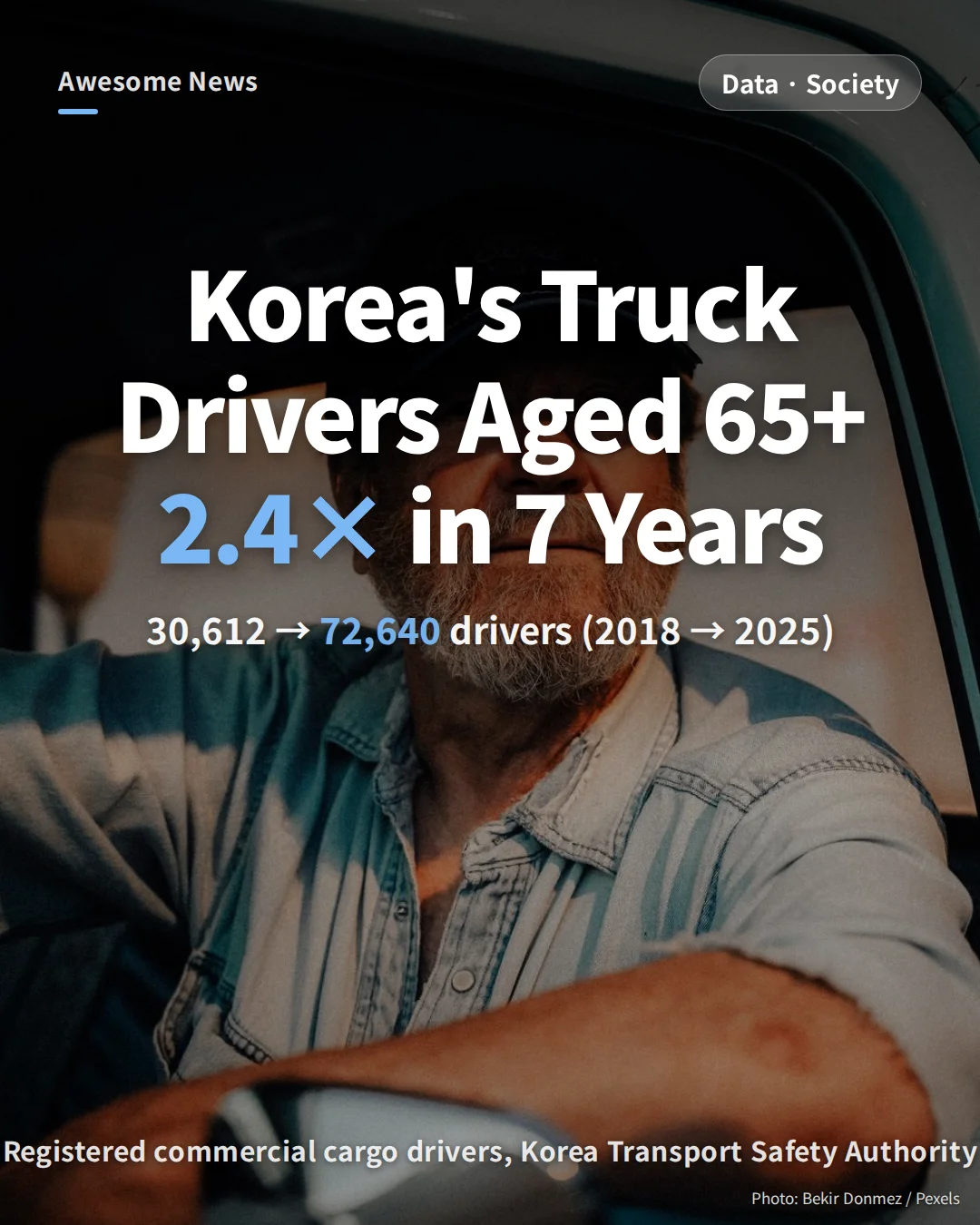
South Korea’s cargo trucks are increasingly driven by seniors. The number of registered freight drivers aged 65 or older grew from 30,612 (9.1% of the total) in 2018 to 72,640 (16.4%) in 2025 — a 2.4× increase in seven years. Drivers aged 70+ rose from 9,993 to 24,786 over the same period, according to a full-population dataset from the Korea Transportation Safety Authority (TS). This piece walks through why the cab is greying, how it fits with Korea’s broader senior-driving trends, and three caveats before concluding that “older means more dangerous.”
Key numbers at a glance
- Registered population: cargo drivers aged 65+ rose from 30,612 to 72,640 between 2018 and 2025 (2.4×). Drivers 70+ went from 9,993 to 24,786.
- Average age by truck class (2025 survey): small (≤1 ton) 65.5, medium 63.0, large 58.7, special (trailers etc.) 58.3 — all up 3.8–6.0 years since 2019.
- 1-ton drivers: roughly 95% are 50 or older; 32.8% are 70+ (2025, KOTI driver survey).
- Few new entrants: new cargo drivers in 2022 averaged 47.6 years old; just 2.3% of large-cargo drivers are in their 20s or 30s.
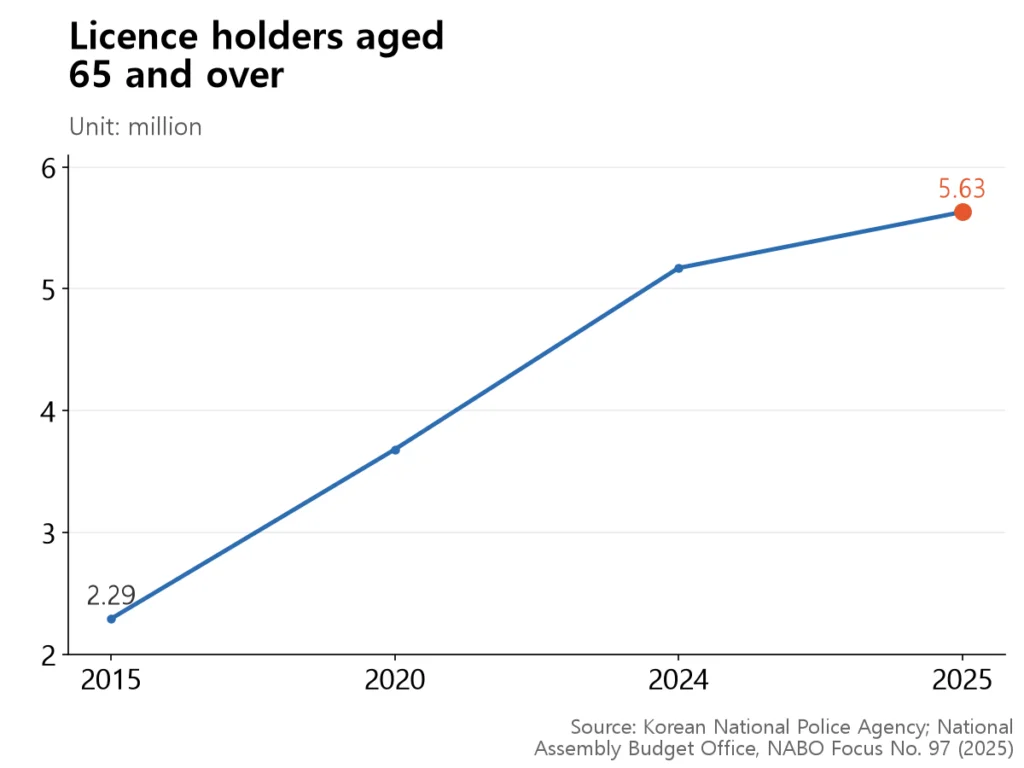
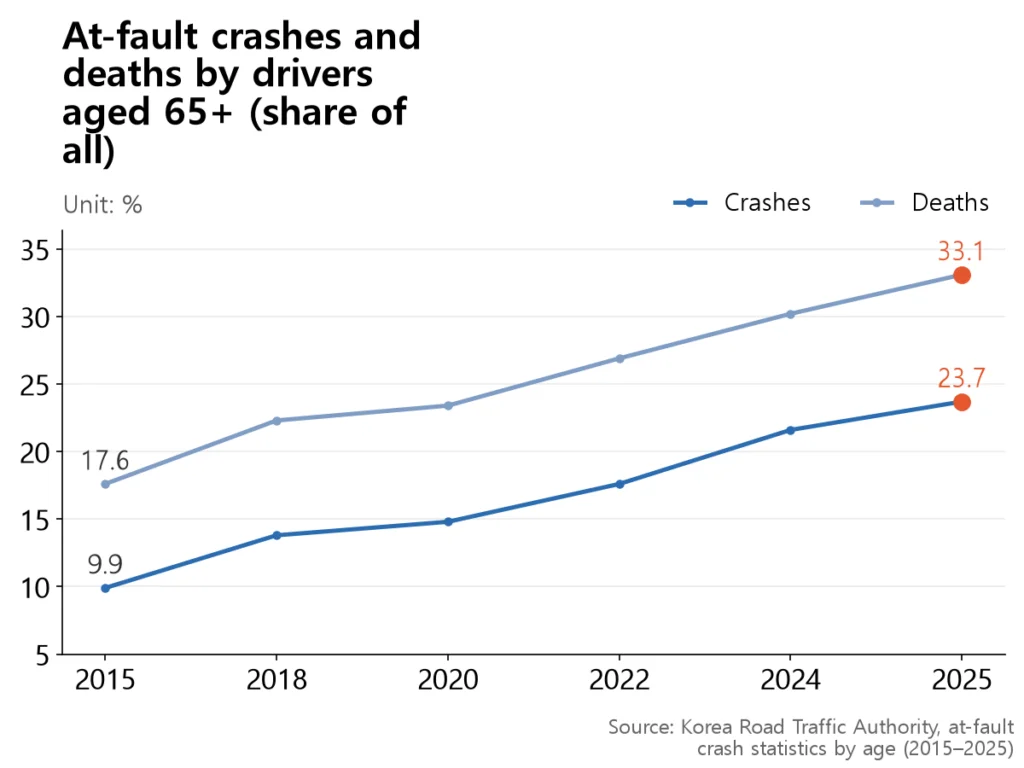
- All senior drivers: licence holders 65+ grew from 2.29 million (2015) to 5.63 million (2025). Their share of at-fault crashes rose from 9.9% to 23.7%, yet crashes per 10,000 licence holders in this age group fell from 101 to 81.
Why trucks, why now
The topic surged into Korean press coverage in mid-2026, first when a navigation-app press release popularised the 65.5-year average for 1-ton drivers, then when a commercial-vehicle trade magazine extended the picture to medium, large and special classes under the headline “double aging” — both the drivers and the trucks are old. The underlying report is the Korea Transport Institute (KOTI) 2025 Freight Transport Market Survey — Cargo Owner-Operator Report.
KOTI’s figures come from face-to-face interviews with 6,262 owner-operators at highway rest areas, ports and terminals nationwide (Jeju Island and parcel-delivery drivers excluded). The sample gives a detailed profile of who sits behind the wheel, but skews older than the full registry — a gap we return to below.
The registry: 65+ drivers up 2.4× in seven years
Across the full TS registry of commercial cargo drivers (small, individual and general freight combined), the workforce grew from 336,641 in 2018 to 442,849 in 2025. Within that total, drivers aged 65 and over expanded from 30,612 to 72,640 — 2.37× in seven years — and their share climbed from 9.1% to 16.4%. The 70+ group rose from 9,993 to 24,786.
| Year | Drivers 65+ | Share |
|---|---|---|
| 2018 | 30,612 | 9.1% |
| 2020 | 39,920 | 11.0% |
| 2022 | 50,859 | 12.7% |
| 2024 | 64,343 | 14.9% |
| 2025 | 72,640 | 16.4% |
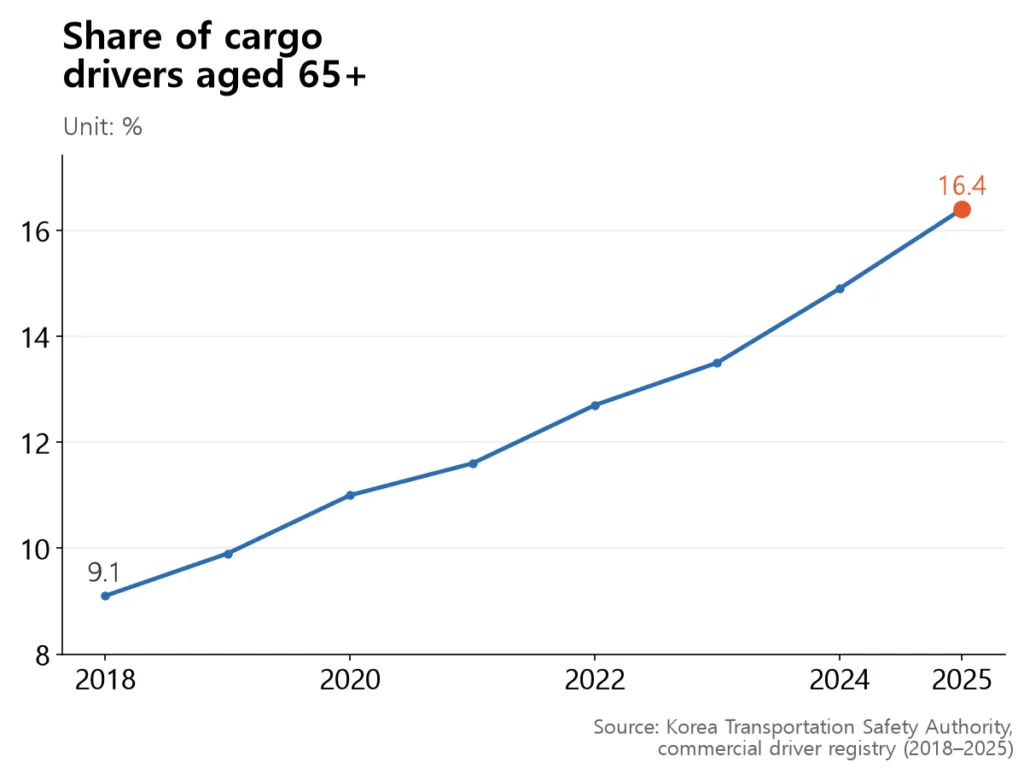
The pace differs by segment. “Individual” freight aged fastest, from 11.7% to 21.7%. “General” freight more than doubled, from 4.4% to 11.3%. Old-style “small-haul” (yongdal) rose more gently from 16.7% to 20.4% — because, KOTI notes, young parcel-delivery drivers register under this category and drag the average down.
By truck class — the 1-ton problem
In KOTI’s survey of 6,262 owner-operators (parcel delivery excluded), there is a clear gradient: the smallest trucks have the oldest drivers, and ages fall as trucks get bigger. But every class has aged 4–6 years in just six years.
| Truck class | 2019 | 2025 | 6-yr change |
|---|---|---|---|
| Small (≤1 ton) | 61.7 | 65.5 | +3.8 |
| Medium (1–5 tons) | 57.6 | 63.0 | +5.4 |
| Large (≥5 tons) | 52.9 | 58.7 | +5.8 |
| Special (trailers etc.) | 52.3 | 58.3 | +6.0 |
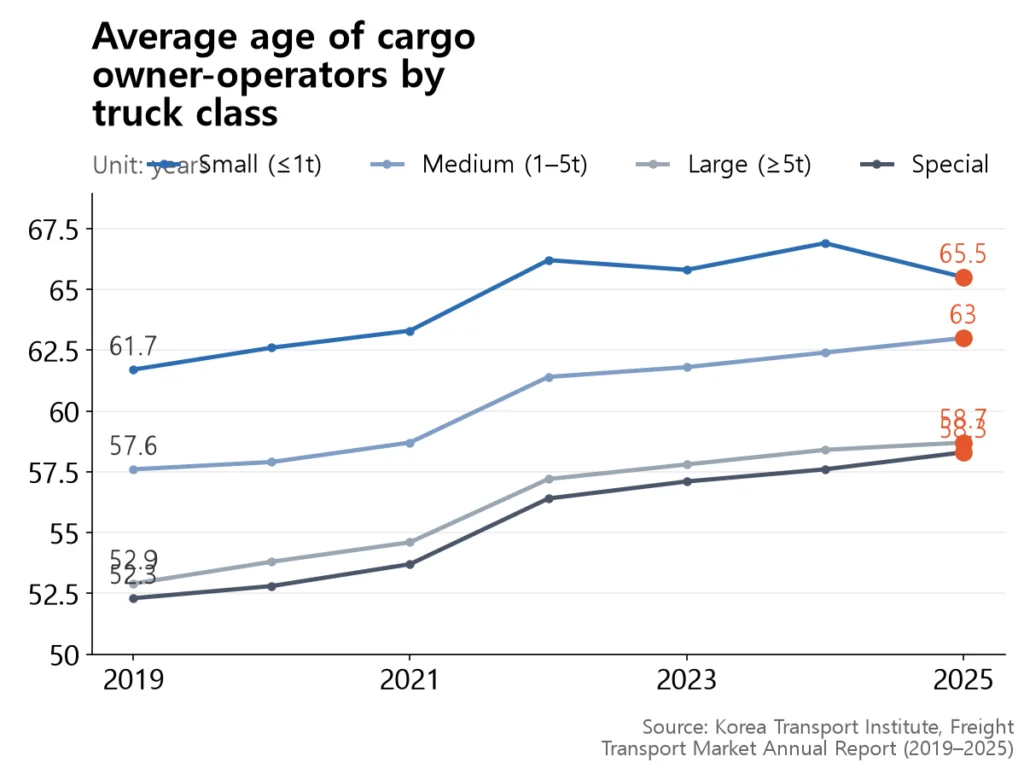
One nuance: the small-truck average actually fell from 66.9 in 2024 to 65.5 in 2025, a drop of 1.4 years. Only medium, large and special classes rose every single year — so “the trucks get older every year” isn’t quite right. Over six years, however, even the small class has aged by 3.8 years.
The 2025 age breakdown for small-truck drivers: 20s 0.2%, 30s 0.4%, 40s 4.7%, 50s 14.9%, 60s 47.0%, and 70+ 32.8%. Adding up everyone 50 or older gives 94.7% — KOTI’s own wording is “about 95%.” Infographics that round this up to “over 95%” are slightly inflated. In 2024 the figure reached 96.0% before easing back in 2025.
Why cab after cab turns grey
The average 1-ton driver has 18.8 years of experience. If the average age is 65.5, that career length implies most are not lifelong truckers. KOTI reads it this way:
This appears to reflect an inflow of drivers after retirement from other careers, rather than young workers entering the industry.
Korea Transport Institute, 2025 Freight Transport Market Owner-Operator Survey (Korean, our translation)
In other words, driving a 1-ton truck has become a second career for retirees. The same survey puts the small-truck driver’s monthly net income at about 1,900,000 won (on revenue of 3,590,000 won). Barrier to entry is relatively low — a used truck plus the plate costs roughly 40–50 million won for small trucks, versus around 100 million won for large rigs — and the pay-per-drop city delivery work fits older bodies better than long-haul shifts.
Few young people take the opposite path. New cargo drivers in 2022 already averaged 47.6 years old on entry (general cargo 45.9, individual and small-haul both 48.7). Among large-cargo drivers in 2025, only 2.3% are aged 20–39. With start-up costs of tens of millions of won — up to around 100 million for the largest trucks — and 87.0% of general-cargo drivers (2022) working under a vehicle-leasing (*jiip*) arrangement, becoming a trucker in Korea is closer to opening a small business than taking a job.
The bigger picture: all of Korea’s drivers are ageing
This is not just a cargo story. Licence holders aged 65 and over grew from 2.29 million in 2015 to 5.63 million in 2025. The share of Koreans aged 65+ who actually drive climbed from 10.1% in 2008 to 26.2% in 2023, according to the Senior Life Survey. Older people are living longer and staying mobile.
Police and Road Traffic Authority data show that at-fault crashes involving drivers 65+ rose from 23,063 (9.9% of all at-fault crashes) in 2015 to 45,873 (23.7%) in 2025. The share of road deaths rose from 17.6% to 33.1%. Narrowing to cargo trucks: of 24,230 at-fault truck crashes in 2025, 7,264 (30.0%) involved a driver aged 65+; of 585 cargo-truck fatalities, 206 (35.2%) did.
How to read these numbers
Taken at face value these figures suggest “older driver = more dangerous.” Three caveats are worth keeping in mind.
1. More crashes largely reflects more drivers
Crashes per 10,000 licence holders aged 65+ actually fell from about 101 in 2015 to about 81 in 2025 (calculated from crash counts and licence totals). Deaths per 100,000 licence holders in this age group dropped from 35.6 to 15.0. Rising crash counts largely reflect the much bigger pool of senior drivers. That said, in 2023 the 65+ rate of 83.4 crashes per 10,000 licences was still around 45% higher than the all-ages average of 57.6, according to the Korea Insurance Research Institute.
2. Survey averages and the registry measure different things
In KOTI’s owner-operator survey, 94.7% of small-truck drivers were 50 or older in 2025. In the TS registry, only 60.1% of drivers in the old small-haul category are. Why so different? KOTI’s survey was conducted at rest areas and terminals among traditional cargo-truck owners and excludes parcel-delivery drivers, while the TS registry sweeps in many young parcel couriers registered under small-haul. So “1-ton drivers average 65.5” is accurate only as a survey of traditional cargo owners.
3. Fatal senior crashes concentrate in private — not commercial — trucks
Of 594 cargo-truck fatalities in 2024, 196 (33.0%) involved a driver 65+. But splitting commercial from private trucks: commercial 189 → 39 deaths (20.6%), private (non-business) 405 → 157 deaths (38.8%). The toll falls much more heavily on private 1-ton trucks — the kind common in rural areas — which are outside Korea’s commercial fitness-exam regime. (KOTI analysis of 2024 TAAS data.)
How the rules are responding
Commercial cargo drivers aged 65–69 must take the Korea Transportation Safety Authority’s qualification maintenance exam every three years, and every year from age 70 — seven test items for a fee of 20,000 won. A hospital-based medical aptitude test (eight items) can substitute. The exam was introduced for cargo in 2020, after buses (2016) and taxis (2019).
But the pass rate has been so high that regulators have questioned whether the test discriminates at all. The combined pass rate across buses, taxis and trucks rose from 95.8% in 2019 to 98.8% by August 2024 — of 71,553 drivers tested through August 2024, only 870 failed. In December 2025, Ministry of Land Notice No. 2025-700 tightened the scoring: a driver is deemed unfit if two or more of the four core items (field of vision, route-finding, tracking, complex function) score grade 4 or lower. The ministry expects the pass rate to fall to around 95.2% once the new rule takes full effect in 2026.
A separate measure addresses pedal-misapplication incidents. In 2026 the Ministry of Land and the Korea Transportation Safety Authority will subsidise pedal-misoperation prevention devices on 3,260 vehicles driven by people aged 65 or older — 1,360 corporate taxis, 1,300 private-hire taxis and 600 cargo trucks of 1.4 tons or less. The device cancels acceleration when the accelerator is pressed to more than 80% at under 15 km/h or when the engine hits 4,500 rpm. Subsidies cover 50% of cost for corporate operators and 80% for individuals.
Summary
Korea’s cargo-truck cab is undeniably ageing: 65+ drivers in the registry have grown 2.4× in seven years, and retirees moving into 1-ton trucks fill most of the small-truck segment. But framing this purely as a safety problem overstates what the data say. Crashes per licence holder in the 65+ group have actually fallen, fatal senior truck crashes concentrate in private vehicles that lie outside the commercial fitness regime, and the fitness exam itself still passes 98% of applicants. Any policy response — tougher tests, pedal-misoperation devices — probably needs to be paired with a harder question: why don’t younger Koreans want to drive a truck?

Awesome News on Instagram @awesome_news_kr
This article is the research behind our Korean-language card news. Every morning we turn Korean data and official sources into short visual stories. See it on Instagram →
Sources
- Korea Transport Institute (KOTI), Freight Transport Market Information Center — 2025 Freight Transport Market Survey — Cargo Owner-Operator Report (Korean) (2026-03-23)
- Korea Transport Institute — Freight Transport Market Trends — 2022 Annual Report (Korean) (2023-05-17)
- Korea Transport Institute — Outlook and Policy Response for Freight Driver Jobs in the Cargo Trucking Market (Korean) (2023-10-31)
- Korea Transport Institute — Innovation Plan for the Cargo Driver Management System (MP-26-07) (Korean) (2026-03-31)
- Korea Transportation Safety Authority (TS) — Commercial Driver Registry by Age and Region (CSV, 2025-12-31) (Korean) (2026-07-28)
- Korean National Police Agency and Korea Road Traffic Authority — 2025 Road Traffic Accident Statistics (press release, Table 4: senior drivers) (Korean) (2026-04-17)
- Korea Road Traffic Authority — At-fault Driver Crash Statistics by Age (annual CSV, 2012–2025) (Korean) (2026-08-03)
- Korea Road Traffic Authority — At-fault Driver Crash Statistics by Party Type and Age (2025-12-31) (Korean) (2026-08-10)
- National Assembly Budget Office — NABO Focus No. 97: Policy and Legislation on Senior-Driver Road Safety at Home and Abroad (Korean) (2025-03-18)
- Ministry of Land, Infrastructure and Transport — Tightening the Fitness Exam for Senior Commercial Drivers (press release) (Korean) (2025-02-19)
- Korea Policy Briefing (Ministry of Land, Infrastructure and Transport) — Pedal-Misoperation Prevention Devices Rolled Out First for Taxi and Cargo Drivers Aged 65+ (Korean) (2026-02-10)
- Korea Law Information Center — Regulation on Fitness Exams for Commercial Vehicle Drivers (MOLIT Notice No. 2025-700) (Korean) (2025-12-05)
- Korea Insurance Research Institute — Research Report 2025-13: Population Aging and Senior Drivers (Ch. II–III) (Korean) (2025)
- The Kyunghyang Shinmun — [Exclusive] Half of Taxi Drivers Are 65+; Fitness Exam Pass Rate 99% (Korean) (2024-10-10)
- CV Info (Commercial Vehicle Magazine) — Freight Transport Market: “Double Aging” — Drivers and Trucks Both Getting Old (Korean) (2026-08-07)
- The Chosun Ilbo — Senior-Driver Crashes Up 44%, But Only 2.5% Return Their Licence (Korean) (2026-08-01)
- Ministry of Health and Welfare and Korea Institute for Health and Social Affairs (as reported) — 2023 Survey on the Elderly, Section 9: Living Environment and Later Life (Korean) (2024-11-07)
📊 Download the data
Every number in this article’s 6 charts and tables, in one CSV file (opens in Excel or Google Sheets). When you cite it, please name the original source and link to this page.
Download CSV