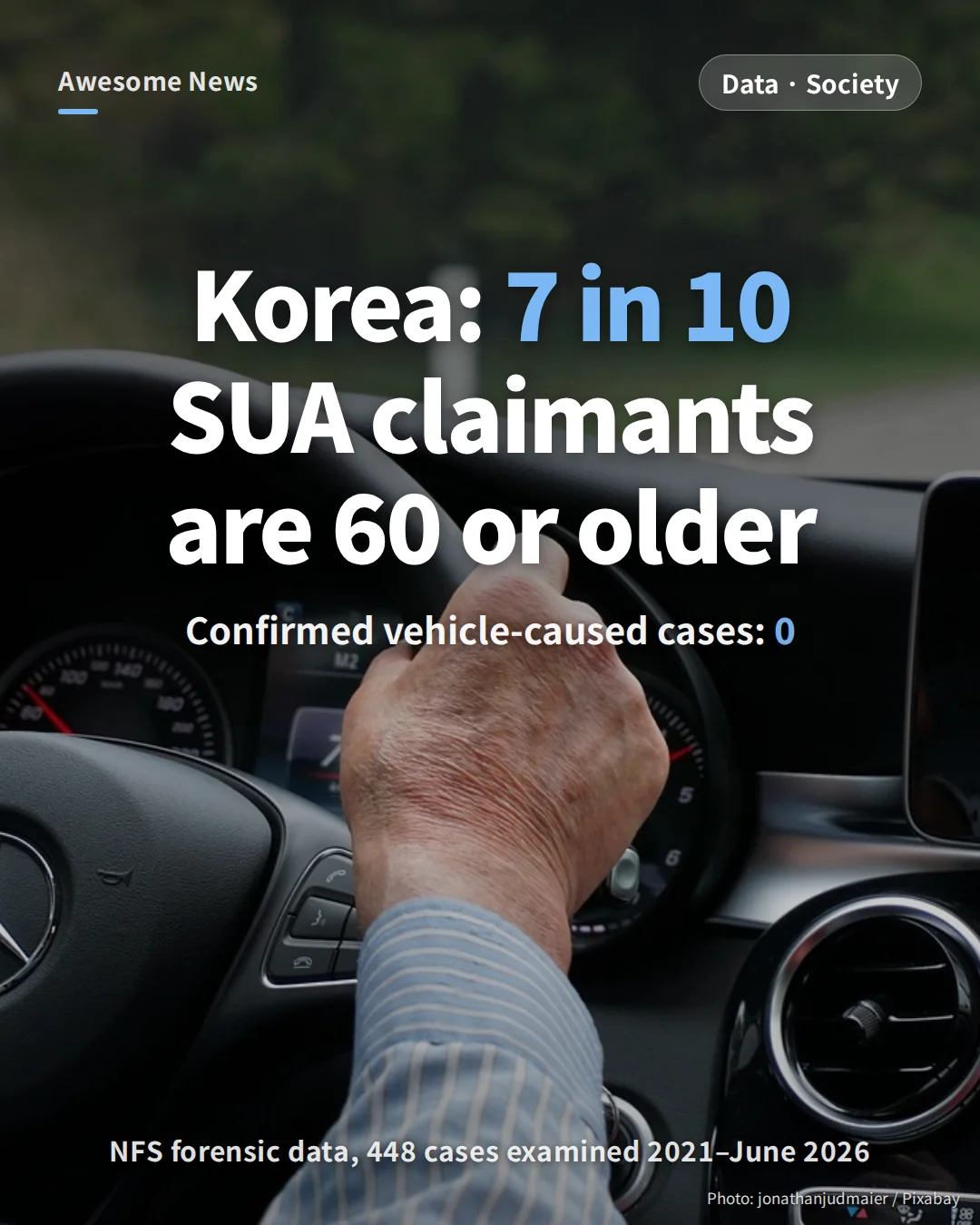
A striking line keeps circulating in Korean media: seven out of ten drivers who claim sudden unintended acceleration are 60 or older. Rechecking the primary data from the National Forensic Service (NFS) and the Korea Transportation Safety Authority (TS), that figure holds — but only inside those two forensic samples. In the same period, the number of crashes officially confirmed as vehicle-caused sudden acceleration is zero: 0 of 448 cases examined by NFS from 2021 through June 2026.
This piece lays out five things: how the age distribution looks in the NFS and TS samples, how it compares with the pool of licensed drivers, why the share drops to 43% when you count people filing recall-center complaints instead, how Japan and the United States show a U-shaped curve with young drivers also elevated, and the main ways these numbers get misread.
Key numbers at a glance
- 0 of 448 NFS forensic cases were confirmed as sudden acceleration; 85.7% were ruled pedal misapplication (2021–June 2026).
- In the NFS sample where driver age was known (326 cases, 2020–H1 2024), 71.5% were 60 or older.
- In TS’s 2025 review of 141 press-reported cases with known driver age, 75.2% were 60 or older (60s: 51, 70s: 40, 80+: 15).
- Only 22.6% of licensed drivers in Korea are 60+ (2023) — so the forensic samples are skewed about 3× relative to the licensed population (calculated).
- By contrast, among 396 named filers at the Vehicle Recall Center (2014–June 2024), just 43.2% were 60+; 56.8% were under 60.
- In Japan, pedal-error injury crashes per 100,000 licensees run 10.0 for drivers 24 and under and 12.3 for 75+ — a U-shape (ITARDA).
In the NFS forensic pool: 71.5% of drivers are 60+
Of the suspected-sudden-acceleration cases NFS examined between January 2020 and the first half of 2024, 326 had an identifiable driver age. In that pool, 233 drivers (71.5%) were 60 or older. Drivers in their 60s accounted for 136 cases (41.7%), 70s for 86 (26.4%), and 50s for 68 (20.9%). Drivers in their 60s and 70s alone made up 222 cases, or 68.1% of the sample (calculated).
| Driver age | Cases | Share |
|---|---|---|
| 20s | 4 | 1.2% |
| 30s | 2 | 0.6% |
| 40s | 19 | 5.8% |
| 50s | 68 | 20.9% |
| 60s | 136 | 41.7% |
| 70s | 86 | 26.4% |
| 80s | 11 | 3.4% |
| 60+ total | 233 | 71.5% |
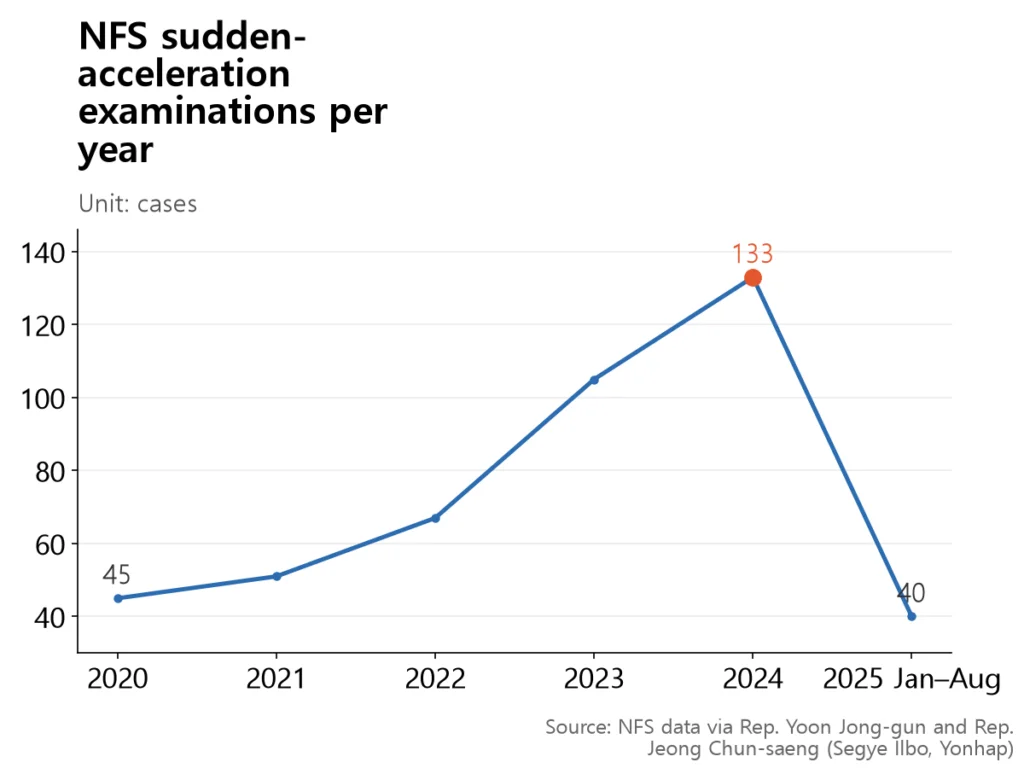
Annual NFS examinations climbed sharply over the same period: 45 cases in 2020, 51 in 2021, 67 in 2022, 105 in 2023 and 133 in 2024. According to data released by lawmaker Jeong Chun-saeng’s office in October 2025, requests then collapsed to just 40 cases in January–August 2025. The average age of claimants moved around rather than rising steadily — 61.2 in 2020, 67 in 2023, 66.5 in H1 2026 — so a simple ‘always climbing’ story would overstate the trend.
TS’s 2025 press-report analysis: 106 of 141 drivers were 60+
The Korea Automobile Safety Research Institute, part of TS, published its ‘2025 analysis of suspected sudden-acceleration crashes’ on 19 January 2026. It covered 149 crashes that appeared in Korean media last year. 109 (73.2%) were confirmed as pedal misapplication, none were traced to a vehicle defect, and the remaining 40 cases were still under investigation or had no confirmed finding.
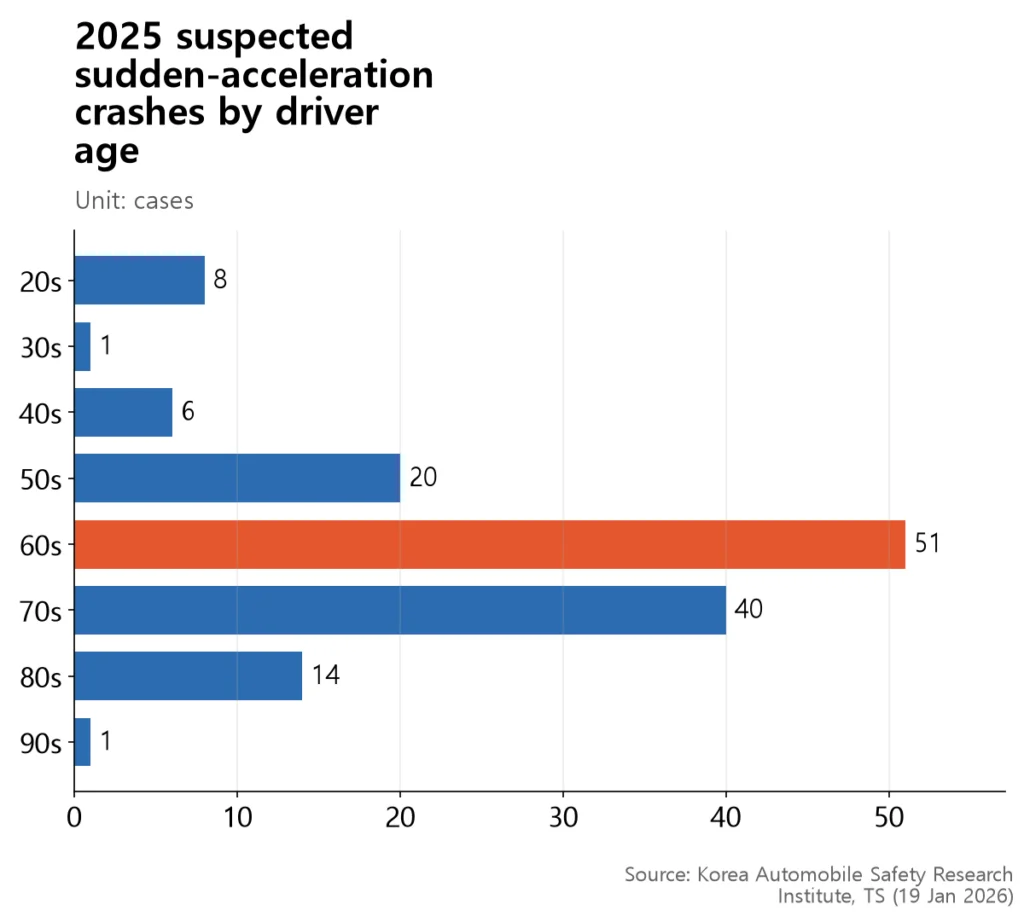
Driver age was identified in 141 of those cases. 106 drivers (75.2%) were 60 or older — 51 in their 60s (36.2%), 40 in their 70s (28.4%) and 15 aged 80 or above. The under-60 slices were small: 20 in their 50s (14.2%), 6 in their 40s (4.3%), 1 in the 30s and 8 in the 20s. (Several Korean news stories duplicated ‘4.3%’ for both 40s and 50s; the totals confirm the 4.3% belongs to the 40s.)
Compared with licensed drivers, the sample is skewed about 3×
Drivers aged 60 and over make up 22.6% of Korea’s 34.13 million licensed drivers (as of August 2023, Statistics Korea). Setting that next to the 71.5% in the NFS pool and 75.2% in the TS pool, older drivers appear in the forensic samples at roughly three times their share of the licensed population (calculated).
| Dataset | Period | Share 60+ | Sample size |
|---|---|---|---|
| Suspected cases in press reports (TS) | 2025 | 75.2% | 141 cases |
| NFS forensic examinations | 2020–H1 2024 | 71.5% | 326 cases |
| NFS, earlier period (Park et al.) | 2013–2018 | 49.3% | 219 cases |
| Vehicle Recall Center filers | 2014–H1 2024 | 43.2% | 396 reports |
| Licensed drivers in Korea | 2023 | 22.6% | 34.13 million |
The same NFS data looked different a decade ago: in a peer-reviewed study of 219 age-identified cases from 2013–2018, 60-and-over drivers were 49.3%, under half. Part of the rise in the 2020s reflects the licensed population itself ageing, so both the sample and the denominator need to move together. But jumping from ‘49% to 75%’ by chaining the old NFS pool to the newer TS press-report pool mixes two different populations and overstates the shift.
How many were confirmed as sudden acceleration? Zero
Data released in September 2026 by lawmaker Jeong Chun-saeng (Rebuilding Korea Party), obtained from the NFS, shows that of 448 claimed sudden-acceleration cases examined between 2021 and June 2026, not one was confirmed as a vehicle-caused sudden acceleration event. 85.7% were ruled pedal misapplication. The pattern is consistent across earlier releases: in 382 cases from 2020 to October 2024 (lawmaker Cho Eun-hee), 327 were pedal misapplication (85.6%) and none were confirmed; in 396 cases from 2021 through August 2025 (Jeong Chun-saeng, 2025 release), the misapplication rate was 86%.
Narrowing further to the 327 confirmed pedal-misapplication cases from the Cho Eun-hee release, 148 drivers (45.3%) were in their 60s, 89 (27.2%) in their 70s and 59 (18.0%) in their 50s. Drivers in their 60s and 70s together accounted for 237 (72.5%) — the clearest expression in any of these datasets of the ‘mostly older drivers’ pattern.
But recall-center reports flip the share to 43%
Data released in July 2024 by lawmaker An Tae-jun (Democratic Party), obtained from TS, covers the government’s Vehicle Recall Center. From January 2014 to June 2024 the center received 456 sudden-acceleration complaints; the age of the filer was recorded in 396 of them. Drivers in their 60s were the single biggest group with 122 reports (30.8%), but the 60+ total was only 171, or 43.2% — and reporters under 60 outnumbered them, at 225 (56.8%).
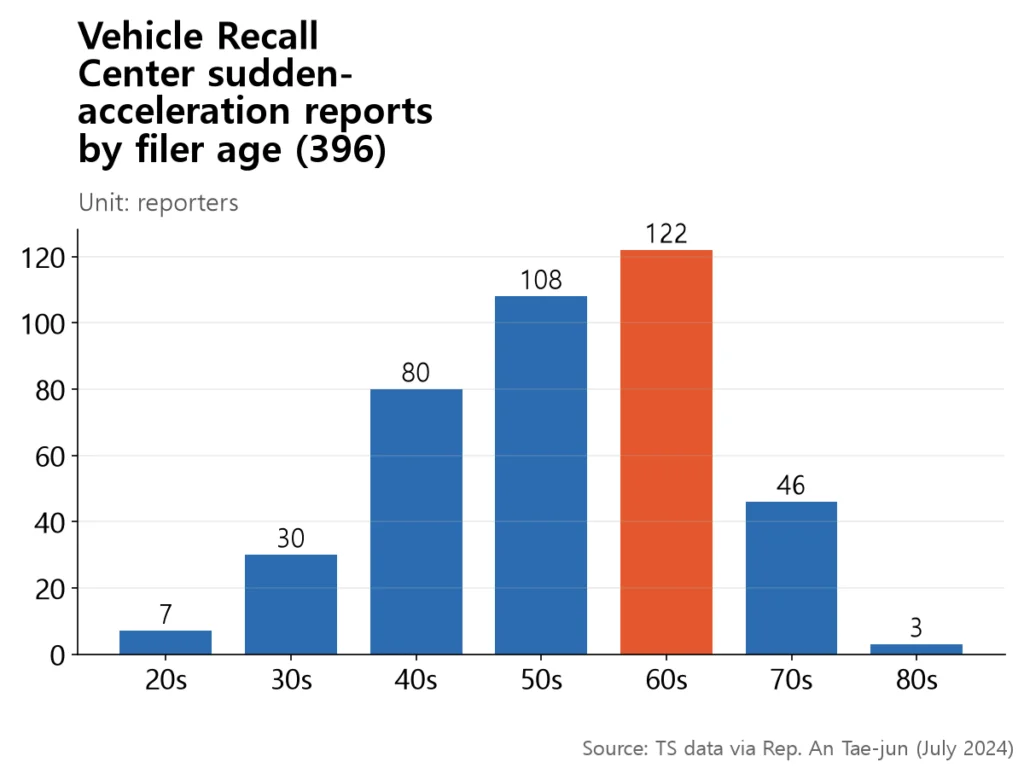
Why the gap with NFS and TS? Three partial explanations: (1) this is the age of the person who filed the complaint, not the driver, so a report lodged by an adult child counts under their age; (2) more than half the period is 2014–2019, when even the NFS sample showed fewer than half of drivers aged 60+; and (3) the Recall Center accepts complaints without a crash, so the pool itself is different from the police-referred cases NFS examines.
Insurance data: adjusted for licence share, risk climbs with age
The Samsung Fire Traffic Safety Culture Research Institute analysed 11,042 pedal-misapplication claims from its own auto-insurance book, filed between January 2019 and June 2024. Among all claimants, about 61% were under 60 — so older drivers are not a majority of raw claims. Once you divide claim share by licence-holder share, however, risk rises sharply after 55: the ratio was 137.0% for drivers 60–64, 169.4% for 65–69, 227.0% for 70–74 and 256.5% for 75+. A reading of 100% would mean a group’s share of claims matches its share of licences; 75-and-over drivers come in at more than 2.5 times their licence share.
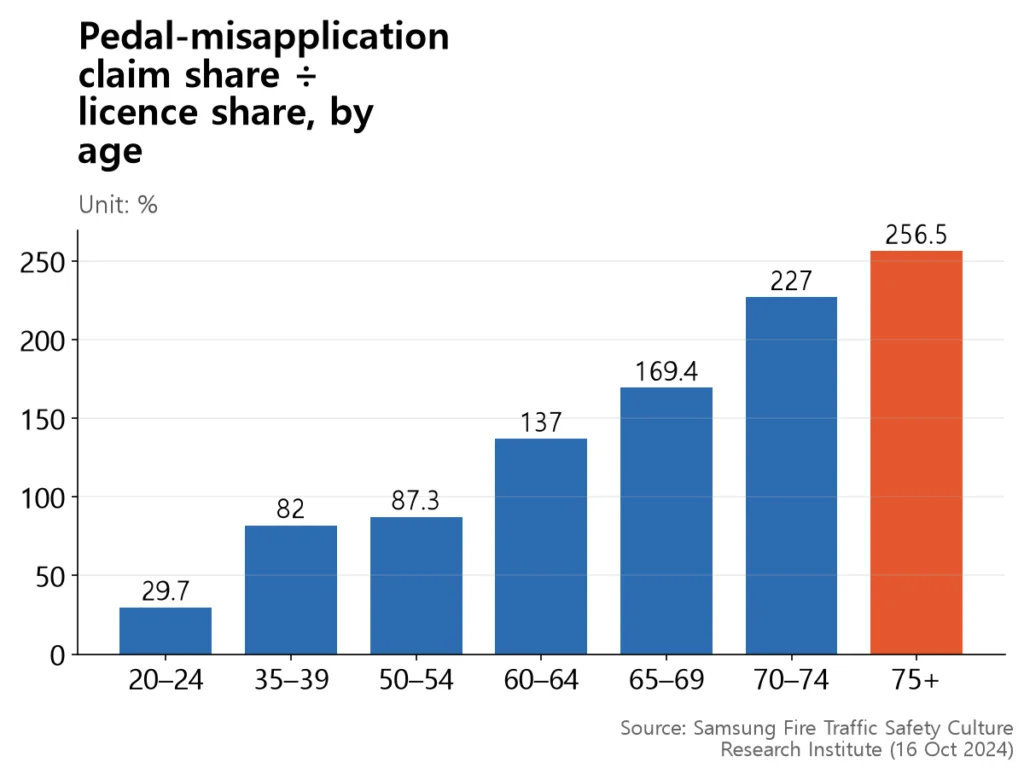
In a separate June 2026 release, Samsung Fire looked at 567 suspected pedal-misapplication crashes reported in the Korean media from 2021 to 2025: 400 (70.5%) involved a driver aged 60+, and in the 119 fatal crashes 93 (78.2%) did. 132 of the 160 deaths (82.5%) came from those crashes. Because this dataset is drawn from news coverage, it tilts toward severe crashes, which is why it reads very differently from Samsung Fire’s own full claims book (where the 60+ share is 39.1%).
Japan and the US: a U-shape, with young drivers also elevated
Japan’s Institute for Traffic Accident Research and Data Analysis (ITARDA) analysed 9,738 pedal-error crashes from 2018 to 2020. Drivers 75 and over accounted for 2,080, drivers 65–74 for 1,870 — and drivers 24 and under for 1,613. Normalised to 100,000 licence-holders, the rates are 10.0 for the youngest group, 12.3 for 75+, 4.9 for 65–74 and just 1.9 for 45–54 — a classic U-shape with both ends elevated.
The older skew grows as crashes get more severe. In the ITARDA subset of 797 fatal and serious-injury pedal-error crashes, 588 (about 74%) involved drivers 65+. Japan’s National Police Agency data for 2025 counted 46 fatal pedal-misapplication crashes: 31 (about 67%) involved drivers 75+, and 42 (about 91%) involved drivers 65+. A 2012 report from the US National Highway Traffic Safety Administration drew a similar U-shaped conclusion from a North Carolina police database of 2,399 pedal-error crashes (2004–2008), with 16-to-20-year-olds at 16.7% and drivers 76+ at 17.5%.
| Driver age | Per 100,000 licensees |
|---|---|
| 24 and under | 10.0 |
| 25–34 | 3.4 |
| 35–44 | 2.0 |
| 45–54 | 1.9 |
| 55–64 | 2.8 |
| 65–74 | 4.9 |
| 75+ | 12.3 |
How to read these numbers
A few recurring misreadings are worth flagging before using any of these figures.
- These are ‘claimed’ sudden-acceleration cases, not confirmed ones. The number of NFS-confirmed vehicle-caused sudden-acceleration events in 2021–June 2026 is still zero.
- Watch the denominator. One Korean news outlet reported that ‘60.5% of pedal-misapplication cases involved drivers 60+’. That 60.5% divides 202 older drivers by *all 334* NFS cases, not by the 277 pedal-misapplication cases; using the correct denominator the share is 72.9%.
- A share is not a risk rate. The 71–75% share in the forensic samples is roughly 3× the 22.6% that 60+ drivers hold in the licence pool, but older drivers may log fewer kilometres, and Korea does not publish mileage-based crash statistics for this calculation.
- Press-report samples tilt toward severe crashes. Both the TS 2025 analysis and the Samsung Fire 567-case review start from news coverage, so fatal and injurious crashes are over-represented.
- Timing bias matters too. A keyword search of Korean press coverage by Segye Ilbo found that sudden-acceleration claims in media reports jumped from 6 in the year before the July 2024 City Hall Station crash to 18 in the following year, and the 60+ share among drivers in those reports rose from 66.7% to 94.4%. The sample is small, but it shows how a single high-profile incident can reshape what shows up in press-based datasets.
Policy: subsidies for 3,260 pedal-limit devices
The Ministry of Land, Infrastructure and Transport is this year subsidising installation of pedal-misapplication prevention devices on 3,260 commercial taxis and light trucks (up to 1.4 tonnes) driven by operators aged 65 or over. The device blocks sudden acceleration when the pedal is pressed hard at speeds under 15 km/h — the same family of system that Japan has been moving to mandate.
Summary
The ‘7 in 10 claimants are 60 or older’ line is accurate — but only inside the NFS forensic pool and the TS press-report pool. Among people filing recall-center complaints the share is 43.2%, less than half; among Samsung Fire’s full insurance claims the under-60 group is around 61%. Across more than five years of NFS examinations, no claimed case has been confirmed as a vehicle-caused sudden acceleration event. Which leaves two questions worth taking seriously: what conditions let people drive safely later in life, and whether we are using the right denominator when we talk about who causes these crashes.

Awesome News on Instagram @awesome_news_kr
This article is the research behind our Korean-language card news. Every morning we turn Korean data and official sources into short visual stories. See it on Instagram →
Sources
- KPI News — [Exclusive] Sudden-acceleration claims rising yearly — 7 of 10 drivers are 60+ (Korean) (2024-07-29)
- Korea Transportation Safety Authority (via kscnews) — Analysis of 149 suspected sudden-acceleration crashes in 2025 (press release, full text) (Korean) (2026-01-19)
- Munhwa Ilbo — 73% of suspected sudden-acceleration crashes were pedal misapplication; 75% of drivers 60+ (Korean) (2026-01-19)
- Edaily — Only the elderly claim sudden acceleration? The data say otherwise (Korean) (2024-07-10)
- SBS (Yonhap) — In a decade of sudden-acceleration reports, 56.8% of filers are under 50 (Korean) (2024-07-10)
- Joseilbo — Five years of sudden-acceleration claims analysed: 7 of 10 drivers are 60+ (Korean) (2024-10-10)
- Munhwa Ilbo — NFS sudden-acceleration examinations hit a record high this year (Korean) (2024-12-01)
- Segye Ilbo — [Exclusive] 7 of 10 suspected sudden-acceleration cases were Hyundai/Kia — confirmed cases: 0 (Korean) (2025-06-11)
- Yonhap (via Daum) — Sudden acceleration, really a ‘hallucination’? NFS requests have halved (Korean) (2025-10-09)
- Seoul Shinmun — Of 448 sudden-acceleration claims, 0 confirmed — calls to mandate pedal-limit devices (Korean) (2026-09-26)
- Dong-A Ilbo — [Exclusive] 88% of suspected sudden-acceleration cases were pedal misapplication (Korean) (2024-09-10)
- Newsis — ‘City Hall Station wrong-way crash was not sudden acceleration’ — NFS’s reasoning (Korean) (2024-10-30)
- Segye Ilbo — After the disaster, sudden-acceleration claims tripled; confirmed cases still 0 (Korean) (2025-07-01)
- Samsung Fire Traffic Safety Culture Research Institute — Press release: analysis of pedal-misapplication crash characteristics (Korean) (2024-10-16)
- Kookmin Ilbo — Accelerator instead of brake — 83% of fatalities involve drivers aged 60+ (Korean) (2026-06-04)
- Transactions of the Korean Society of Automotive Engineers 27(11), Park Jong-jin et al. (NFS) — Case study of driver pedal misapplication in suspected sudden-acceleration crashes (Korean) (2019-11-01)
- Institute for Traffic Accident Research and Data Analysis (ITARDA) — ITARDA Information No.139: Crashes caused by pedal misapplication (Japanese) (2022)
- NHTSA — Pedal Application Errors (DOT HS 811 597) (2012-03)
- Japan National Police Agency, Traffic Bureau — Analysis of road-traffic crashes in Reiwa 7 (Japanese) (2026-02-26)
- Korea Insurance Research Institute (KIRI) — Research report 2025-13: Population ageing and auto-insurance responses (Korean) (2025)
- Korea Transportation Safety Authority (via Bizwatch) — TS strengthens response capacity for suspected sudden-acceleration crashes (press release, full text) (Korean) (2025-04-10)
📊 Download the data
Every number in this article’s 7 charts and tables, in one CSV file (opens in Excel or Google Sheets). When you cite it, please name the original source and link to this page.
Download CSV