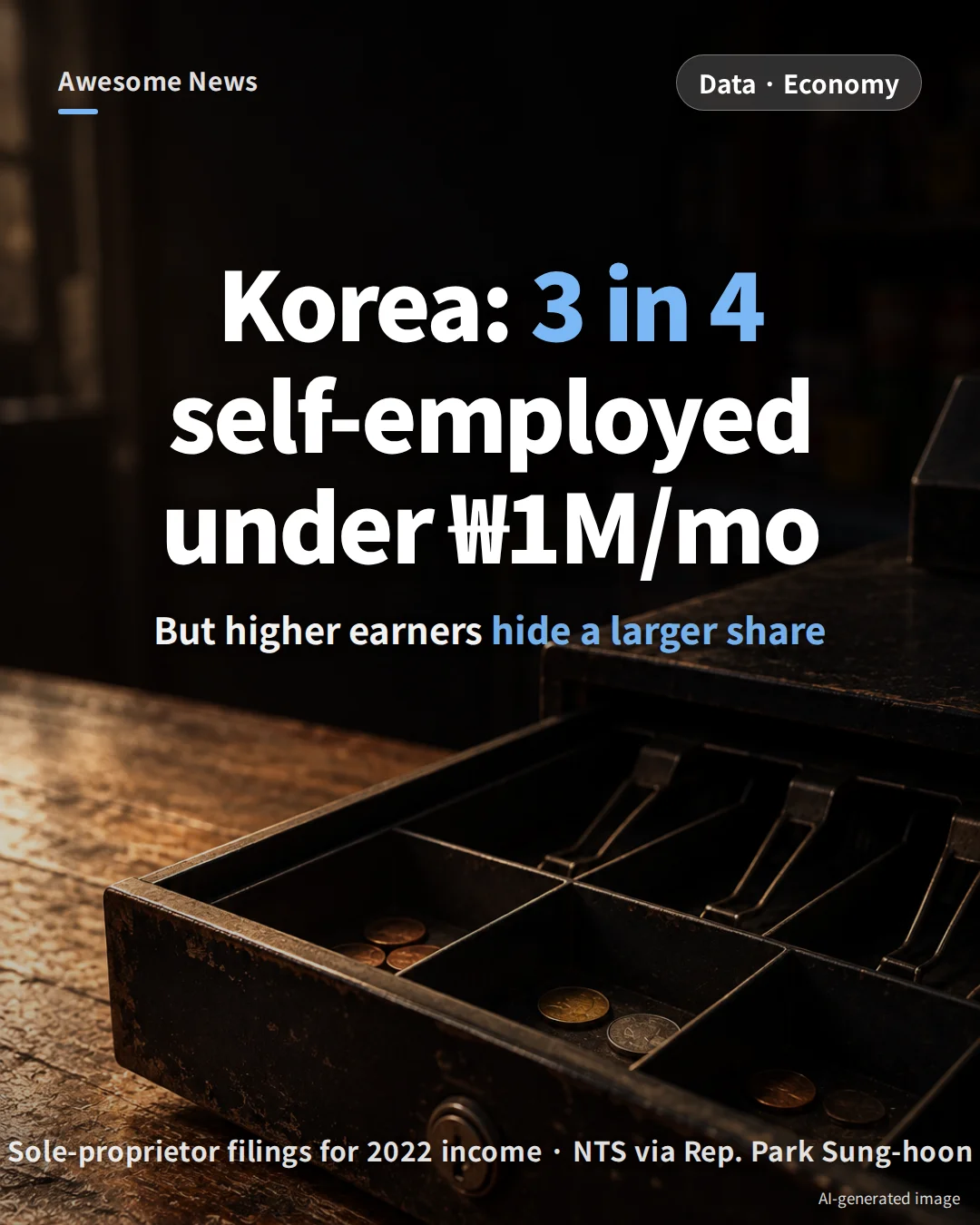
Three out of every four comprehensive income tax filings by South Korean sole proprietors report less than 12 million won a year — about 1 million won a month — for income earned in 2022. That looks like a nation of struggling shopkeepers. The fuller picture is messier: academic estimates suggest higher earners hide a larger share of what they make, and the top 10% of filers already pay 84.8% of the tax. (Comprehensive income tax in Korea covers business, rental, pension, financial and other non-wage income, filed every May.)
Key numbers at a glance
- 3 of 4 filings under 1 million won/month — 75.1% of 11.46 million sole-proprietor filings for 2022 income, up from 71.6% in 2019.
- 8.2% reported zero income in 2022 — 944,250 filings.
- Hidden-income share rises with income — estimated 18.5% at the bottom decile vs. 38.1% at the top (based on 2010–2012 data).
- Tax is concentrated at the top — in 2023 the top 10% of comprehensive-income filers earned 52.1% of income and paid 84.8% of final tax.
- 1 in 4 filers paid no tax — 2.84 million of 11.48 million filers in 2023 (24.7%).
A widening base: 75% of filings under 12 million won a year

Data obtained from the National Tax Service (NTS) by lawmaker Park Sung-hoon and reported by Etoday show sole-proprietor comprehensive income tax filings rose from 8.53 million in 2019 to 11.46 million in 2022. Over the same period, the share reporting under 12 million won a year climbed every year — 71.6% → 73.0% → 75.0% → 75.1%. In 2022 that was about 8.61 million filings.
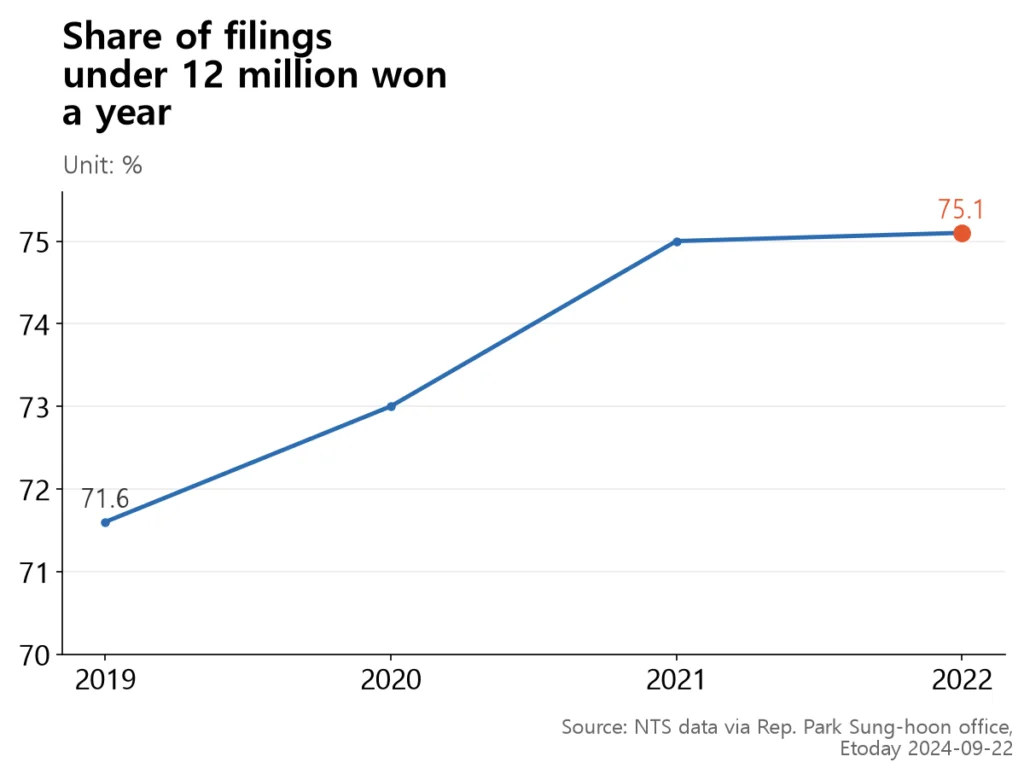
Filings reporting zero income are a persistent slice too: 944,250 cases (8.2%) in 2022, after 7.6% in 2019, 8.6% in 2020 and 7.8% in 2021 — a steady 7–8% band.
| Income year | Total filings | Share under 12M won | Share at zero income |
|---|---|---|---|
| 2019 | 8,534,609 | 71.6% | 7.6% |
| 2020 | 9,063,231 | 73.0% | 8.6% |
| 2021 | 10,594,555 | 75.0% | 7.8% |
| 2022 | 11,464,368 | 75.1% | 8.2% |
Economists read these numbers differently. In a 2021 Kyunghyang Shinmun article, Professor Woo Seok-jin argued that much of the low-income reporting may reflect inflated business expenses rather than actual earnings, while Professor Kim Woo-chul countered that there really are that many very small operators. The data alone can’t settle it.
But higher earners appear to hide more

A 2016 paper by professors Kim Tae-il and Kim Do-gyun, “Self-Employment and Equity in Taxation,” estimated self-employed income under-reporting by income decile. The authors took household-survey “reported” and “actual” income from a National Assembly Budget Office study (Shin & Kang, 2014, using 2010–2012 averages), assumed NTS-reported income equals 96% of the household-survey figure, and calculated (actual − reported) ÷ actual.
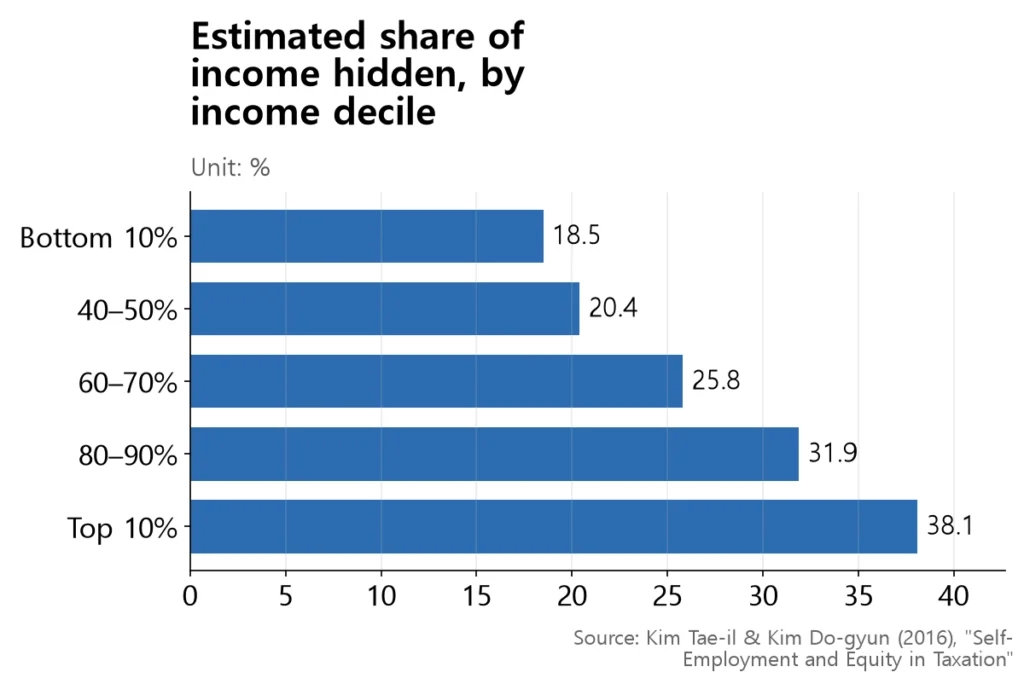
The top decile stands out. The paper’s table shows an actual annual income of 112.01 million won against reported income of 69.34 million won — a gap of 42.67 million won (calculated). The bottom 10% shows actual 12.54 million won and reported 10.22 million won, a gap of about 2.32 million won.
Caveats matter. The estimate uses 2010–2012 data, and the “96%” assumption comes from a 2008 study (Sung, 2008) based on 2006 nationwide averages applied uniformly across deciles. The paper’s own abstract notes that even after accounting for under-reporting, the self-employed tax burden — outside a small group of high earners — is heavier than wage earners’. Read “hiding” seriously, but don’t treat these numbers as current.
Tax audits of high-income proprietors: rising detection rates
The National Assembly Research Service’s “2021 National Audit Issue Analysis Vol. IV” (Finance Committee edition, pp. 312–313) reprints internal NTS data on the detection rate (undeclared income ÷ total income) for sole proprietors targeted in “high-income self-employed special audits.”
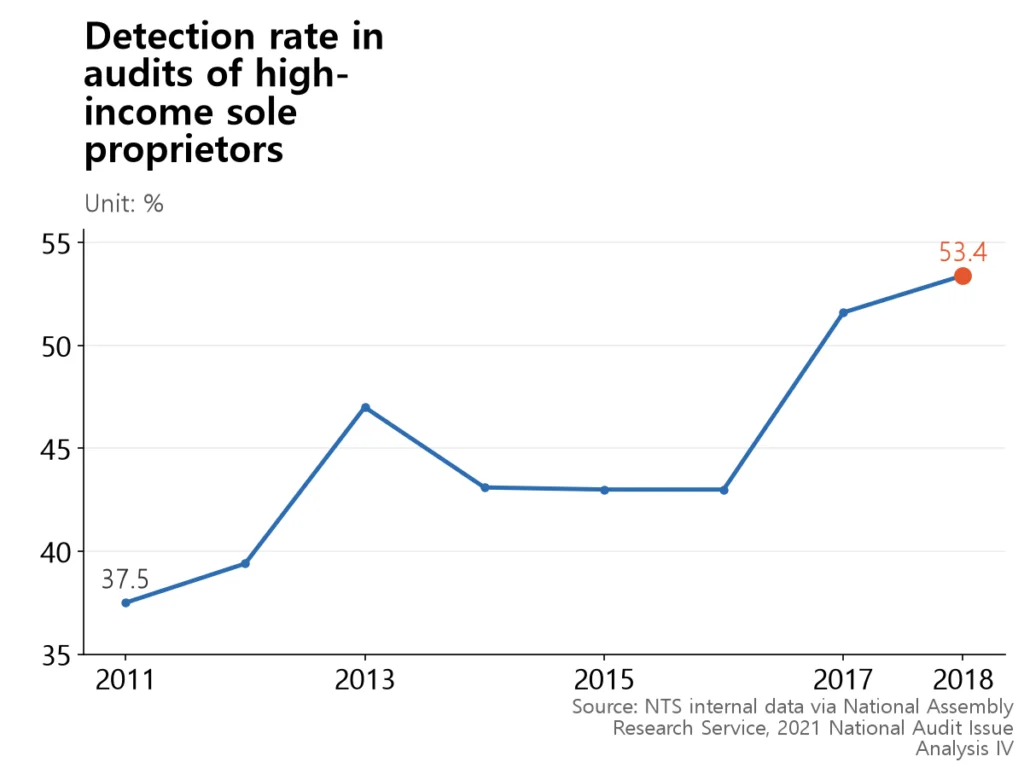
The jump looks dramatic, but these are audit targets only — 596 to 967 people per year (2011–2018) flagged by NTS as suspected of under-reporting. NTS itself told Kyunghyang that the figures can’t be generalised to all high-income self-employed. The underlying table also lists audit headcount, total income and assessed tax: in 2018, 881 people, 2.3769 trillion won in total income, and 692.9 billion won in assessed tax.
The research service tied the rising detection rate to tax changes — the 2012 addition of a top bracket at 300 million won, and bracket expansions in 2014, 2017 and 2018 — summarising that “when tax rates rise, evasion rises” (summary of the report). The point is to read the rate alongside the incentive to under-report.
Tax is already concentrated at the top

NTS statistics on 2023-income comprehensive income tax, published in December 2024, show the top 10% of filers paid 84.8% of final tax, while earning 52.1% of income. The top 1% alone accounted for 21.1% of income and 49.3% of tax.
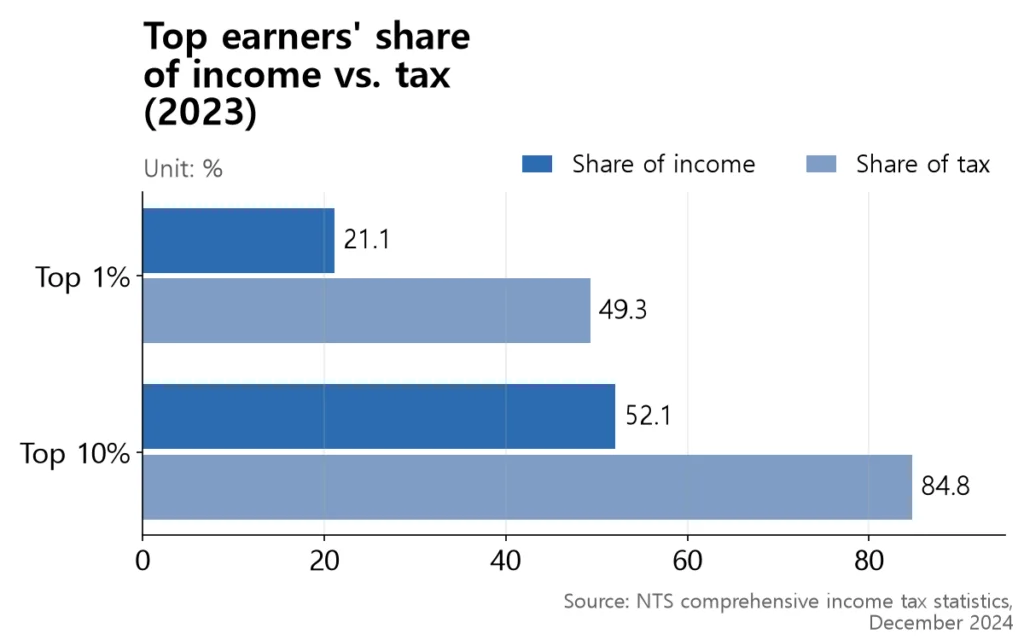
At the other end, many pay nothing. Of 11.48 million comprehensive-income filers in 2023, 2.84 million (24.7%) owed zero final tax. But that 24.7% excludes from the denominator two groups: filers below the threshold using the “simplified expense ratio” estimation method, and non-business filers below the threshold. The true share paying nothing is higher.
“Comprehensive income tax filers” is also not the same as “self-employed people.” The group includes landlords, pensioners, holders of financial income, and wage earners with side businesses. Any claim about “the share of self-employed who pay no tax” needs a different denominator.
Don’t put this next to the wage-earner zero-tax rate
Two phrases circulate side by side in Korean media: “1 in 3 wage earners pay no tax” and “1 in 4 self-employed pay no tax.” Comparing them directly is misleading. The 24.7% comprehensive-income figure uses a denominator that excludes simplified-ratio sub-threshold filers; the wage-earner “tax-free” rate uses all year-end-settlement filers. The definitions differ. There is no official statistic on a “self-employed tax-free rate.”
Card payments and cash receipts have improved visibility
A “self-employed income capture rate” produced by the National Assembly Budget Office — comparing NTS business income with Bank of Korea household operating-surplus data — rose from 55% in 2009 to 91.6% in 2017 (as cited by Kyunghyang in 2021). The two series are defined differently, so the trend matters more than the absolute level, but the direction is clear. The rise tracks the spread of card payments and mandatory cash receipts.
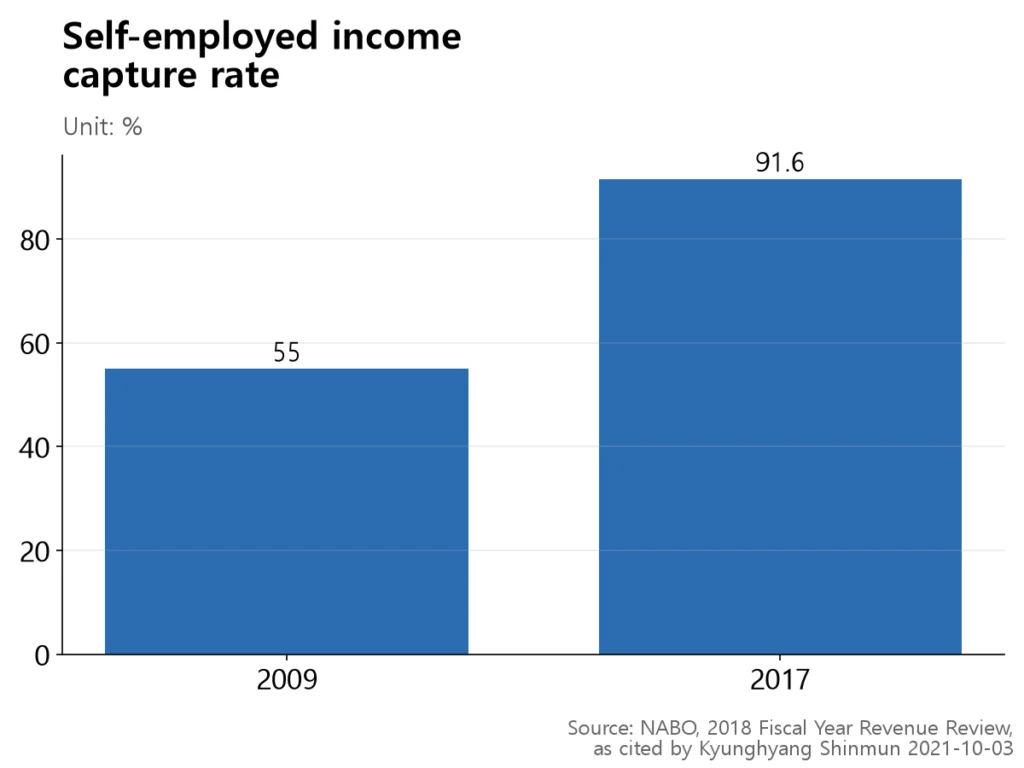
Values after 2018 are not available in the public sources used here. Claims that the rate has kept climbing or now sits above 90% can’t be backed from the data on hand.
What the National Assembly Research Service recommended

The research service’s “2021 National Audit Issue Analysis Vol. IV” (p. 314) lists five measures “worth reviewing”:
- Expand the pool of high-income proprietors under active management, and audit them thoroughly.
- Keep expanding the list of industries required to issue cash receipts.
- Lower the cash-receipt issuance threshold (currently 100,000 won).
- Raise the penalty surcharge for failing to issue a cash receipt (currently 20%).
- Expand the reward for reporting non-issuance (currently 20% of the non-issued amount, capped at 2 million won a year).
One clarification: the original research-service text does not contain a comparative claim such as “audits of high-income proprietors are more effective than audits of small ones.” Its weight is on widening the managed pool and catching cash transactions.
How to read these numbers
- Units differ. The 75.1% figure counts filings (one person can file more than once). A separate SBS Biz 2024 report that “66.8% of business sites earn under 12 million won a year” counts sites — don’t chain the two numbers.
- Estimates stay estimates. The 18.5% / 38.1% hidden-income figures come from 2010–2012 household survey data; audit detection rates apply only to those flagged as suspected under-reporters. Neither supports a claim like “half of high earners hide income.”
- Denominators differ. The 2023 zero-tax share of 24.7% excludes simplified-ratio sub-threshold filers. Comparing it to the wage-earner zero-tax rate confuses two definitions.
- Filers are not self-employed. Comprehensive income tax filers include landlords, pensioners, holders of financial income, and wage earners with side businesses.
- Low-income filings have more than one cause. Both “actually small” and “inflated expenses” are in the mix, and academics disagree on the balance.
Summary
“Three in four filings under 1 million won a month” is true. Posted alone, it hides the other half of the story. The same body of data suggests the share of hidden income rises with income, and the top 10% of filers already pay 84.8% of the tax. The reform agenda proposed by the National Assembly Research Service is not aimed at tightening the screws on small operators — it is about widening the managed pool of high earners and catching more cash transactions.

Awesome News on Instagram @awesome_news_kr
This article is the research behind our Korean-language card news. Every morning we turn Korean data and official sources into short visual stories. See it on Instagram →
Sources
- Kyunghyang Shinmun — Is the self-employed sector still a hotbed of tax evasion? (Korean) (2021-10-03)
- Etoday — 3 in 4 self-employed earn under 1 million won a month (Rep. Park Sung-hoon office data) (Korean) (2024-09-22)
- Samili.com — Top 10% of earners pay 85% of all comprehensive income tax (Korean) (2024-12-20)
- Dailian — NTS 2023-income comprehensive income tax statistics release (Korean) (2024-12-20)
- Etoday — 2023-income comprehensive income tax statistics release (Korean) (2024-12-20)
- SBS Biz — 8.37 million self-employed business sites earn under 12 million won a year (Rep. Moon Jin-seok office data) (Korean) (2026-09-25)
- Kim Tae-il & Kim Do-gyun — Self-Employment and Equity in Taxation (Journal of Government Studies 22-1) (Korean) (2016)
- National Assembly Research Service — 2021 National Audit Issue Analysis IV — Tax evasion by high-income professionals and the self-employed (Finance Committee) (Korean) (2021-08-02)
- e-Nara Indicators — Comprehensive income tax filings — index (Korean)
- Etoday — 4 in 10 wage earners and self-employed pay no income tax (Korean) (2012-02-21)
- Edaily — Self-employed average 2.07 million won in evaded tax (citing NABO Shin & Kang report) (Korean) (2014-03-03)
📊 Download the data
Every number in this article’s 6 charts and tables, in one CSV file (opens in Excel or Google Sheets). When you cite it, please name the original source and link to this page.
Download CSV