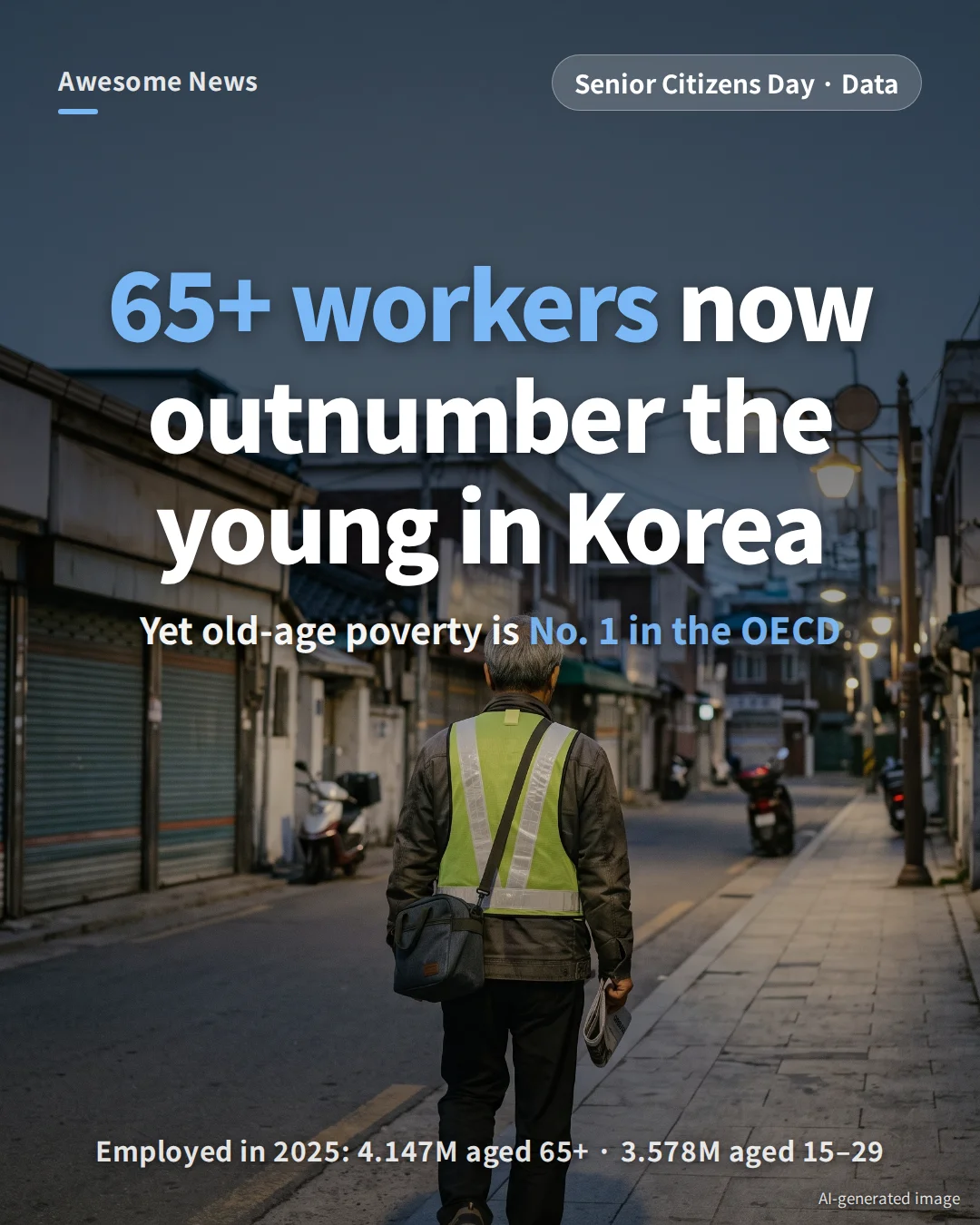
In 2025 South Korea had 4,147,000 employed people aged 65 or older — more than the 3,578,000 employed young people aged 15–29 (Statistics Korea Economically Active Population Survey; older workers first overtook the young in 2024). Yet the poverty rate among those same older people is 37.7%, the highest in the OECD. Below are the numbers and definitions behind that paradox.
We look in turn at how many older people work (employment rate), until when (retirement age), why (living costs), what jobs they get (simple labor, non-regular work), what has actually happened among taxi drivers, and where Korea’s debate on retirement age stands compared with Japan and Denmark. (October 2 is Senior Citizens’ Day in Korea.)
Key numbers at a glance
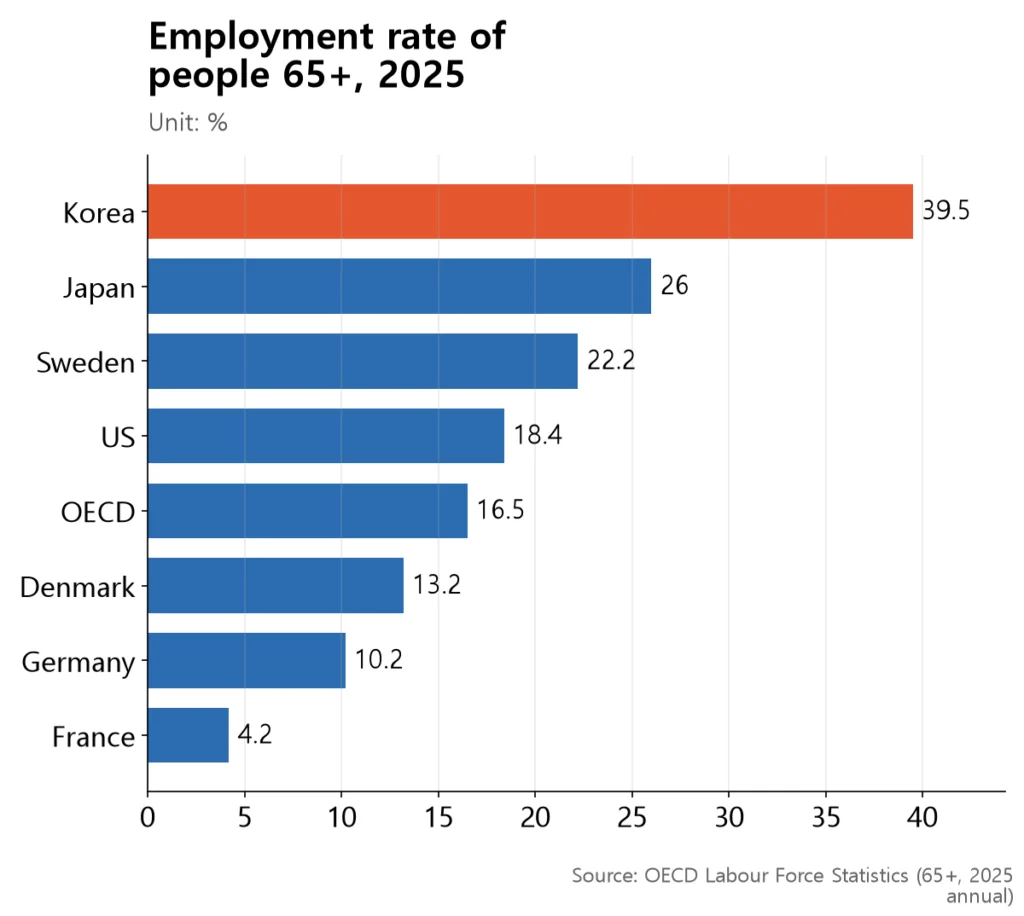
- Employment rate of people 65+: 39.5% — 2.4 times the OECD average of 16.5% (calculated), and higher than Japan (26.0%) and Denmark (13.2%).
- Employed 65+: 4.147 million > employed 15–29: 3.578 million — the first reversal was in 2024, and the gap widened in 2025.
- People leave their main job at 53.0 on average — far earlier than the legal retirement age (60) or the pension age (63), while the age at which they actually stop working is 67.4 for men and 69.6 for women.
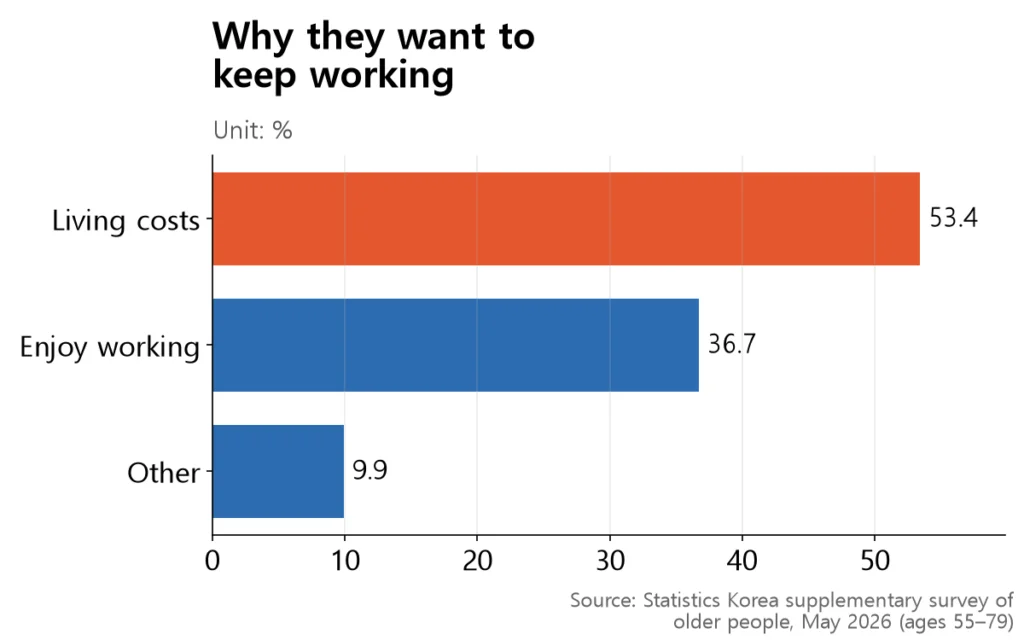
- 69.2% of people aged 55–79 want to keep working, to age 73.6 on average — 53.4% to help with living costs, 36.7% because they enjoy working.
- Old-age poverty of 37.7%, the highest in the OECD — compared with 5.0% in Denmark and 6.1% in France. Earnings from work make up 49.9% of older people’s income (OECD average 27.0%).
Four in ten are working — flat for 15 years, then a 10-year surge

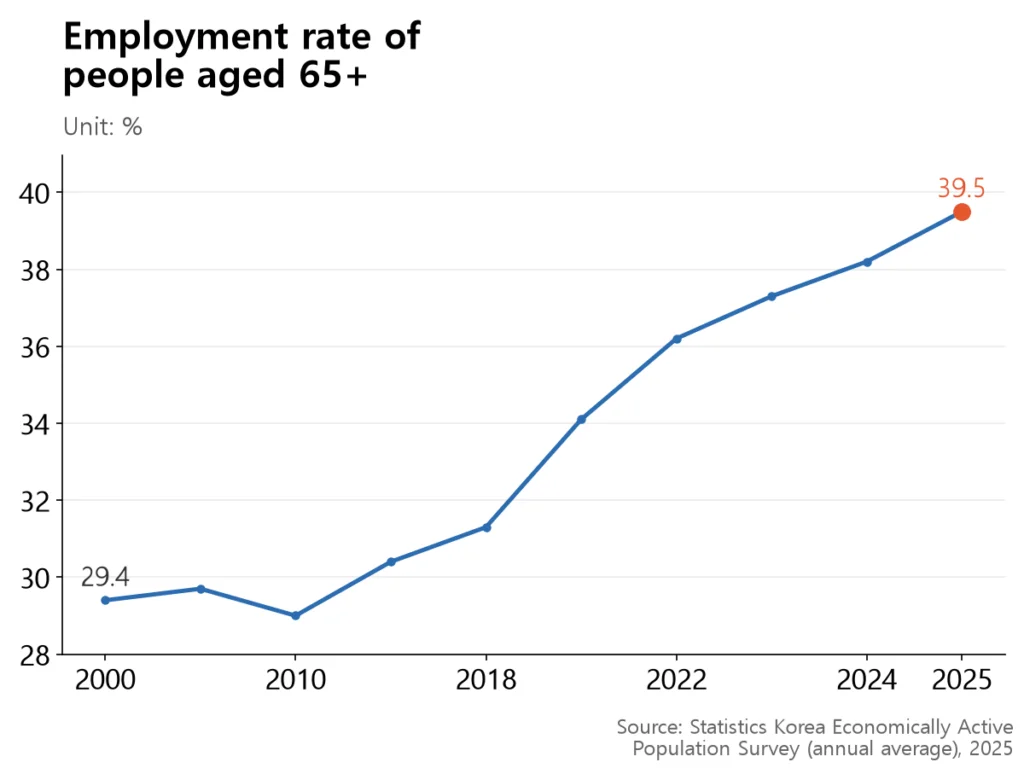
In 2025 the employment rate for people aged 65+ was 39.5% — four in ten are working for pay. The indicator barely moved from around 30% for 15 years, from 2000 (29.4%) to 2015 (30.4%), and then rose by more than 9 percentage points over the past decade.
Korea is also at the top internationally. The 2025 OECD average was 16.5%, less than half Korea’s rate. Korea ranks first among the countries for which data were available (values for some countries, such as Iceland, Australia and Canada, could not be retrieved, hence the caveat “among countries with data”).
By age, the employment rate for 70–74 is still 41.8% (OECD average 17.0%). Contrary to the idea that older people retire, nearly half of Koreans in their early 70s keep working.
Out of the main job at 53, wanting to work until 73

According to Statistics Korea’s May 2026 supplementary survey of older people (ages 55–79), the average age of leaving the job held longest was 53.0 — 55.3 for men and 51.1 for women. That is far earlier than the legal retirement age (60) or the start of the National Pension (63; 65 for those born in 1969 or later).
The age at which people stop working altogether, however, comes much later. The OECD’s Pensions at a Glance 2025, which estimates the effective retirement age from changes in labor-force participation after 40, puts Korea’s at 67.4 for men and 69.6 for women — for women, among the highest in the OECD. That means men keep working 4.4 years and women 6.6 years after they start receiving a pension.
| Age | |
|---|---|
| Leaving the main job (average) | 53.0 |
| Legal retirement age | 60 |
| National Pension starts | 63 (65 for those born 1969 or later) |
| Actually stopping work | Men 67.4 · Women 69.6 |
| Age people want to work until | 73.6 |
Why do people leave their main job so early? Only 13.2% ended it through mandatory retirement. Other reasons were business slowdown, suspension or closure (24.9%), health (22.1%), family care (15.2%), and recommended resignation, early retirement or layoffs (9.9%). Those pushed out for company reasons alone add up to 34.8% (calculated).
Half say they work “for living costs”

69.2% of people aged 55–79 said they want to keep working, until 73.6 on average. The most common reason was “to help with living costs” (53.4%); “enjoyment of work” was 36.7%.
The income structure shows this is not just a feeling. According to the OECD pensions report (household basis, 2022), 49.9% of older Koreans’ income comes from work (earnings), while public transfers (pensions, allowances and so on) make up only 29.1%. The OECD average is almost the reverse: 27.0% from work and 55.9% from public transfers.
| Country | Work | Public transfers | Occupational pensions etc. | Capital |
|---|---|---|---|---|
| Korea | 49.9% | 29.1% | — | 21.0% |
| OECD average | 27.0% | 55.9% | 7.1% | 10.0% |
| Japan | 40% | 50% | — | 8% |
| US | 33.2% | 38.3% | — | 23.2% |
| Denmark | 20.2% | 43.2% | 14.7% | 22.0% |
| Sweden | 16.3% | 50.3% | 18.4% | 15.0% |
| France | 6.9% | — | — | — |
Even so, the relative poverty rate of people 66+ (share living in households below 50% of median income) was 37.7% on 2024 incomes, the highest in the OECD — far above Denmark (5.0%), France (6.1%) and Sweden (9.4%). Old age is hard to keep out of poverty even with physical work. Note, though, that this indicator looks only at income: older households’ assets (average net worth of 465.94 million won, 2024 Survey of Household Finances and Living Conditions) are not included.
Another background factor is that Korea’s net pension replacement rate (average earner, full career from age 22) is 39%, about two-thirds of the OECD average (63%). For low earners the gap is also large: 55% in Korea vs 76% in the OECD.
The jobs they get back: simple labor, non-regular, short hours
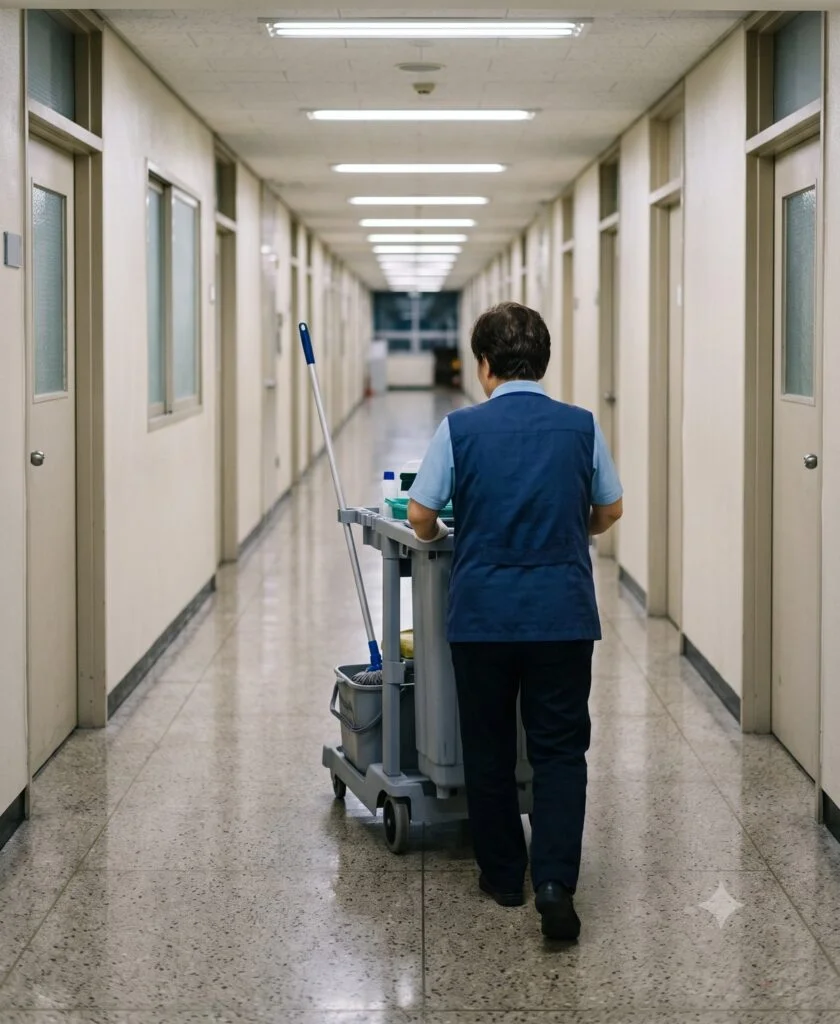
The jobs people find after being pushed out early are mostly not “decent jobs”. 33.1% of employed people aged 65–79 (calculated) are in elementary (simple-labor) occupations — more than twice the 13.8% share among all workers.
| Indicator | Comparison (all / earlier) | Older people |
|---|---|---|
| Share in simple labor | All workers 13.8% | Ages 65–79: 33.1% (calculated) |
| Share aged 60+ among non-regular workers | 2018: 24.9% | 2025: 35.5% |
| Government senior jobs (actual) | 2018: 494,000 | 2025: 1,164,000 |
| Pay in public-service senior jobs | 30 hours of work a month | 290,000 won a month |
It is not that they don’t want work, but that they can’t find it. Among non-employed people not looking for work, only 8.1% said they did not want to work. The biggest barriers were health (42.4%) and age (16.9%), followed by “I don’t think there are suitable jobs” (10.5%, 623,000 people). The unemployment rate for ages 55–79 is only 2.3% — a sign that the problem is job quality rather than the number of jobs.
The government senior jobs program more than doubled, from 494,000 jobs in 2018 to 1,164,000 in 2025 (calculated, excluding talent-sharing). But the largest category, public-service jobs (701,215 in 2025), pays 290,000 won a month for 30 hours of work. The 2027 budget proposal raises the total slightly, to 1.18 million jobs (2.4861 trillion won).
“Older taxi drivers are disappearing” — is it true?

After qualification tests for older drivers were tightened, the impression spread that older taxi drivers were disappearing. Adding up the Korea Transportation Safety Authority’s registered-driver data (company and individual taxis, year-end), the opposite is true: drivers aged 65+ rose from 75,000 in 2018 (28.0% of all drivers) to 118,000 in 2025 (49.1%).
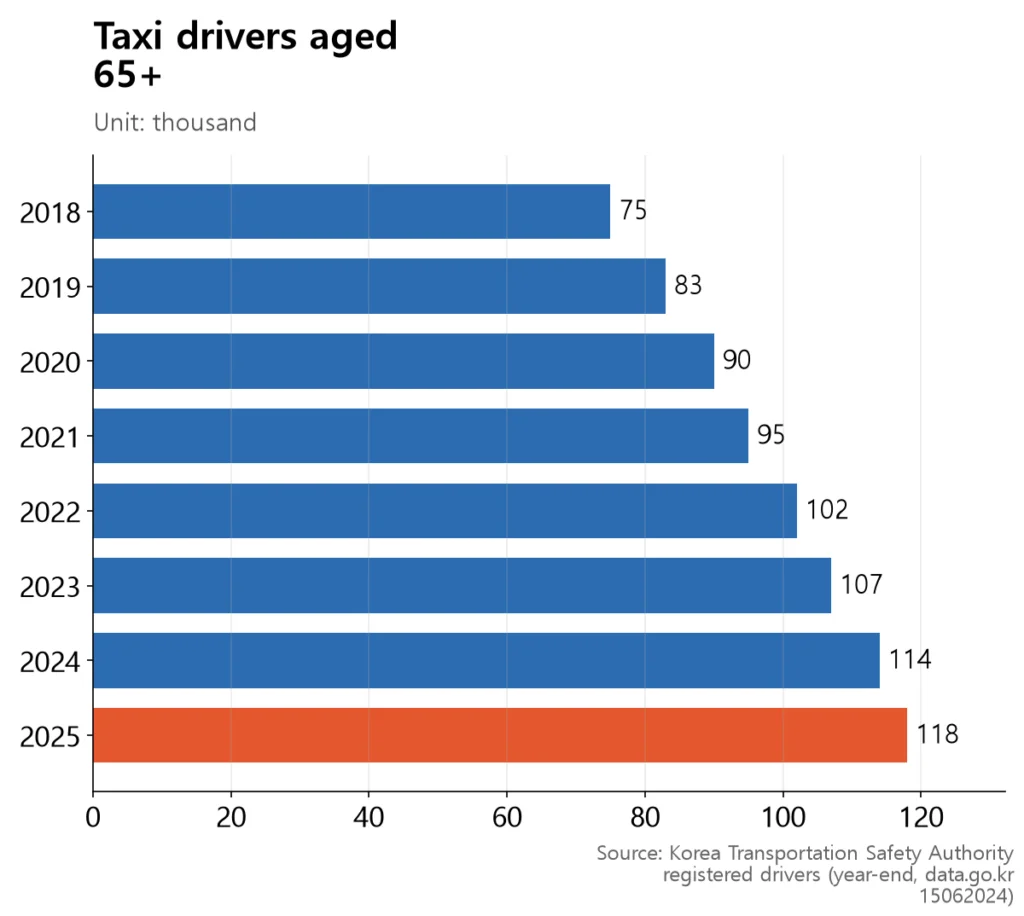
The decline is in other age groups. From 2018 to 2025, drivers aged 60–64 fell 26.4% and those 50 and under fell 42.5%. Company-taxi drivers overall fell 27.8%. Individual (owner-operated) taxis actually rose 1.1%, and within them the share aged 65+ is 55.4% — 27.8% are 70 or older.
Drivers aged 65–69 did peak in 2024 and fell 1.1% in 2025 for the first time. That may signal that the number of drivers 65+ will eventually turn down, but for now it is hard to say “older drivers have decreased”.
A retirement age of 65: how far from Japan and Denmark?

Korea’s working-age population (15–64) peaked at 37.63 million in 2019 and is shrinking: 35.91 million in 2025, 29.03 million projected for 2040 and 24.45 million for 2050 (Statistics Korea projections 2022–2072). That is why how long people work is directly linked to growth.
A Bank of Korea issue note from April 2025 (the authors’ views) estimated that if people kept working until 65, growth over the next ten years could rise by 0.1 percentage points a year, 0.9–1.4 percentage points cumulatively. However, noting that when the retirement age was extended to 60 in 2016, each additional older worker appeared to displace about one young worker (0.4–1.5), it recommended expanding re-employment after retirement before extending the legal retirement age.
| Country | Retirement / employment rules | Pension age | Employment rate 65+ |
|---|---|---|---|
| Korea | Retirement age 60; bill for 65 under discussion (press reports) | 63 (65 for those born 1969+) | 39.5% |
| Japan | Employers must secure employment to 65 (2013); duty to try to offer work to 70 (2021) | 65 | 26.0% |
| Denmark | Pension age linked to life expectancy; tax-free bonus for working longer | 67 → 70 from 2040 (confirmed May 2025) | 13.2% |
Denmark has the world’s latest pension age, confirmed at 70 from 2040, yet its effective retirement age — 66.3 for men and 63.5 for women — is earlier than Korea’s. Its 65+ employment rate is only 13.2%, and old-age poverty just 5.0%. The contrast is stark between a country that makes long working lives possible and one where weak pensions leave people no choice but to keep working.
The OECD report makes the same point: in Korea, Colombia and Costa Rica, pension ages are low but people retire late, working until very late because pensions are small; and Japan and Korea are the only countries that allow mandatory retirement before the pension age (summary of the report).
How to read these numbers
- Don’t mix three bases: annual averages for 65+ (Economically Active Population Survey, OECD), the May survey of ages 55–79 (supplementary survey of older people), and the August survey of 60+ (survey by employment type) differ in both coverage and timing.
- Part of the rise in employment comes from government senior jobs — participants count as employed if they worked for pay in the survey week. There is no official figure separating them out.
- The poverty rate looks only at income — housing and savings held by older households (average net worth 465.94 million won, 2024) are not included.
- The “work share” of older people’s income is measured by household — income of adult children living together may be included.
- The status of the retirement-age-65 bill and its 2029–2037 phased schedule are based on press reports. It has not passed the National Assembly plenary session, and no labor-management agreement has been finalized.
Summary: countries that “enable” long working lives, and one where people “have to” work long
Older Koreans work longer and more than almost anyone in the world. Four in ten people 65+ work, 41.8% are still working in their early 70s, and the effective retirement age is close to 67 for men and 70 for women. Half of them say it is for living costs. They leave their main job at 53, and the jobs they find afterwards are largely simple labor, non-regular work and public-service senior jobs paying 290,000 won a month.
Japan spent 30 years making employment to 65 mandatory and extending it toward 70; Denmark is raising its pension age to 70, yet people retire earlier and old-age poverty stays around 5%. Korea is still debating a retirement age of 65. The question for Senior Citizens’ Day is not how long people should work, but whether working longer can make old age less poor.

Awesome News on Instagram @awesome_news_kr
This article is the research behind our Korean-language card news. Every morning we turn Korean data and official sources into short visual stories. See it on Instagram →
Sources
- Statistics Korea — May 2026 Economically Active Population Survey: supplementary survey of older people (Korean) (2026-08-05)
- Statistics Korea — 2025 Statistics on the Aged (Korean) (2025-09-29)
- Statistics Korea — December and annual 2025 employment trends (Excel tables, Korean) (2026-01)
- Statistics Korea — August 2025 survey by employment type (Korean) (2025)
- Statistics Korea, Bank of Korea, Financial Supervisory Service — 2025 Survey of Household Finances and Living Conditions (Korean) (2025-12)
- OECD — Employment and unemployment by five-year age group and sex – indicators (DF_LFS_INDIC) (accessed 2026-09-29)
- OECD — Pensions at a Glance 2025 (2025-11)
- OECD — Pensions at a Glance 2025 — Korea Country Note (2025-11)
- e-Narajipyo (Ministry of Health and Welfare) — Senior jobs created (actual), table idx_cd=2767 (Korean)
- e-Narajipyo (Social Survey) — How people 60+ cover living costs (Korean)
- Ministry of Health and Welfare — 2027 budget proposal (Korean) (2026-09-04)
- Bank of Korea — BOK Issue Note 2025-8: Super-aged society and continued employment of older workers (Korean) (2025-04-08)
- Japan Ministry of Health, Labour and Welfare — Amendment to the Act on Stabilization of Employment of Elderly Persons (work opportunities to 70, Japanese) (in force 2021-04-01)
- National Pension Service — Old-age pension starting age (Korean)
- Korea Transportation Safety Authority — Registered transport workers by age and region, 2025-12-31 CSV (data.go.kr 15062024, Korean) (as of 2025-12-31)
- Seoul Shinmun — Aging causes driver shortage at taxi companies; foreigners take the wheel (Korean) (2026-09-21)
- Careyou News — Extending the retirement age to 65: the September regular session is the final hurdle (Korean) (2026-09-05)
📊 Download the data
Every number in this article’s 8 charts and tables, in one CSV file (opens in Excel or Google Sheets). When you cite it, please name the original source and link to this page.
Download CSV