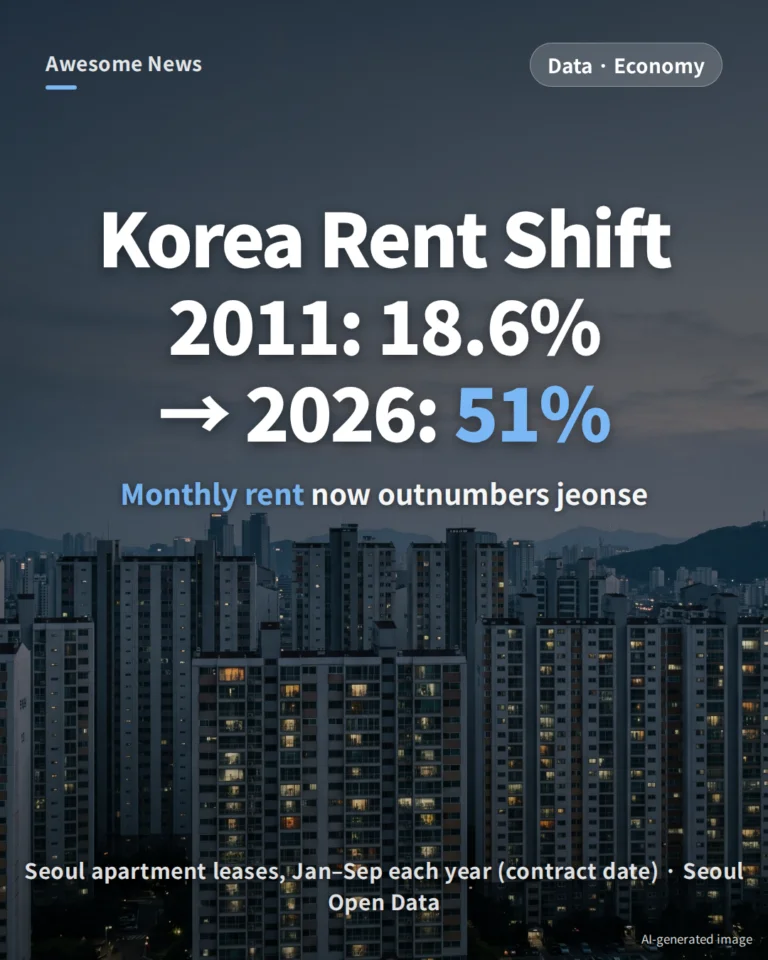
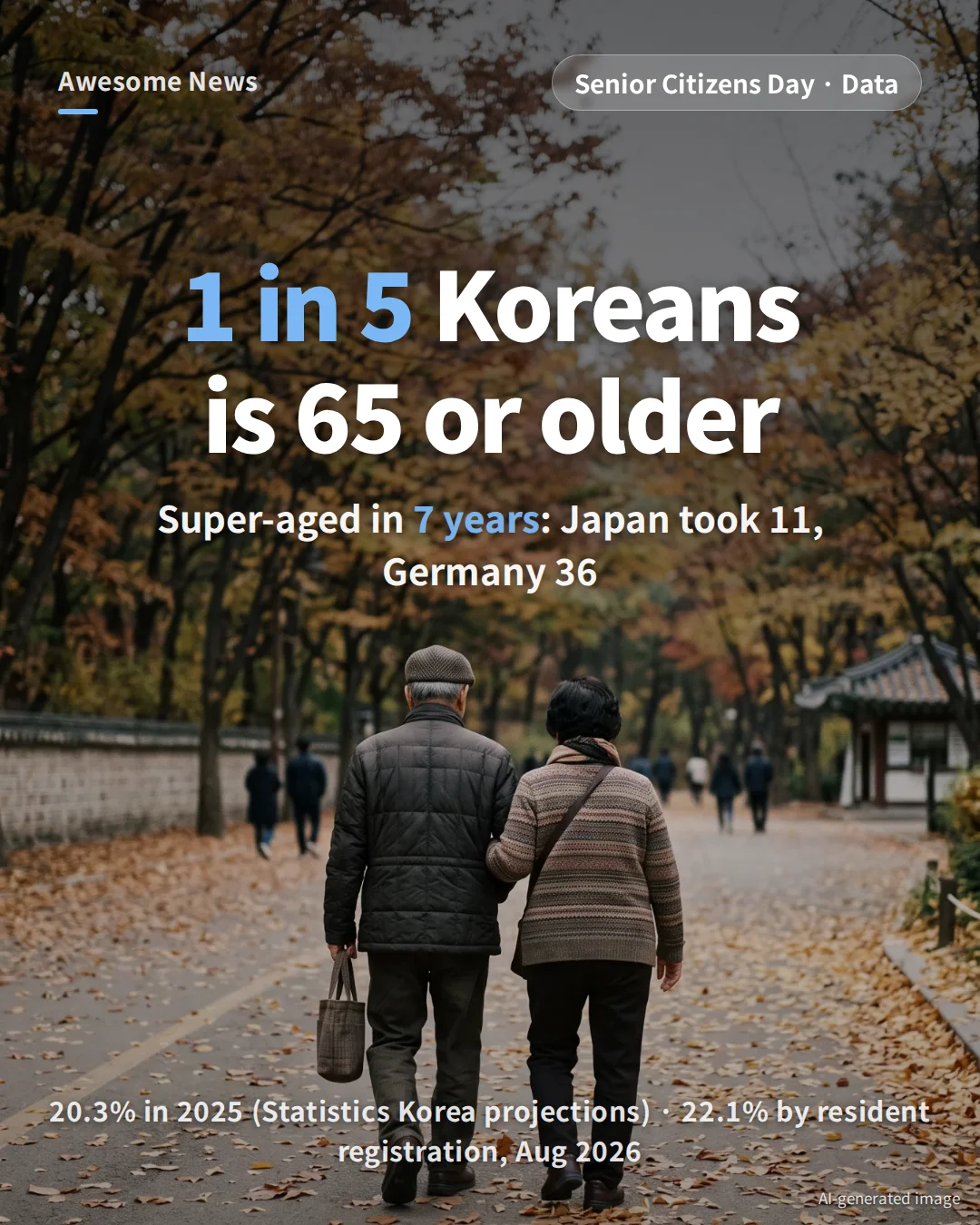
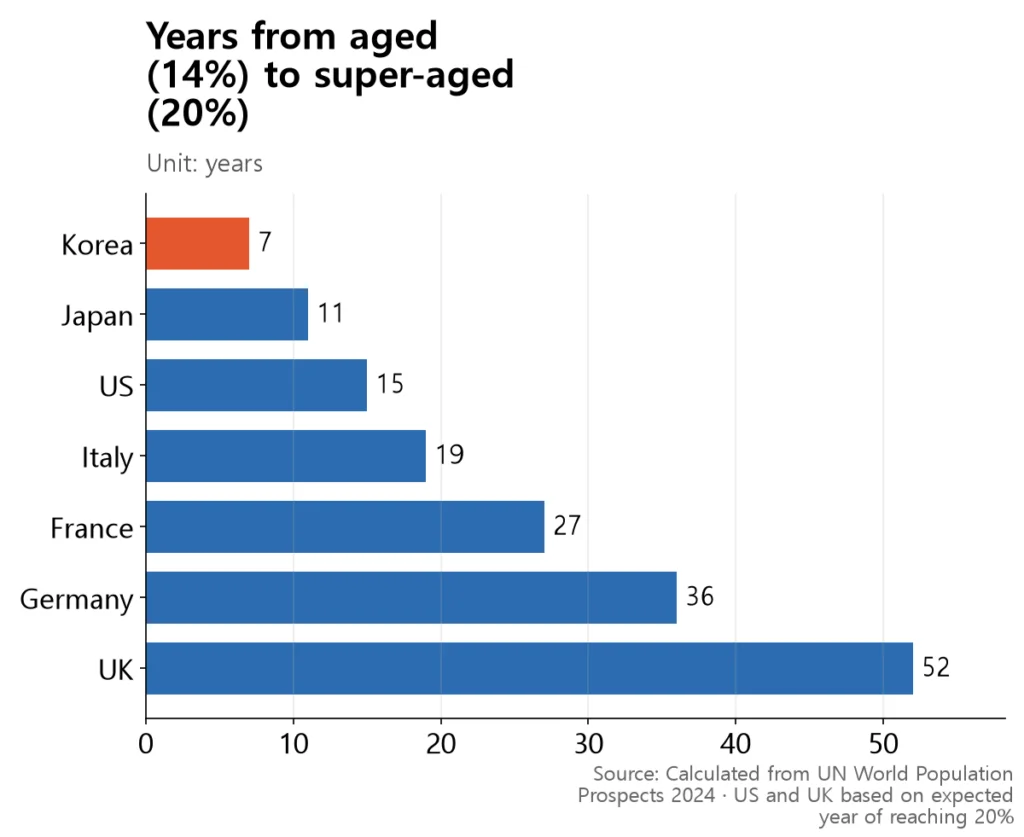
In 2025 South Korea for the first time became a super-aged society, with one in five people (20.3%) aged 65 or older. According to official projections, the older population stands at 10,514,000. The real story is the speed: it took Korea only seven years to cross this threshold. Japan took 11 years, Germany 36.
Below are the numbers behind that shift: the share of people 65+ from 1960 to 2072, the point where older people outnumbered children, where Korea stands among other countries, and how many working-age people there are for every older person. (South Korea marks Senior Citizens’ Day on October 2.)
Key numbers at a glance
- 20.3% aged 65+ in 2025, or 10,514,000 people — Statistics Korea population projections (as of July 1). By resident registration, the share was 22.08% (11,278,011 people) at the end of August 2026.
- Seven years from aged (14%) to super-aged (20%) — Korea 7, Japan 11, the US 15 (expected by 2029), France 27, Germany 36, the UK 52 (expected by 2027).
- Korea passes Japan in 2045 and reaches 39.7% in 2050, second in the world (first: Hong Kong, 46.4%).
- More older people than children — in August 2026, people aged 65–69 (3.99 million) outnumbered children aged 0–4 (1.27 million) 3.2 to 1 (calculated).
- 3.4 working-age people per person aged 65+ → 1.3 in 2050 and 0.96 in 2072 (calculated as 100 ÷ old-age dependency ratio).
One in five — and a 60-year timeline
The “2025 Statistics on the Aged” report, released on September 29, 2025 by Korea’s national statistics agency (formerly Statistics Korea), opens with this sentence (translated):
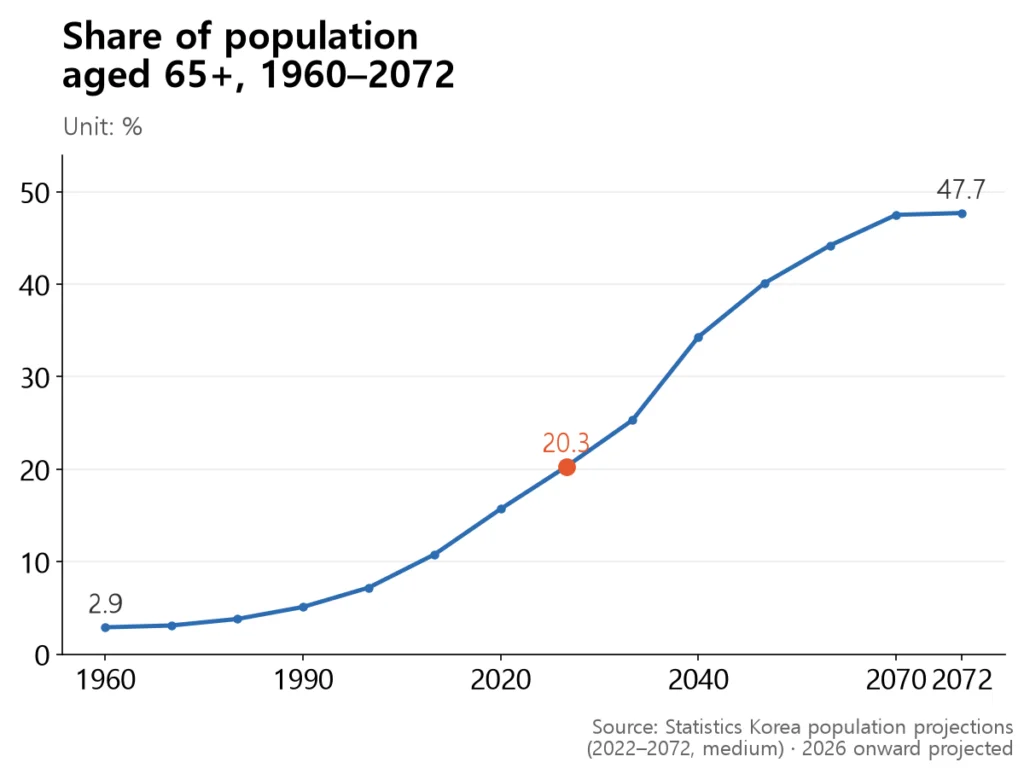
In 2025 the population aged 65 and over is 10,514,000, or 20.3% of the total population. It exceeds 20% of the total for the first time in 2025 and is projected to exceed 30% in 2036 and 40% in 2050.
2025 Statistics on the Aged (Korean, our translation)
In 1960 there were just 726,000 people aged 65+, 2.9% of the population. Korea then climbed one step at a time: 7.2% in 2000 (aging society), 14.3% in 2018 (aged society) and 20.3% in 2025 (super-aged society). Projections now point to 30% in 2036, 40% in 2050 and 47.7% in 2072. The number of people 65+ peaks at 18.91 million in 2050 and then declines slightly, but the total population shrinks even faster, so the share keeps rising.
Why there are two sets of numbers
Figures differ from source to source because there are two bases. Statistics Korea’s population projections use the resident population as of July 1 each year, including foreigners (20.3% in 2025). The Ministry of the Interior and Safety’s resident registration counts Korean nationals only, at the end of each month (20.00% on December 23, 2024; 22.08% at the end of August 2026). That is why the ministry announced super-aged status in December 2024 (registration) and the statistics agency in 2025 (projections). Neither is wrong — they count differently.
| Basis | When it passed 20% | Latest value |
|---|---|---|
| Statistics Korea projections (July 1, incl. foreigners) | 2025: 20.3% | 2026 projection: 21.6% |
| Interior ministry resident registration (month-end, nationals) | 2024-12-23: 20.00% (10,244,550) | End of Aug 2026: 22.08% (11,278,011) |
More older people than children
Spread out the age structure and the shift is even clearer. In 1970 half the population (52.5%) was under 20. By 2025 that share had fallen to 14.6%, while people aged 60–79 made up 23.6%. By 2050, those aged 80+ alone will be 16.3% — a thicker layer than any ten-year age band.
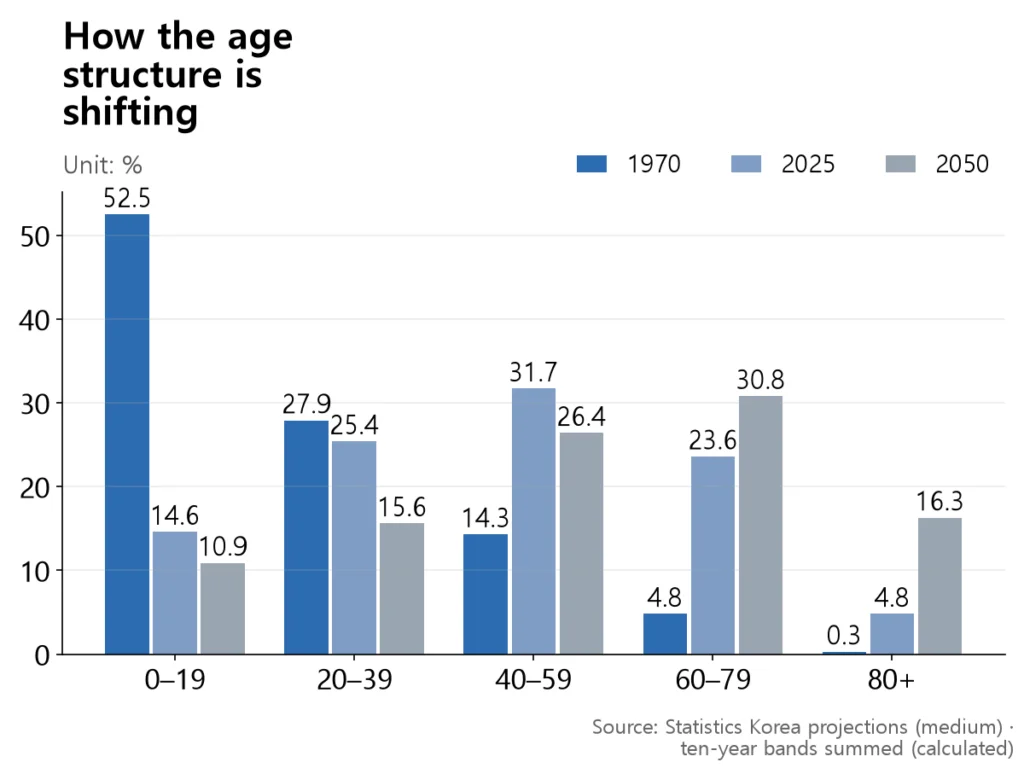
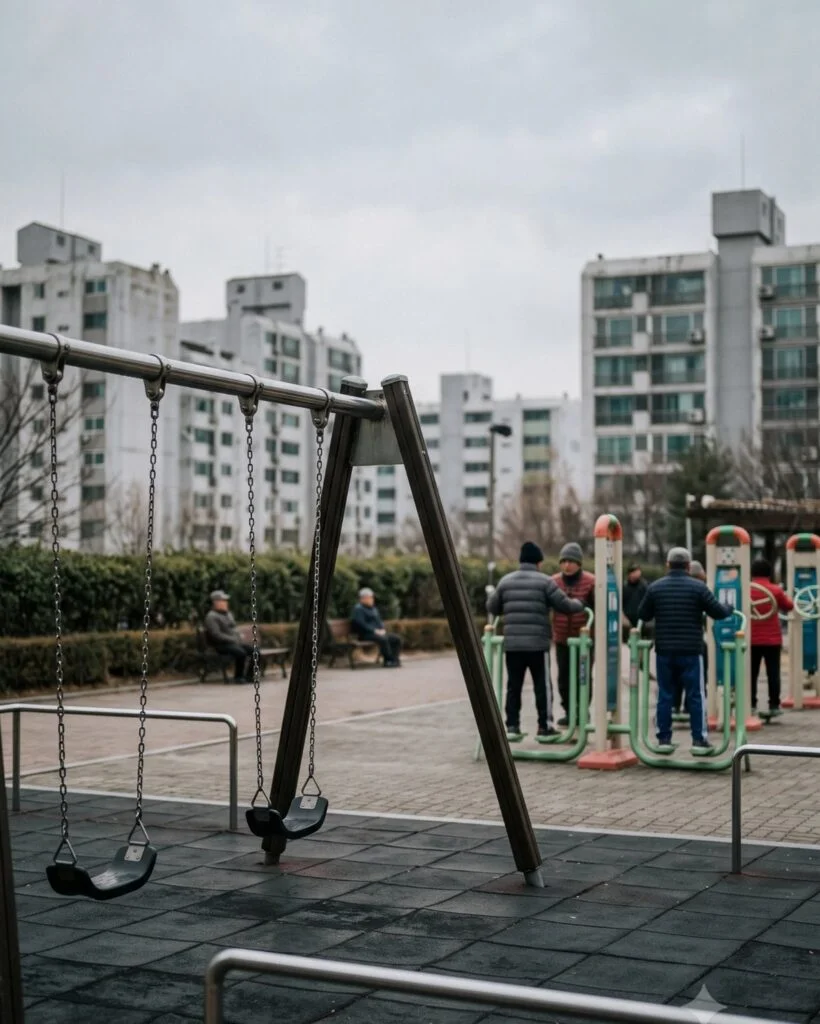
“More older people than children” is no longer a figure of speech but a statistic. Using Statistics Korea’s single-year data, people 65+ first outnumbered those aged 0–14 in 2017, and those aged 0–19 in 2021. In the August 2026 resident registration, the 3.99 million people aged 65–69 outnumbered the 1.27 million aged 0–4 by 3.2 to 1 (calculated), and exceeded all children aged 0–9 (2.87 million). Projections show people 80+ outnumbering children aged 0–9 by 2027.
Population share by ten-year age band (%)
| Age | 1970 | 2000 | 2025 | 2050 | 2072 |
|---|---|---|---|---|---|
| 0–9 | 28.4 | 14.4 | 5.8 | 5.1 | 4.4 |
| 10–19 | 24.1 | 14.8 | 8.8 | 5.8 | 4.7 |
| 20–29 | 15.2 | 17.5 | 11.9 | 5.9 | 7.5 |
| 30–39 | 12.7 | 18.1 | 13.5 | 9.7 | 8.9 |
| 40–49 | 8.5 | 14.8 | 14.9 | 11.2 | 8.1 |
| 50–59 | 5.8 | 9.3 | 16.8 | 15.2 | 11.6 |
| 60–69 | 3.4 | 6.8 | 15.2 | 14.9 | 14.1 |
| 70–79 | 1.4 | 3.3 | 8.4 | 15.9 | 18.3 |
| 80+ | 0.3 | 1.0 | 4.8 | 16.3 | 22.4 |
Compared with other countries: middle of the pack today, heading for the top
Looking only at today, Korea’s 20.3% (2025) is lower than Japan’s 30.0%, Italy’s 25.1% and Germany’s 23.7%. It is almost the same as the simple average of the 38 OECD countries (19.5%), calculated from the UN World Population Prospects 2024. Korea ranks 28th among 161 countries and territories with more than one million people, and 22nd in the OECD.
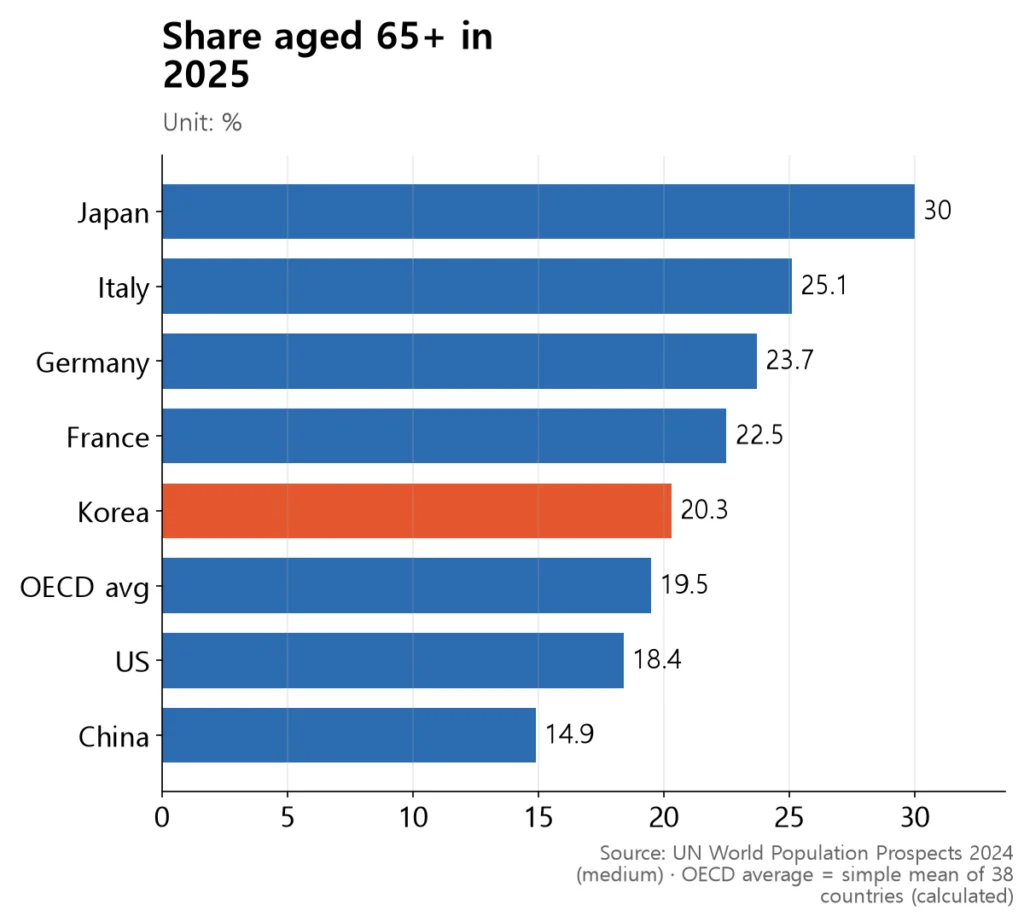
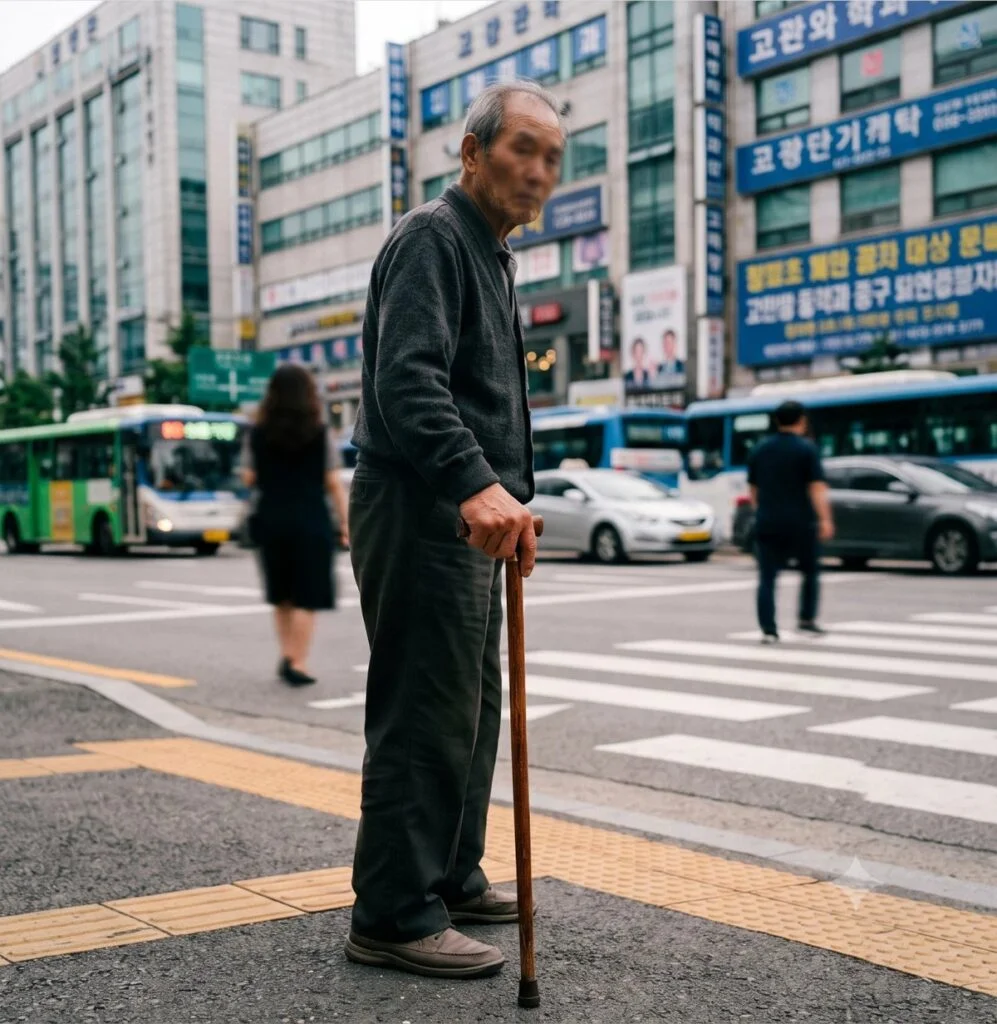
Widen the view by 25 years, however, and the ranking flips. In the UN projections Korea passes Italy in 2043, overtakes Japan in 2045 (Korea 36.9% vs Japan 36.8%) and reaches 39.7% in 2050, second in the world. First place goes to Hong Kong (46.4%), a city territory, so calling Korea “number one among countries” requires the caveat of excluding Hong Kong.
Projected ranking around 2050
| Rank | Country / territory | Share 65+ (2050) |
|---|---|---|
| 1 | Hong Kong | 46.4% |
| 2 | South Korea | 39.7% |
| 3 | Taiwan | 38.7% |
| 4 | Japan | 37.5% |
| 5 | Italy | 36.8% |
| 6 | Spain | 36.1% |
| – | China | 30.9% |
| – | Germany | 30.3% |
| – | France | 27.6% |
| – | United States | 23.1% |
| – | OECD average | 27.9% |
| – | World | 16.3% |
The real issue is speed: years from aged to super-aged
Every developed country ages. What differs is speed. Calculated from UN WPP 2024, the time it took for the 65+ share to rise from 14% to 20% was 7 years for Korea (2018→2025). Japan took 11 years, the US 15 (expected by 2029), Italy 19, France 27 and Germany 36. The UK is expected to take 52 years to reach the same threshold.
Measured from 7% (aging society) to 20% (super-aged), Korea took 25 years and Japan 35 years — that much less time to prepare. Neighboring Taiwan also took 7 years, and China is expected to reach 20% around 2032 (9 years).
How many working-age people per older person?
The indicator that makes the speed most tangible is the old-age dependency ratio (people 65+ per 100 people aged 15–64). In Statistics Korea projections it rises from 10.1 in 2000 to 29.3 in 2025, 77.3 in 2050 and 104.2 in 2072. Flip it (100 ÷ ratio, calculated) and you get the number of working-age people for each person aged 65+.
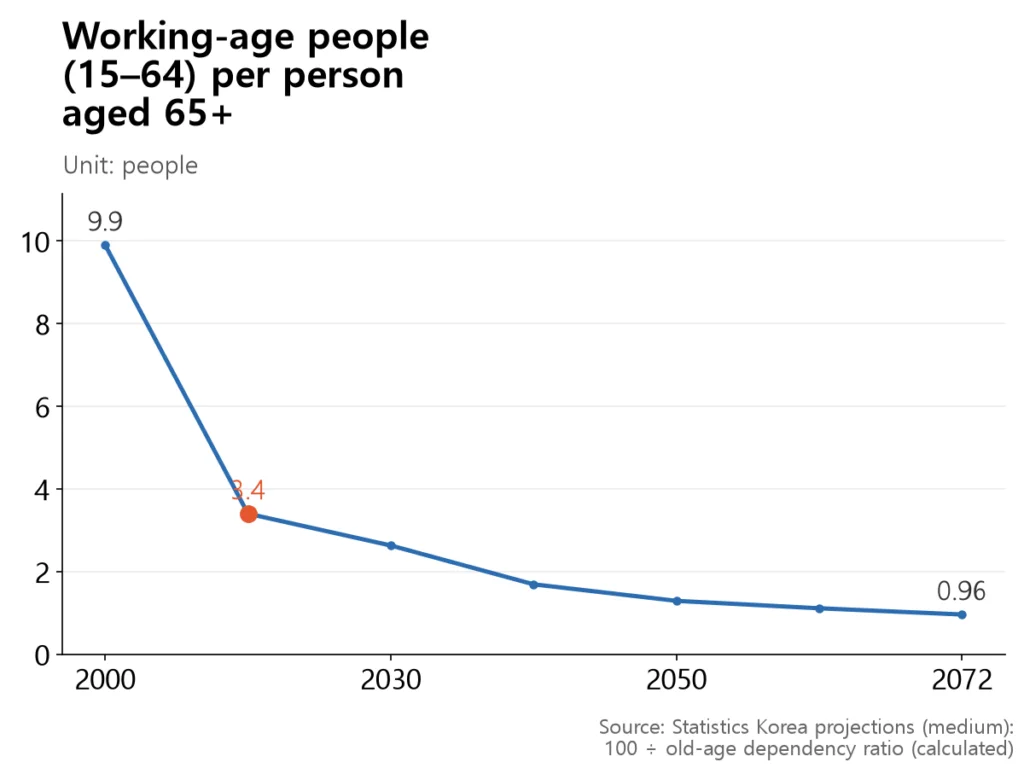
In 2000, 9.9 working-age people shared the support of each older person; in 2025 it is 3.4, in 2050 1.3, and in 2072 0.96 (calculated) — less than one. The aging index (people 65+ per 100 children aged 0–14) was 199.9 in 2025, about two older people for every child. The Population Projections press release notes that Korea’s old-age dependency ratio was among the ten lowest in the OECD in 2022 but will be the highest in the OECD by 2072.
How to read these numbers
- Projections and resident registration count differently. Don’t compare them as if they were the same “entry date”; say which basis you are using.
- All values from 2030 on are projections. The latest projection uses 2022 as its base year and was published in December 2023; the next one is due in December 2026.
- Years for other countries are calculated from UN WPP 2024. They may differ by a year or two from each country’s own statistics, and for countries already above 7% before 1950, when the UN data begin (the US, Italy, France, Germany, the UK), the date can only be shown as “before 1950”.
- Hong Kong and Taiwan are territories. When saying “second in the world in 2050”, always add “after Hong Kong”.
- UN WPP has no OECD aggregate, so the OECD average is a simple mean of 38 countries (19.5% in 2025; 19.0% population-weighted). It may differ in the decimals from averages published by the OECD itself.
- The 2026 “Statistics on the Aged” had not been released at the time of research (2026-09-29). It is usually published at the end of September and may update these figures soon.
Summary
The heaviest part of “one in five is 65 or older” is that no country has ever crossed this threshold so quickly. France had 27 years and Germany 36 to adjust its institutions, budgets, housing and health care. Korea had to do the same in 7 years, and in about 25 years it will overtake Japan, today the oldest country in the world. The load once shared by 3.4 working-age people per older person falls to 1.3 by 2050. “Seven years to a super-aged society” is ultimately a question about the choices Korea will make on this tight timetable.

Awesome News on Instagram @awesome_news_kr
This article is the research behind our Korean-language card news. Every morning we turn Korean data and official sources into short visual stories. See it on Instagram →
Sources
- National statistics agency (formerly Statistics Korea) — 2025 Statistics on the Aged (Korean) (2025-09-29)
- Statistics Korea — Population Projections: 2022–2072, medium (Korean) (2023-12-14)
- National statistics agency — e-Narajipyo population structure (idx_cd=1010), population by age (Korean)
- KOSIS — Korea in population: population pyramid data (Korean)
- Ministry of the Interior and Safety — Press release: population aged 65+ reaches 20% (Korean) (2024-12-24)
- Ministry of the Interior and Safety — Resident registration statistics: population by age and older population (Korean) (accessed Aug 2026)
- UN DESA — World Population Prospects 2024 (population by five-year age group, medium)
📊 Download the data
Every number in this article’s 8 charts and tables, in one CSV file (opens in Excel or Google Sheets). When you cite it, please name the original source and link to this page.
Download CSV